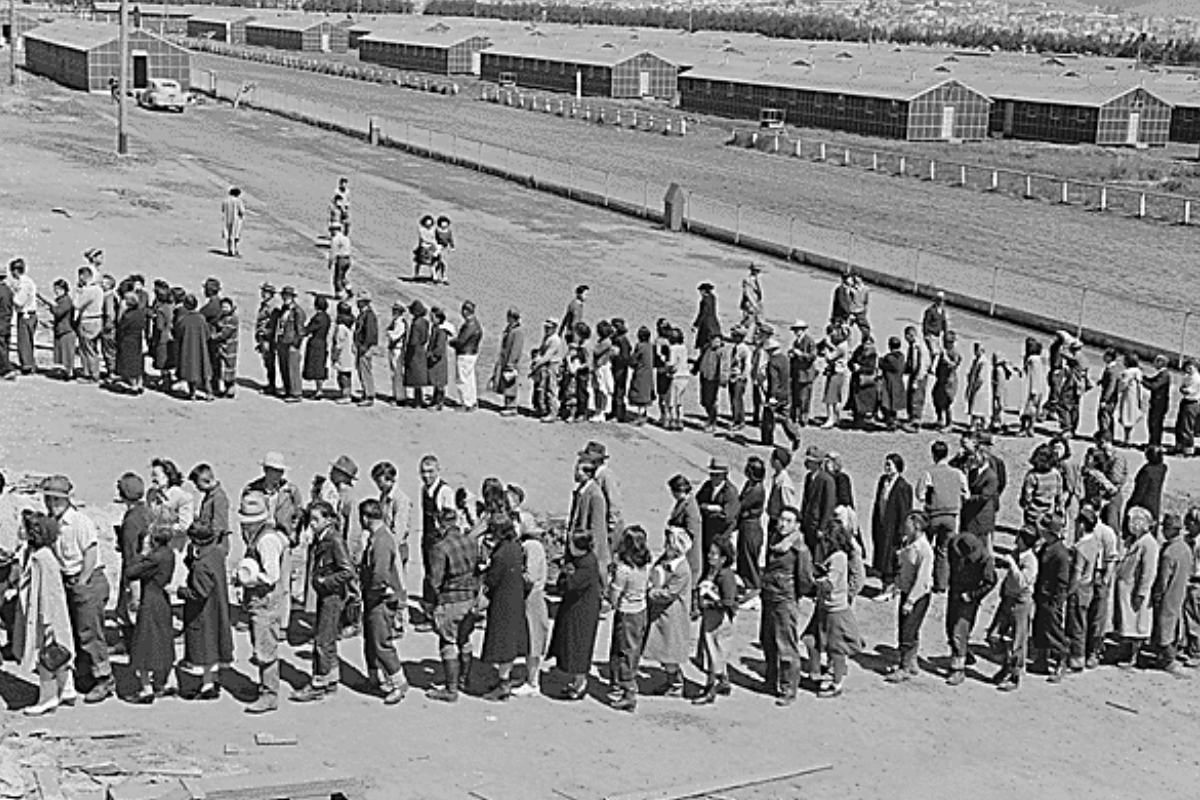
Japanese American Assembly Center at Tanforan race track, San Bruno
Introduction
Even a casual glance at the history of civil liberties in America reveals a common pattern. The most egregious governmental attacks on personal freedoms tend to arise during times of war, or relatedly when the populace is afflicted with a deep unease or anxiety over perceived threats to national safety, security or defense. Nor can the Supreme Court necessarily be counted upon to preserve liberties in the midst of public fear. A stark illustration of both points was the internment of some 120,000 Japanese Americans living on the West Coast following the December 7, 1941 attack by Japan on Pearl Harbor, and the Court’s subsequent sanction of those exclusion policies. As a result, the Court’s decision in Korematsu v. U.S. is firmly entrenched in the anti-canon of cases which are "universally assailed as wrong, immoral, and unconstitutional."
The Historical Context
While Pearl Harbor was the immediate trigger for the internment of Japanese-Americans in 1942, it was anchored in a much longer history of anti-Asian prejudice in the country. Recall from the story of Wong Kim Ark the anti-Chinese prejudice that followed the migration of large numbers of Chinese to the U.S. in the mid-1800s to work the mines, railroads and farms. Restrictive immigration laws sprang up in California, where the largest concentrations of Chinese settled, prohibiting them from attending public schools, testifying in court, or working for California companies or in public sector jobs. Other states likewise enacted “alien land laws” that barred Asian immigrants from purchasing real property. Congress’s passage of the Page Act in 1875 restricting immigration for Asian women was followed by the Chinese Exclusion Act, which barred most Chinese immigrants from entering the country.
With the drying up of the supply of Chinese laborers, Americans companies turned their recruitment efforts to Japanese workers, feeding a rapid increase in the Japanese population, again mostly in California. Unsurprisingly, they would in turn become the targets of deep-seated hostility and resentment by American citizens and of a powerful and well-organized coalition of anti-Japanese businesses and interest groups. Additional restrictive immigration policies followed, culminating in the passage of the National Origins Act of 1924. Motivated by a goal of racial homogeneity, the Act banned virtually any immigration among Japanese and other Asians. It codified bigoted perceptions of Japanese as un-American and incapable of inculcation into American culture, feeding societal marginalization of the Japanese and setting the stage for the exclusion policies to come.
The Japanese attack on Pearl Harbor did not immediately provoke action against Japanese-Americans residing on the West Coast. The LA Times and other influential outlets in cities where Japanese-Americans were concentrated urged calm and cautioned against retaliation against Japanese living there. That shifted suddenly in mid-January of 1942 when Congressman Leland Ford, representing the Los Angeles area, demanded that all Japanese be moved to inland concentration camps. Walter Lippman and other widely read commentators joined in the call for evacuation and internment of Japanese. The Times reversed its earlier position, calling for the removal of the Japanese from what it termed “danger spots” on the West Coast. Commercial and agricultural groups whose economic interests were in direct competition with those of Japanese Americans joined in. The demands quickly gained purchase in Washington D.C., and the Roosevelt administration acted in short order.
The Executive Order and the Arrest and Trial of Fred Korematsu
On February 19, 1942, President Roosevelt signed Executive Order 9066 directing the Secretary of War to designate West Coast military areas “from which any and all persons may be excluded.” The commander of the army on the West Coast, General John DeWitt, responded with several orders demarcating the military zones from which people could be excluded. That was followed by the imposition of a nighttime curfew and then by orders that “all persons of Japanese ancestry, including aliens and non-aliens be excluded.” By the end of the year, some 120,000 Japanese Americans living up and down the west Coast had been rounded up into relocation centers. Most were native-born Americans who were never charged with crimes or granted due process of any kind.
Fred Korematsu was a 23 year-old college dropout who had been working as a shipyard welder in Oakland. He had tried to join the Navy in June of 1941, but was rejected on medical grounds. He also had been expelled from his labor union following the Pearl Harbor attacks. Unlike several other Japanese Americans who courted arrest in order to challenge the government orders, Korematsu actively sought to evade them, changing his name, altering his draft card, and even undergoing plastic surgery to make himself look less Japanese. His efforts proved unsuccessful. He was picked up on May 30, 1942 in San Leandro, California, where he had been living. His story quickly fell apart under police questioning and he was placed under arrest. Korematsu’s trial in San Francisco was a relatively perfunctory matter. He was found guilty in a bench trial and sentenced to a five-year probation. After a circuit court upheld Korematsu’s conviction, his lawyer filed an appeal with the U.S. Supreme Court.
Hirabayashi v. U.S. (1943) and the Lead Up to Korematsu
While circuit court machinations slowed the progress of Korematsu’s appeal, a companion case moved more quickly in reaching the High Court. Gordon Hirabayashi was a student at the University of Washington in Seattle when the nighttime curfew was ordered for all Japanese Americans in March of 1942. After initially complying, Hirabayashi eventually decided to contest both the curfew and evacuation and internment orders. He went to the local FBI office and informed them he would not obey the orders; he claimed conscientious objector status, invoking his Quaker faith as grounds for resisting what he saw as unjust and discriminatory policies against Japanese citizens and aliens. He was arrested for violating both the curfew and the evacuation orders, jailed, and quickly convicted.
On June 21, 1943, the Supreme Court issued a unanimous decision affirming Hirabayashi’s conviction for the curfew violation. While characterizing distinctions based “solely on [citizens] ancestry” as “odious to a free people,” Chief Justice Stone upheld the actions taken “in the crisis of war and of threatened invasion . . . [as justified by] facts and circumstances which indicate that a group of one national extraction may menace that safety more than others . . .” National defense considerations warranted placing “citizens of one ancestry in a different category from others.” It was not unreasonable for the military to constrain their movements via imposition of a curfew. Stone engaged openly in racial assumptions, expressing “grave concern” over the nature of Japanese Americans’ “attachments to the Japanese enemy,” the intensity of their solidarity, and the inability of many of them to fully assimilate into the broader white population. Notwithstanding the relatively recent vintage of Stone’s Carolene Products footnote four contemplating strict scrutiny for governmental actions against “discrete and insular minorities,” he only required a “rational basis” for the President’s and military officials’ actions against Japanese residents.
The Majority Opinion in Korematsu
Some have speculated that Chief Justice Stone intentionally sidestepped any consideration of the more difficult question of evacuation in Hirabayashi in hopes that the war might end, thus sparing the Court’s having to decide the constitutionality of the internment orders. If so, it was wishful thinking. Korematsu reached the Court for oral argument in October of 1944, and the Court announced its decision on December 18, 1944. Writing for a six-justice majority in support of the exclusion orders, Justice Hugo Black relied on the same principle the Court had rested upon in Hirabayashi, namely that the Court needed to defer to Congress and the military authorities, particularly in light of the attack on Pearl Harbor. Black deemed any rights held by Americans of Japanese ancestry as subordinate to the military interest in safeguarding against possible espionage by Japan.
Unlike Stone’s rational basis review in Hirabayashi, Black opened his opinion by invoking the strict scrutiny standard of review. He noted that legal restrictions which curtailed the civil rights of a single racial group were “immediately suspect” and “subject . . .to the most rigid scrutiny.” Yet he found that public necessity survived the classification in this case, given the “definite and close relationship” between the policy of “exclusion from a threatened area” and the “prevention of espionage and sabotage.” In light of this, the Court could not conclude that it was beyond the authority of Congress and the President to “exclude those of Japanese ancestry from the West Coast war area” when they did.
In deferring to the military’s decision to intern the entire Japanese population in the war areas without any specific finding of disloyalty, Black fell back on the rationale that military officials provided in Hirabayashi, that it was impossible under the circumstances to segregate disloyal Japanese Americans from the loyal. This justified the temporary exclusion of the entire group of those of Japanese ancestry. Black blithely dismissed the claim that exclusions were a significantly greater hardship than curfews, replying that “hardships are a part of war, and war is an aggregation of hardships.”
Anticipating the charges of racism that were lodged in the dissent of Justice Murphy, Black denied that the orders were the product of racism. He asserted that "Korematsu was not excluded from the Military Area because of hostility to him or his race." Rather “[h]e was excluded because we are at war with the Japanese Empire, . . .” Black gave wide credence to the military leadership’s stated fears of an invasion of the West Coast and their authority “to take proper security measures.” Black refused to second guess the military’s judgment that the “urgency of the . . .situation demanded that all citizens of Japanese ancestry be segregated from the West Coast . . .”
The Dissenting Opinions
The three dissenting justices each wrote separately. Justice Murphy was the most forceful. He had cast a reluctant vote to uphold the curfew in Hirabayashi, despite it approaching the “very brink of constitutional power.” He described the exclusion orders as falling "into the ugly abyss of racism" on a par with the “abhorrent and despicable treatment of minority groups by the dictatorial tyrannies which this nation is now pledged to destroy." The exclusion orders were an “obvious racial discrimination” which deprived Japanese Americans of the most basic rights – to work, live, and move about as they chose – without due process of law. The government failed to establish that there were impending dangers that might justify a “racial distinction which is one of the most sweeping and complete deprivations of constitutional rights” in history. In response to Black’s rejection of racism as a motive, Murphy attributed the undifferentiated orders to “an accumulation of . . . misinformation, half-truths and insinuations that for years have been directed against Japanese Americans by people with racial and economic prejudice.” As evidence of the orders’ racial underpinnings, Murphy noted that the government and military made no similar exclusions for Americans of German or Italian nationality.
Murphy ended his dissent by calling the majority’s decision a “legalization of racism.” In ringing language that would be frequently cited for decades to come, Murphy wrote:
that [r]acial discrimination in any form and in any degree has no justifiable part whatever in our democratic way of life. It is unattractive in any setting, but it is utterly revolting among a free people who have embraced the principles set forth in the Constitution of the United States. All residents of this nation are kin in some way by blood or culture to a foreign land. Yet they are primarily and necessarily a part of the new and distinct civilization of the United States. They must, accordingly, be treated at all times as the heirs of the American experiment, and as entitled to all the rights and freedoms guaranteed by the Constitution.”
Justice Jackson was more sympathetic to the government’s argument. He recognized that "military decisions are not susceptible of intelligent judicial appraisal," and acknowledged that the Court really had no “real alternative to accepting the mere declaration of the authority that issued the order that it was reasonably necessary from a military viewpoint." However, the Court’s limitations in second guessing the miliary did not mean they were compelled to ratify an unconstitutional military order.
He worried that the precedent of Korematsu could extend far beyond the war and the internment of Japanese Americans. While the military order itself was not likely to last longer than the military emergency, a judicial opinion upholding that order would not pass so quickly. Rather it would validate “the principle of racial discrimination in criminal procedure and of transplanting American citizens.” The principle then “lies about like a loaded weapon, ready for the hand of any authority that [might expand] . . . it to new purposes.” A military act that overstepped constitutional bounds could be more easily survived; a Court’s approval of it settles into a constitutional doctrine that takes on a life of its own.
Jackson spoke clearly and simply of Korematsu’s status as an American citizen by birth, that he had never been shown to be anything but law abiding and loyal to America, and that he had been arrested, not for a crime, but merely for “being present in the state whereof he is a citizen, near the place where he was born, and where all his life he has lived.” His crime had nothing to do with anything he said, did, or thought, but only that “he was born of different racial stock.” Ultimately the orders rested on “a military expedient that has no place in law under the Constitution.”
The Significance of the Decision
The timing of the Korematsu decision did much to dampen its impact. The Court had delayed its release of the opinion to give the government the opportunity to end the policy of detention. The day before the announcement of Korematsu, the War Department announced the release from internment camps those “persons of Japanese ancestry” who would be “permitted the same freedom of movement throughout the Unites States as other loyal citizens . . .” Formal rescission of the exclusion orders would come on January 2, 1945, and all the camps but one were closed by the end of that year.
In the short term, the extreme deference extended by the Court to the military and the President in Korematsu fed the expansion of executive and military authority during wartime, even to the point of overriding fundamental individual liberties. But in one of the more striking ironies in Supreme Court lore, a decision generally reviled as a stain on the Court’s civil rights jurisprudence would become responsible for solidifying the standard of strict review in equal protection and racial discrimination cases. Even as Justice Black deemed legal restrictions aimed at a single racial group as “immediately suspect,” Korematsu was the rare case where the presumption of unconstitutionality under strict scrutiny of a racial distinction was overcome. For a time, the case was relied upon for the principle that national security considerations could qualify as a “compelling interest” under equal protection analysis to warrant separate treatment of a specified racial group. But the tiers of scrutiny traceable to Korematsu continue to serve as the standard mode of analysis in balancing governmental action and individual rights.
Korematsu also had longer historical importance as a landmark reparations case for the survivors of the internment camps. The rescinding of the exclusion orders hardly meant the resumption of normal life for internees. Many returned to find homes, businesses, and their personal property seized, stolen or confiscated. Justice would come slowly, with a set of victories for the victims of detention that were deferred for decades and then realized only gradually. The redress movement did not begin in earnest until the 1970s, when Japanese American lobbying groups began to petition Congress for payments to those forced into internment camps. Congress responded in 1980 with the formation of a Commission on Wartime Relocation and Internment of Civilians. In 1983, the Commission issued a lengthy report in which its members unanimously found that Japanese Americans had suffered a “grave injustice” caused by “race prejudice, war hysteria, and a failure of political leadership.” It would take until 1988 for Congress to finally act on the Commission’s recommendation for payments to camp survivors. In the Civil Liberties Act of 1988, Congress authorized $20,000 to the living survivors and issued an apology "on behalf of the people of the United States for the evacuation, relocation, and internment of such citizens and permanent resident aliens." By that time, over half of those who had been interned were no longer living.
A Postscript - Closing the Book on Korematsu
Individual justice for Fred Korematsu took the form of efforts to overturn his criminal conviction, along with those of his fellow Japanese American litigants. The opening of Justice department files on the Japanese internment cases in the early 1980s revealed multiple intelligence reports that disavowed any claims of treason or espionage and found no evidence for claims of Japanese American disloyalty. Moreover, those reports had been shared with, and ignored by, legal counsel arguing the case for the government. A federal judge finally vacated Korematsu’s conviction in November 1983, finding substantial evidence that “the government deliberately omitted relevant information and provided misleading information” to the Supreme Court. As a final grace note to the story, Fred Korematsu was awarded the Presidential Medal of Freedom in a White House ceremony in 1998.
Despite the overwhelming judgment that the Korematsu decision was among the worst in the Court’s history, it took some seven decades for it to be finally and formally disavowed by the Supreme Court. In Trump v. Hawaii (2018), Chief Justice Roberts at last spoke on behalf of the Court in finding that Korematsu was no longer persuasive precedent. Lest there be any doubt on the legal point, Roberts stated that “The forcible relocation of U.S. citizens to concentration camps, solely and explicitly on the basis of race, is objectively unlawful and outside the scope of Presidential authority.” Quoting Justice Jackson’s dissent, Roberts added that “Korematsu was gravely wrong the day it was decided, has been overruled in the court of history, and—to be clear—has no place in law under the Constitution.'”