Beauty: A Needed Balm for Our Nation
e.e. cummings’ “Poem, Or Beauty Hurts Mr. Vinal” takes a cool look at patriotism. Cummings had experienced the First World War and witnessed the rise of American advertising and consumerism and found that advertising slogans and patriotic messages were often nearly indistinguishable. Published in 1926, one stanza includes: “land of Abraham Lincoln and Lydia E. Pinkham,/ land above all of Just Add Hot Water And Serve—/ from every B. V. D./let freedom ring.” As far as cummings was concerned, “certain ideas gestures/ rhymes, like Gillette Razor Blades/ having been used and reused/ to the mystical moment of dullness emphatically are Not To Be Resharpened.” The title of that critical poem suggests that “beauty hurts,” but what if beauty is also capable of healing?
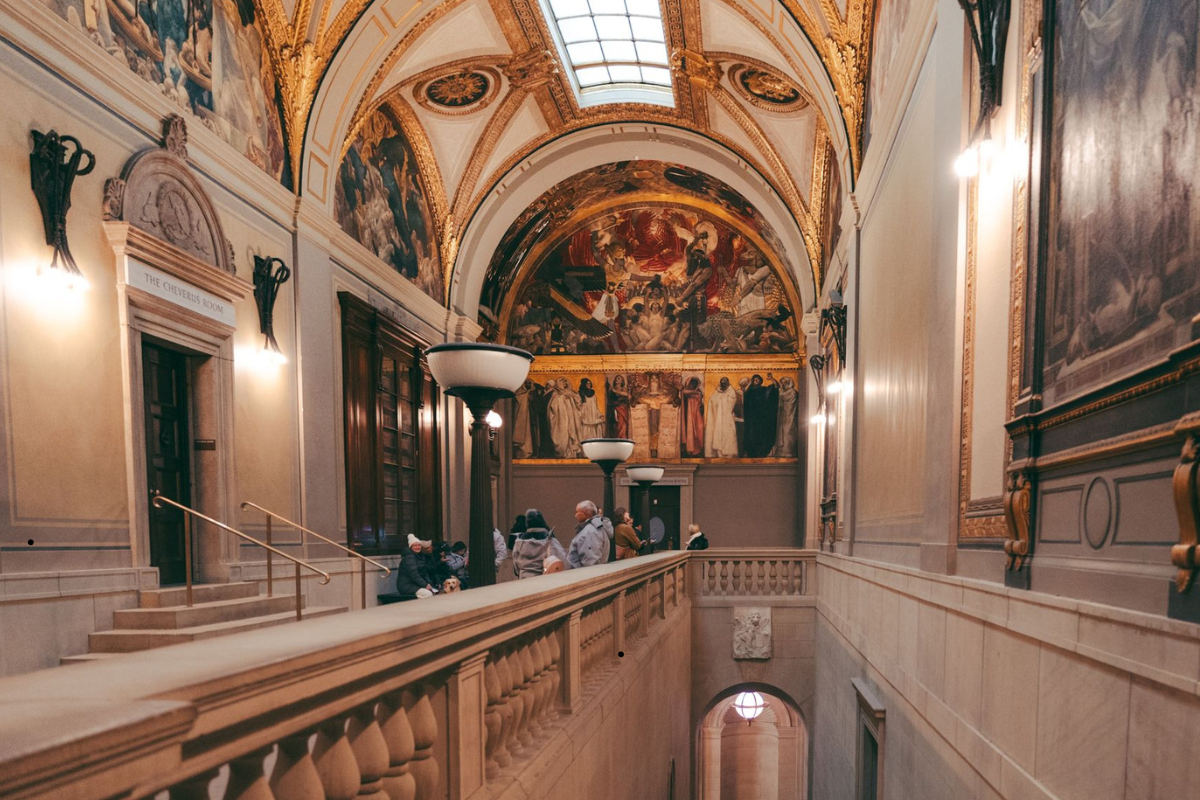
Beginning roughly a decade later, the U.S. government turned to art to help heal a hurting nation. During the New Deal, the Treasury Section of Painting and Sculpture funded art across the country from 1934 to 1943. Among the most celebrated works were the post office murals. These murals focused on the “American scene.” There was also the broader Federal Arts Project, which kept artists employed during the Depression and funded additional public art. Murals were painted in post offices and sculptures were scattered across the country, adorning everything from high schools and parks to government buildings.
The New Deal murals and sculptures praise traditional American values and historic figures and elevate the occupations of American workers. In the Dyer Courthouse and Federal Building in Miami, relief sculptures emphasize “Love & Hope” and “Wisdom & Courage.” In the Post Office Department building in Washington, D.C., sculptures portray different types of mail carriers, giving each its own sense of nobility: continental post rider, rural free delivery, Alaska snowshoe carrier, Pony Express, air mail, stage driver, city carrier, express and railway, and present day.
Today, as our national confidence slides and our culture seems fragmented, there is a case to be made for public murals and sculptures. A renewed emphasis on public art, featuring the “American scene,” could do a great deal of good. Beautiful images of our country, and not just the landscape, could inspire some national pride and even national renewal. The strength of that work would come from beauty itself, not didacticism.
Elaine Scarry’s On Beauty: And Being Just is a good place to begin for the generative aspects of beauty. One of the first things that Scarry observes about beauty is that it “brings copies of itself into being.” Beauty inspires imitation—a beautiful flower provokes a painting, swans inspired part of Sibelius’ Symphony No.5. The beauty of the athletic excellence of Tiger Woods and Michael Phelps and Serena Williams inspired new generations of golfers, swimmers, and tennis players. In the case of human beauty, beauty can even bring copies into being through the creation of new people.
Beautiful scenes of American life and industry and values can inspire copies of themselves. Beautiful images of everyday American workers, ennobled rather than beleaguered, can inspire those workers as they go about everyday life. Beautiful images of American towns can increase pride of place.
This may seem far-fetched, but divided opinions on America often use beauty or ugliness in arguments. A good example is the “This is America” image of a road with McDonald’s and Exxon and crowded with ugly sprawl. It has circulated thousands of times in recent years. No one who thinks it is ugly—as most do—look away with increased pride of place. A YouTube video about visiting it is titled “I went to America’s road trip hell.” A comment on that video with 2.3K likes reads: “The thing I love about the Breezewood image is you cannot see a single human anywhere. With that and the long lens and vantage point, it really makes this place feel alienating, like it's not a place you're meant to exist in, only pass through.” This is America?
Pride of place is not the only way that beauty can make us better citizens. Elaine Scarry observes that beauty makes things seem more alive. A nation is an “imagined community,” because it is so large and geographically and humanly diverse. Long before Benedict Anderson, E.B. White (in 1936) wrote in Farewell to Model T, “To an American, the physical fact of the complete America is, at best, a dream, a belief, a memory, and the sound of names.” It is hard for us to visualize something so vast and see it as real. That is probably even harder today when we are drowning in AI images. White gained a vision of America through a cross-country road trip. For all of us, beautiful images with their ability to make things seem more alive can make the country seem more alive and less imagined, even if we are geographically (or politically) distant from most of our fellow citizens. Beautiful images, made by real people, can offer grounding for us and display the living and real country we inhabit.
Consider the power of certain songs in binding people to places. People know “Oh Shenandoah, I long to see you” centuries after it was written and it continues to play a role now at many institutions. While not every song about America, or part of it, is beautiful, those that are have staying power. John Denver’s “Take Me Home, Country Roads” is more than kitsch or cliché to many people.
“Poem, or Beauty Hurts Mr. Vinal” is cynical about protecting the land of B.V.D.s and Gillette razor blades. In 2026, we are more inundated than ever with advertising. But beautiful images of our country, including its people and places, can inspire more protection of it by its people. Scarry writes that “the fact that something is perceived as beautiful is bound up with an urge to protect it, or act on its behalf, in a way that appears to be tied up with the perception of its lifelikeness.”
Arguably, one reason it is so easy for Americans today to hate each other is because we have so few positive images of each other and so little celebration of public and civic spaces. Imagine if the courthouse where you go to do jury duty—something people ought to celebrate but often despise—was more than functional, but beautiful. Imagine if that courthouse emphasized justice in its construction and elevated the citizens who walk through its doors. Imagine if public parks conveyed more pride of place. We do not need to pursue the complete ideal of the City Beautiful Movement to move a bit in this direction.
On Beauty goes much further with the ways that beauty can improve society. Scarry argues that beauty can incline us to fairness and inspire us to be more just. We can see and grasp the importance of equality and correct distribution in the symmetry and balance of beautiful things. Beauty orients us toward goodness. And by drawing us out of ourselves and the ordinary, beauty provokes “nonself-interestedness” in the beholder. A beautiful thing arrests our attention and sometimes even our breath. We forget ourselves in the moment of recognition of beauty, just as we should in the pursuit of justice. And, as Scarry emphasizes, beauty “intensifies the pressure we feel to repair existing injuries.”
Beauty may seem like a silly approach to national healing, but our politics may be broken in a way that national repair needs to begin outside the realm of traditional politics. In Power of the Powerless, Havel writes about how better lives can produce better politics. Beauty inspires and elevates and encourages. We do not listen to beautiful music and walk away wanting to make bad music. Some of our best schools and universities are known for their beautiful campuses. A field full of wildflowers, blooming in their variety and liberty, does not inspire uniformity and unhealthy conformity. It is certainly possible to appreciate great art and be a bad person. Beauty will not fix everyone or everything. But believing that the things we have in common are beautiful and that the lives of our fellow citizens can also be beautiful can only help us in our journey to increase mutual respect and understanding.
To secure beautiful art, we would need to “secure the blessings of liberty to ourselves and our posterity.” Artists today would require the same liberty as artists had during the New Deal, even if funding comes from other sources than the federal government. As explained by Irene Rawlings in The Saturday Evening Post, “There were no government-mandated requirements about the subject of the art or its style — only nudes or overt political propaganda were prohibited. However, artists who participated in the program were encouraged to depict ‘the American scene’ and were allowed to interpret this idea freely. Artists painted recognizable subjects — ranging from portraits to cityscapes and images of city life to landscapes and depictions of rural life — that reminded the public of quintessential American values, like hard work, community, and optimism.”
Though they may be guidelines and oversight, the “sweet land of liberty” can only be reflected by art created by artists with liberty. The countries known for didactic and formulaic art, with strict guidelines, are countries with political traditions antithetical to our own. Soviet art was known for its dictated socialist realism. Nazi art was known for its “Romantic realism” and strict adherence to certain themes and subjects. In North Korea, not only is art unfree, some of its creators are not free—like the movie director and movie star who were kidnapped from South Korea and forced to make films for Kim Jong-Il for eight years.
Artists might well produce art that is considered objectionable, now or later. In recent years, some WPA murals have come under attack for their depictions of American people and history. Some risk can be offset by establishing local governance over art projects, rather than national. Some of the risk must simply be hazarded. If a project is rejected because of the potential to have a success rate of less than 100%, no project will move forward. It is also possible for art to become more lauded over time, not less. The “Star-Spangled Banner” took its melody from an old drinking song.
Objections to public art projects would not be novel. Not all the WPA art of the past—or even the whole project of employing artists—was embraced by everyone at the time. Another concern might be the national expense. Keeping the project out of the hands of the federal government is probably the best bet for promoting local artists and scenes and avoiding the overly political. Beautiful public art can be funded at different levels of government and by sources outside of government. The Carnegie libraries contributed to public beauty without the use of public funds.
An distinct advantage of pursuing art as a way to bind the country together is that while opinions on art are very divided, no party has exclusive rights to beauty or good taste. Whether it’s Trump’s gilded White House or Obama’s bleak library, it’s clear that bad taste is non-partisan. Woe to those who seek aesthetic direction from political platforms or figures. From birth, we take many of our cues on beauty from nature and the world around us. The most politically divided Americans are likely to be united on affirming the beauty of a mountain or waterfall or meadow full of fields, even if they are divided on how those things ought to be preserved.
Beauty is a powerful response to some of the specific problems facing our society today. The pursuit of beautiful public art in the present can help resist the discontent fueled by nostalgia. Many Americans are caught up in pessimism recognizable from the refrain, “we used to be a proper country.” On social media, people circulate images of City Beautiful plans and New Deal engineering projects, always comparing our country unfavorably to itself in the past. This kind of nostalgia leads to national despair. The way to turn the tide on that pessimism is to make beautiful things and draw attention to them. The best counterpoint to the people who claim that the modern world would never make a cathedral is the Sagrada Familia or the rebuilt Notre Dame. Here in America, Carmelite monks in Wyoming are building a Gothic monastery as you read.
The look of places communicates the level of respect that places deserve. You are less likely to litter a pristine park. You are more likely to behave yourself in beautiful places. As we know, American public spaces and infrastructure are famously rough around the edges at present. Interestingly, debates about New York’s subway system often hinge on images, whether that is today’s worm condition or the famously graffiti-riddled cars Ed Koch warred against. Increasing the amount of beauty in public spaces can encourage greater respect for those spaces and the public they serve.
Beauty will not heal all our national divides, but the healing power of beauty would be helpful in our present moment. Beautiful public art, about the “American scene” and its everyday people and places and occupations, can uplift the American people. Beautiful depictions of life and work would encourage beautiful life and work and convey the dignity of our endeavors and shared spaces. We can gain pride of place and be inspired to better protect the country. Beautiful images of our neighbors, near and far, can bring our country to life for us and move us toward a helpful “unself-interestedness.” An effort for more public art could achieve many things and if it achieved the least possible, we would still be left with a more beautiful country.

Dr. Stice has taught at PBA since 2012 in the history department and in the Frederick M. Supper Honors Program.
Related Essays