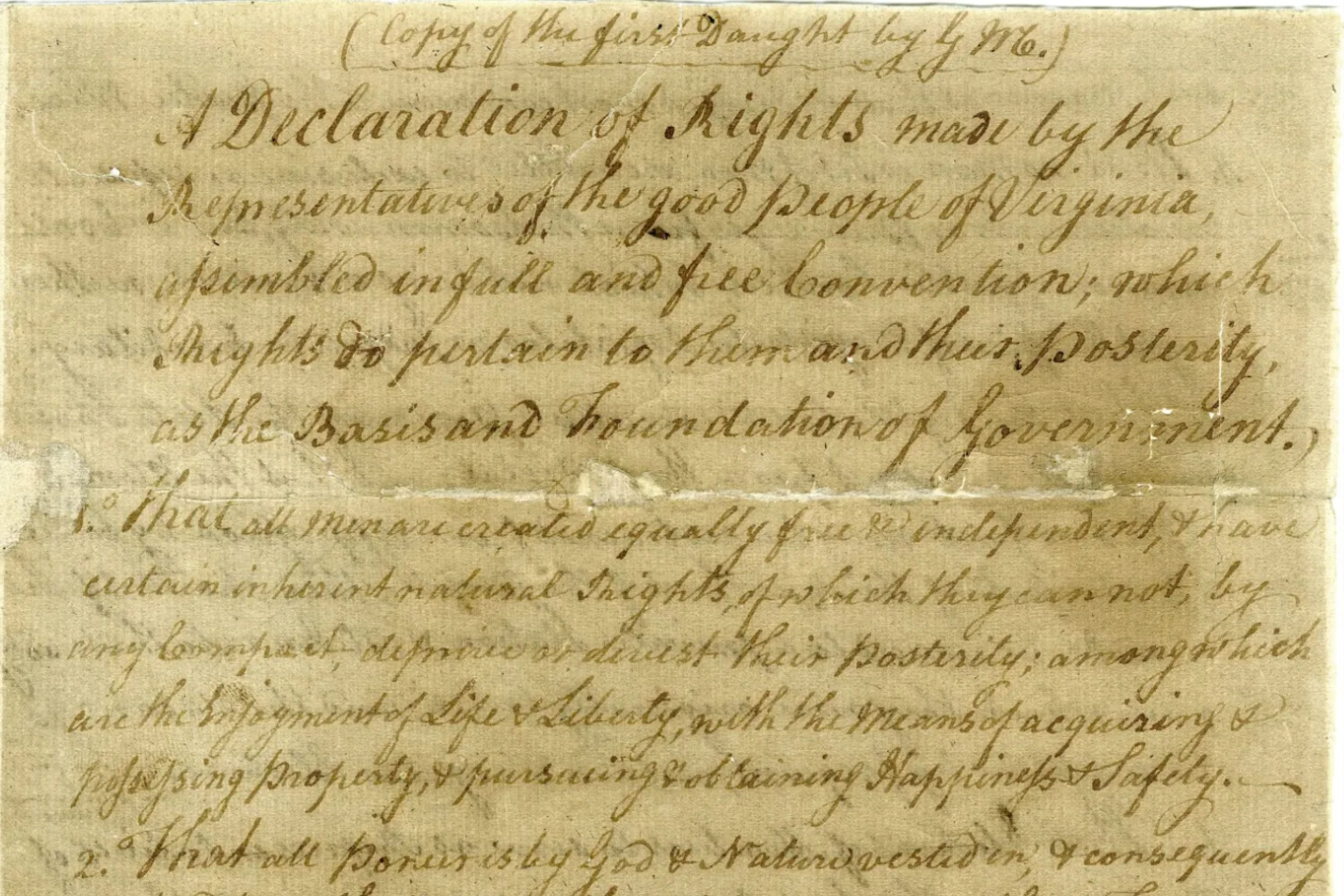
The Virginia Declaration of Rights
Many readers have focused their attention on the upcoming 250th anniversary of The Declaration of Independence, by which the independent colonies expressed their common desire to separate from England and give an accounting thereof. It’s typical of American optimism to refer to this as a “semiquincentennial” with its implied optimism of this nation making it to 500 years. Why not call it the quartermillenium and go all in on that optimism with its religious overtones?
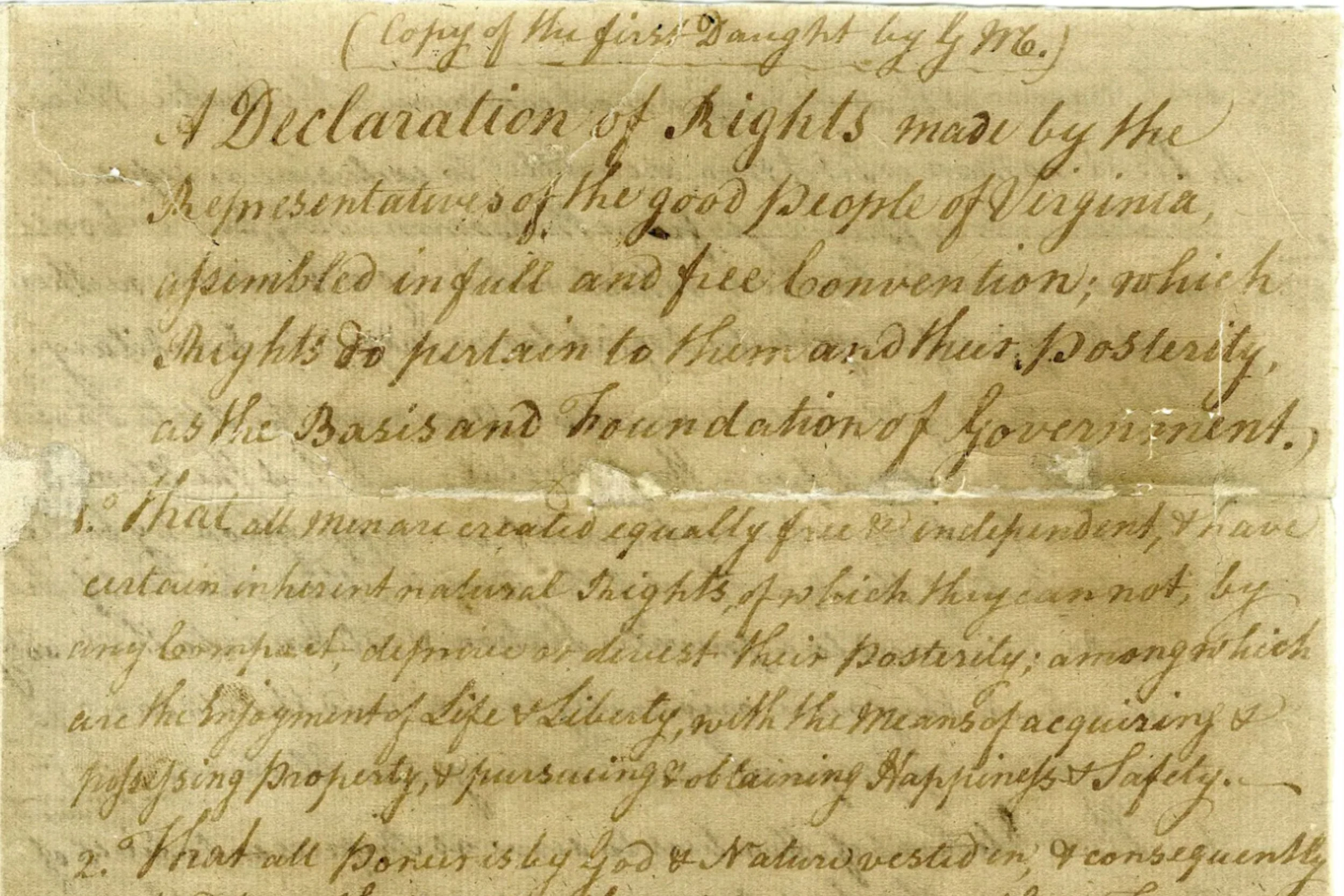
Some readers may not realize, however, that some of the colonies had already declared their independence from England and had already submitted their cases “to a candid world.” June 12th marked the 250th anniversary of one of the more substantial instances: The Virginia Declaration of Rights, authored primarily by George Mason, one of the more mercurial and interesting thinkers of that time. Mason was one of the three delegates who stuck the Convention out to the end and then refused to sign the proposed Constitution, declaring he would sooner cut off his hand than use it to sign such a flawed plan. Mason had made some interesting proposals at the convention that—alas!—had not carried the day, such as 2/3 supermajorities for both revenue bills and declarations of war. One could have a lot of fun with these counterfactuals.
Mason’s Virginia Declaration clearly influenced the writers of the Continental Congress’s more famous declaration of a month hence. Other states that were busy creating their own new governments looked to Mason’s handiwork as a guide. The Virginia declaration is composed of sixteen articles, each outlining the basic principles of republican government. It’s concise distillation of extant ideas of what constituted good government and under what circumstances a people have a right to abolish a bad one resonated across the colonies and down to our present.
I’ve argued before that America didn’t really have a founding, at least not in the sense that it was creating something de novo. Most writers at that time understood what they were doing in America as an extension of “The Glorious Revolution” that had occurred in Great Britain in 1688. They referred constantly to historic documents going back to Magna Carta (1215 AD) and The English Bill of Rights (1689), as well as thinkers such as Montesquieu, Locke, Hume, Sydney, and others.
The opening article of The Virginia Declaration sounds familiar: “That all men are by nature equally free and independent and have certain inherent rights, of which, when they enter into a state of society, they cannot, by any compact, deprive or divest their posterity; namely, the enjoyment of life and liberty, with the means of acquiring and possessing property, and pursuing and obtaining happiness and safety.” The reference to posterity stands in interesting contrast to its absence in the federal Declaration, it is simultaneously both more revolutionary and more conservative than its national counterpart.
Article 2 states the basic principle of republican government concerning the nature of political representation, the issue that would so bedevil delegates at the Constitutional Convention 11 years later. “That all power is vested in, and consequently derived from, the people; that magistrates are their trustees and servants and at all times amenable to them.” The principal-agent problem remains to this day a serious issue in our politics: do our representatives represent the interests of those who elected them and the places from whence they hail, or are the advancing a “foreign” set of interests (among which one would have to include the desire to be reelected to what is nearly a permanent sinecure).
The Virginia Declaration also outlines the principles of a limited government, one whose main—one is tempted to say sole—purpose is to provide protection and security, on the one hand, but also to insure that a government powerful enough to provide such benefits would not threaten a people’s “happiness” through “maladministration.” One way the Virginia Declaration proposed to accomplish this was through a strict separation of the government’s legislative, judicial, and executive powers. We might take such separation for granted now, but the realization of the principle took centuries of trial and error to develop.
Articles 8-13 codified basic rights that would become the template for the federal Bill of Rights. I want to draw your attention to the formulation of Article 13, since its premise remains controversial to this day: “That a well-regulated militia, composed of the body of the people, trained to arms, is the proper, natural, and safe defense of a free state; that standing armies, in time of peace, should be avoided as dangerous to liberty; and that in all cases the military should be under strict subordination to, and governed by, the civil power.” Note this does not evolve into a “right to bear arms,” but it does suggest that “a standing army in times of peace” presented one of the greatest threats imaginable to republican government. Such armies are appropriate for empires, not republics.
Articles 15 and 16, those which conclude the Virginia Declaration, employ concepts missing in both Jefferson’s subsequent Declaration and in the federal constitution. Article 15 stated “That no free government, or the blessings of liberty, can be preserved to any people but by a firm adherence to justice, moderation, temperance, frugality, and virtue and by frequent recurrence to fundamental principles.” These are classically republican concepts, and their expression here is rather interesting. Justice and temperance are two of the four cardinal virtues (prudence and courage being the other two, and noticeably absent in article 15’s list), rendering the word “virtue” in the clause nearly redundant, as is the pairing of “temperance” with “moderation.” The word that jumps off the page to our contemporary eyes is “frugality,” whose counterpart in republican virtue was “liberality.” Conspicuous consumption, living beyond one’s means was considered contrary to republican principles, just as hoarding wealth was. Being frugal in one’s habits meant that one was both able and required to give from one’s surplus. No central redistributive scheme that turned people into subjects could compensate for the liberal generosity of citizen to citizen. Governments also had to live within their means. Debt is the enemy of independence. Try borrowing money from your parents and see how “free” you are to use it as you see fit.
Article 16 outlines the basic principles of religious freedom, clearly a hot-button issue when a colony operates with an established church (toward the support of which even dissenters had to pay taxes; indeed, Virginia’s Baptist preachers in the 1770’s were imprisoned for ministering without a license). Again, however, the right is accompanied by a duty, in this case a twofold duty to both God and his creation: “That religion, or the duty which we owe to our Creator, and the manner of discharging it, can be directed only by reason and conviction, not by force or violence; and therefore all men are equally entitled to the free exercise of religion, according to the dictates of conscience; and that it is the mutual duty of all to practise Christian forbearance, love, and charity toward each other.”
Article 16 shows Madison’s handiwork in the final draft of the Virginia Declaration. Mason had initially written a template for religious toleration, but Madison believed that that edict still gave too much power to the magistrate in regulating religious conviction and practice. Madison thus substituted “free exercise” of religion in place of Mason’s “toleration in the exercise of religion.” Notice also that Article 16’s protections extend to both religious beliefs and practices.
Mason’s original draft also included an expressed limit to those practices and beliefs, namely, if “under Colour of Religion, any Man disturb the Peace, the Happiness, or Safety of Society, or of Individuals.” Madison had altered this to read “Unless the preservation of equal liberty and the existence of the State are manifestly endangered,” but the qualifying limits were removed altogether from the final draft. Instead, Article 16 did something more consequential: it connected the rights of belief and conduct to the substance of religious faith itself: our duty to love one another and behave charitably even to our enemies. As we celebrate our 250th anniversary we would do well to remember that the call to love one another was the summative height of the call to independence.

Director of the Ford Leadership Forum, Gerald R. Ford Presidential Foundation
Related Essays