Gideon v. Wainwright (1963)
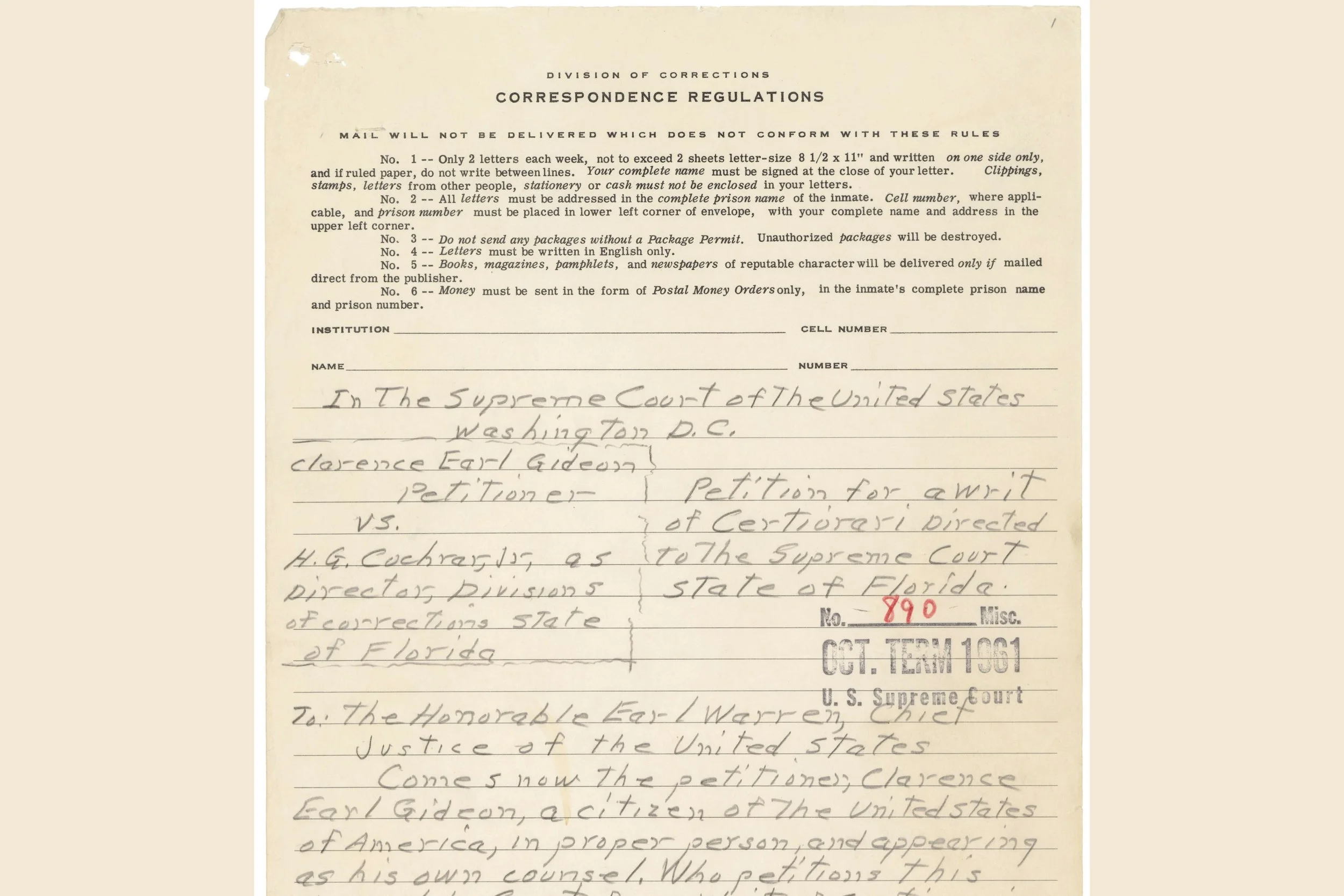
The first page of Gideon's handwritten petition for a writ of certiorari to the US Supreme Court.
The Rights of the Accused
The Warren Court is known for many things including its “due process revolution,” the explosive expansion of the rights of the accused. In some respects, characterizing the Warren Court’s due process case law as revolutionary is deceiving. State law, state constitutions, and state courts initiated due process reforms that the Supreme Court later nationalized. In those instances, the Court was less revolutionary than it was collaborative. Gideon v. Wainwright (1963) illustrates the point. It did not incite expansion of the right to counsel as much as it was the culmination of efforts in the states to do so. By the time Gideon was decided by the Court, forty-five states guaranteed the right to counsel in most criminal trials for defendants who could not afford one. Florida, one of the holdouts, was where Clarence Earl Gideon was arrested, tried, convicted, and imprisoned.
Background and Legal Issues in Gideon v. Wainwright
In 1961, Gideon was accused of breaking into the Bay Harbor Poolroom in Panama City, Florida and stealing soda, beer, wine, and coins from vending machines. Were it not for the break-in, he was likely to face only a misdemeanor and not a felony. It was not his first brush with the law. The real-life Clarence Earl Gideon was romanticized in the film Gideon’s Trumpet (1964), that was based on Anthony Lewis’s book by the same name. Henry Fonda, playing the role of Gideon, was closer to Jefferson Smith (Jimmy Stewart) in Mr. Smith Goes to Washington than the real-life Gideon. Gideon had been arrested in multiple states for a host of crimes including theft, escaping from police custody, larceny, burglary, and robbery for which he served several years, off and on, in prison. His criminal record included arrest at age 18 for burglary and larceny in Missouri for which he was appointed a lawyer. In all likelihood, this early experience in a Missouri court was one of the reasons why Gideon requested an attorney at trial in Florida when he was 51. His request for an attorney, however, was denied by the Florida court and he was forced to provide his own defense. It took the jury one hour to convict him. He was sentenced to five years in prison. His innocence is debated to this day.
Although Gideon had extensive experience with criminal courts, by most estimations, a man of his education and character was incapable of providing an adequate legal defense. He dropped out of school when he was 14 and ran away from home. He had four failed marriages (five marriages in total), lived most of his adult life in poverty, and likely had a gambling addiction. His three children were removed from his custody by the state. Occasional jobs, government welfare, and private charity were his main sources of income.
While serving his prison term for the poolhall break-in, Gideon wrote a certiorari petition to the Supreme Court to hear his case on appeal. As luck would have it, Chief Justice Warren was interested in finding cases that had been petitioned to the Court that would give the Justices the opportunity to change the direction of case law. One such area of law that Warren and Justice Black were anxious to change was Betts v. Brady, a 1942 case that limited the right to counsel to “special circumstances.” Powell v. Alabama (1932), the Scottsboro case, established the Sixth Amendment right to counsel for indigent defendants in capital cases, but Betts confined that right to the “special circumstances” standard that left some poor defendants without counsel in non-capital criminal trials. Justice Black wrote a spirited dissent in Betts. He suggested that “A practice cannot be reconciled with ‘common and fundamental ideas of fairness and right,’ which subjects innocent men to increased dangers of conviction merely because of their poverty. Whether a man is innocent cannot be determined from a trial in which…denial of counsel has made it impossible to conclude, with any satisfactory degree of certainty, that the defendant's case was adequately presented.” Warren and Black (the latter an advocate of absolute incorporation of the Bill of Rights), favored a more universal application of the Sixth Amendment right to counsel. They wanted to incorporate the Sixth Amendment right to an attorney to the states and extend it to non-capital criminal cases in addition to capital cases. Gideon’s case provided the opportunity for the Justices to revisit the Betts ruling.
A few weeks after the Supreme Court accepted Gideon v. Wainwright for review, it appointed Abe Fortas, a leading defense attorney and future Supreme Court Justice, as Gideon’s attorney. Fortas was a Yale Law School graduate, a member of the Supreme Court Bar, and in 1948 he represented U.S. Senate candidate Lyndon Johnson in the U.S. Court of Appeals and the U.S. Supreme Court. He also represented Owen Lattimore during the McCarthy era Red Scare. Bruce Jacob represented Florida. He was 27 years old, three years out of Stetson University College of Law, and had never argued a case before the U.S. Supreme Court or even been to Washington, D.C.
The central legal question for the Court in Gideon v. Wainwright was whether Gideon’s Sixth Amendment right to counsel was denied by Florida when his request for an attorney was rejected. Other adjacent legal questions implied by the case were left unanswered. For example, if the Court ruled for Gideon, incorporated the right to counsel in non-capital criminal cases, and overturned Betts, would the ruling be retroactive (as opposed to prospective, i.e., only apply to such cases in the future), meaning that thousands of prisoners who did not receive court-appointed counsel would be set free? Or would they receive new trials?
The Court’s Ruling in Gideon v. Wainwright
The Court ruled unanimously for Gideon. Justice Black wrote for the Court and argued that “lawyers in criminal courts are necessities, not luxuries.” Lawyers are necessities because the prosecution has extensive resources at its disposal. In an adversarial system of criminal justice, fair trials require that both sides have adequate legal representation. In Gideon’s case, such standards of due process were absent. Given his level of education and history of irresponsible behavior, he had no realistic chance to provide a legal defense that could balance the prosecutor’s education and experience. Gideon’s only hope for a fair trial was a court-appointed attorney.
The Court could have stayed within the existing case law represented by Betts and Powell v. Alabama and ruled that the Florida court that tried Gideon failed to recognize his “special circumstances” and provide him with an attorney. Doing so would not have broadened the Sixth Amendment right to counsel; it would not have changed Sixth Amendment case law in any fundamental way. Because the Court chose a more expansive path, its ruling has been characterized as revolutionary. The right to counsel’s meaning continued to move from its original narrow understanding (defendants cannot be denied the right to counsel by the state), to a broader meaning (defendants must be provided counsel at state expense).
Justice John Marshall Harlan II wrote a concurring opinion that expressed reluctance to create uniform rules in state courts mandated by federal courts. He agreed that Gideon’s circumstances justified the right to an attorney, but he wanted to leave room for states to tailor their due process rules as the Court allowed in Hurtado v. California (1884).
The divide between Justice Black’s and Justice Harlan’s opinions reveals competing conceptions of federalism and civil rights. Black was willing to sacrifice state sovereignty for the sake of nationalizing rights and detaching them from the context in which they were exercised. Harlan wanted rights to be contingent on circumstances and the discretion of state judges with some guidance from the Supreme Court.
Gideon v. Wainwright Legacy
Gideon v. Wainwright was not the end of legal disputes about the extent and application of the Sixth Amendment right to counsel. While it settled the big question about the right to counsel in non-capital criminal cases, the Court continued to tinker with the boundaries of that right in late twentieth century cases such as Argersinger v. Hamlin (1972), Ross v. Moffitt (1974), Faretta v. California (1975), Scott v. Illinois (1979), Pennsylvania v. Finley (1987), and McNeil v. Wisconsin (1991). These cases delt with whether defendants in criminal trials could waive their right to counsel, if the right to counsel extends to criminal cases in which jail time is not a penalty, and the right to counsel in the appeals or post-conviction processes. Twenty-first century cases also trimmed at the edges of or extended the right to counsel. United States v. Gonzalez-Lopez (2006) upheld the notion that defendants have the right to choose paid counsel. Indiana v. Edwards (2008) ruled that courts can appoint counsel for defendants with mental illness even if they choose to defend themselves and are considered competent to stand trial. Montejo v. Louisiana (2009) removed a ban established in Michigan v. Jackson (1986) on police questioning of suspects who requested an attorney.
This extensive case law is a reminder that landmark Supreme Court decisions do not always settle every legal dimension of a constitutional issue. Courts are limited to deciding the case before them, and they have discretion in limiting the scope of their rulings. New cases can raise corollary issues about the precise boundaries of rights and government powers. What characterizes landmark cases is that they decide major constitutional questions on which there have been ongoing disputes, and they reduce the work of the judiciary to determining the outer boundaries of the precedent. In response to some Supreme Court rulings, critics will suggest that the Court has depreciated the foundational ruling and violated the principle of stare decisis. In most instances, however, case law orbits landmark rulings as it has with Gideon, which is a testament to their elevated importance. The rare instance of landmark cases being overturned upsets the order of the legal universe, at least in the short term, and introduces chaos into an endeavor of politics that is by its nature conservative. Gideon v. Wainwright had such an effect in the short term, but over time it has become settled law and established a new order to the legal universe.

Professor of Political Science at Middle Tennessee State University
Related Essays