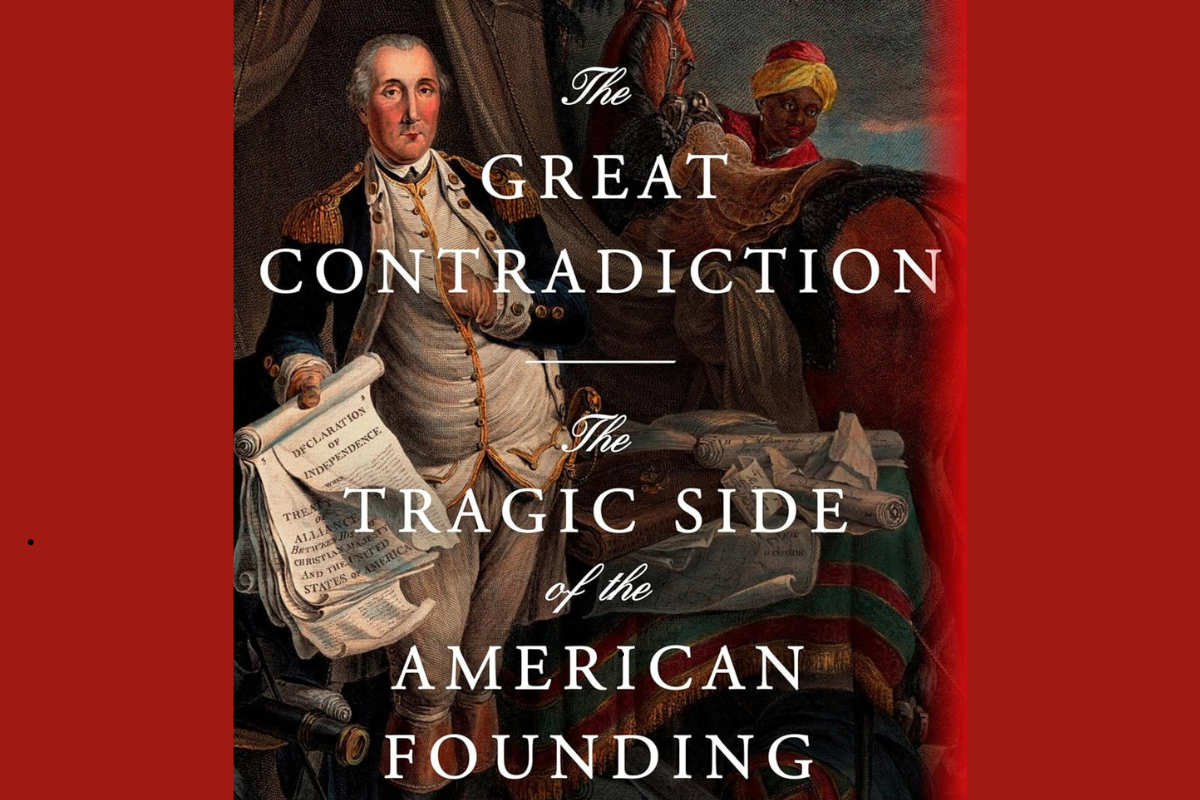
The Great Contradiction: The Tragic Side of the American Founding
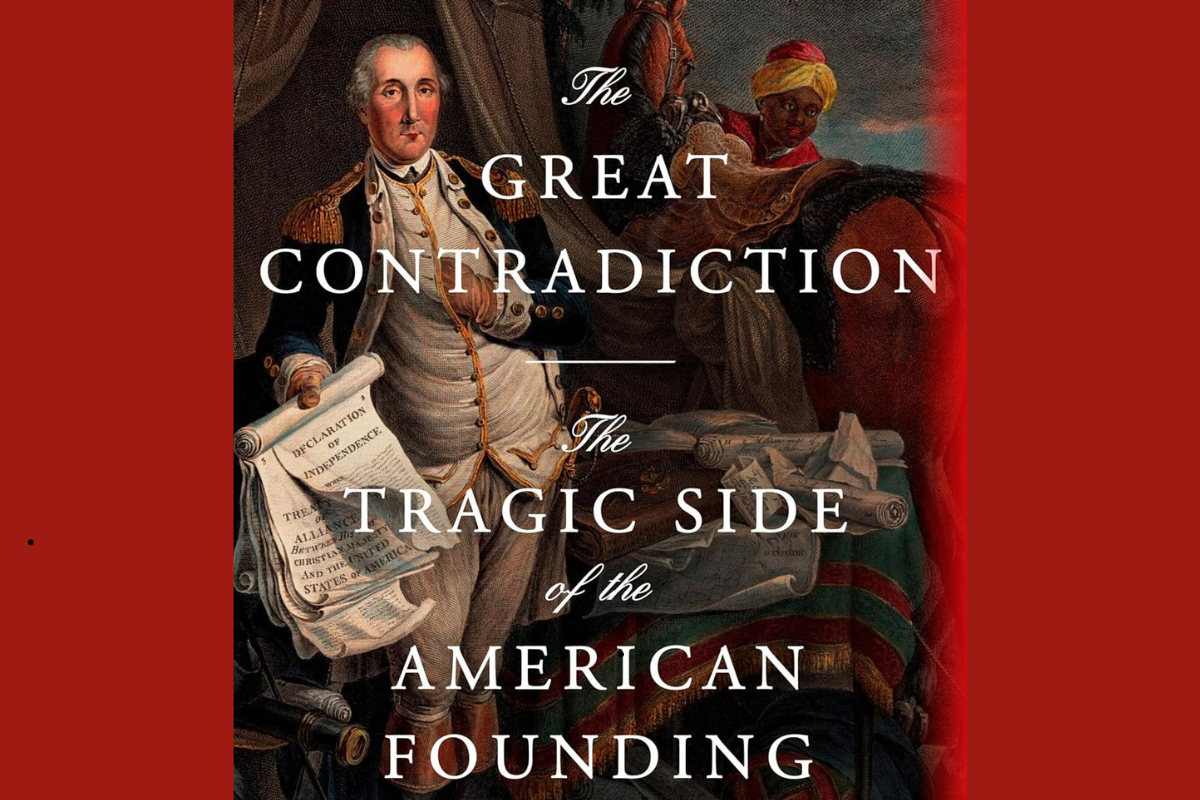
Joseph Ellis Alfred A. Knopf New York, 2025 $17.47, 240pp
Joseph Ellis’s has written several books on the American Founding. They include American Dialogue: The Founders and Us (2018) the Pulitzer Prize winning Founding Brothers: The Revolutionary Generation(2000). These are valuable contributions to the scholarship of the Founding period, though, in his enthusiasm for demonstrating the relevance of the American Founding to the present day, Ellis occasionally draws conclusions that might be best left to the reader; consequently, the objectivity of his work is at times tainted by limited, but nonetheless significant, political partisanship. Topicality will always undermine the integrity of scholarship.
Seeking a Balanced View of the Founders
In these books—and we should note there is a measure of redundancy from one to the other—Ellis seeks to show the reader that the American Founders were made of flesh and bone. On the one hand, as Lincoln reverently noted in his Young Men’s Lyceum speech, they were “pillars of liberty” “; on the other hand, they were flawed, and at times those flaws shaped the public policies for which they were responsible.
What is most admirable in Ellis’s book is his balanced view of the Founding itself. He notes that
[W]e have been asked to choose between two competing narratives of the founding. One features the founders as demigods who were permitted to glimpse the eternal truths, or, as Ralph Waldo Emerson once put it, “to see God face to face.” The other is crowded with a cast of despicable villains who collectively comprise the deadest, whitest males in American history.
He astutely adds, “These mindlessly celebratory and naïvely judgmental responses to the founders are in fact complementary cartoons, the front and back sides of the same childlike portrait that we periodically rotate, like adolescents fluctuating between the emotional imperatives of unconditional love and Oedipal hate.”
Thus, Ellis decries “presentism,” the interpretive error by which we judge the American Founding exactly as we might judge events today, without making allowance for the differences in culture, politics, demography, and science that inevitably exist between a two-hundred-and-fifty-year separation:
If the original sin of American history is slavery, and racism its toxic residue, the original sin for American historians is “presentism,” the presumption that our political and moral values now are wholly reliable standards of truth and justice for the assessment of our predecessors then.
Accordingly, we must “inhabit the dilemma” if we wish to intelligently and responsibly assess the contributions and failures of the Founding.
To rush headlong into an abolition of slavery at the Constitutional Convention would have doomed the project, left the country divided between slave and free, and thus leaving behind the hope of the extermination of slavery in the South within any reasonable span of time. Moreover, as Ellis plausibly argues, the Founding Generation was unable to surmount was the possibility of a biracial society and the prohibitive cost of establishing a freedman population elsewhere, even if former slaves were willing to go.
Regarding American Indians, though George Washington, Thomas Jefferson, and Secretary of War Henry Knox made gallant efforts to craft a political solution that allowed settlers and native Americans to coexist, the collective push westward by the rapidly growing population of American citizens could not be controlled short of a militarized state. Thus, a solution for slavery was impossible to envision, and a solution for American Indians was impossible to implement. In the final analysis, both tragedies were the price of a democratic form of government, a system that the Founders endeavored to attenuate at the Constitutional Convention in 1787.
The Complexity of American Slavery
Slavery was a civilizational affair. Portugal first made it possible by their maritime superiority, specifically, the innovation in sailing by which ships might sail against the wind, not just with it. Soon other European nations profited from the Portuguese seafaring skills. Those seeking slaves came not only from the West; even the Muslim world to the east of Africa participated in the slave trade. Ellis damned the slave trade by pronouncing that Western Civilization lacked a conscience; but, by his own accounts, if a conscience was lacking it was deficient in the Middle East as well.
He explains,
Another African diaspora in the other direction was occurring at the same time, even larger than the Atlantic Slave Trade. Between fourteen and sixteen million Africans were carried east, across the Sahara, over the Red Sea and Indian Ocean. Africa was plundered from the west by Christians and from the east by Muslims.
Moral idealism was not hard to find, especially with the presence of Quakers and abolitionists. But their “moral certainty” was not combined with the practical means by which the sin of slavery might be overcome. Illustrative of the position in which America’s greatest statesmen found themselves was the great orator Patrick Henry’s acknowledgement of the immorality of owning his own slaves. It was “a bewildering mixture of denial and guilt,” an attitude that approached a kind of moral schizophrenia. Ellis records Henry’s response to criticisms of the institution:
“Would anyone believe that I was a Master of Slaves of my own Purchase?” he asked rhetorically, “I am drawn along by the General inconvenience of living without them,” he admitted, “but I will not, I cannot justify it. I will so far pay my devoir to Virtue, as to own the excellence & rectitude of her Precepts & to lament my want of conformity to them.”
In the original draft of the Declaration Jefferson condemned the slave trade in harsh terms, but he lays the blame on George III. Ellis explains that the reasons may have been twofold. It was clumsily written and also it might have upset the fragile debates underway. The Revolutionary War involved more strained thinking about slavery. Despite recommendations that free blacks join the Continental Army forces, such a move was never undertaken in a meaningful way. The British were able to lure several thousand Southern slaves to their side with a promise of freedom; however, the majority of the slaves died of smallpox when the disease ravaged the area where they were congregated, which tamped down the enthusiasm for slaves to runaway to the British.
As is well known, the Constitution, hammered out in 1787, contains several compromises over slavery, most intended to protect the slave trade, although Article I, Section 9, Clause 1 allows the importation of slaves to continue for only two decades more. Ellis is careful to point out that the 3/5 Compromise, quantifying the count of slaves both for representation and taxation, was not a moral statement, rather a pragmatic solution to a difficult political question. We might also note that a careful reading of Federalist Paper #54, while at first glance appears to be a straightforward explication of the relevant constitutional clause, is also a subtle subversion of the institution as Publius gratuitously calls it “debased.” Publius also takes the opportunity to underscore that, although the compromise accepts that slaves are taxed as “property,” their recognition for the purpose of representation means that they are also human beings.
The State Ratifying Conventions and the First Congress
The records of the state constitutional ratifying conventions offer more insight as whatever moral zeal may have been present Philadelphia began to dissipate. For example, George Mason of Virginia had argued against slavery in the Constitutional Convention, but once in Virginia he changed course as “slavery took a back seat to local and regional priorities.” Charles Pickney of South Carolina revealed a heretofore unknown reason for the opposition to a Bill of Rights given that a Bill of Rights would be a reminder that enslaved men and women did not enjoy those celebrated rights.
Two delegations of Quakers presented petitions to the first Congress in Federal Hall, New York City in 1790, but they may have undermined their own case when Representative James Jackson of Georgia, while rejecting the petition by “shaking his fist at the Quakers in the gallery . . . denounced them as infamous innocents incessantly disposed to drip their precious purity like holy water over everyone else’s sins.” They were, furthermore “highly questionable patriots” since they had declined to fight “in deference to their cherished consciences.” But the next day a petition arrived from the Pennsylvania Abolition Society signed by none other than Benjamin Franklin. It was his last official act. He died three weeks later and the petition was dismissed.
Ellis concludes that over the next few years, the revolutionary fervor that fueled the events symbolized by 1776 and 1787 began to subside as did the opportunity for the abolition of slavery. Jefferson and Madison represented many when they said that emancipation could not succeed if it meant a biracial society. At this point in time, it was difficult if not impossible for many to imagine that Negroes were the equal of those to whom they were subjugated. This is not entirely implausible though ironic given that Negroes were only seen in their enslaved state, many pitifully deferential to whites.
The Tragedy of American Indians
Native Americans were not included in the negotiations of the Treaty of Paris even though one hundred thousand lived between the Appalachians and the Mississippi Rivers. Ellis plausibly explains that no one at the time thought a just settlement with the Indians was impossible, at least compared to the plight of African slaves. George Washington, Henry Knox, and Thomas Jefferson formed an ad hoc group seeking a just arrangement for the Indians; but not even the prestige of Washington was able to stem the steady flow of settlers westward.
In short, as the apparently inevitable tragedy so clear to us began to unfold, neither side regarded it as inevitable. Washington went so far as to declare that a truly just Indian policy was one of his highest priorities, that failure on this score would damage his reputation and “stain the nation.” No man in American history was more accustomed to getting his way than Washington, especially when he invested his personal prestige in the cause. The fate of the Native American population proved the exception to that rule, a case where his own efforts proved inadequate for reasons that not even he could control.
Nor did the Northwest Ordinance secure the land rights of Indians. Although it read that Indian policy would be guided by the very best “Republican Principles,” the ordinance was also predicated on the idea that American settlers would continue their habit of claiming land as their own. Even though the Article I Section 8 provision that made Native Americans a federal responsibility rather than a state responsibility, when all was said and done, it made little difference in the ultimate fate of the Indian Tribes.
Though the clause may have given the federal government, and specifically Washington, Knox, and Jefferson the authority to protect American Indian rights, it did not furnish them the power to stop or even slow the momentum to the west. To make matters worse, the commissioners sent to negotiate with the Indians were no match for the shrewd and fascinating leader of the Creeks, Alexander McGillivray, who could see the future better than the Americans. Experience, moreover, had taught him not to trust the Americans. In the end, concludes Ellis, “demography trumped democracy.”
Scholarship and Partisanship
Joseph Ellis begins his otherwise valuable book with an unfortunate shout-out to a faddish trend:
But there is another, more relevant reason to focus on slavery and its racist residue: namely, it connects the way we were then with the way we are now, as a society that continues to grapple with the political and even emotional implications of becoming a biracial or multiracial America. In effect, we are still living a story about the presumption of white supremacy that had its origins and first chapter in the American founding. (emphasis added.)
Like Ellis’s other books, this one has a target audience of intelligent lay readers—of laymen who will appreciate the moral, political, and philosophical matters he recounts. They are apt to come away from The Great Contradiction with a new appreciation of the limits on even our most powerful historical leaders’ ability to shape events even in their own day, let alone in ours.

Henry T. Edmondson III, is Carl Vinson Professor of Political Science and Public Administration at Georgia College.
Related Essays