Ex Parte Milligan (1866)
Introduction
Questions of emergency governmental powers and their deleterious impact on civil liberties have raised especially perplexing challenges when occurring in the midst of or in proximity to war and threats to our national security. Not only was the Civil War a singular event in American history, so too were the profoundly acute tensions it generated between the effective prosecution of the war and the continued guarantees of basic individual rights. President Lincoln’s unprecedented resort to widespread consignment of those suspected of treasonous behavior to military trials, had it gone unchecked, might, in the words of Justice Robert Jackson in his Korematsu dissent, have served as “a loaded weapon, ready for the hand of any authority that can bring forward a plausible claim of an urgent need.” Instead the Supreme Court in Ex Parte Milligan (1866), still in the shadow of a terrible Civil war, laid down a clear rule that martial law and the suspension of rights had no place in areas outside the theatre of battle; where the normal courts were in operation, citizens had an unquestionable right to avail themselves of their protection. Sometimes shaken, Milligan lives on as an important procedural check on governmental war powers amidst terrorism and other contemporary conflicts.
Civil War and Presidential Power: Habeas Corpus and Martial Law
The onset of the Civil War raised difficult questions of what constituted treasonous behavior toward the Union and how (strictly) to handle those suspected of treason. Once shots were fired on Fort Sumter on April 12, 1864, President Lincoln wasted no time aggressively wielding what he considered his inherent executive authority in wartime. Within several weeks, he had taken dramatic actions that included the suspension of habeas corpus and the imposition of martial law in select territories, as well as blockades on the rebel states. Habeas corpus ranks among the most important of individual rights, a protection against unrestrained government power by ensuring that someone detained is entitled to a judicial review of the propriety of his arrest. As a product of English common law, it was one of the few rights explicit in the original Constitution prior to the addition of the Bill of Rights. Under Article 1 section 9, “. . . habeas corpus shall not be suspended, unless when in cases of rebellion or invasion the public safety may require it.” While there was little doubt the country was in a state of rebellion in 1861, it was unclear that there was a sufficient threat to public safety to justify military courts when the regular courts were open and operating. Moreover, although the clause does not specify which branch holds the power to suspend the writ, its inclusion in Art. 1 indicated that it lay with Congress.
Lincoln displayed little doubt, however, that he had the power to do what he did, especially with Congress out of session. The preservation of the Union prevailed over the maintenance of privileges and immunities which could later be restored. In his words, “I felt that measures, otherwise unconstitutional, might become lawful by becoming indispensable to the preservation of the Constitution, through the preservation of the nation.” Nevertheless, he did go before Congress seeking its post hoc approval of his wartime actions. In justifying his action to Congress in July of 1861, he implicitly acknowledged his extra-constitutional exercise of power, trusting that Congress would expeditiously “and readily ratify them.”
The suspension of habeas corpus and the imposition of martial law were central to Lincoln’s strategy, given his lack of faith in a judiciary responsible for the Dred Scott debacle, and he would make frequent use of them when he thought it necessary to the waging of the war. In September of 1861 he issued a broad declaration suspending habeas corpus throughout the U.S. for anyone suspected of “disloyal practices.” The proliferation of military tribunals followed, with at least several thousand pro-Confederate suspects detained and tried without a jury during the war. Congress again retroactively approved of Lincoln’s decisions in the Habeas Corpus Act of 1863.
An Early Legal Test of Presidential War Power: Ex Parte Merryman
These actions were not uncontroversial, with vigorous debate and strong opposition arising within Congress and in the press. The case of Ex Parte Merryman (1861) offered an early test of the extent of the President’s power to deny a prisoner the right to seek a judicial review of the grounds of his detention. One of Lincoln’s earliest acts as President had been to impose martial law in areas of the country that had not seceded but were sympathetic to the southern cause. This included the slave state of Maryland. John Merryman, a pro-confederate state militia officer living in Baltimore was arrested for anti-Union property destruction in May 1861 and jailed in Fort McHenry without formal charge or a trial. Merryman appealed to Chief Justice Taney, acting in his capacity as the circuit judge for Baltimore, for a writ of habeas corpus ordering the military to produce Merryman in federal court for a hearing. Taney granted the plea, but the local military commander, General George Cadwalader refused to comply, citing the President’s order. When Taney’s order to have Cadwalader arrested for contempt of court proved ineffective, he penned his opinion in Ex parte Merryman. Taney cited separation of powers principles to find that Lincoln had no grounds for suspending the writ of habeas corpus, which was a legislative act reserved to Congress. Surely realizing he held a weak hand, Taney made no attempt to order Merryman’s release, instead simply sending his opinion to Lincoln. Lincoln never bothered to acknowledge or respond to Taney’s judgment.
Taney’s decision was an important limitation on the President’s power to unilaterally suspend habeas corpus or to impose martial law. But the presidential disregard of Taney’s opinion also served as a stark reminder of the impotence of the judiciary in opposing the executive or compelling presidential compliance in the midst of the conflict. Perhaps unsurprisingly, the full Court would not take up the question again while the Civil War was being fought, strategically relying on jurisdictional arguments to avoid taking appeals they would likely be unable to enforce. The courts’ passivity meant they had little part in limiting or regulating martial law or the decision of military tribunals. Only upon the end of the war would the courts begin to exert independence.
The Story of Lambdin Milligan
While Ex Parte Merryman was a separation of powers question of who can suspend habeas corpus, Ex Parte Milligan raised the question of how, under what circumstances the writ could be suspended. Lambdin Milligan, a citizen of the free state of Indiana, lived in the southern part of the state, which was a hotbed of southern sympathies. He was a Copperhead who went beyond mere opposition to the war to actively aiding and supporting the southern cause, organizing pro-southern groups, and working to convince young draft-eligible men to refuse to serve in the Union Army. Such efforts caused growing concern and fear for the Union cause, leading Lincoln in September 1862 to announce that anyone “discouraging volunteer enlistments, resisting militia drafts, or guilty of any disloyal practice . . . shall be subject to martial law and liable to trial and punishment by Courts Martial or Military Commission.” Vehemently opposed to Indiana’s contributions of troops to the Union army, Milligan’s attempts to discourage enlistments would eventually bring him to the attention of pro-Union press and federal agents.
By late 1863 and into 1864, those efforts had taken an ominous turn, as a secret society of conspirators that included Milligan schemed to overthrow the government. Beyond merely agitating against the Union, Milligan and his fellow Copperheads hatched an audacious (some might say ridiculous) scheme to bolster a northern Confederate force. The plan that came to be known as the Northwest Conspiracy was grand in scale, if ultimately futile in its execution. The conspirators would seize control of federal and state arsenals in Ohio, Indiana and Illinois, raid prisoner of war camps to free Confederate soldiers and arm them with the stolen weapons and ammunition, with the ultimate goal of marching against Union forces in Missouri and Kentucky, where they hoped to be joined by regular Confederate soldiers. Once they reached out to the Confederates to obtain their cooperation, the conspirators had clearly crossed the line into treason.
In August 1864, Milligan gave a public speech urging fellow Democrats to rise up in resistance to the war and fight. He was arrested on October 6, 1864; within two weeks he was on trial before a military tribunal consisting exclusively of army officers. In early December, he was convicted of conspiracy, inciting insurrection, and giving aid and comfort to the enemy and was sentenced to hang May 19, 1865. Whatever the reason for the delay of the execution until May, it proved fortuitous for Milligan. Not only did it provide him an opportunity to file a habeas corpus petition in federal court challenging the arrest and trial, it also meant that by the time the issue reached the Supreme Court, the war had ended. The fact that the case reached the High Court after the war had ended undoubtedly eased much of the political pressure on the justices.
Ex Parte Milligan: The Opinions
The issue before the Court was whether the government had the power, in an area free from rebellion and not within the theatre of operations, and where the courts were in full discharge of their duties, to suspend a citizen’s constitutional guarantees and consign him to a military commission for arrest, trial, and sentence. Put another way, did the trial and conviction of Milligan as a resident of a non-rebel state by a military tribunal subject to Pres Lincoln’s orders suspending habeas corpus and imposing martial law despite the fact that the normal courts were open and operating, exceed the President’s war powers?
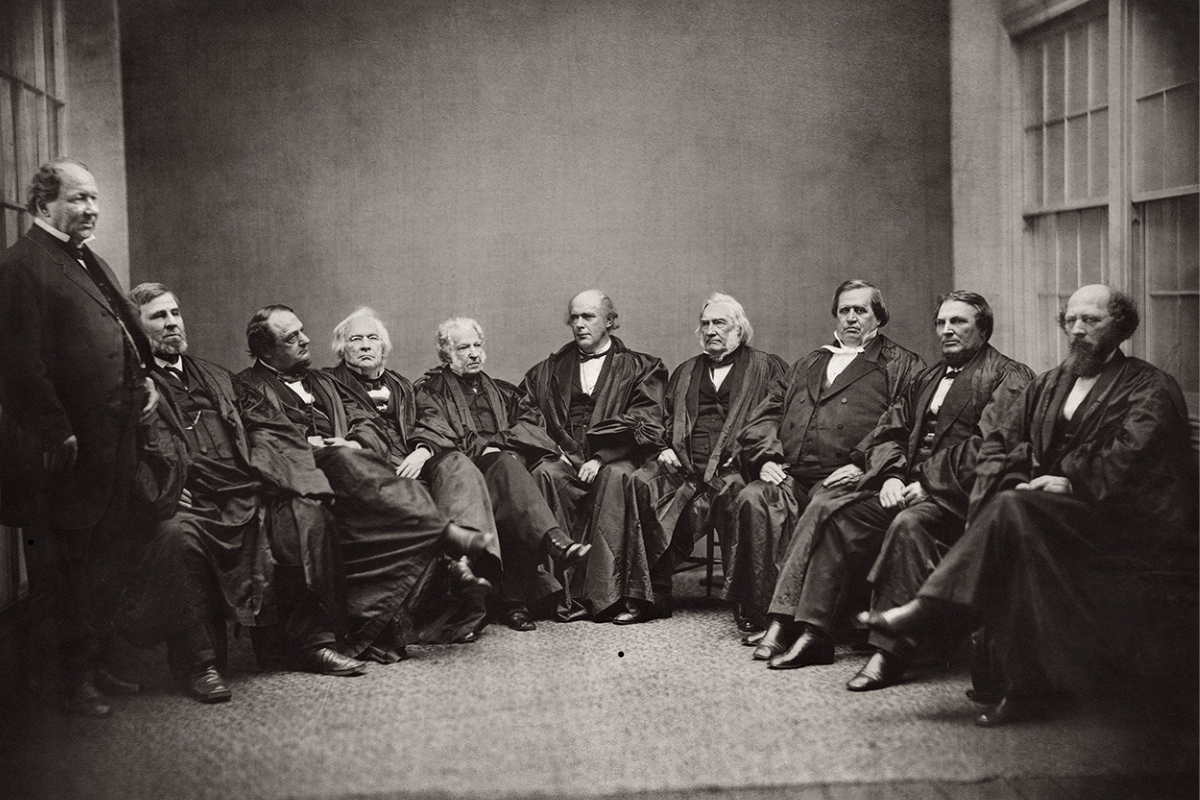
The Court unanimously sided with Milligan, even as the justices differed over the rationale. In his majority opinion, Justice Davis determined that “[m]artial law cannot arise from a threatened invasion. The necessity must be actual and present; the invasion real, such as effectually closes the courts and deposes the civil administration.” Martial law was suitable only when the courts were actually closed, rendering it impossible to administer civil justice, when there is no power left but the military. Martial law could never exist where “the courts are open and in the proper and unobstructed exercise of their jurisdiction," as was the case in Indiana. Milligan and his fellow detainees were entitled to trial by jury.
In ringing language, Davis declared the Constitution “a law for rulers and people, equally in war and peace, and covers with the shield of its protection all classes of men, at all times, and under all circumstances. . . No doctrine, involving more pernicious consequences, was ever invented by the wit of man than that any of its provisions can be suspended during any of the great exigencies of government. Such a doctrine leads directly to anarchy or despotism . . .”
Justice Chase’s concurring opinion, joined by three of his colleagues, was more permissive, granting the government broader authority in the midst of war to suspend civil rights and to rely on military courts. Chase opined that “it is within the power of Congress to determine in what states or districts such great and imminent public danger exists as justifies the authorization of military tribunals for the trial of crimes and offences against the discipline or security of the army or against the public safety.” Congress, under its powers to declare war and raise standing armies, could have created the military commission in Indiana, even if the civil courts were open. It simply chose not to do so. Lincoln’s error was not in the unconstitutional impairment of civil liberties, but in his violation of principles of separation of powers.
The Consequences of the Case
Ex Parte Milligan is rightly considered a landmark defense of civil liberties. Lincoln’s broad proclamations suspending the right of habeas corpus in the hands of a less judicious executive carried a dangerous potential for trammeling of individual rights whenever collective security might seem at risk. The Court had stood in unison against him. The line was now clear. Even with the echoes of a terrible Civil War still reverberating, the Court emphasized the primacy of civil authority, that when civil authority was established and in operation, citizens had a basic right to avail themselves of its protection.
But the decision’s announcement hardly met with universal acclaim. Critics found it too severe a hamstringing of the government when in the throes of war or serious civil disturbance. Journalists derided it as taking the side of the south and lumped it in with Dred Scott. Proponents of Reconstruction worried that it revealed a Court that could not be counted on to uphold the North’s presence in the south or support other Reconstruction measures.
Nor did the Supreme Court’s decree necessarily end the practice of military tribunals. In open defiance of Milligan, Congress promptly passed the First Reconstruction Act of 1867, establishing military jurisdiction and commissions of precisely the kind that the Court had rejected. As a result, tribunals continued to function in South under martial law during Reconstruction, albeit at a diminished pace. Despite the legislative disregard for its authority, the Court flinched in the face of Congress and refused to hear challenges to the enforcement of what seemed a manifestly unconstitutional law.
Even as the decision grew reputationally as a triumph of civil liberties even in the face of wartime pressures, its doctrine of “one law in war and peace” did not always holding up well under the weight of political and military realities in the midst of actual warfare. Notable historical stumbles included the upholding of sedition acts during WWI, the internment of Japanese-Americans in WWII, and the Court’s support in Ex Parte Quirin of a military tribunal’s questionable convictions of eight hapless Nazi saboteurs who had come ashore. These foibles aside, Milligan has had a lasting impact, its relevance re-emerging with the rise of the war on terror and providing a foundation for ensuring some threshold of due process for detainees.
A Postscript
John Merryman, the detainee in the case that gave rise to Ex Parte Merryman, went on to serve as Maryland’s state treasurer in the early 1870s and named one of his sons Roger B. Taney Merryman in honor of the Chief Justice who supported his cause. Lambdin Milligan was released from custody in April 1866. He would return to his law practice in Indiana, where he filed a civil lawsuit seeking damages for the wrongful military detention and trial. While prevailing on the merits, his satisfaction was surely dampened when his damages award was limited by statute to $5. He passed away in 1899. One of Milligan’s lawyers before the Supreme Court would enjoy a more auspicious career, though it would be tragically cut short. James Garfield was a former union general and acting congressman when he served as one of Milligan’s lawyers before the Court. He would eventually be elected president in 1881, although his presidency was short-lived. He was shot by a disgruntled seeker of a patronage position and died on September 19, 1881.