Gerald R. Ford, John Lewis, and African American History Month
In 1976, America’s Bicentennial, President Gerald R. Ford issued an important message on the observance of Black History Month. Ford, acknowledging the injustices of the past, called on Americans to “seize the opportunity to honor the too-often neglected accomplishments of black Americans in every area of endeavor throughout our history.”
Black History Month, also known as African-American History Month, is commemorated annually to remember the contributions and struggles of African Americans. While it was originally a weeklong observation, it became a month-long event in 1970. Black History Month is celebrated in February in the U.S. and Canada.
The 1963 March on Washington, on August 28, was an important event in America’s Civil Rights history. An estimated one-quarter of a million people participated in the March on Washington, D.C. for Jobs and Freedom.
An editorial in the Grand Rapids Press on August 30, 1963, titled “The Way of Free Citizens” quoted then-Representative Gerald R. Ford, Jr., then-Chairman of the House Republican Conference, on the March on Washington. “In assembling, these people were, as Representative Gerald R. Ford, Jr., has observed, exercising as free Americans, their right of petition to Congress for redress of their grievances.”
At the March on Washington, Dr. Martin Luther King, Jr., delivered his powerful “I Have a Dream” speech on the steps of the Lincoln Memorial. Dr. King, excited and inspired America and the world when he spoke about his dream of a day when “this nation would rise up and live out the true meaning of its creed: ‘We hold these truths to be self-evident, that all men are created equal.’”
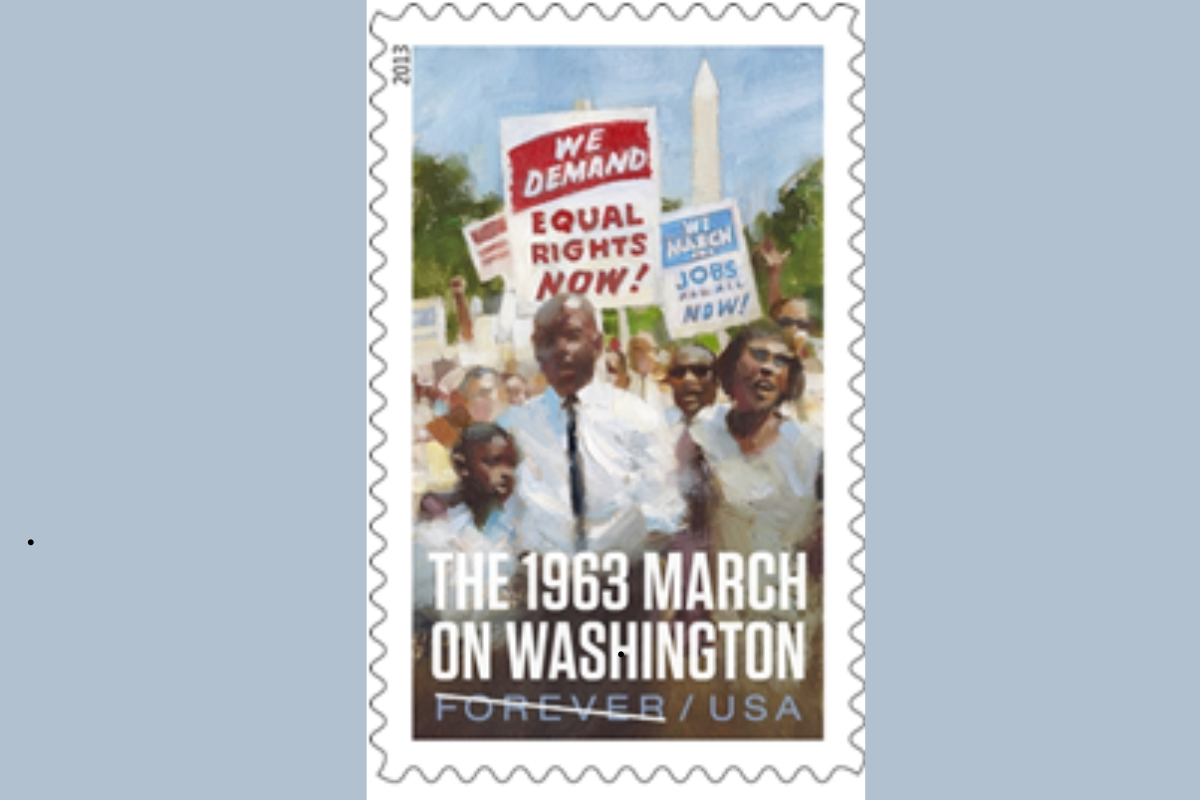
On August 23, 2013, the U.S. Postal Service issued a Forever stamp commemorating the 50th anniversary of the March on Washington. At the First-Day-of-Issuance ceremony for the March on Washington Forever Stamp, held at the since-closed Newseum in Washington, D.C., Rep. John Lewis (1940-2020), who attended the 1963 march, spoke.
“It is so appropriate and so fitting for the United States Postal Service to issue this Forever stamp on the eve of the 50th anniversary of the March on Washington,” Lewis said. “The march was one of the turning points in the on-going struggle for civil rights and social justice in America.”
Lewis said that when future philatelists and students study the stamp and its history: “[T]hey will be reminded of the distance we have come and the progress we have made as a nation. And they will be reminded of the civic duty of every American to stand up for what is right in our democracy.”
The March on Washington Forever stamp depicts African American marchers, a man, a woman, and a young girl, with a red-and-white sign reading: “We Demand Equal Rights Now!” Another sign in the background reads: “We Demand Jobs Now!”
As America’s 250th Anniversary of Independence approaches, it is worth recalling President Ford’s important 1976 message to Americans about Black History Month. “In the Bicentennial year of our Independence, we can review with admiration the impressive contributions of black Americans to our national life and culture.” President Ford acknowledged the achievements of Dr. Carter G. Woodson, founder of the Association for the Study of Afro-American Life and History. The President said America was “richer for the work of his organization.”
In his message, President Ford said, “Freedom and the recognition of individual rights are what our Revolution was all about. They were ideals that inspired our fight for Independence: ideals that we have been striving to live up to ever since. Yet it took many years before these ideals became a reality for black citizens.”
For Black History Month 2026, let us be inspired by President Ford’s wise words from 1976: “[S]eize the opportunity to honor the too-often neglected accomplishments of black Americans in every area of endeavor throughout our history.”

Former U.S. diplomat, life member of the American Foreign Service Association, and worked for the President Ford Committee at the 1976 Republican National Convention in Kansas City.
Related Essays