A Review: Akhil Reed Amar, Born Equal: Remaking America’s Constitution
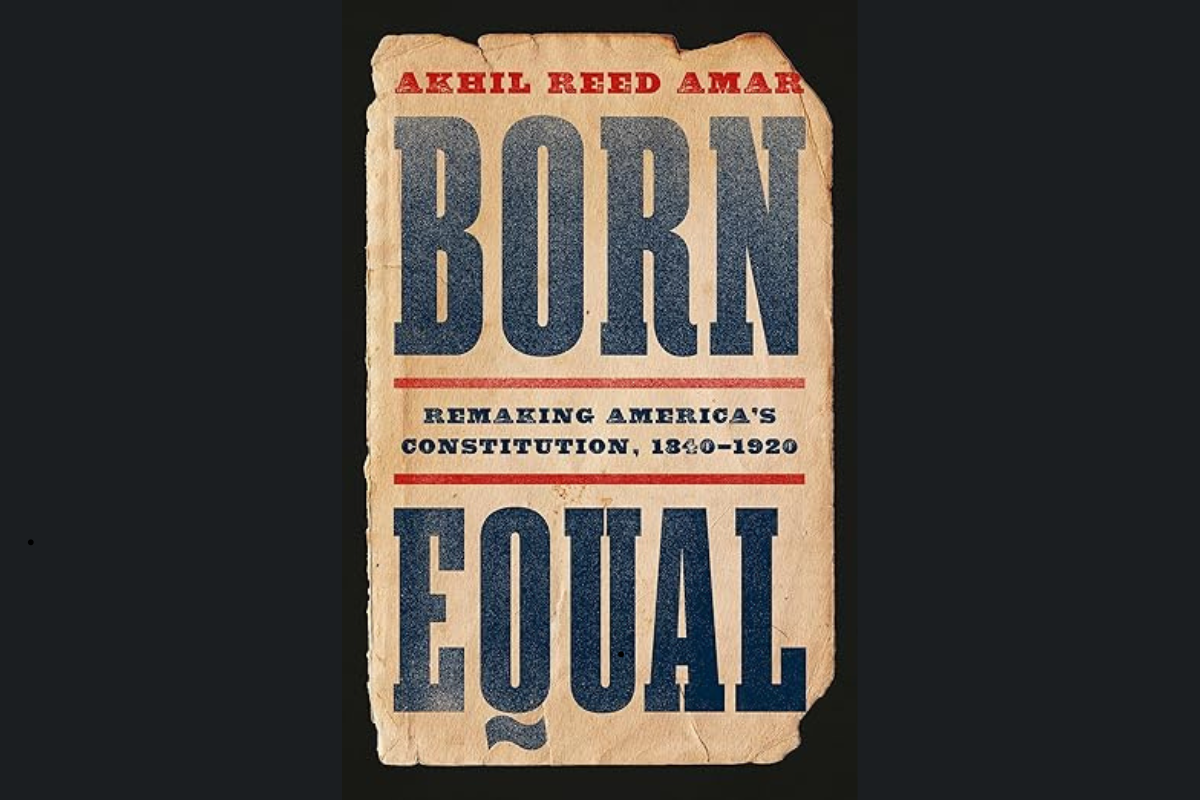
For several decades, a debate over the proper approach to Constitutional interpretation has raged between “conservative” advocates of “originalism” or textualism, who hold that judges must be guided by the Constitution’s text and its underlying intent, and “liberal” proponents of a “living Constitution,” according to whom members of the judiciary are authorized and even obliged to interpret the document in light of changing contemporary notions of justice. By contrast, Akhil Reed Amar, Sterling Professor of Law and Political Science at Yale University, is that rara avis: a political liberal (in the broad sense) who celebrates the advance of the liberal principles of people’s equal rights enunciated in the Declaration of Independence and given effect in the Constitution, while making reasoned efforts to ground his argument in those documents’ text. Hence, while devoting the second volume of his projected three-part trilogy on American Constitutional history largely to the successful effort led by Abraham Lincoln and Frederick Douglass to actualize the Declaration’s promise by abolishing slavery, along with the advance (starting with the Seneca Falls Declaration of 1848) to amend the Constitution so as to guarantee female suffrage, Amar is prepared to depart from today’s professedly liberal agenda (e.g. regarding the Second Amendment’s guarantee of the right to bear arms) when both text and original context support a different interpretation. And he unmasks several idols of today’s professed liberals - notably Justice Oliver Wendell Holmes, Jr., Woodrow Wilson, and “progressive” historian Charles Beard - as only false friends of liberty, precisely because of their contempt or at best lack of interest in our Constitution’s text and its authors’ intent.
What links Amar’s authentic liberalism to his originalism is his restoration of Lincoln’s and Douglass’s understanding of the Constitution as – in Douglass’s words – “a glorious liberty document.” Amar, of course, is fully aware of the unfortunate compromises that the Constitution’s authors made with (what nearly all of them recognized as) the great evil of slavery in order to secure ratification and thus preserve the Union. But despite those compromises, Amar stresses, as both Lincoln and Douglass did, the Founders’ avoidance of any use of the terms “slave” or “slavery” in those three compromises with Southern states (the fugitive slave clause, the three-fifths clause regarding representation, and the prohibition of Federal interference with the importation of slaves before 1808). He emphasizes, as well, the significance of the Northwest Ordinance’s ban on slavery in the western territories (originally penned by Jefferson before the Constitution’s adoption), as well as the gradual abolition of slavery in northern states during the decade or so around 1787. And he notes that before the publication of James Madison’s notes of the 1787 Convention was finally published in 1840, most ordinary Americans had no idea just how fiercely some of slavery’s critics at Philadelphia had expressed their abhorrence of what was later called the “peculiar institution” at that meeting.
As Amar, following numerous distinguished historians of the Founding, observes, in compromising with the temporary persistence of slavery in some states, most authors of the Constitution anticipated that it would gradually die away – as a consequence of the spread of enlightenment; the growing prosperity of the states that had abolished it; the cutoff of the importation of slaves, and the spreading awareness even among slaves themselves of the possibility of an escape towards freedom. What dashed those hopes was the invention of the cotton gin (which made the production of cotton by slaves far more efficient than the gradually dying tobacco industry), along with the opportunity to export slaves into new territories opened by the purchases of Florida and the Louisiana territory. But those developments in no way altered the liberating intent of the Declaration and Constitution – a position on which takes a stand diametrically opposed to the radical Abolitionist Willam Lloyd Garrison, pro-slavery Chief Justice Roger Taney (in the infamous 1857 decision of Dred Scott v. Sandford), and the New York Times’s now widely circulated 1619 Project (which aims to identify the core principles of the American regime with the year in which a small cargo of Spanish slaves was landed on what became the coast of Georgia, rather than the year the Pilgrims, seeking a mix of religious freedom and economic opportunity, arrived in Massachusetts). Politics indeed sometimes makes strange bedfellows!
Amar’s treatment of Lincoln’s originalist quest to halt the further spread of slavery, following the 1854 Kansas-Nebraska Act, engineered by his fellow Illinoisan, the amoral Stephen Douglas, which repealed the Missouri Compromise’s prohibition on the introduction of slavery in most of the Louisiana Territory, and then in opposition to Dred Scott, is largely sensitive and mostly persuasive. Amar shows awareness of how Lincoln’s advancement in Illinois politics, notably in his 1858 debates with Douglas, required him to renounce believing in full “political and social equality” for black people (as distinguished from the natural rights stated in the Declaration), since many of those opposed to slavery in that state were themselves often racial bigots who feared economic competition from free blacks. But if anything, Amar still underestimates the liberality of Lincoln’s original position by claiming that his stated doubt in the debates to the possibility of the white and black races “living together on terms of social and political equality” reflected a “narrow-minded” outlook from which he gradually “matured” as President, rather than an accommodation to political necessity. In any event Amar notes that during “his final years” Lincoln not only greeted leading blacks, including Douglass and Sojourner Truth, “with unprecedented courtesy and kindness” (as Douglass himself later attested), but came to “embrace equal Black citizenship as a national rule,” through the Emancipation Proclamation and the Thirteenth Amendment (which he shepherded through Congress, as documented in Doris Kearns Goodwin’s film “Lincoln”) and the Fourteenth and Fifteenth Amendments, which Amar maintains the Great Emancipator would have favored.
Amar’s account of the quest to secure black freedom does not stint in describing “the Constitutional failures” to achieve that goal in the former Confederate states after 1875, despite the three post-Civil War amendments. Aside from political explanations, he properly blames the Supreme Court’s narrow, un-originalist readings of the amendments, notably the Slaughterhouse Cases (1873), which despite concerning a non-racial issue, had the effect of “disemboweling” the 14th Amendment’s “privileges and immunities” clause, and U.S. v. Cruikshank (1876), in which the Grant administration’s prosecution of a gang of “White thugs” for massacring dozens of Black freedmen in a post-election controversy denied that the amendment had “incorporated” the First, Second, and other Bill of Rights amendments to apply against the states. (Quite properly, in contrast to contemporary incorporationsts, Amar denies that the Amendment applies all of the Bill of Rights to the states, since part of the reason for the First Amendment’s prohibition on Federal establishments of religion was “to protect early state-sponsored establishments aimed in part to protect early state-sponsored churches from federal disestablishment.” Had Amar’s sage judgment on this point been followed, many foolish, antireligious judgments of the Court since the 1950s, such as Lee v. Weisman (1992), in which a 5-4 majority ruled the practice of offering nondenominational prayers at middle schools in Providence, R.I., an unconstitutional “establishment of religion.”)
Amar also properly laments the Court’s decisions in the Civil Rights Cases (1883), which struck down the 1875 Civil Rights Act banning racial discrimination in facilities like “privately owned theaters, hotels, steamships, trains, and other places that by long tradition had been open to all” upholding segregation in public facilities in Plessy v. Ferguson (1896), even while providing a better textual ground for Justice Harlan’s justly admired dissent in that case than is widely appreciated. In passing, I note that Amar’s ground for upholding the 1875 Act would probably not have applied, as the Court subsequently held the 1964 Civil Rights Act to do, to a facility like Ollie’s Barbecue – an application which seemed to obliterate the very distinction between public and private.
Amar’s account of the quest for racial equality (which also includes a brief but significant treatment of America’s “indigenous” peoples) is framed by his treatment of the march towards women’s suffrage, notably launched by the Seneca Falls Conference of 1848, a movement in which Frederick Douglass took part. Although it is unlikely that the authors of either the Declaration or the Constitution had that goal in mind, Amar makes a plausible case for holding that it harmonizes with their intentions. But he never maintains that the change could have been enacted at the national level via Congressional legislation, as distinguished from a constitutional amendment.
The one aspect of Amar’s argument that must be questioned is his treatment of the right to economic freedom. As has long been customary in academic circles, he takes the Supreme Court to task for its 1905 decision in Lochner v. New York, striking down the number of hours that bakery workers could be obliged to work, Unfairly, Amar attributes the ruling to the influence of "Gilded Age fat cats," apparently unaware of Scalia Law School Professor David Bernstein's demonstration in Rehabilitating “Lochner” (2011) that the law in question was actually advocated by the fat cats of the bakery industry – large baking companies eager to put small, often immigrant-owned, family bakers out of business. Older readers will recall how, in the era before Permanent Press, Chinese-American families similarly worked long hours at family laundries, the parents thereby aspiring to enable their offspring to become physicians. (Another ruling upholding the right to economic freedom and decried by progressive commentators ever since was Adkins v. Children’s Hospital [1923], striking down a D.C. minimum wage ordinance that had the effect of putting the low-paid plaintiff out of a job: see Hadley Arkes, The Return of Justice Sutherland: Restoring a Jurisprudence of Natural Rights [1997].)
It is similarly unfortunate that Amar abruptly dismisses one of the most influential late-19th-century treatises on constitutional law, Thomas Cooley’s The General Principles of Constitutional Law in the United States of America, as ‘tedious” simply because of its “laissez-faire political philosophy.” As previously noted, Amar is on far stronger ground in taking to task the nihilistic Holmes, the Anglophile but racist Wilson, and the would-be but quite unscholarly uncoverer of the Founders’ supposed capitalist bias, Beard, for misrepresenting or simply disregarding their intentions and the nature of the text that they composed. But one fears that in his disparagement of economic liberty in favor of what he calls the “redistribution” authorized by the Fourteenth Amendment (citing the postwar confiscation of slave-property as his sole example), Amar risks weakening all Americans’ ability to enjoy “the blessings of liberty” promised in the Constitution’s Preamble and the Declaration itself.
My calling into question Amar’s treatment of economic freedom is not meant to detract from my overall judgment of Born Equal as an admirable – and well-written - work of scholarship. Simply by repeatedly emphasizing the “originalist” character of American political culture since the time of the Founding, and demonstrating how supportive an originalist approach to the Declaration and Constitution are to the fundamental principles of liberty, Amar refutes the unfortunate tendency in contemporary legal scholarship exemplified by Berkeley law dean Erwin Chemerinsky’s lamentable, narrowly partisan work Originalism: Worse than Nothing (reviewed by the present author in Perspectives on Political Science, 53.2 (April-June, 2024).

Professor Emeritus of Political Science at Holy Cross College