The Slaughterhouse Cases (1873)
The Fourteenth Amendment
The effect of amendments on American constitutional law varies with time and their interpretation by the Supreme Court. The Fourteenth Amendment (1868), which has a long and storied history, was interpreted by the Court for the first time in Butchers’ Benevolent Association of New Orleans v. Crescent City Livestock Landing & Slaughterhouse Co. (1873), or the Slaughterhouse Cases. The ruling was typical of late-nineteenth-century Fourteenth Amendment case law. The Court was reluctant to interpret the amendment in an expansive way that would fundamentally change the nature of federalism. It would take the prevalence of Progressive ideology and its corresponding theory of constitutional interpretation, living constitutionalism, to ignite major changes to federalism stemming from a broad reading of the Fourteenth Amendment. In addition, the Slaughterhouse Cases are a far cry from the substantive due process revolution that became a major part of early-twentieth-century jurisprudence that lasted for four decades starting with Allgeyer v. Louisiana (1897) and Lochner v. New York (1905).
Passed in the aftermath of the Civil War, the Fourteenth Amendment was intended to ensure that states did not legally discriminate against newly freed slaves. Its provisions, however, were not limited to race discrimination. The Fourteenth Amendment’s reach would be determined by Congress’s use of power granted by it and the Supreme Court’s rulings pertaining to it.
The Legal Dispute
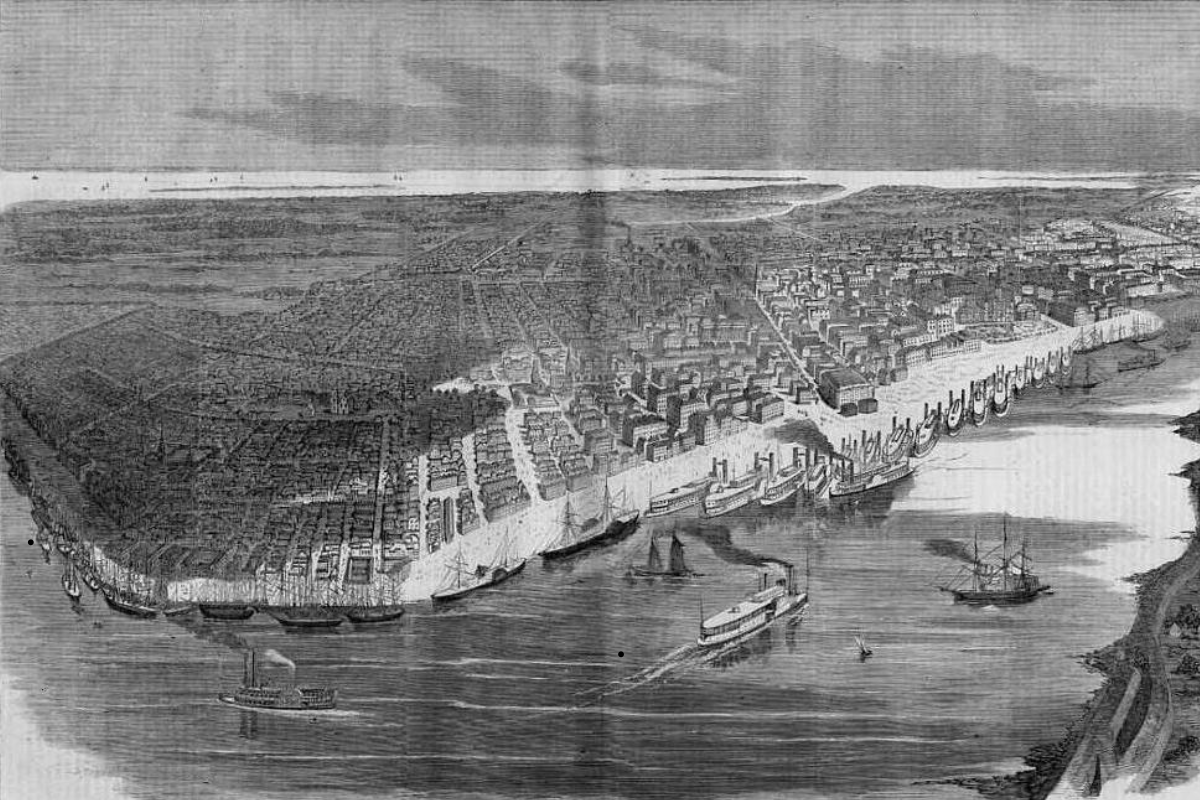
The immediate legal dispute that was resolved in the Slaughterhouse Cases began when the Louisiana legislature passed a public health law in 1869 that addressed the growing problem of slaughterhouse waste in the Mississippi River. The river was contaminated by slaughterhouse waste to the point that New Orleans was nicknamed “the necropolis of America.” In an effort to clean up the river, the Louisiana legislature passed a law that granted a twenty-five-year monopoly to Crescent City Livestock Landing & Slaughterhouse Company. Other slaughterhouse companies that operated their businesses in New Orleans and the adjacent parishes of Jefferson and St. Bernard (an area of about 1154 square miles) were prohibited from doing so and forced to move their operations far from the city where most of their business was done or to use the Crescent City Livestock facilities. In the designated areas, independent butchers could use the Crescent City Company’s facilities, but at a cost that they considered prohibitive. At stake was the reach of the Fourteenth Amendment into state governments’ policies and laws created under their police powers and, to a lesser extent, the legal status of the relationship between the Bill of Rights and the states.
The Plaintiff’s Argument
The Benevolent Butchers Association sued on behalf of independent butchers challenging the constitutionality of the 1869 law. The independent butchers were represented by John A. Campbell, a former Supreme Court Justice who resigned from the Court when his home state of Alabama seceded from the Union. Campbell argued that the law was the consequence of political corruption and efforts to advantage one slaughtering company over others. He argued that monopolies are inconsistent with common law and natural rights theory. The law should not stand for these reasons alone. Moreover, the law violated the Thirteenth and Fourteenth Amendments that combined to protect the “right to labor.” The Louisiana law restricted the right to labor because it infringed the freedom to locate a business and to freely engage in business without crippling government restrictions. Campbell argued that the Louisiana law violated the Fourteenth Amendment by excluding nearly one thousand people from practicing butchery so that seventeen people could practice it exclusively. Specifically, the law violated the Due Process Clause of the Fourteenth Amendment by prohibiting the right to labor that derives from the right to property. The states have police powers to promote public morals, health, welfare, and safety. But as the Court noted in Gibbons v. Ogden (1824), these powers are limited, including when they interfere with navigation that is vital to commerce or the privileges and immunities guaranteed by the Constitution. One such privilege was “the full enjoyment of the fruits of [one’s] labor without constraint, subject only to legal taxation or contribution.” Likewise, the Louisiana law created a monopoly that interfered with “the power to carry on commerce” that is protected by the Privileges and Immunities Clause of Article IV, Section 2, a point noted by the Court in Ward v. Maryland (1870).
The Supreme Court’s Ruling
The Court voted 5-4 for Crescent City Livestock Landing & Slaughterhouse Company. It upheld the Louisiana law and rejected the argument made by the Butchers’ Benevolent Association that the law violated their Thirteenth and Fourteenth Amendment right to engage in their professional craft without state interference. The Court also argued, as had Crescent City Company attorney Thomas Durant, that the law was a legitimate exercise of state police powers used to promote the public morals, health, welfare, and safety of citizens.
Justice Miller’s Majority Opinion
Justice Samuel Miller, a former physician appointed by President Lincoln to the Supreme Court, wrote for the majority. He interpreted the Thirteenth and Fourteenth Amendments as having a common purpose that was evident from their common history. He described that purpose as “the freedom of the slave race, the security and firm establishment of that freedom, and the protection of the newly made freemen and citizens from the oppressions of those who had formerly exercised unlimited dominion over him.” The Fourteenth Amendment was created to nullify the Court’s Dred Scott decision. While Justice Miller acknowledged that the Thirteenth and Fourteenth Amendments apply to all Americans regardless of racial identity, he narrowed their scope by refusing to extend their protection much beyond the enumerated rights of national citizenship. The Butchers’ Benevolent Association suggested that the Fourteenth Amendment Privileges and Immunities Clause protected their right to conduct their business. In its view, the Louisiana law violated that right.
Miller makes a distinction, however, between national and state citizenship and the rights attached to each. While there is some overlap between the rights protected under each category of citizenship, the Fourteenth Amendment was created to protect the rights associated with national citizenship from state infringement. That distinction has a bearing on the interpretation of the Civil War amendments. The plaintiffs argued that the two forms of citizenship are indistinguishable insofar as the application of constitutional rights is concerned. Justice Miller disagreed. Some rights apply to one category of citizenship without applying to the other. It was not the constitutional responsibility of the national government to protect all rights. The right of the members of the Butchers’ Benevolent Association to conduct their businesses without the interference of monopolies was not a right that fell under the purview of Fourteenth Amendment rights or federal jurisdiction. No such right was enumerated in the Constitution. If the right existed, it was a matter of state sovereignty to be decided by state lawmakers, state courts, and state constitutions. Moreover, it was not the responsibility of the U.S. Supreme Court to be “a perpetual censor” of state laws.
The Slaughterhouse Cases was not the first time that the Court was asked to determine which rights were protected under the Privileges and Immunities Clause of Article IV, Section 2. In Corfield v. Coryell (1823) the Court upheld a New Jersey law that prohibited individuals from other states from harvesting oysters in the state. In Justice Bushrod Washington’s majority opinion, he listed the privileges and immunities rights under Article IV including the Fifth Amendment rights of life, liberty, and property. In Ward v. Maryland (1870), the Court struck down a Maryland law that required individuals to secure a license to trade goods within the state but charged out-of-state residents a higher fee for the license. The Privileges and Immunities Clause of Article IV prohibits such inconsistent taxation. Justice Clifford’s opinion for the Court listed specific rights protected under the Privileges and Immunities Clause of Article IV. In his view, “the clause plainly and unmistakably secures and protects the right of a citizen of one state to pass into any other state of the Union for the purpose of engaging in lawful commerce, trade, or business without molestation; to acquire personal property; to take and hold real estate; to maintain actions in the courts of the state; and to be exempt from any higher taxes or excises than are imposed by the state upon its own citizens.” Justice Miller used this case law to suggest that the rights protected under the Fourteenth Amendment do not include protection from state-created monopolies and are not relevant to the Slaughterhouse Cases. The rights claimed by the plaintiffs are “the class of rights which the State governments were created to establish and secure.”
The prohibition of slaughtering in certain areas was necessary for the law to have its intended public health benefits. Moreover, independent butchers were permitted to practice their trade in the designated areas within the structure of the monopoly. They were not, as claimed by Campbell, being denied “the right to exercise their trade.” Justice Miller explained that the independent butcher “is still permitted to slaughter, to prepare, and to sell his own meats; but he is required to slaughter at a specified place and to pay a reasonable compensation for the use of the accommodations furnished him at that place.” These circumstances do not constitute slavery, nor do they deprive the independent butchers of the right to labor. Miller added that property rights are not absolute. He quoted Chancellor James Kent’s Commentaries on American Law: “‘every person ought so to use his property as not to injure his neighbors;…private interests must be made subservient to the general interests of the community.’” The Lousiania law was consistent with these principles.
Dissenting Arguments
Justice field wrote in dissent that “under the preten[s]e of prescribing a police regulation, the State cannot be permitted to encroach upon any of the just rights of the citizen, which the Constitution intended to secure against abridgment.” Use of state police powers cannot be justified to grant a monopoly that excludes the vast majority of butchers. Justice Bradley argued that “[i]f a man be denied full equality before the law [as guaranteed by the Fourteenth Amendment], he is denied one of the essential rights of citizenship as a citizen of the United States.” The independent butchers were treated unequally by the Louisiana law in violation of the Fourteenth Amendment Equal Protection Clause. Justice Noah Swayne argued that the Bill of Rights was incorporated by the Fourteenth Amendment. The Civil War amendments “rise to the dignity of a new Magna Charta.” The Fourteenth Amendment meant that a “citizen of a State has the same fundamental rights as a citizen of the United States.” The Lousiania law is unconstitutional because it violates the due process rights of the independent butchers. Swayne surmised that “[a] more flagrant and indefensible invasion of the rights of many for the benefit of a few has not occurred in the legislative history of the country.”
Significance of The Slaughterhouse Cases
Justice Miller’s majority opinion in the Slaughterhouse Cases did not overturn Barron v. Baltimore, but it did acknowledge that the Fourteenth Amendment changed the relationship between the national government and the Bill of Rights. The ruling was not a cataclysmic shift in constitutional law. Rather, it was an incremental and modest movement toward more active involvement of the federal government in the security of civil liberties and civil rights regarding state law. A dramatic shift came in Lochner v. New York (1905). In Lochner, the Court did what the majority Justices in the Slaughterhouse Cases refused to do and what Justice Swayne suggested in his dissenting opinion, expansively read the Fourteenth Amendment in a way that protected individuals from state public health laws that interfered with their liberty of contract, their right to conduct business without interference from government.

Professor of Political Science at Middle Tennessee State University
Related Essays