Is Grit the American Virtue?
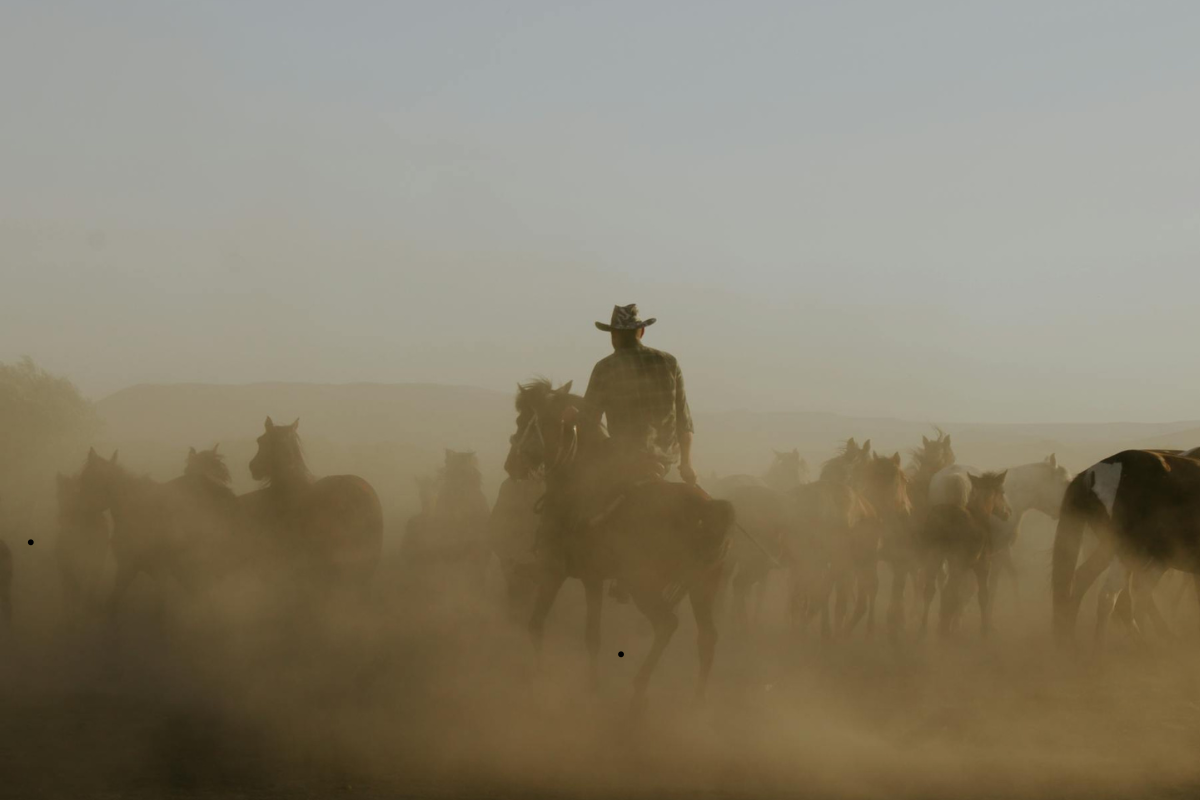
Walk into almost any American movie theater in the 1950s, and you would find a Western on the marquee. The best of them featured someone like John Wayne—upright, resolute, and propelled by a sense of duty that required sacrifice. These heroes entertained, certainly, but in our own era, the squeaky-clean Western protagonist has largely been overshadowed by the picaresque anti-hero of the Spaghetti Western: Clint Eastwood’s laconic gunslinger in The Good, the Bad, and the Ugly, the man who does the right thing usually by accident, and never without violence. That this figure endures—and even captivates—tells us something about how Americans imagine themselves.
I want to argue that Spaghetti Western heroes appeal because they give cinematic form to a distinctly American virtue: grit.
But what is grit? What is American about it? And what does it mean to speak, as Charles Portis does, of true grit—as though grit might come in both genuine and counterfeit forms?
For most people, the metaphor comes from manual labor: grit is abrasive, coarse, something like sandpaper that wears down whatever resists it. But grit is not simply toughness. It suggests endurance—the ability to follow through with a difficult task no matter the conditions or consequences. It is less a moral virtue in the classical sense than a practical one. It is not justice or moderation, but the stubborn refusal to yield.
The American imagination has long harbored two versions of grit. One is the vigilante’s grit: acting outside the law, unconcerned with moral purity, ready to shoot first and account for it later. The other is the settler’s or pioneer’s grit: perseverance, industriousness, and the conviction that hard things must be done by one’s own hand. To be sure, when left unwedded to some higher ideal, grit can collapse into unmeasured cruelty. But when guided by justice, it shines.
Few works capture the tension between these two forms of grit better than Portis’s True Grit. Donna Tartt, Pulitzer Prize-winning author of The Goldfinch, hails True Grit as a masterpiece, and she is right. Its brilliance lies in showing that grit is not exclusive to the grizzled lawman; it can emerge just as forcefully in a fourteen-year-old girl.
This is precisely the plot of True Grit. The novel follows fourteen-year-old Mattie Ross of Yell County, Arkansas, who journeys into the Indian Territory to capture and kill her father’s murderer, a man who went by the name of Tom Chaney. She looks into hiring a Marshall to follow Chaney into the Indian Territory and bring him back to Arkansas to be hanged. Upon hearing that, among the available Marshalls, “the meanest is Rooster Cogburn,” she asks, without hesitating, “where can I find this Rooster?” After initially resisting her request, Rooster agrees to pursue Chaney for a payment of $50. A few days later, Mattie, Marshall Cogburn, and a Texas Ranger named LaBoeuf (pronounced “LaBeef”) —who pursues Chaney for a bounty from murdering a Texas State Senator—set off for the Indian Territory to hunt Chaney, who became affiliated with the gang of notorious outlaw “Lucky” Ned Pepper.
It is worth meditating on the substance of grit as Mattie understands it. She believes she is hiring Rooster because he is a man of “true grit,” though no one but she ever describes him this way. The officer she consults merely notes Rooster’s willingness to kill the men he pursues. Rooster himself admits on the witness stand to killing twenty-one people in three years. Why, then, does Mattie interpret his ruthlessness as grit?
For Mattie, grit means follow-through. It is the ability to do one’s job—however brutal—without flinching. Rooster’s violence is not admirable to her in itself, but it is evidence that he will persevere. Even this God-fearing young Presbyterian, no friend of vice, concludes that moral squeamishness is not a prerequisite for justice. Her father has been murdered. Justice requires the murderer be caught and hanged. Nothing more, nothing less. This is an Old Testament conception of justice, not as mercy to one’s enemy, but as measure-for-measure.
Yet as the story unfolds, it becomes clear that Mattie possesses more grit than the man she hires. Despite Rooster’s attempts to leave her behind, she follows him into dangerous, unfamiliar terrain. She eats little, sleeps less, and refuses every opportunity to give up. Unlike Rooster, who is motivated by money, Mattie is animated by a righteous sense of duty. Her upbringing has made her the opposite of Rooster: law-abiding, methodical, stubbornly principled. And yet she, not Rooster, ultimately kills Chaney with her father’s own rifle.
This tension—between the lawless grit of Rooster and the principled grit of Mattie—captures something fundamental about the American character as imagined in our national mythology. If America is shaped by the dispositions of those who came before, Mattie embodies the perseverance of early American settlers and frontier families, the relentless Protestant insistence that injustice must be confronted directly, that one must not shrink from doing hard things oneself. Her world is set fifty years after Tocqueville’s travels, yet she would not look out of place in his account of the determined, self-reliant Americans of Jacksonian America.
The Western endures because it dramatizes this dual nature of American grit. Sometimes it manifests as admirable perseverance, sometimes as dangerous vigilante hardness. But it is unmistakably American in its insistence that adversity is not an excuse to retreat.
Whether grit is always good is another matter. As a civic virtue, grit can harden into self-righteousness, contempt for law, or an inability to compromise. But understood properly—as steadfastness, endurance, and the willingness to see difficult tasks through—it remains a deeply valuable quality, especially in a society that increasingly rewards outrage more than resolve, performance more than perseverance.
If the American literary tradition teaches anything, it is that difficulty is the test of character, not the excuse to avoid it. In that sense, Americans today could do worse than to recover a measure of true grit—not the grit of Rooster’s trigger-happy violence, but the grit of Mattie’s unwavering sense of justice, manifest in her refusal to look away from hard responsibilities, no matter how tough the road ahead.