Common Sense
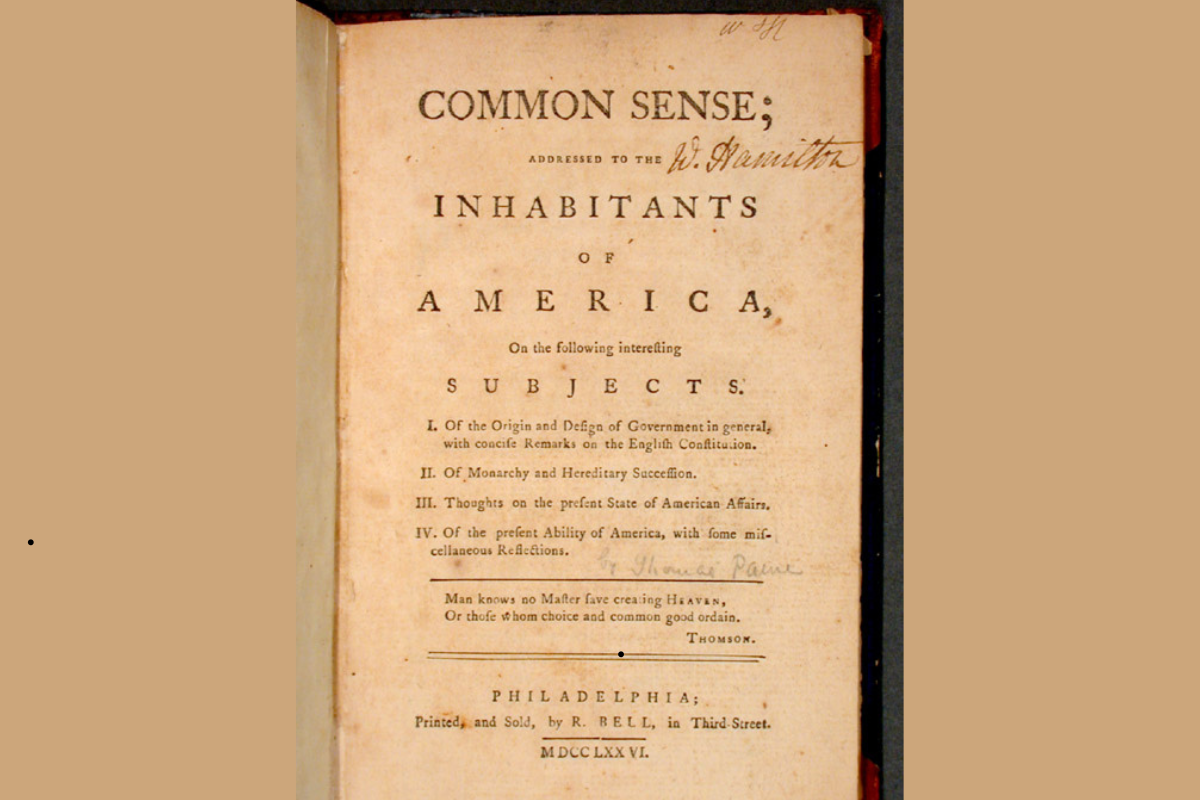
On January 10th, 1776, Thomas Paine published his pamphlet Common Sense. For those who think that ideas don’t have consequences, Common Sense is bracing tonic. Paine wrote as the clash between colonists and the British army intensified. He not only explained the necessity for separation, but also laid out a vision for colonial self-government. Another important aspect of the pamphlet was Paine’s effort to demonstrate that the war against British tyranny had the effect of, in some sense, creating a new species of person: The American, united by opposition.
We present below some key excerpts from Common Sense. Astute readers will notice the continued relevance of his words.
Some writers have so confounded society with government, as to leave little or no distinction between them; whereas they are not only different, but have different origins. Society is produced by our wants, and government by our wickedness; the former promotes our happiness possitively by uniting our affections, the latter negatively by restraining our vices. The one encourages intercourse, the other creates distinctions. The first is a patron, the last a punisher. …
were the impulses of conscience clear, uniform and irresistibly obeyed, man would need no other law-giver; but that not being the case, he finds it necessary to surrender up a part of his property to furnish means for the protection of the rest; and this he is induced to do by the same prudence which in every other case advises him, out of two evils to choose the least. Wherefore, security being the true design and end of government, it unanswerably follows that whatever form thereof appears most likely to ensure it to us, with the least expence and greatest benefit, is preferable to all others. …
Here then is the origin and rise of government; namely, a mode rendered necessary by the inability of moral virtue to govern the world; here too is the design and end of government, viz. Freedom and security. And however our eyes may be dazzled with show, or our ears deceived by sound; however prejudice may warp our wills, or interest darken our understanding, the simple voice of nature and reason will say, ‘tis right. …
Secondly, as no man at first could possess any other public honors than were bestowed upon him, so the givers of those honors could have no power to give away the right of posterity, and though they might say “We choose you for our head,” they could not without manifest injustice to their children say “that your children and your children’s children shall reign over ours forever.” Because such an unwise, unjust, unnatural compact might (perhaps) in the next succession put them under the government of a rogue or a fool. Most wise men in their private sentiments have ever treated hereditary right with contempt; yet it is one of those evils which when once established is not easily removed: many submit from fear, others from superstition, and the more powerful part shares with the king the plunder of the rest. …
The Sun never shined on a cause of greater worth. ‘Tis not the affair of a City, a County, a Province, or a Kingdom; but of a Continent—of at least one eighth part of the habitable Globe. ‘Tis not the concern of a day, a year, or an age; posterity are virtually involved in the contest, and will be more or less affected even to the end of time, by the proceedings now. Now is the seed-time of Continental union, faith and honour. The least fracture now will be like a name engraved with the point of a pin on the tender rind of a young oak; the wound would enlarge with the tree, and posterity read it in full grown characters. …
Every thing that is right or reasonable pleads for separation. The blood of the slain, the weeping voice of nature cries, ‘TIS TIME TO PART. Even the distance at which the Almighty hath placed England and America is a strong and natural proof that the authority of the one over the other, was never the design of Heaven. The time likewise at which the Continent was discovered, adds weight to the argument, and the manner in which it was peopled, encreases the force of it. …
‘Tis repugnant to reason, to the universal order of things, to all examples from former ages, to suppose that this Continent can long remain subject to any external power. The most sanguine in Britain doth not think so. The utmost stretch of human wisdom cannot, at this time, compass a plan, short of separation, which can promise the continent even a year’s security. …
But where, say some, is the King of America? I’ll tell you, friend, he reigns above, and doth not make havoc of mankind like the Royal Brute of Great Britain. Yet that we may not appear to be defective even in earthly honours, let a day be solemnly set apart for proclaiming the Charter; let it be brought forth placed on the Divine Law, the Word of God; let a crown be placed thereon, by which the world may know, that so far as we approve of monarchy, that in America the law is king. For as in absolute governments the King is law, so in free countries the law ought to be king; and there ought to be no other. But lest any ill use should afterwards arise, let the Crown at the conclusion of the ceremony be demolished, and scattered among the people whose right it is.
A government of our own is our natural right…
I have heretofore likewise mentioned the necessity of a large and equal representation; and there is no political matter which more deserves our attention. A small number of electors, or a small number of representatives, are equally dangerous. But if the number of the representatives be not only small, but unequal, the danger is encreased. As an instance of this, I mention the following; when the petition of the associators was before the House of Assembly of Pennsylvania, twenty-eight members only were present; all the Bucks county members, being eight, voted against it, and had seven of the Chester members done the same, this whole province had been governed by two counties only; and this danger it is always exposed to. The unwarrantable stretch likewise, which that house made in their last sitting, to gain an undue authority over the Delegates of that Province, ought to warn the people at large, how they trust power out of their own hands. A set of instructions for their Delegates were put together, which in point of sense and business would have dishonoured a school-boy, and after being approved by a few, a very few, without doors, were carried into the house, and there passed in behalf of the whole Colony; whereas, did the whole colony know with what ill will that house had entered on some necessary public measures, they would not hesitate a moment to think them unworthy of such a trust. …
In support of the first, I could, if I judged it proper, produce the opinion of some of the ablest and most experienced men on this continent: and whose sentiments on that head, are not yet publicly known. It is in reality a self-evident position: for no nation in a state of foreign dependance, limited in its commerce, and cramped and fettered in its legislative powers, can ever arrive at any material eminence. America doth not yet know what opulence is; and although the progress which she hath made stands unparalleled in the history of other nations, it is but childhood compared with what she would be capable of arriving at, had she, as she ought to have, the legislative powers in her own hands. England is at this time proudly coveting what would do her no good were she to accomplish it; and the continent hesitating on a matter which will be her final ruin if neglected. It is the commerce and not the conquest of America by which England is to be benefited, and that would in a great measure continue, were the countries as independant of each other as France and Spain; because in many articles neither can go to a better market. But it is the independance of this country of Britain, or any other, which is now the main and only object worthy of contention, and which, like all other truths discovered by necessity, will appear clear and stronger every day. …
Our present condition is, Legislation without law; wisdom without a plan; a constitution without a name; and, what is strangely astonishing, perfect independance contending for dependance. The instance is without a precedent, the case never existed before, and who can tell what may be the event? The property of no man is secure in the present unbraced system of things. The mind of the multitude is left at random, and seeing no fixed object before them, they pursue such as fancy or opinion presents. Nothing is criminal; there is no such thing as treason; wherefore, every one thinks himself at liberty to act as he pleases. …
On these grounds I rest the matter. And as no offer hath yet been made to refute the doctrine contained in the former editions of this pamphlet, it is a negative proof, that either the doctrine cannot be refuted, or, that the party in favor of it are too numerous to be opposed. WHEREFORE, instead of gazing at each other with suspicious or doubtful curiosity, let each of us hold out to his neighbor the hearty hand of friendship, and unite in drawing a line, which, like an act of oblivion, shall bury in forgetfulness every former dissention. Let the names of Whig and Tory be extinct; and let none other be heard among us, than those of a good citizen; an open and resolute friend; and a virtuous supporter of the RIGHTS of MANKIND, and of the FREE AND INDEPENDANT STATES OF AMERICA.

Director of the Ford Leadership Forum, Gerald R. Ford Presidential Foundation
Related Essays