The Virtue Ethics of Martin Luther King Jr.
Typically, we think of our politics as locked in perennial struggle between the forces of left and right, roughly liberalism and conservatism, flanked you might say by progressivism and libertarianism. These categories have been scrambled and swelled in recent years, with the strengthening of a social justice progressivism on the left that overlaps with but is distinct from, let us say, the rising democratic socialism of Bernie Sanders and Zohran Mamdani. But that populism is itself part of a broader bipartisan phenomenon of modern politics, one that has seen the rise of Donald Trump on the right, and that sits alongside a resurgent ideology of nationalism that expresses itself in religious and sometimes even racial terms. Truly we live in an age of ideological proliferation. But dig down to a level deeper and you will find that, overwhelmingly, our battle royale of political worldviews masks a more fundamental struggle between utilitarianism and dogma in our political thinking. Nearly all of our political discourse, whether from the right or from the left, tends to express itself in these terms. Yet in this 250th year of our national experiment, some of us have realized that salvation for our rocky republic rests not along the paths of clever consequentialism or dogmatic programs for national renewal. It is in virtue that we find the road towards a flourishing national tomorrow—and in the corpus of American virtue ethics, there is none whose contributions stand greater than that of the Reverend Martin Luther King Jr.
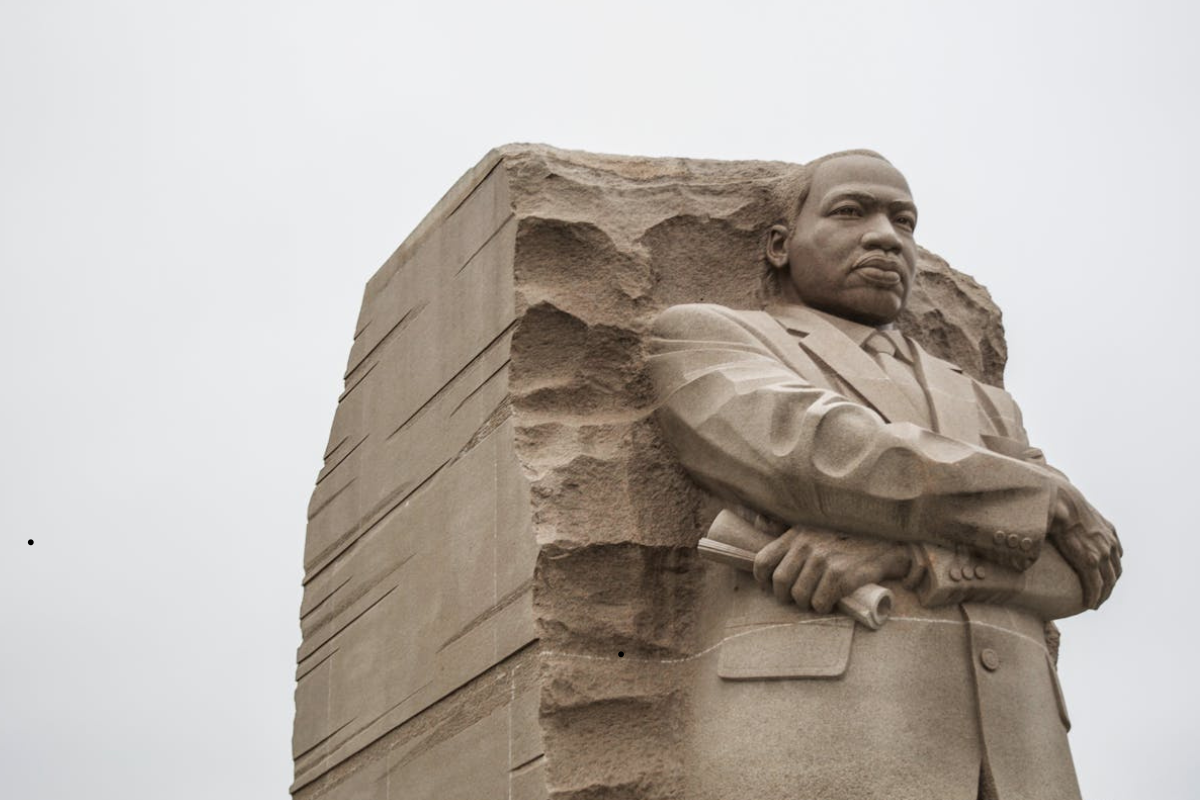
The Reverend/Dr. King is a well-remembered figure in our history. That is putting it mildly of course; though controversial in his own time (and not without fierce critics even today) he is the only ordinary American citizen in our history ever to be granted a national holiday. His monument stands tall in Washington D.C., immortalized as a peer of Lincoln, Washington and Jefferson in the vaults of historical memory. Yet the sad and plain truth is that the philosophy of Dr. King, the philosophy that made the Civil Rights Movement a moral force in the land, is far less remembered than the man himself. In fact, the systematic philosophical worldview of Dr. King is rarely acknowledged as such, and seldom do those who speak in his name seek to emphasize the substance of his teachings beyond the cherry-picked phrases that serve whatever political program actors left, right, and center may be seeking to appropriate King for at the time.
Martin Luther King Jr. was our nation’s greatest proponent of philosophical nonviolence. Though he was a man of liberal political opinions and a conservative cultural upbringing, the philosophy of nonviolence transcends ideological categories insofar as it is neither dogmatic nor utilitarian; that is to say, it is neither a creed of static beliefs that can be measured by a litmus test nor a mode of calculation whereby progress can be measured by mere wealth redistribution or the annual GDP. The philosophy of nonviolence is a philosophy of virtue, seeking the good of society and the individual in terms that can only be measured according to the cultivated capacity of the human heart and soul.
What do I mean by that? Virtue ethics in general root us in an approach to right and wrong that is not about being ideologically correct or possessing correct belief per se, but that rather anchors us in a way of being. Virtue ethics lie at the deeper roots of the moral history of western civilization, a heritage the reverend King revered. Plato and Aristotle spoke of wisdom, the “golden mean” whereby vice might be identified as the extreme or deficiency of any quality or character (too much courage was foolhardiness, too little cowardice, but courage itself is the balance in between). Jesus himself and the apostle Paul spoke of the “treasure of the heart” and the “fruits of the spirit” among them “love, joy, peace, kindness, gentleness, long-suffering, and self-control”. These are inward realities of the human spirit that produce good acts through good character, not through mere cleverness nor rigid dogmatism. They require us to do the work of conditioning ourselves (through practice and faith) to be the type of person who can serve our neighbors and stand in honesty and integrity in the face of trial, tragedy and temptation.
The principle virtue of Martin King’s philosophy of nonviolence was love: Namely, agape love. Dr. King was insistent that love in this vein was not a matter of sentimentality, not mere “emotional bosh,” but was rather an overarching goodwill towards one’s fellow man on the simple basis of his humanity and that allows us to speak to the conscience of those who may oppress us while liberating ourselves from the spiritual weights of contempt and fear. It allows us to withstand the evil forces of the world with the conviction that “unearned suffering is redemptive,” giving us power to ultimately call forth the best in our neighbors by calling forth the best in ourselves.
“We do not seek to defeat or humiliate the opponent” King instructed his followers, “we do not seek to defeat or humiliate the white man,” but to win his friendship so that we may be reconciled to one another in what King called “the beloved community.” This was a vision of an American society transformed by agape love, a vision that reflected the light of “the kingdom of God.” What this meant in practice was that the means by which this nonviolent movement pursued social change had to be consistent with the vision of this change – which meant that the heart itself had to be consistent with the means.
This of course is not a matter of policy or even worldview per se but of virtue. Thus Dr. King praised the student demonstrators who led the sit-ins at segregated lunch counters across the south, explaining their cultivated virtue of love in this way:
“Sometimes you will read the literature of the student movement and see that, as they are getting ready for the sit-in or stand-in, they will read something like this, ‘If you are hit do not hit back, if you are cursed do not curse back.’ This is the whole idea, that the individual who is engaged in a nonviolent struggle must never inflict injury upon another. Now this has an external aspect and it has an internal one. From the external point of view it means that the individuals involved must avoid external physical violence. So they don’t have guns, they don’t retaliate with physical violence…But it also means that they avoid internal violence of the spirit. This is why the love ethic stands so high in the student movement.”
In the years that followed the nonviolent movement there have been those in the community of social justice who have argued that nonviolence was merely a tactic for activism, to be used for its utility and nothing more. King’s words above show the error of this understanding, because nonviolence was as much about eschewing the “internal violence of the spirit” as it was about nonviolent tactics of protest. That requires an internal orientation toward virtue. It is what King meant when he said “Our goal is to create a beloved community and this will require a qualitative change in our souls as well as a quantitative change in our lives.”
Agape love is a virtue that, within itself, suggests the virtues of courage, kindness, humility and wisdom—all elements of which our republic stands in great need. All of which transcend the tribal lines of political party and ideology. Sound law is necessary, but insufficient. It is for this reason that America’s first great conservative, President John Adams, said “Our constitution was made only for a moral and religious people. It is wholly inadequate to the government of any other.”
But there can be no morality or religion worth the name that is not ultimately grounded in a conception of virtue. Let us remember this as we reflect upon 250 years of American history, and as we honor the legacy of Reverend Martin Luther King.