NLRB v. Jones & Laughlin Steel (1937)
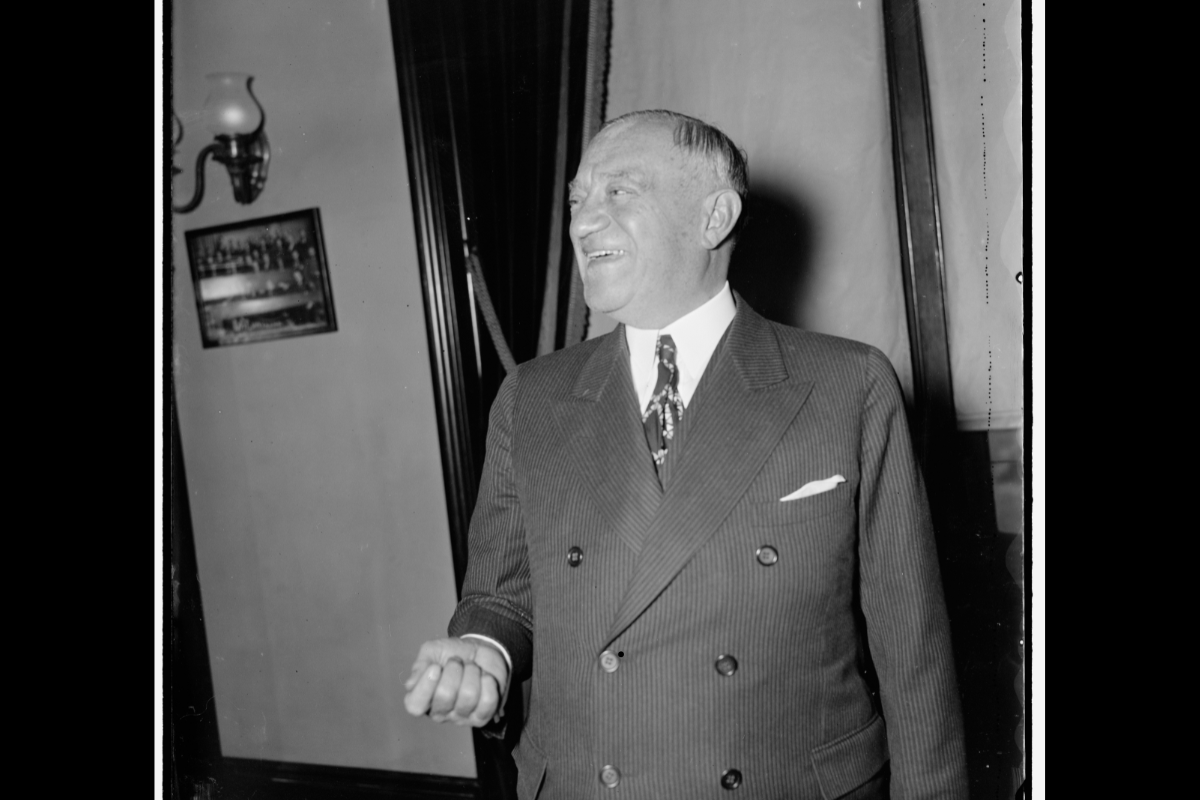
Author of Wagner Labor Relations Act happy over Supreme Court decision. Washington, D.C., April 12. Senator Robert F. Wagner of New York, author of the Wagner Labor Relations Act, was all smiles today as he heard the Supreme Court uphold the validity of the act. Hailed a great victory for the government, the Supreme Court unanimously upheld the act in cases of the Jones and Laughlin Steel Corp., and the Washington, Virginia and Maryland Coach Co., 4/12/1937
The Expansion of Commerce Power and the Rise of the Administrative State
It was apparent in the early years of the Constitution that its enumerated powers were open to interpretation. Under the Commerce Clause, Congress had the power to regulate commerce between the states, with foreign nation, and with Indian tribes. The power to regulate commerce within a state was reserved to the states and guaranteed by the Tenth Amendment. This constitutional distinction would appear, on its surface, to be rather clearcut. Yet, like alcohol, sex, and money, power and the seeming necessity of circumstance make human beings deviate from deeply embedded conventions.
If ever there was an example of a malleable constitutional clause, the Commerce Clause is it. In Gibbons v. Ogden (1824) the Court read the Commerce Clause in a way that expanded congressional power. Navigation, the Court ruled, was an aspect of commerce and, thus, subject to congressional regulation. Yet Gibbons v. Ogden did not engender an era of federal control and management of the economy. The case was not a paradigm shift. The most expansive and sustained expansion of commerce power came more than a century later during the Great Depression. After the Court’s rulings in Schechter Poultry Company v. U.S. (1935) and U.S. v. Butler (1936) that struck down key parts of the New Deal, FDR remade the Supreme Court by appointing nine new Justices to the Court in eight years. He appointed a majority of the Court in just over two years. FDR’s Justices served a combined 146 years on the Supreme Court, more years than the Justices of any other President. More than their years on the bench, what is noteworthy about FDR’s Justices is how they transformed Commerce Clause case law. The paradigm shift came with FDR’s victory in NLRB v. Jones & Laughlin Steel (1937), and it came before he made even one appointment to the Supreme Court. He tipped the balance of the Court using populist pressure and threatening to pack it.
NLRB v. Jones & Laughlin Steel marks the transition from the old to the new Commerce Clause case law. It was a revolution in constitutional law as significant as the Court’s acceptance of the doctrine of incorporation. While the Court was often skeptical of the constitutionality of FDR’s New Deal legislation before 1937, it did not strike down a piece of New Deal legislation after it. In fact, the Supreme Court did not strike down federal legislation based on the Commerce Clause for 58 years after NLRB v. Jones & Laughlin Steel. When it did overturn the Gun-Free School Zones Act of 1990 in U.S. v. Lopez (1995), it refused to overturn any of the Court’s Commerce Clause decisions dating back to 1937. Along with West Coast Hotel v. Parrish (1937), NLRB v. Jones & Laughlin Steel ushered in a new era of Commerce Clause case law.
The Legal Issues in NLRB v. Jones & Laughlin Steel
The primary issue in NLRB v. Jones & Laughlin Steel was the constitutionality of the National Labor Relations Act (Wagner Act). The purpose of the law was to promote fair labor practices, collective bargaining, and the rights of workers. The law created the National Labor Relations Board to enforce its provisions. The NLRB was the government agency that acted against Jones & Laughlin Steel for violating workers’ rights to organize. The law replaced the National Industrial Recovery Act that was declared unconstitutional 9-0 in Schechter v. U.S. just two years before NLRB v. Jones & Laughlin Steel came to the Court. The Court had to decide if labor practices fell into the domain of Congress’s Commerce Clause power. Jones & Laughlin Steel was in violation of the Wagner Act when it fired workers for collaborating with unions and discouraged workers from joining unions.
The Jones & Laughlin Steel Company argued that management-labor relations were neither commerce nor did they did involve interstate commerce. In their briefs, attorneys for Jones & Laughlin Steel described the company’s business as manufacturing not commerce. They classified the National Labor Relations Act as “a labor statute.” Consequently, the law was unconstitutional because it empowered Congress to regulate non-commercial activity. In their view, the law was part of an attempt to “remodel” the Americal political system for the sake of expediency. The Constitution gives states, not the federal government, the power to regulate labor relations. The NLRB, however, argued that Congress can regulate not only commerce, but activities that affect commerce, activities that are part of the “stream of commerce.” The Jones & Laughlin Steel attorneys responded that management-labor relations at a plant in Aliquippa, Pennsylvania are a local matter. That they may have an indirect effect on interstate commerce is true, but beside the point. If Congress can regulate everything that indirectly affects interstate commerce, then there is little it cannot regulate, and the distinction between interstate and intrastate commerce is lost. In Carter v. Carter Coal Company (1936), the Court rejected the argument being made by the NLRB when it struck down a federal labor law, the Bituminous Coal Conservation Act. In Carter, the Court stated that production is not commerce. Moreover, it specifically rejected the argument that hiring, firing, wages, and working hours are part of commerce and not manufacturing. Congress can regulate the former but not the latter.
Attorneys for NLRB knew that to win the case they would have to convince a majority of the Justices that the Commerce Clause empowers Congress to regulate more than what existing case law permitted. A more expansive definition of commerce was needed. The NLRB attorneys suggested that the National Labor Relations Act allows Congress to regulate “activities which occur under circumstances closely related to a flow of commerce, and which directly affect that flow.” Schechter and Carter are different than NLRB v. Jones & Laughlin Steel. In Carter, the flow of commerce had not begun; in Schechter it had stopped. What Congress regulated at the Jones & Laughlin Steel plant was midstream in the flow of commerce and, thus, essential to its continuation.
The Court’s Ruling in NLRB v. Jones & Laughlin Steel
The Court ruled 5-4 for the NLRB. The majority opinion was written by Chief Justice Charles Evans Hughes. Along with Justice Owen Roberts, Hughes was the switch in time that saved nine. The pivotal issue in the case was the status of manufacturing. Is it commerce? The Court argued that manufacturing was commerce and that labor disputes affect interstate commerce because they have a close and intimate relationship to it; they affect the flow of interstate commerce because they can obstruct it. Labor disputes are not categorically excluded from congressional regulation. If they affect the flow of commerce, they can be regulated by Congress. The standard for determining what Congress can regulate under the Commerce Clause is determined by “the effect upon commerce” not “the source of the injury.” Hughes agreed with the NLRB attorneys that Schechter and Carter were not controlling.
Chief Justice Hughes devoted the first part of his opinion to illustrating the extensive national and international reach of the Jones & Laughlin Steel operation. The company was national, if not international, in scope with facilities in several states. It gathered raw materials from several states, and it sold steel in and outside of its Pennsylvania plant. He framed the case as one of interstate commerce and not the Tenth Amendment. Manufacturing is commerce because it is part of the flow of commerce. What Congress regulates under the Commerce Clause does not have to be commerce to be regulated. It has to be part of the flow of commerce and have a significant effect on it.
The workers who were fired by Jones & Laughlin Steel for organizing were exercising a legitimate right. Congress has the authority to protect the rights of workers. Moreover, workers’ right to organize cannot be viewed in isolation of the larger commercial endeavor of the company. Even activities that are intrastate in nature can be regulated by Congress if they are related substantially to interstate commerce.
Justice McReynolds’ Dissent
Justice McReynolds dissented. He noted that the majority’s opinion diverged from the Court’s Schechter and Carter case law. The implications of the ruling are striking. Justice McReynolds suggests that based on the Court’s ruling Congress can regulate “almost anything,” including “marriage, birth, death.” He argued that Congress can regulate activities that are “direct and material” not things that may have a hypothetical effect on interstate commerce.
NLRB v. Jones & Laughlin Steel Legacy
The Supreme Court’s dramatic shift from Schechter and Cater to NLRB v. Jones & Laughlin Steel is a reminder of why judicial appointments matter. FDR understood their significance as well as anyone. He used populist pressure to encourage the Justices to switch their interpretation of the Constitution even before he made his first appointment to the Supreme Court. It seemed to work with Justice Roberts and Chief Justice Hughes. Congress helped FDR’s efforts by passing a retirement bill that granted full pay and benefits to Justices who retired with at least ten years of service and who were over 70 years of age. Justice Van Devanter and Justice Sutherland, two of the four horsemen retired shortly after the law went into effect. A third Justice in that group, Pierce Butler, died in 1939 leaving Justice McReynolds, the last of the four horsemen, ideologically isolated on the bench.
Historian Forrest McDonald would write about the Court’s ruling in NLRB v. Jones & Laughlin Steel that it “stretched the commerce clause beyond recognition.” Senator Robert Wagner and other progressives applauded the Court’s ruling and declared the end of the laissez-faire era. The stream-of-commerce doctrine would give way to even broader interpretations of the Commerce Clause. In Wickard v. Filburn (1942), FDR’s remade Court upheld a federal law that permitted Congress to regulate wheat production that was neither sold or commercially produced.

Professor of Political Science at Middle Tennessee State University
Related Essays