Ancient Thievery and Small-Minded Men
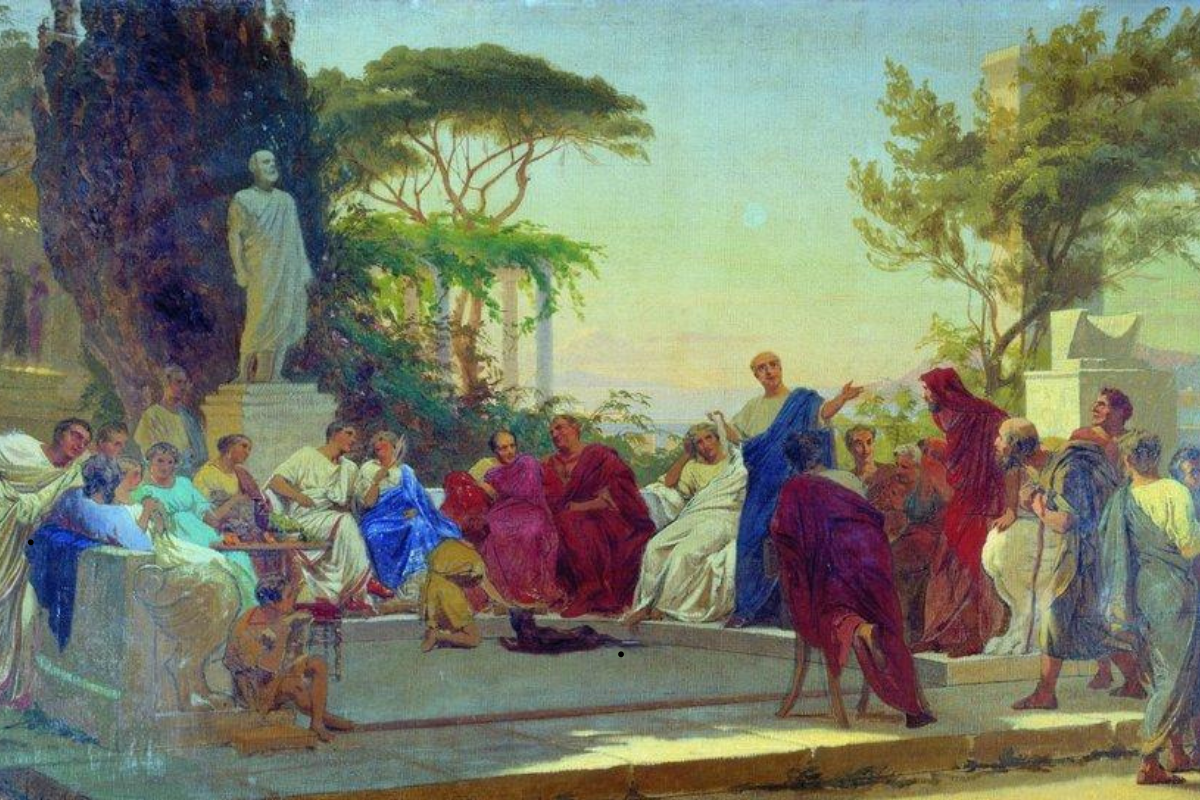
O imitatores, servum pecus![1]
O ye imitators, servile herd!
Imitation is normal. It’s how we learn—to speak, to write, to behave. It’s a beginning. But thievery is a different matter. And in the first century, theft was deeply personal to Quintus Horatius Flaccus.
The son of a slave, Horace was likely of mixed heritage, but he was privileged to be educated in Rome rather than in his native village with the sons of centurions. His father worked as an auction agent and owned his own farm, a rare feat for a former slave in the first century.
His education complete, Horace made the grand tour of his time with other wealthy young men by traveling to Athens. While visiting the Forum, however, his story quickly changed. Caesar’s assassin Brutus was passionately pleading with the crowd to join him in his battle for the empire. At age 20, Horace was enamored by those words, and with no military training, he joined in the first major battle at Philippi where Brutus’s forces were quickly overthrown. Horace was captured but not executed.
When he finally returned to Rome, he found that his father had died. What’s worse is that the family home, possessions, and land had all been given to an honorable war veteran, not a traitor like Horace. Penniless, Horace was angry but alive. He found a menial job in the treasury but remained furious at his own choices and at the loss of all his father had worked for. Thus began an almost vindictive hobby of writing critical verse. His early poetry was entertaining, and friends shared his negative verse with Maecenas, a nobleman and trusted advisor to the emperor Augustus.[2]
Horace was lucky. Within a year, Maecenas became Horace’s patron, offering him wealth and a rural estate outside of Rome. Thriving as a writer of both critical and noble verse, Horace had arrived. He quickly won the Emperor’s attention, yet Horace was never constrained by a desire to please those in power. A handful of odes and sermones (pithy moral lessons) make that clear. And with his popularity and position came the imitators and thieves.
In Epistle 3 to Florus, Horace attacks Celsus:
“What is my Celsus doing? He has been advised, and the advice is still often to be repeated, to acquire stock of his own, and forbear to touch whatever writings the Palatine Apollo has received: lest, if it chance that the flock of birds should some time or other come to demand their feathers, he, like the daw stripped of his stolen colors, be exposed to ridicule.”[3]
Celsus had been warned to stop stealing from the wordstock of others more than once. He is compared to a temple robber, yet Horace leaves him with a light warning. He doesn’t waste time telling us what type of imitation he found or read because he is likely more concerned with imitation as an ethical issue, a common topic at the time.
In ancient Greece and Rome, MacLeod writes that “The poet's craft is a way of life with its virtues and vices; so the failure of the imitators is a moral as much as an aesthetic failure.”[4] Poor imitation may not be theft, but it’s a moral failure nonetheless. Horace sees imitators as superficial, not as true thieves or plagiarists.
MacLeod and other scholars are convinced that when we survey all of Horace’s work, it is clear that “he [Horace] is concerned with their behaviour, or with the practice of literature as a way of life.”[5] Emulation should be an imitation of virtue, not the “imitating” men Aristotle refers to who are puffed up in pride. These men are “small-minded,” vain. Aristotle calls them foolish and self-ignorant, “and that palpably: because they attempt honourable things, as though they were worthy, and then they are detected.”[6]
I’m convinced that this is Horace’s way of thinking, too. He is not angry at an injustice but rather dismissive, disappointed in those who have shown themselves to be superficial. Aristotle describes this well. He speaks of imitators as those who mimic the great-minded “without doing the actions which can only flow from real goodness.” Such men despise the great-minded men they imitate.[7] The small-minded man is mistaken and does not recognize the good in himself, thus harming himself:
“ . . . in fact from self-ignorance: because, but for this, he would have grasped after what he really is entitled to, and that is good. Still such characters are not thought to be foolish, but rather laggards. But the having such an opinion of themselves seems to have a deteriorating effect on the character: because in all cases men's aims are regulated by their supposed desert, and thus these men, under a notion of their own want of desert, stand aloof from honourable actions and courses, and similarly from external goods.”[8]
And maybe this is why Horace seems hardly bothered by his imitators. Imitation is a starting place for learners and beginners as they learn skill and craft. If they do not move past imitation, but instead rely on it, they have distinguished themselves in a different way, separating themselves from the potential of good. That is why Horace can lightheartedly say, “O ye imitators, ye servile herd, how often your bustlings have stirred my bile, how often my mirth!”
[1] Horace
[2] Sidney Alexander, “Introduction,” in The Complete Odes and Satires of Horace (Princeton University Press, 1999).
[3] Quintus Horatius Flaccus, The Works of Horace, trans. Christopher Smart (American Book Company, 1906).
[4] C. W. MacLeod, “The Poet, The Critic, and The Moralist: Horace, Epistles 1.19.” The Classical Quarterly 27, no. 2 (1977): 367. http://www.jstor.org/stable/638437.
[5] C. W. MacLeod, “The Poet, The Critic,” 366.
[6] Aristotle, Nicomachean Ethics, accessed January 27, 2026, https://www.online-literature.com/aristotle/ethics/4/. 1125a.
[7] Aristotle, Nicomachean Ethics, 1124b
[8] Aristotle, Nicomachean Ethics, 1125a.

Christine has taught high school literature in public, private, and homeschool worlds for over 20 years.
Related Essays