An Unbroken Thread of Courage: From Bunche to Today
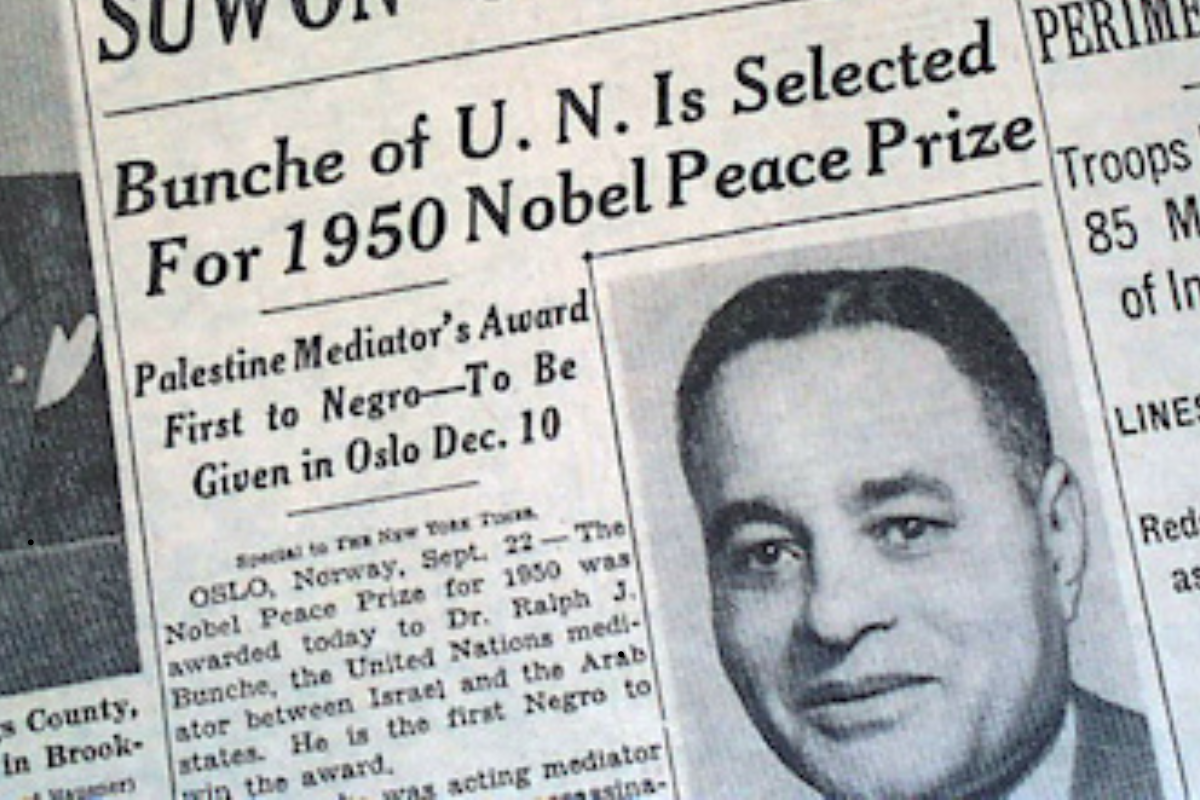
“All the world is saddened,” Congressman Gerald R. Ford wrote on December 9, 1971, “by the death of Dr. Ralph Bunche.” In 1950, Dr. Bunche was the first African American recipient of the Nobel Peace Prize.
In 1971, future President Ford called Dr. Bunche “a force for peace in the world.” Noting Bunche’s work at the United Nations, Ford said it was “symbolic for the thirst for peace that is experienced by all Americans.”
The Norwegian Nobel Committee awarded the Peace Prize to Dr. Bunche for his work as the lead U.N. mediator, whose efforts produced an armistice in the 1948 war between Israel and Palestine. When he won the prize, Dr. Bunche was the principal director in the United Nations Department of Trusteeship.
In an editorial, Michigan’s Lansing State Journal said Dr. Bunch “has been called the story of American democracy at its best.” Born in Detroit in 1904, Bunche, grandson of a Negro slave, was orphaned at 14 years old. He graduated with a BA from the University of California, Los Angeles. He obtained his MA from Howard University in Washington, D.C., and his Ph.D. in international relations from Harvard University.
In 1963, President John F. Kennedy awarded Bunche the Presidential Medal of Freedom. Also in 1963, an Albany, New York, high school student wrote an award-winning essay about Bunche.
In October 1963, the Albany (New York) Committee on the Observance of the 100th Anniversary of the Emancipation Proclamation announced that African American high school graduate Joyce Ford had won its essay contest. Miss Ford entered the contest in twelfth grade. The essay theme was “A Hundred Years’ Progress - America’s Challenge.”
Miss Ford’s essay, “I am Proud I am an American Negro,” examined African American history and progress, exemplified by the life of Dr. Bunche, named for his African-born grandfather, Ralph Johnson, who was enslaved in the United States. In her 1963 award-winning essay, Miss Ford wrote, “representing 100 years of progress from a slave grandfather [Dr. Bunche] climbed to a great height.” She wrote that Bunche’s family had risen “[f]rom slave quarters to a desk in the United States Department of State.”
“Ralph Bunche … understood the plight of his people and recognized the full challenge of the Emancipation Proclamation,” Ford wrote. She said Bunche represented “[h]umility, honesty and pure grit.” She concluded her essay writing: “Dr. Bunch‘s life is indeed an inspiration and a challenge, and I am proud and happy that I am a member of one of the finest races on earth; I pledge to do my best to bring honor to my country, and my people (as Dr. Bunche has done) all the days of my life.“
Joyce Ford’s powerful words resonated with me when I read them on a New York historical newspaper website. In 2021, I authored an op/ed, “Acts of Courage Amid Danger Inspiring Years Later,” for the Albany Times Union. I wrote about Dr. Bunche’s courageous decision to march with fellow Nobel Peace Prize recipient Dr. Martin Luther King, Jr., at Selma in March 1965. This was two years after Miss Ford’s essay. In my op/ed, I quoted Dr. Bunche: “Never be faint-hearted. Be resolute, but never bitter.”
In 1965, Bunche, then 61 years old and in poor health, demonstrated courage by coming to Alabama during a dangerous time. In Ford’s essay, she expressed admiration for his educational and diplomatic accomplishments. These achievements motivated Dr. Bunche to march in Selma.
After my op/ed’s publication, I received a priceless letter from Dr. William S. Pretzer, Ph.D., Senior Curator of History at the National Museum of African American History and Culture. Dr. Pretzer wrote that my work, “inspired by the 1963 essay by Joyce Ford, vividly illustrates the lasting impact of Dr. Bunche’s career. That career motivated both an African American high school graduate during the Civil Rights Movement and you, a White former U.S. diplomat nearly 60 years later. Dr. Bunche’s integrity and resilience (‘Never be faint-hearted. Be resolute, but never bitter.’) provide a powerful perspective for social activists.”
Based on his diplomatic experience, Bunch advised: “You can surmount the obstacles in your path if you are determined, courageous, and hard-working. Never be faint-hearted. Be resolute, but never bitter.” Perhaps those words inspired Joyce Ford’s essay in 1963 and Jerry Ford’s 1971 statement on Bunche’s death.
When Dr. Bunche died in 1971, President Nixon said of him: “America is deeply proud of this distinguished son and profoundly saddened by his death. America was strengthened by the inexhaustible measure of dedication and creative action that spanned his splendid career.”
U.N. Secretary General U Thant observed, “He was the most effective and best known of international civil servants, and his record of achievement as an individual member of the secretariat was unsurpassed.”
About Bunche’s passing, House Republican Leader Gerald R. Ford said, “The world mourns the passing of one of the most dedicated men ever to serve the cause of peace.”
America continues to face racial challenges. Dr. Bunche, who marched at Selma in 1965, believed these challenges could be overcome by being “resolute, but never bitter.”

James Patterson is a former U.S. diplomat, life member of the American Foreign Service Association.
Related Essays