Gerald Ford and Shirley Temple Black Calmed America
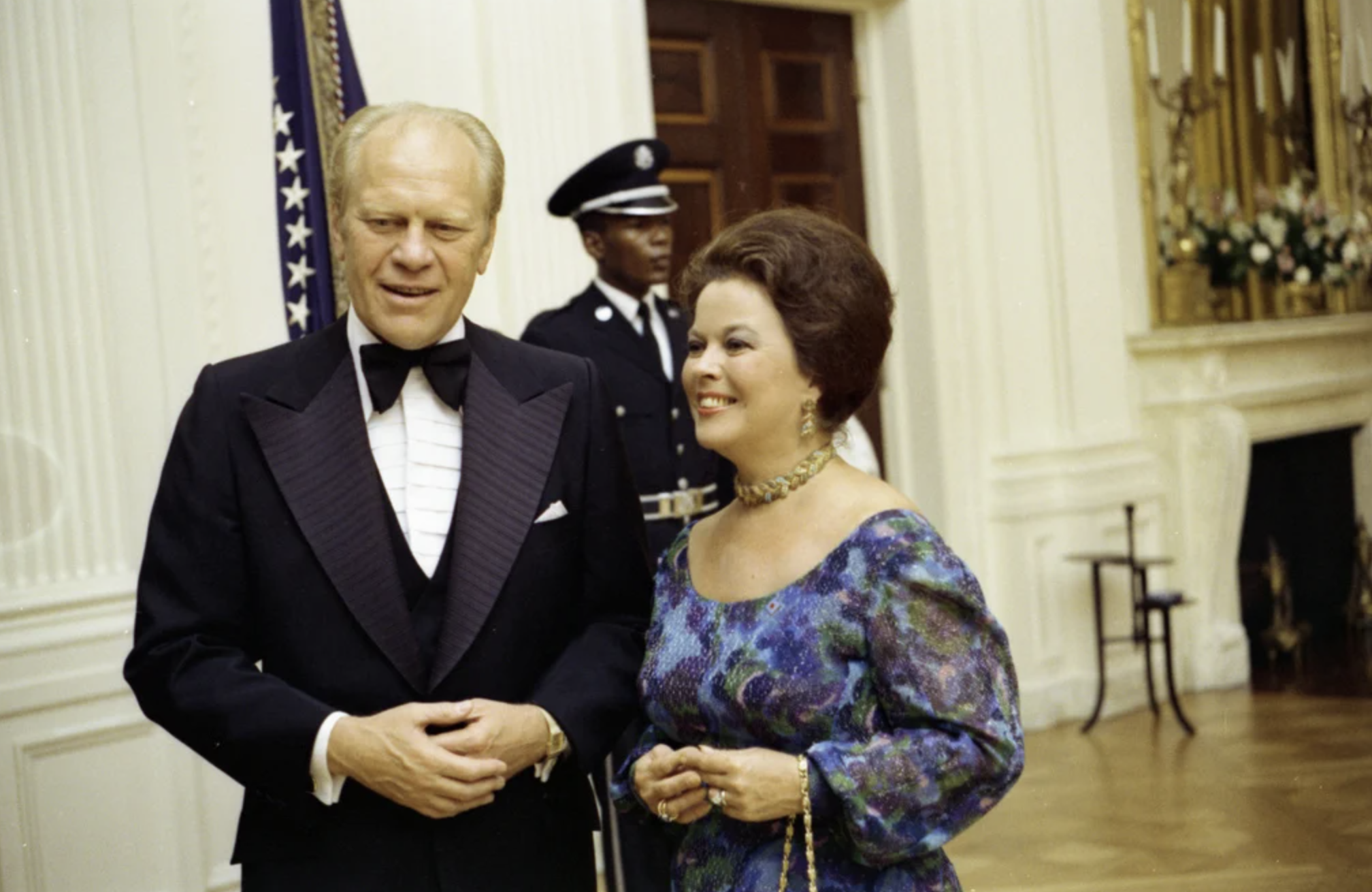
When President Ford appointed Shirley Temple Black, the former Hollywood child star, as U.S. Ambassador-designate to Ghana in 1974, a New York newspaper columnist smugly suggested that Ford’s appointment might have been influenced by the charming child star’s old movies. The columnist was clearly unaware of Temple Black’s impressive international credentials prior to Ford’s decision.
In 1969, President Nixon made Shirley Temple Black a U.S. Representative to the 24th General Assembly of the United Nations. Critics considered Temple Black a diplomatic lightweight. A U.N. observer, quoted in the Washington Post, said “[S]he proved them wrong. She took the job very seriously, did her homework, and really worked – and before long she was highly regarded by almost everybody there.”
“At the U.N., I made it sort of a personal crusade to learn all I could about developing countries,” Temple Black said. She took a keen interest in health and environmental issues. In 1973, she was appointed deputy chair of the United States delegation to the U.N. Conference on Health and Environment in Stockholm.
Temple Black said that during the 1930s, the height of her stardom, she had sat on the laps of world leaders. As an adult representing the U.S., she met with Yugoslavian President Josip Broz Tito, the Shah of Iran, First Secretary of the Communist Party of the Soviet Union Nikita Khrushchev, Saudi Arabia’s King Faisal, and Israeli Prime Minister Golda Meir. In one of her meetings with Egyptian President Anwar Sadat, he told her that her 1937 film “Heidi” was his favorite movie.
In 1974, Ghana was a hardship post for U.S. diplomats. “There is no country club life for an envoy in Accra,” Professor Robert Price, a Berkeley professor, said. Outside the U.S. Embassy in Accra, life was hard. When one went up country, Temple Black was told, there was no indoor plumbing.
Temple Black was ready for the challenges posed by the lack of plumbing and Ghana’s more serious issues, such as rampant inflation, a shortage of foreign investment capital, and a stagnant farm sector. She said she could live without indoor plumbing. She said she was not afraid of difficult diplomatic work. “I like to work long hours. I’ve been working since I was three years old,” she told the press.
U.S. Ambassador Shirley Temple Black was not without critics. Former U.S. Ambassador to Ghana Franklin Williams was not critical. Williams served in Ghana during the Johnson administration. Williams praised Ford’s decision. “Shirley Temple Black will prove to be a sensitive, warm, and capable ambassador,” Williams said.
Dr. David Apter, Yale University author of “Ghana in Transition,” said the post calls for a “career foreign service officer, or an experienced diplomat.” In a telegram to Secretary of State Henry Kissinger, Apter protested Temple Black’s appointment.
Williams, the former U.S. Ambassador to Ghana, again came to Temple Black’s defense. “Half the career foreign service people I’ve met were fine public servants, but the other half were horses asses. Being a career diplomat is not what’s important.” Williams predicted Temple Black would be a “smash.”
Temple Black served her country with distinction in Ghana. She later served in the U.S. Embassy in Czechoslovakia.
Shirley Temple was born in April 1928, one year before the U.S. stock market crash led to the Great Depression. She began making films in 1932. She is credited with getting America and the world through difficult economic times. It took ten years for the U.S. to recover from the Depression’s record-high unemployment and poverty, closed factories, and bank failures. In those ten years, Temple made 30 films.
In 1935, Temple received a special Academy Award for the most outstanding personality of 1934. “Little Miss Miracle” was the title given to her by President Franklin Delano Roosevelt. Temple was the biggest box-office attraction of the 1930s.
Shirley Temple starred opposite some of the biggest male stars in Hollywood, including Cary Grant, John Wayne, and Gary Cooper. Future President of the United States Ronald Reagan was Temple’s love interest in 1947’s “That Hagen Woman.” At the time, Reagan was 36; Temple was 19.
In 1950, Temple retired from films. She married businessman Charles Black. She entered public service in 1969.
In her 1988 autobiography “Child Star,” Temple Black said her role models were aviator Amelia Earhart and First Lady Eleanor Roosevelt. She admitted to having a major crush on FBI Director J. Edgar Hoover.
Why Hoover? At the height of her fame, the FBI investigated death threats against her.
In 1998, Shirley Temple Black received a Kennedy Center Honor. In 2005, the Screen Actors Guild presented her with a lifetime achievement award. She continued to contribute to diplomacy with non-profits.
Temple Black’s death in 2014 was international news. The Los Angeles Times headline: “Curly-haired girl sang and danced her way into Americans’ hearts amid the Great Depression.” The paper said: “Shirley Temple, perhaps more than any actor before or since, always was a symbol of national resolve during one of the darkest eras for the country, the Great Depression.” President Roosevelt marveled, the paper said, “that for just 15 cents, an American can go to a movie and look at the smiling face of a baby and forget his troubles.”
Shirley Temple calmed America, as the Los Angeles Times reported, “during one of the darkest eras for the country, the Great Depression.” Gerald Ford calmed and healed America after the equally dark period of Watergate.
It is likely that Ford, as a young man, saw Temple’s films in movie theaters. An armchair psychologist might offer analysis that Ford, like the Los Angeles Times, also saw Temple as “a symbol of national resolve in the crisis of 1930s.” America was lucky to have Shirley Temple at just the right moment in history.
Speaker of the House Tip O’Neill had a similar sentiment about Gerald Ford’s presidency. O’Neill’s words are inscribed on Ford’s statue in Grand Rapids. "God has been good to America, especially during difficult times.
At the time of the Civil War, he gave us Abraham Lincoln. And at the time of Watergate, he gave us Gerald Ford — the right man at the right time who was able to put our nation back together again."
Strong adults influence kids. Strong kids influence adults. “God has been good to America.”

Former U.S. diplomat, life member of the American Foreign Service Association, and worked for the President Ford Committee at the 1976 Republican National Convention in Kansas City.
Related Essays