Interesting Times
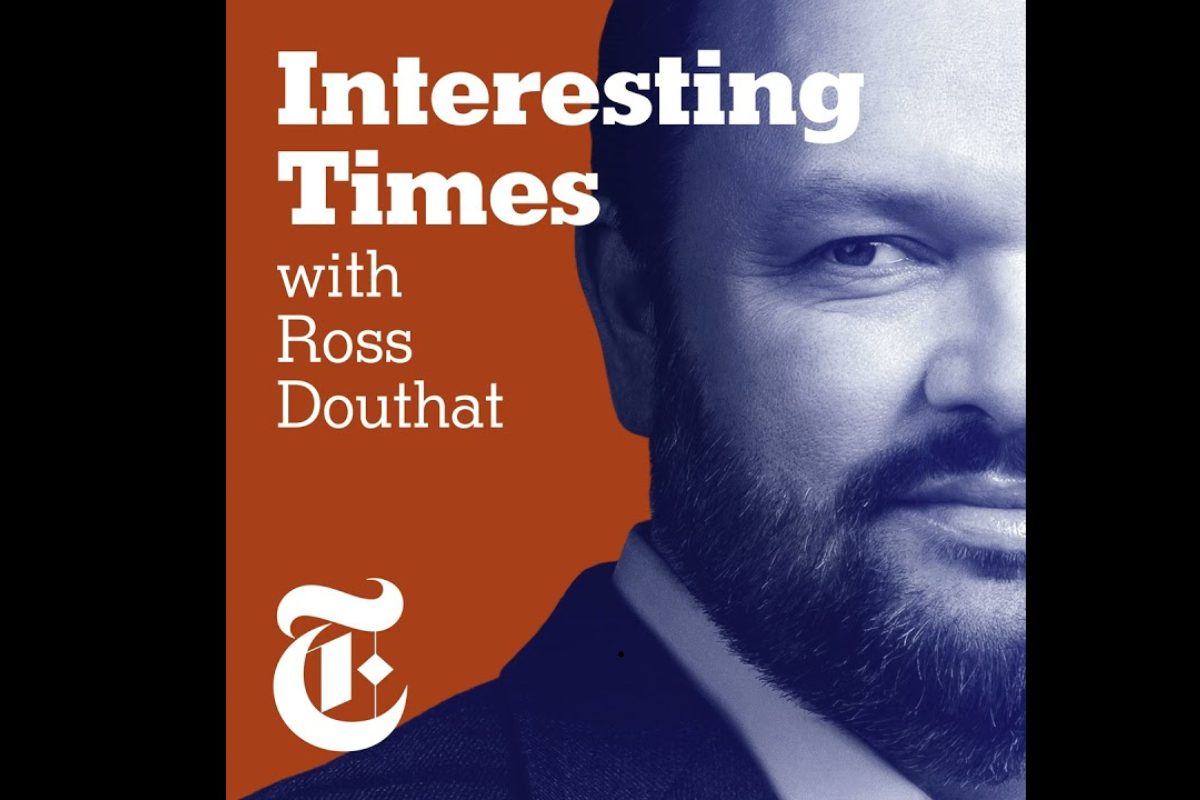
One of the best developments of the year 2025, I’m surprised to report, was the creation of yet another new video podcast.
Theoretically independent practitioners of social media, many of whom host podcasts, wield a great deal of power in our current moment. This seems related to the decline of old established media. (The Pittsburgh Post-Gazette is the most recent newspaper to announce impending closure, and the most prestigious.) It’s not hard to see how the media establishment’s suffocating consensus on Covid, race riots, and the last few elections led people to seek information from less formal sources. It’s nevertheless staggering to consider the extent of this shift. The outcome of the 2024 election has been ascribed, among other factors, to candidates’ facility (or lack thereof) with these new media platforms, as well as the endorsements of prominent podcasters. To the dismay of impatient, text-oriented people like me, the podcast appears to reign supreme.
However, it’s worth noting the difference between the traditional podcast (named after two obsolete technologies: the radio broadcast and the Ipod), which usually explores some niche interest episode at a time, and the personality-based formats that are especially prevalent right now. The idea of “streaming” and “streamers” is more up-to-date, better reflecting the context and practice of this medium, as currently experienced. Clips from a video podcast are encountered in the context of the algorithmic “feed” (and are designed to be consumed in this way); but the recording itself — the “stream” — is endless and formless, usually consisting of long unstructured conversation or monologue. Often, the streamer engages with commenters in real time, in the “chat” that appears on the side of the screen. The appeal of this medium is parasocial: one feels one is listening in to friends, and engaging with their camaraderie. The viewer is invested in these personalities, and follows their alliances with other shows and their subsequent “beefs”: a protean situation, given that the figures with whom the host shoots the breeze and goes down rabbit holes and chemtrails one day might be a suspected “fed” the next. If there is an air of unreality about all this — a sense of “kayfabe,” in the terminology of the wrestling world — it is not out of place with the fog of unreality that pervades our culture and politics.
If I don’t sound especially sanguine about the popularity and influence of video podcasts and influencers, it’s because I’m not. Perhaps it was inevitable that a personality-based model of communication would replace one based on institutions, after those institutions had spectacularly failed to perform their basic function and maintain an honest, non-partisan objectivity. However, just because someone can point out the emperor’s obvious lack of clothes, does not mean that he or she can be trusted any more than the emperor. The lack of trustworthy institutions is regrettable not least because their place is bound to be filled by self-interested agents and informational chaos.
The heart of what’s wrong with the “influencer” model of political discourse is that it does not see truth as a common good to be made clearly manifest to all; instead, truth is the domain of a select few, to be hinted at and then withdrawn, with the promise of fuller revelation to the most zealous followers of a given personality. The kind of special knowledge on offer is defined by particulars, rather than universals; it is conveyed through constantly updated video content, the real ephemerality of which belies its technical permanence. In this way it’s like the oral transmission of knowledge based on the evanescent medium of the human voice, except that it lacks the relational component of in-person pedagogy. It offers the illusion of personal relationship, but in reality, the influencers’ relationship to their audience is not one characterized by persuasion or personal understanding, but rather by suggestion, manipulation, and control. The good of the hearer is not the end, but rather the consumption of the content by as many people as possible. The message of influencers is determined by the economy of clicks, with no accountability to external standards of truth.
The media ecosystem I’ve described reminds me of nothing so much as Plato’s allegory of the cave from the Republic, in which Socrates likens people habituated to this world of becoming to the inhabitants of a dark cave, far from the light of the sun. The prisoners trapped in this cave mistake shadows cast onto the wall of the cave for real things, and even develop ways of studying these cave shadows, competing to guess which image will appear next, and so forth. Some manage to go up to the world lit by the sun, which represents the pure light of changeless Being. It is the responsibility of those who have made the difficult journey to the world above, whose eyes have become accustomed to the light of the sun, to go back into the shadows, and drag people up to the light. If the world of influencers is the cave in the analogy, someone has to re-enter it to interrogate its inhabitants and maybe expose them to the light of truth. I hope it’s not histrionic to say I think this is something like what Ross Douthat, the conservative columnist at the New York Times, does in his new podcast, Interesting Times.
Interesting Times, which debuted early in 2025, takes its name from the Chinese proverb: “may you live in interesting times” — famously ambiguous as to whether it is a curse or a blessing. In his introduction to the podcast, Douthat surveys the state of affairs marked by the second election of Donald Trump, the emergence from Covid lockdowns, the development of AI technology, the wars in Ukraine and Israel, and the strange bedfellows of the new MAGA coalition, among other phenomena indicating the “return of history,” and the end of sleepy neoliberal normalcy. Douthat claims that the “reactionary, radical, and simply weird are here to stay,” and therefore intends to use the podcast to interrogate these new perspectives, many of which originate on new media platforms, and which would otherwise continue to bounce around unquestioned like Lucretian atoms. The first guests on the podcast were various figures on the Right, with competing explanations of (and agendas for) the second Trump coalition: Steve Bannon, Oren Cass, Marc Andreesen, Christopher Rufo. But of course liberals have their own explanations for Trump and the times we live in, and are themselves undergoing their own “interesting times,” so the guest list has expanded as far leftward as the transgender activist Chase Strangio and the anti-Zionist streamer Hasan Piker, as well as Osita Nwanevu, the talented leftist writer who has eloquently argued for a new American constitution. Beyond Douthat’s stated reasons for hosting the podcast, perhaps it represents an attempt on the New York Times’s part to capitalize on a “vertical,” personality-based media model; perhaps it also represents a tacit admission that in the recent past many voices have been excluded by establishment media or been rigidly conscribed. It’s certainly hard to imagine a Times columnist five years ago joking with a cheerfully profane Steve Bannon about inviting him back “every week.”
In spite of the odd rapport that Douthat seemed to generate with Bannon, Interesting Times is generally not a place of excessive comfort or bonhomie for guests. Indeed, that’s one thing that separates it from the hours-long bull sessions that characterize other podcasts. Douthat just wants to hear his guests’ ideas and evaluate them, with a minimum of theatrics and extraneous chat. Interesting Times’s minimalist furnishings and neutral color palette contrast with Joe Rogan’s smoky red-curtained den, or Tucker Carlson’s sepia-toned hunting lodge, and suggest that like William F. Buckley’s Firing Line, this is a show for rational adults. Douthat does not pal around very much with guests, nor does he come across as hostile. There is no “kayfabe” element, in which beefs are hashed and reconcilements made. For better or worse, depending on the guest, there are only ideas and their consequences.
I think Douthat’s lack of overt friendliness is instructive. On podcasts like the ones mentioned above, saying things that are “edgy” or wildly improbable is a way of signalling friendship. It shows that you’re in on the joke: you know we’re not serious, you know what we really mean. Podcasts like these offer a private gnosis, and the audience is invited to feel themselves part of an inner ring. Douthat, on the other hand, hosts what is meant to be a public forum, and tries to disambiguate his guests’ ideologies when they seem obfuscatory. Although Interesting Times presents discourse that is more sophisticated than most outlets, it is the opposite of esoteric. This kind of space, free of shibboleths and in-jokes, seems necessary for the healthy functioning of democracy, like the ancient Greek agora. This is not to say that political friendship, with its back-room parrhesia, is necessarily a bad thing; but Douthat is a journalist, and if journalism becomes a matter of competing cliques, the political community loses an essential tether to reality.
Although Douthat is never overtly hostile towards his guests, even those whose ideas are totally repugnant to him, there are certainly tense moments on Interesting Times. Sometimes even a prosaic line of questioning can lead guests to make unforced errors and reveal unattractive aspects of their positions. For example, when Douthat questions the socialist streamer Hasan Piker about the idea of political violence, which Piker has been accused of inciting, Piker responds by equivocating on the term “violence.” Piker suggests that since the system is “inherently violent,” he believes in “redirecting that” violence. When Douthat impatiently presses his interlocutor on what he means by redirecting violence, Piker changes the referent of the term and starts talking about the “structural violence of poverty.” Later, Piker claims that certain right-wing policies, such as abortion bans and immigration enforcement, cause harm, and so violence is “already normal.” Throughout the conversation, Douthat seems to have a better grasp of Piker’s position than Piker himself, and gets Piker to expose its ultimate unseriousness.
As one can see in the Piker interview, Douthat is able to speak in multiple ideological registers, and is able to engage with a guest’s idiosyncratic ideas at a high level from a hypothetical distance. Certain guests might find it gratifying to speak with someone who actually understands them — but Douthat’s grasp of their difficult ideas can prove a double-edged sword. His interview with Peter Thiel illustrates this. Thiel, the tech founder and investor who funds most of the institutions of the new Trumpist right, discussed his idea that our period is one of cultural stagnation, especially when it comes to technology, and that this is due to a widespread fear of risk-taking and distrust of the heterodox genius. Thiel laments that nowadays “the Manhattan Project is unthinkable,” although earlier generations had hopes that science could radically improve the conditions of life, and early modern scientists even hoped to achieve immortality. Thiel, who espouses a sort of idiosyncratic theology derived from the work of Rene Girard, has come to identify this fear of technological innovation with the spirit of the Antichrist, who will promise “peace and safety.” The Antichrist, according to Thiel, will stoke fears of climate change, AI, or some other technological catastrophe, in order to establish one-world government. Near the end of the interview, Douthat challenges this idea by pointing out that the only way to get from stagnation to the Antichrist is a fearful “burst of technological progress,” where the Antichrist is “someone who promises to control technology, make it safer.” Having developed this idea, Douthat asks Thiel whether his own company’s development of data-collection and surveillance technologies may resemble, or at least bring about, the project of using technological power to keep the world safe from technological power. Thiel was clearly nonplussed by the question, and stammers defensively through the last five minutes of the interview. He needn’t have been nonplussed, however; anyone steeped in the Christian tradition could have told him that the project of seeking immortality through material scientific progress is in fundamental opposition to the Christian imperative to surrender one’s life so that it may be raised again with Christ. Thiel, however, is clearly not used to being challenged by Christian conservatives; he is not used to being asked to clarify the interesting but vague ideas on the apocalypse which he publishes with ease in the conservative magazines which he personally keeps afloat. Douthat’s platform at the liberal New York Times, with its independence from right-wing funding, gives him rhetorical space in which to keep conservatives accountable, by engaging their ideas at a much more rigorous level than could either a hostile journalist or a denizen of the conservative media ghetto.
The Thiel interview was tense by the end, but not because Douthat took a stance of outrage or hurled accusations in Thiel’s direction. Douthat first put Thiel at ease by fluently responding in kind to his indirect and suggestive style. His restraint made the uncomfortable questions at the end more effective: it’s hard to defend oneself against what an interlocutor has left unsaid. Douthat tends to adopt whatever tone will make his guests comfortable enough to say what they think. Because of this deft courtesy, guests are led to frank admissions they might not make elsewhere. In a very warm, friendly interview, the liberal Jesuit priest Fr. James Martin explains the byzantine process of transcription, telefacsimile, and translation by which he would sometimes communicate with Pope Francis — which seems to belie the close relationship Martin often claimed to have with the late pontiff. In the course of the interview, he also says he wouldn’t have been as harsh towards the Traditional Latin Mass as Pope Francis; and he has little to say when asked what concrete changes in Church teaching on sexuality he would be satisfied with. Surely a candid interview like this does more to shift the discourse in Douthat’s preferred direction than however many anti-liberal screeds.
Douthat’s achievements on Interesting Times help clarify the real value of civility, a much-misunderstood virtue. A commitment to civil discourse does not confine us to a bland centrism (which, I admit, is what most people who talk about civility all the time subscribe to). It does not mitigate strong disagreement, or even repugnance at someone’s views. Rather, it allows us to engage with people’s views at their most complex and interesting and bypass the cant of self-promotion and polemic. It opens up ideological possibilities that are inaccessible in the algorithmic echo chamber that usually dominates personality-based media. And as we have seen, the courteous habit of sympathetically entering an interlocutor’s mode of speech, finding common ground, and making concessions for the sake of argument, while keeping one’s own stance clear, allows for greater candor, which can expose shallow arguments or bring about admissions that would not make it into a traditional op-ed. Since we are certainly living in interesting times, the citizen who wants to be informed needs to examine a wider range of ideological stances than before. Douthat shows us how to do this in a sober, civilized way.

Student at the Graduate School of Classical Education at Hillsdale College.
Related Essays