Schechter v. U.S. (1935)
The “Sick” Chicken that Cried Wolf
Historical and political context are important for understanding most Supreme Court cases. For Schechter v. U.S. (1935) this generalization is especially true. Were it not for the Great Depression and FDR’s New Deal, the particularities of buying, selling, and slaughtering chickens in a Brooklyn, New York market would not likely have warranted the attention of the Congress and the President or the Supreme Court. However, FDR’s response to the Great Depression involved the federal government in the management of the economy to an extent and in ways previously unknown. The regulatory or administrative state was taking shape. Given the fact that the American Constitution was designed to limit and check the power of government, it was highly likely that massive new government regulations, programs, and centralization would be challenged in federal courts.
Two factors make Schechter especially interesting. FDR’s efforts to end the Great Depression were coupled with attempts to change labor law and business practices that were largely unrelated to fixing the broken economy. At times these objectives were conflated, making it seem that it was necessary to fix the former in order to end the latter. As politicians are quick to understand, crisis is an opportunity to expand power beyond its legal or political limits. Under the cover and darkness of crisis, government is more apt to test the constitutional and legal boundaries of power than in times of relative peace and tranquility. Korematsu v. U.S. (1944) is one of the most egregious examples of this phenomenon. With broad support from Congress, state legislatures, and then California Attorney General Earl Warren, FDR issued executive orders creating curfews, evacuations, and imprisonment of innocent American citizens in clear violation of Fifth Amendment protections to liberty. Why would the Court approve of such measures in 1944, but deny FDR the power to regulate the selling and slaughtering of chickens, a far less consequential matter, less than a decade earlier?
What separates Schechter and Korematsu are two factors. FDR justified his treatment of American citizens of Japanese dissent by claiming national security objectives. When some Japanese Americans refused to take a loyalty oath pledging “unqualified allegiance” to the United States, FDR claimed they were a national security risk. No such security risks were at stake in Schechter. The difference in the two cases is also due to the fact that the composition of the Supreme Court changed significantly between Schechter and Korematsu. FDR appointed eight of the nine Justices who participated in the Korematsu decision. The one Justice that FDR did not appoint, Owen Roberts, was the switch in time that saved nine. He was the only Justice that participated in Korematsu and was on the bench when Schechter was decided. The Schechter decision was one of the reasons why FDR tried to pack the Supreme Court. It was the immediate cause that triggered his court packing plan. As it turned out, the plan was unnecessary because FDR transformed the Court through appointments and populist political pressure.
The Legal Issues in Schechter v. U.S.
The legal controversies in Schechter stem from legislation passed by Congress that delegated power to the president to create codes for regulating business practices. The Court had to decided if such delegation violated the separation of powers given that the Constitution grants legislative power to the Congress and not to the president. The second issue had to do with the constitutional classification of the Schechter brothers’ commercial activity. Was it intrastate commerce, in which case the federal government had no constitutional authority to regulate it, or was it interstate commerce, in which case Congress was empowered to regulate it under the Commerce Clause of Article I, Section 8.
In 1933, Congress passed the National Industrial Recovery Act (NIRA) that declared an economic national emergency. It claimed a wide range of powers under the Commerce Clause and the General Welfare Clause to combat the Great Depression. Under this law, NRA codes of fair business were created that the Schechter brothers were prosecuted for violating. In sum, more than 750 NRA codes were created. The Schechter brothers owned and ran slaughterhouse businesses that catered to Jewish customers who desired kosher food. Consequently, they allowed their patrons to choose which chickens they would buy, and the Schechters (“schechter” means ritual slaughterer in Yiddish) who were kosher butchers (shochtims) would drain the blood from the chickens according to Jewish law. The NRA codes, however, required poultry producers to practice “straight killing,” that is, the selection of chickens had to be random; customers could not select chickens from cages. The purpose of the code was to prevent businesses from favoring particular customers, an example of a fair business practice under the NIRA created by the president. In Federal District Court, the Schechter brothers were indicted and convicted on more than 60 counts of violating the NRA poultry codes, fined almost $7,500 (more than $180,000 in 2026 dollars), and sentenced to prison (one to three months). The presiding judge, however, voided all but eighteen of the counts. The remaining counts included being found guilty of selling an “unfit chicken” to Harry Stauber, thus, the name: the sick chicken case. As it turned out, the only “defect” in the chicken was that it was carrying eggs. It did not carry disease as the government claimed.
The Court’s Ruling in Schechter v. U.S.
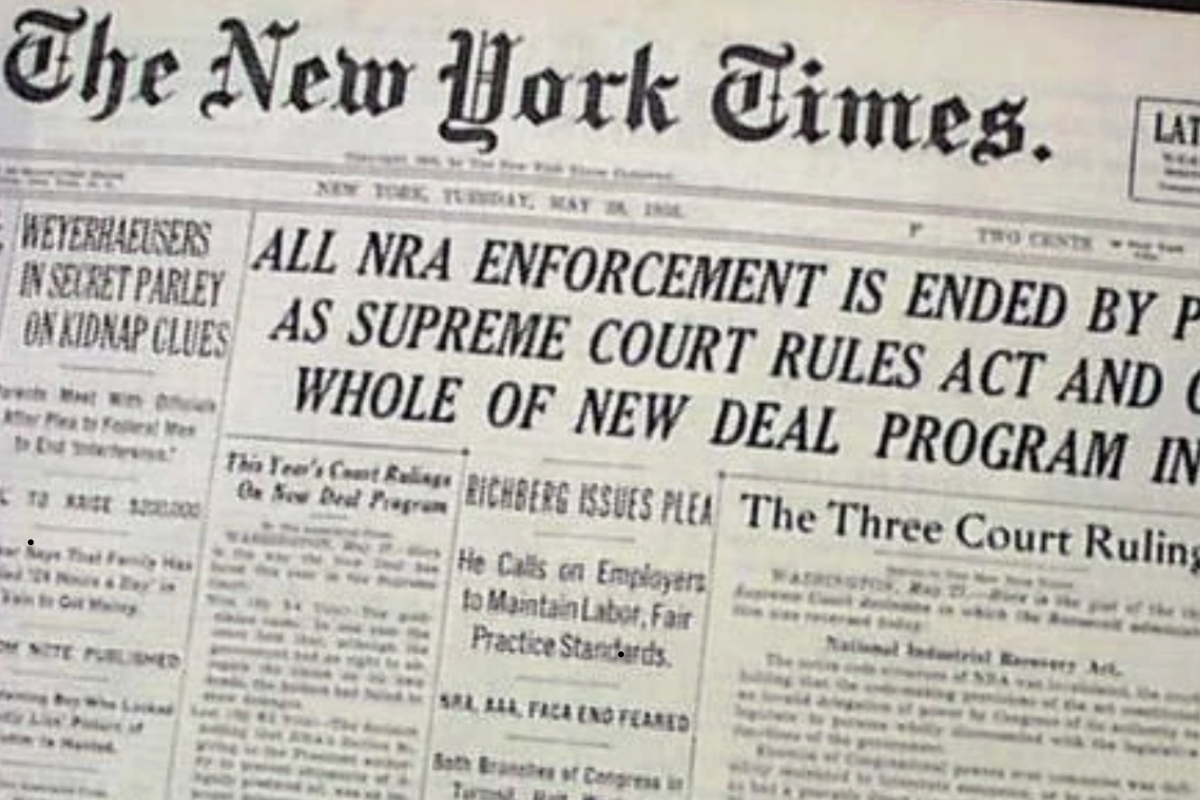
After losing an appeal to the Second Circuit Court of Appeals, the Schechter brothers appealed their case to the U.S. Supreme Court. The Court ruled 9-0 for the Schechter brothers. During oral argument, the Solicitor General, Stanley Reed, suggested that because a high percentage of the chickens that the Schechter brothers slaughtered came from outside New York, they were engaged in interstate commerce, and, thus, the NRA codes under which they were prosecuted were constitutionally valid. The Justices were skeptical. They questioned whether the business practices in question were local or national. They also questioned whether the president had a free hand in creating the business codes or if he had to follow a legally established process and legally established guidelines created by Congress.
Chief Justice Hughes wrote for the Court. He argued that in instances when Congress delegates regulatory authority to the executive branch it must be minimal and well defined. The NRA codes in question were neither. The laws gave the president broad power to create codes that promote “fair competition.” Congress failed to define or provide clear guidelines indicating what fair competition is. Too much power and discretion were given to the president. Congress was abdicating legislative power to the president. Hughes wrote that “Congress cannot delegate legislative power to the President to exercise an unfettered discretion to make whatever laws he thinks may be needed or advisable for the rehabilitation and expansion of trade or industry.” This statement reaffirmed what the Court ruled just months earlier in Panama Refining Company v. Ryan. The law gives the president the power to “impose his own conditions, adding to or taking from what is proposed, as ‘in his discretion’ he thinks necessary ‘to effectuate the policy’ declared by the act (O’Brien 449). Chief Justice Hughes characterized the law as “a sweeping delegation of legislative power.” In his concurring opinion, Justice Cardozo called it “delegation running riot.”
Given the furious pace with which the NIRA was written, it is not surprising that it suffered from two problems identified by Hughes. It was vague and it was filled with enormous detail that made it difficult to know how a practice like straight killing had anything to do with the law’s stated objective of ending the Great Depression. The codes under which the Schechter brothers were prosecuted only applied to the Metro New York poultry industry. They were not part of a national effort to regulate the national market, although Stanley Reed argued that the New York poultry market set the trends for the entire nation. In regulating the Schechters’ business, the federal government was regulating a local market. Moreover, the Schechter brothers played an insignificant part in the national poultry market; it was a neighborhood business confined to transactions within the state. Their profit margins were small. They struggled to stay in business. Why was the federal government scrutinizing a small, struggling, family-run business that had little, if any, effect on what the law was created to manage, wages, prices, production efficiency, and economic growth? In short, the federal government’s regulation of the Schechter brothers’ business had little, if anything, to do with interstate commerce. Everything the Schechter brothers were prosecuted for was confined to their local business operations. In its rush to end the Great Depression, the President and Congress lost sight of the basic division in the American system of federalism that reserved to the states the power to regulate intrastate commerce.
Schechter’s Legacy
FDR was furious over the Schechter ruling. After Congress passed the NIRA, he commented that “If that philosophy [free-market capitalism] hadn’t proved to be bankrupt, Herbert Hoover would be sitting here right now. I never felt surer of anything in my life than I do of the soundness of this passage.” After the Court handed down its ruling, FDR’s tone shifted. At a press conference, he called the Justices’ view “the horse-and-buggy definition of interstate commerce.” The Court’s ruling in U.S. v. Butler (1936) striking down the Agricultural Adjustment Act also infuriated FDR. Both cases inspired him to create a court-packing plan that would enable him to radically change the ideological composition of the Supreme Court. After he made eight appointments to the Court in a short period of time, the court-packing plan became unnecessary for FDR to dominate the three branches of the federal government. U.S. v. Butler was the last time that the Court struck down New Deal legislation. Once FDR reshaped the Court, it validated every economic policy that came before it including dramatic reversals of previous case law in cases such as NLRB v. Jones and Laughlin Steele (1937) and Wickard v. Filburn (1942). In the end, the Schechter Court refused to comply with the New Dealers’ efforts to emasculate federalism and fuel the administrative state.
It is worth emphasizing that the “sick” chicken for which the Schechter brothers were prosecuted, fined, and imprisoned did not violate NRA codes. The other infractions were minor but somehow under the law justified fines that would financially bankrupt a small business. From the Court’s perspective, the sick chicken that so concerned the federal government was crying wolf. The Schechter brothers were not standing in the way of economic recovery. They were, rather, hard-working middle-class businessmen serving a local Jewish community, and struggling economically to make a profit. Although they won their case in the Supreme Court, the Schechter brothers’ business was destroyed by the combination of legal fees they incurred defending themselves and the stigma that came from federal prosecution and bad press. Because of the sovereign immunity doctrine, they could not sue the federal government for their legal fees or business losses associated with their prosecution and imprisonment.

Professor of Political Science at Middle Tennessee State University
Related Essays