Congress Needs To Restore the Ford Rule
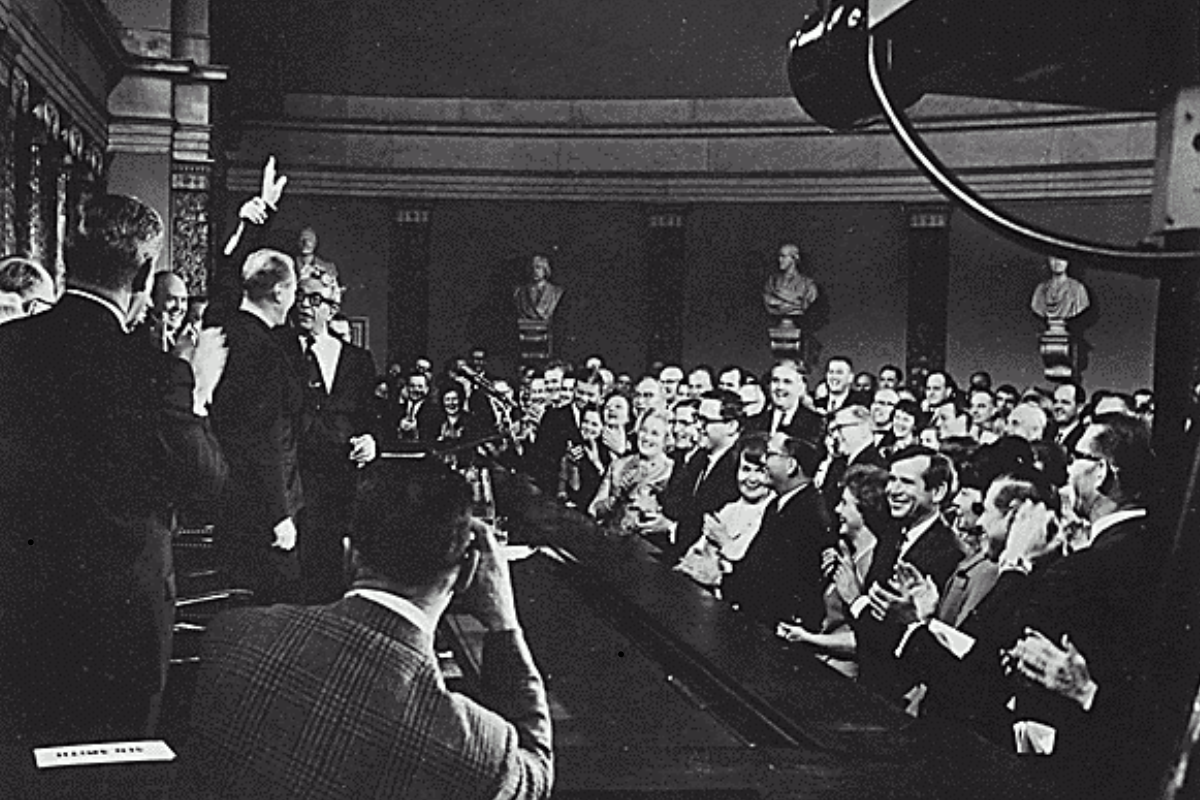
As House Republicans show their approval, Senate Minority Leader Everett M. Dirksen raises the hand of Gerald R. Ford, newly elected House Minority Leader. January 1965.
In 1965, House Minority Leader Gerald Ford told his constituents that it was his duty to “oppose those proposals of the President and the majority which for one reason or another are unsound or do not get at the problem in the best way.” He added that the “minority’s task is to offer good alternatives, so the Congress and the people have a real choice.” What can reasonably be called the “Ford Rule” came after Lyndon B. Johnson’s historic 1964 landslide. Ford was tasked with leading the decimated House Republicans who controlled a mere 140 seats.
Whenever a political party loses an election, it not only accommodates itself to its unhappy present but argues that its alternatives deserve a hearing and a vote. E.E. Schattschneider, the political scientist most associated with the idea of “responsible parties,” conceded that, while the “language of politics is usually immoderate,” the minority party, acting out of necessity, must be selective in choosing its disagreements. Such selectivity, Schattschneider argued, would result in a temperate opposition, even as lively and substantive debates ensued.
For decades, Republicans followed the “Ford rule.” It resulted in good governance and helped forge bipartisan friendships. Gerald Ford counted many Democrats as friends, including House Speaker John McCormack, and even Lyndon Johnson himself. Upon leaving the White House, Johnson told Ford: “Jerry, you and I have had a lot of head-to-head confrontations, but I never doubted your integrity. When I leave here, I want you to know that we are friends and we will always be, and if I can ever help you, I want you to let me know.” The Ford Rule made that conversation possible.
One reason the Ford Rule worked is that both parties adhered to the Tip O’Neill’s maxim that “all politics is local.” That meant there would be times when the interests of various regions aligned, giving members from both parties cause to come together and advance those interests. Mutual interests helped forge friendships that not only extended to individual members but to their families. Like many of his colleagues, the Fords made a home in Alexandria, Virginia. Back then, Congress did not work on a Tuesday-Thursday schedule and members, like the Fords, took up residence in the area.
It was the Ford Rule that paved his way to the vice presidency. After the resignation of Spiro Agnew in 1973, the 25th Amendment was invoked for the first time that required Richard Nixon to submit a vice-presidential nominee to Congress. While candidates such as John Connally and Ronald Reagan were on Nixon’s short list, the sure-fire confirmable contender was Gerald Ford. Already politically weakened by Watergate, Nixon bowed to the inevitable and sent Ford’s name to Congress.
As president, Ford continued the habit of talking to members of the opposite party. An outstanding example occurred in 1977 when Ford invited Senator Hubert Humphrey and his wife, Muriel, to a private dinner at the White House. For three-and-a-half hours, the two men confided in each other. Humphrey reaffirmed his friendship, telling the President: “You restored decency and honor to this house. You gave the American people a reason to believe once again in their government.” At an earlier visit, Humphrey revealed, “You’re going to be getting some votes from the Humphrey family.”
Those comments came after Hubert Humphrey excoriated Gerald Ford in a rousing speech to the 1976 Democratic Convention. In it, Humphrey told the cheering delegates: “After eight years of phases, freezes, and failure; of start-ups and slow-downs, of high prices and fewer jobs, we are still being asked for ‘just a little more time and patience.’ Go slow, not now, no, no, veto. This is the Republican theme. This is their policy. Well, we’ve had enough of their defeatism.” What E. E. Schattschneider might have called the immoderate language of politics did not hinder the friendship Ford and Humphrey forged.
Famously, Gerald Ford forged a remarkable kinship with his political adversary, Jimmy Carter. In a eulogy Ford prepared and delivered by his son, Steve, at Carter’s funeral, Ford wrote, “Friendship bonded us as no two presidents since John Adams and Thomas Jefferson.” Carter’s tribute to Ford was equally effusive, citing “more than 25 different projects on which Jerry and I have shared leadership responsibilities.”
Today, the Ford Rule has been discarded by leaders of both parties. Instead of offering “good alternatives” and forging friendships, politics on Capitol Hill has become a blood sport. Newt Gingrich advised his fellow Republicans to use “contrast words” such as “decay,” “failure,” “shallow,” “traitors,” “pathetic,” “corrupt,” “cheat,” “incompetent,” and “sick.” Bill Clinton unsuccessfully tried to counter Gingrich’s take-no-prisoners approach by emulating Gerald Ford and advising his fellow Democrats, “We’ve got to engage the Republicans in a spirit of genuine partisanship and say, you have some new ideas; we do, too; let’s have a contest of ideas.”
During the Obama years, Republican resistance intensified. On the night Barack Obama was inaugurated President, congressional Republicans held a dinner and vowed to oppose everything Obama put forward. Kevin McCarthy told the assembled group, “"If you act like you're the minority, you're going to stay in the minority. We've gotta challenge them on every single bill and challenge them on every single campaign.”
Their opposition intensified during the last year of the Biden presidency when Joe Biden attempted to work with Republican senators to close the border and restrict illegal immigration. Acting on the orders of Donald Trump, Republicans killed the immigration deal Biden proposed that would have added more border patrol agents, devoted more resources to the illegal importation of fentanyl, expedited the asylum process, and allowed the president to close the border should illegal immigration reach a critical level. Mitt Romney said of Trump’s opposition: “The fact that he would communicate to Republican senators and congresspeople that he doesn’t want to solve the border problem because he wants to blame Biden for it is really appalling.”
Congressional Democrats now operate from a similar perspective. Virulently opposed to Donald Trump, House Speaker Nancy Pelosi famously ripped up his 2020 State of the Union Address calling it a “pack of lies.” During Trump’s second term, their revulsion morphed into protests accompanying Trump’s congressional addresses and shutting down the federal government. Bipartisan compromises, not to mention friendships, are as elusive as Big Foot.
The Ford Rule allowed Congress to work. With its abdication, Congress has descended into chaos and dysfunction. Political scientists Norm Ornstein and Thomas Mann, who have spent decades studying Congress, pronounced it to be a “broken branch.” With each passing year, the titles to their original work have grown more ominous—the last one being, It’s Even Worse Than It Looks.
Making Congress work means there must be a bipartisan commitment to the Ford Rule. A start would be to end the three-day congressional work week. Instead of sleeping in their offices, members of Congress should commit to devoting more time to staying in Washington, D.C. Reforming campaign finance laws and scrapping the disastrous Citizens United decision would also help. Instead of spending inordinate amounts of time raising money, members of Congress would do the jobs their constituents pay them to do. Above all, having leaders from both parties disenthrall themselves of viewing politics as a bloodsport and restoring comity to congressional proceedings is exactly what’s needed. Who knows? It might even win them some votes.
John Kenneth White (johnkennethwhite.com) Substack: https://substack.com/@johnwhite272113 is a professor emeritus at The Catholic University of America. He is the author of several books, including Grand Old Unraveling: The Republican Party, Donald Trump, and the Rise of Authoritarianism. His forthcoming book (co-authored with Matthew R. Kerbel) is titled Democracy on the Edge: The Trump Elections and the Future of American Politics.

Professor Emeritus, The Catholic University of America
Related Essays