The Last Shot and Long Grace of Hope
Editor’s Note: This essay was originally published on John Bridgeland’s Substack, Civic Moonshots.
There is, in modern America, a vacancy where hope should be. The nation conducts its arguments at a fever pitch, while too often neglecting the quieter evidence of courage, character, and renewal that still flourishes in towns far from Washington, D.C. One must turn away from the noise of national grievance to rediscover the enduring virtues of local life — resilience, humility, loyalty, and grace.
Last week, work carried me through the cities and small towns of Indiana. Along the way, I encountered a story that has endured for more than 70 years not merely because of basketball, but because it speaks to something elemental in the American spirit: the conviction that obscurity need not limit greatness.
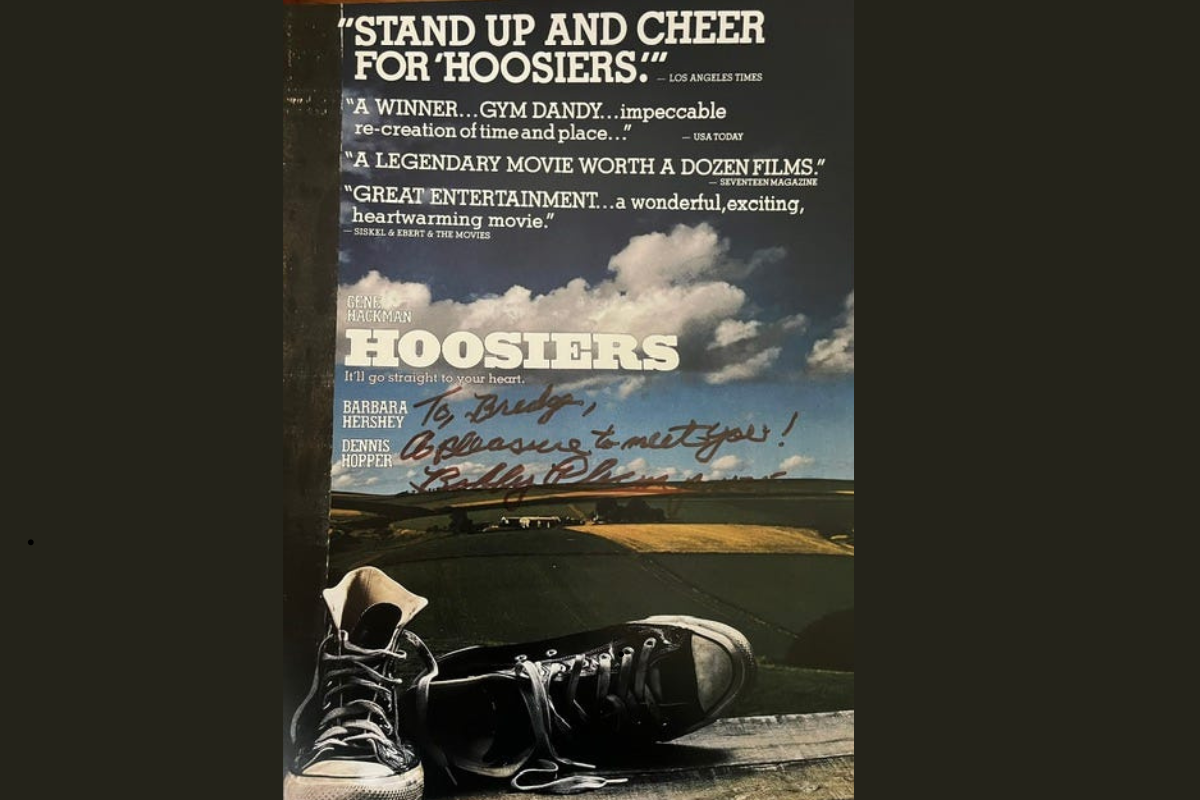
I met Bobby Plump, now 89 years old, whose vitality remains astonishing. Americans know him as the inspiration for “Jimmy Chitwood,” the hero of Hoosiers, the small-town player who sank the final shot to give tiny Milan High School the 1954 Indiana State Championship over mighty Muncie Central, 32–30. But the cinematic legend, stirring as it is, captures only a portion of the man and the meaning of his life.
We sat together in his café, Plump’s Last Shot, on the outskirts of Indianapolis where memory hangs in the air as naturally as conversation. Plump spoke not first of triumph, but of hardship.
He was the youngest of six children, raised in Pierceville, Indiana — a place so small that its population did not reach even 50 souls. There was no telephone in the home, no running water, and the food they ate was what they grew on the farm. His mother died when he was five years old, and oldest sister stepped in to help raise him. He described himself as painfully shy.
When Bobby was only eight years old, his father gave him a basketball for Christmas and made a rim fastened to a homemade backboard. There, in the quiet of rural Indiana, a lonely boy began to practice. It was the first outdoor court in town and is one of those deeply American scenes: a child with little advantage except persistence, rehearsing possibility in isolation. Other boys in town, eventually called the Pierceville Alleycats, would join in.
When he attended school in nearby Milan, some students viewed him as an outsider from the countryside and kidded him about a winter coat he wore. Yet Plump persevered, eventually earning a place on the varsity basketball team. Milan High School enrolled only 161 students, with only 30 students in Bobby’s graduating class. In the championship game, they would face Muncie Central, a school ten times larger, with taller players and every apparent advantage.
But statistics are not destiny. Milan’s players had grown together from childhood, including four of them from Pierceville. Under their young coach, 24-year old Marvin Wood, they had forged discipline, trust, and uncommon unity. Competing among 752 Indiana schools in 1954, Milan survived sectionals and regionals, defeated the celebrated Crispus Attucks team led by future hall-of-famer Oscar Robertson, and advanced improbably to the state final.
Plump recalls those final moments not as faded history, but with the immediacy of lived drama.
“Milan was up 30 to 28,” he told me, his voice quickening. “Our teammate Ray Craft drove for a layup, and the ball rolled around the rim and came out. Muncie went down and tied the game. We called timeout with 18 seconds left.”
Coach Wood drew up the final play: throw the ball into Bobby, move right, take the shot with just seconds left on the clock.
“It didn’t happen exactly that way,” Plump said with a grin. “I threw it into Ray, and he gave it back. Then it worked from there. Coach Woody said that if I missed, there might be a chance to tip it in.”
With six seconds remaining, Bobby Plump rose just above the free-throw line and released the shot that would become part of Indiana folklore. The ball cut through the net. Milan had defeated the giant.
Even now, Plump laughs at the providence hidden inside disappointment. “To this day,” he said, “I thank Ray Craft for missing that layup. If he makes it, there’s no final shot for me.”
That sentence contains more wisdom than nostalgia. So much of life turns not merely on victories, but on reversals that prepare the way for unforeseen grace.
When the team returned home, Bobby recounted, traffic stretched for miles outside Milan. More than 40,000 people poured into a town of barely more than a thousand residents. For one luminous moment, ordinary people felt themselves participants in something larger — not celebrity, but shared joy.
Yet the deeper lesson of Bobby Plump’s life lies beyond a single basket.
He went on to star at Butler University, setting scoring records and excelling with the same discipline that had carried him from the barnyard court in Pierceville. He played professionally and traveled widely. But success never hardened into self-importance. At 89, he still radiates gratitude more than accomplishment.
As we walked through the café, surrounded by photographs and memories, he spoke warmly of his children and grandchildren. He climbed steep stairs into his office on the second floor of the café, welcoming us into his sacred space. He greeted strangers as friends. Before we posed for a photograph, he smiled broadly and said, “Life is good, don’t forget to laugh.”
Then he handed me his state championship ring. “Put it on,” he said. “Feel the story.”
The experience with Bobby boosted my mood and reminded me of what America requires now: not larger spectacles of narcissism or outrage, but deeper encounters with stories that remind us of who we are at our best. Hope does not usually arrive through ideology or abstraction. It emerges through lives marked by perseverance, community, humility, and faithfulness over time.
In Milan, Indiana, that hope still echoes from a final shot taken more than seven decades ago. And in the extraordinary life of Bobby Plump, it still endures.