Brown v. Board of Education (1954)
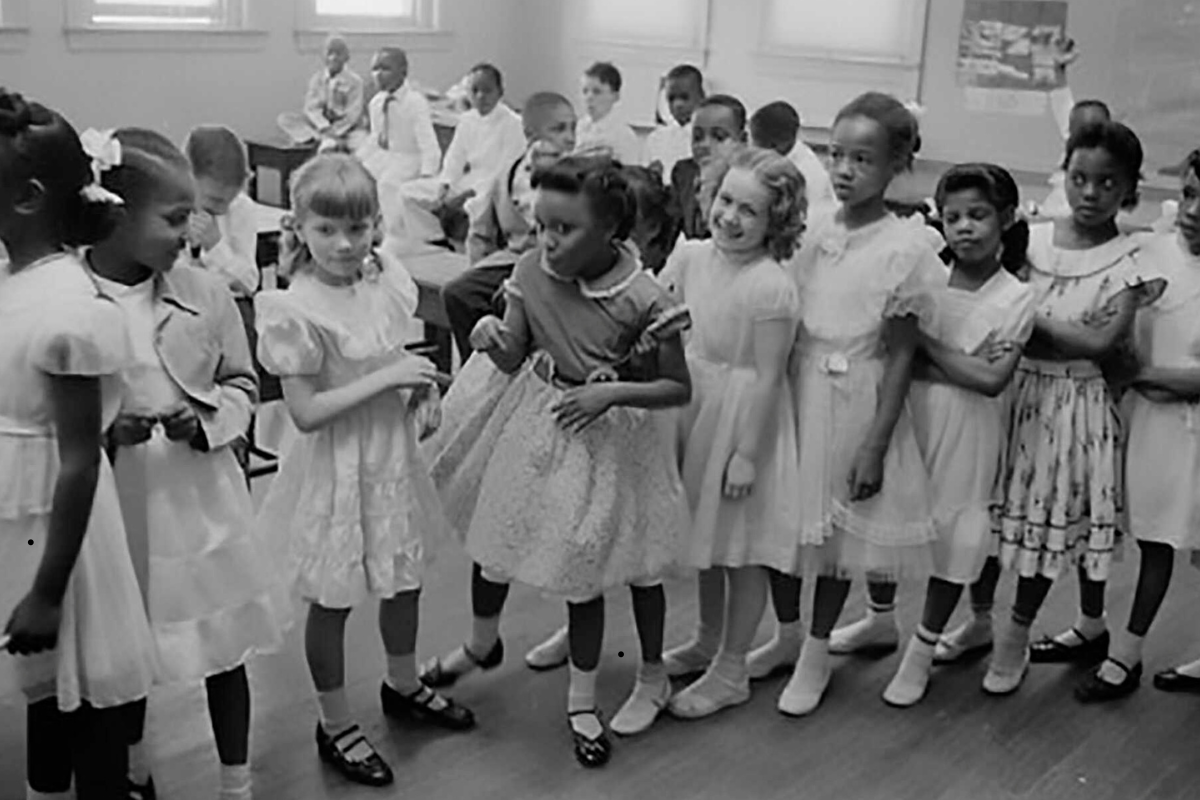
School Integration, Barnard School, Washington, D.C. Photo by Thomas J. O'Halloran, May 27, 1955.Courtesy: Library of Congress
Brown v. Board of Education is probably the most widely recognizable Supreme Court decision in history. Its notoriety is well deserved. The opinion had an outsized influence on modern jurisprudential methodology. It triggered political and social conflict that would last for decades. Ongoing debates over race-conscious legal remedies versus color-blind approaches can be traced to Brown. But most significantly, the landmark case that brought down racially “separate but equal” public schools sparked a chain of events that resulted in the dismantling of Jim Crow and leading to the crowning civil rights legislation of 1964 and 1965.
The Historical Context
The infamous Plessy v. Ferguson (1896) case is typically credited with entrenching Jim Crow and racial segregation across the southern United States. Yet segregation was well established in the realm of education well before Plessy. When the 14th amendment was enacted in 1868, virtually all states outside of New England had some form of legalized segregation in their public schools. By the time Plessy was handed down, nearly thirty states already had “separate but equal” school laws on the books. For three decades after Plessy, the Court studiously avoided any explicit consideration of “separate but equal” in the context of educational institutions. When the question finally arrived on the Court’s doorstep in 1927, Chief Justice Taft breezily concluded that the constitutionality of segregated public schools had “many times been decided [by the Court] to be within the power of the state legislatures to settle without the intervention of the federal courts under the federal constitution.” While this was surely revisionist judicial history, the statement accurately captured the reality on the ground. No judicial or legal action had in any way called into question the permissibility of racially segregated schools.
In the generation to follow, however, the growing black presence in society, particularly in the north, would produce a swell of social, economic and political influence, culminated in the famous Brown v. Board of Education decision of 1954. The socioeconomic revolution that began to take shape in the 1930s and 1940s and which grew black political and economic power and clout is beyond the scope of this essay. But suffice it to say that a growing black labor force, significant black employment in the federal bureaucracy, the creation of a federal Civil Rights Division, the admirable performance of black soldiers in World War II, and a number of other broad developments softened the environment within which our major story line occurred. That was the legal assault on racial segregation inaugurated in the 1930s by the National Association for the Advancement of Colored People (NAACP).
Founded in 1909, the Association redefined itself by launching a broad-based war on segregation, of which racially segregated schools was only one front. Other targets included white primaries, restrictive covenants in housing, and transportation and dining car segregation. The NAACP’s Legal Defense and Education Fund (LDEF), led by Thurgood Marshall, began the offensive aimed at segregated schools in the mid-1930s, settling on a two-phased attack on Plessy and its “separate but equal” standard. Rightly judging that the country was not ready for a wholescale abandonment of segregation in primary and secondary public schools, the LDEF first focused on the disparities between white and black professional schools, where the impact would be relatively mild. The LDEF hoped that this modest opening strategy might nevertheless yield judicial orders that would induce southern officials into having to make black and white schools genuinely of the same quality. The ultimate aim was to raise the cost of meeting the requirement of equal facilities to such levels that the south would be forced to abandon its segregationist educational policies altogether. Eventually a second phase would entail an all-out attack on the very idea of racially segregated schools, driven by the basic premise that black and white schools could never be equal, given the “badge of servitude” segregation foisted on black kids.
The strategy worked brilliantly, with the NAACP realizing a string of judicial victories in which refusals to admit black applicants to white schools were found violative of the “separate but equal” standard. In the first of those, the Supreme Court rejected the state of Missouri’s offer to pay a black applicant to attend an out-of-state law school rather than admitting him to an in-state law school. The Court applied the 14th amendment to require that equal facilities for white and black be set up within the boundaries of the state. Missouri v. Gaines (1938) After a pause in litigation necessitated by World War II, the legal fight against segregated schools resumed in Sipuel v. University of Oklahoma (1948), with a state law school’s rejection of a black female applicant based upon her race. The Court held that because Oklahoma operated no other law school through which it could maintain the fiction of "separate but equal" facilities for black students, the student was entitled to be admitted in "the only institution for legal education maintained by the State."
Shortly thereafter, the Court struck down the University of Oklahoma’s attempt to satisfy a state mandate that instruction be “conducted on a segregated basis” by confining an admitted black graduate student to a roped off section of the classroom for blacks only, and to segregated space in the library and the cafeteria. The Court held that "state-imposed restrictions which produce such inequalities cannot be sustained” and that black students “admitted to a state supported graduate school must receive the same treatment at the hands of the state as students of other races.” McLaurin v. Oklahoma (1950)
The NAACP claimed another significant victory in Sweatt v. Painter (1950). Heman Sweatt was a black postal worker who sued the University of Texas law school after he was denied admission due to his race. The trial court gave the state six months to set up a “substantially equivalent” law school for black students. Texas responded by hastily setting up a school that had no library, several part-time instructors, and was housed in several basement rooms of a downtown office building. The Supreme Court had little problem reversing the trial court finding that the existence of the shadow law school had facilities "substantially equivalent" to those offered white law students. But the Court went beyond the disparities in physical plant, emphasizing that the lack of equal education extended to such intangibles as faculty reputation, alumni networks, and institutional prestige.
The Direct Attack on Racial Segregation in Education
Following the string of victories in Sweatt v. Painter and its antecedents, the NAACP was ready to take Plessy head on. By the fall of 1950, it had commenced five segregation lawsuits across four states and the District of Columbia. In addition to alleging claims that the separate facilities were not equal, each of the lawsuits struck at the core of segregated education, challenging the “separate but equal” rule itself as a violation of the 14the amendment equal protection clause. All five cases would eventually land on the Supreme Court’s docket, where they were consolidated for hearing.
The lawsuit that was to become the most widely known decision in Supreme Court history involved the Browns, an African-American family who lived in a mixed neighborhood in Topeka, Kansas. The Browns lived only a few blocks from the all-white Sumner School where many of the Brown children’s playmates attended school. Like all black children in the community, the Browns were denied admission to Sumner, but were forced to attend the all-black Monroe School several miles away. The Browns literally walked past the Sumner School to catch the bus to their school. Unlike most black and white parallel schools, the Sumner and Monroe schools had a semblance of parity with respect to the physical facilities. Because of this, the Browns’ circumstances made for an attractive vehicle for attacking the fact of segregation itself.
On August 3, 1951 a three-judge federal district court panel rejected the Browns’ claim. However, the decision was written by a judge who was sympathetic to the Browns but simply found himself resigned to following the Plessy precedent. Nevertheless, several aspects of his opinion were noteworthy, and would work in the Browns’ favor as the case advanced on appeal. First the trial court gave special attention to the views of a social psychologist who testified on the Browns’ behalf as to the injury caused black students by enforced racial segregation. The judge also specifically found that the white and black schools were virtually identical physically, thus creating a factual record that might force the High Court to face the central question of the segregation itself. The other four jurisdictions produced similar outcomes, leading to a consolidated appeal before the Supreme Court.
The oral arguments were held in December of 1952; the conference that followed revealed a majority of justices in favor of ruling for the Browns, yet no decision was forthcoming. Instead, several justices were ambivalent about striking down Plessy in the context of education. Justice Frankfurter, of the mind that a decision of such magnitude demanded a unified Court, sought to buy time by proposing a briefing and re-argument of the case around several specific questions. On June 8, 1953, the Court issued a series of questions to the respective counsel and setting the case on for an additional round of arguments. The questions focused on whether the original intentions of the framers of the 14th amendment anticipated its application to segregated schools, and if not, whether the Court had the authority to do so. The delay in the proceedings proved to be fortuitous. In the interregnum between the original oral argument and the subsequent rehearing, Chief Justice Fred Vinson passed away, and was replaced by President Eisenhower with California Governor Earl Warren. Warren’s impressive political skills would play a central part in his successfully coaxing his brethren to join in a unanimous decision in favor of the Browns.
The Decision
After three additional days of oral argument were in early December of 1953, it would take another five months for Chief Justice Warren to issue his opinion. Even more than Justice Frankfurter, Warren was committed to achieving unanimity from his colleagues. Applying his considerable political prowess to wheedle and cajole the other members of the Court, Warren’s May 17, 1954 opinion in favor of the Browns had the full support of the entire Court. The 14-page opinion was remarkable for its brevity, simplicity of reasoning, a straightforward tone that made it readable even to the non-lawyerly, and the breadth of its holding. Warren quickly dispensed with the originalist argument, finding that the Browns’ claim could not to rest on the historical intentions of the drafters of the 14th amendment. The evidence was inconclusive on that front; whether or not the authors of the 14th amendment meant it to apply to segregated schools was unknowable. Warren stated that “[w]e cannot turn the clock back to 1868 when the amendment was adopted or even to 1896 when Plessy v. Ferguson was written.”
Nor did Warren trouble himself with arguments about whether the schools themselves were equal. Lower courts had found that the schools were equal, or becoming equalized “with respect to buildings, curricula, qualifications and salaries of teachers, and other ‘tangible’ factors.” The case was not about the school facilities themselves. Rather the Court focused on “the importance of education to our democratic society” and “its present place in American life.” Warren deemed education central to the cultivation of societal values and “the very foundation of good citizenship.” He declared that no student denied the opportunity of an education could “reasonably be expected to succeed in life.” Hence education was “a right which must be made available to all on equal terms.”
In deciding whether racially segregated schools could meet that high standard, Warren turned to the social science data and the psychological and sociological experts who had testified at length, and whom the lower court had relied upon in its decision. The Court found that to segregate “white and colored children in public schools [is to impose] a detrimental effect upon the colored children.” Falling back on the evidence of psychologists submitted at trial, Warren opined that to “separate [Negroes] from others of similar age and qualifications solely because of their race generates a feeling of inferiority as to their status in the community that may affect their hearts and minds in a way unlikely ever to be undone.” Thus separate schools could not be equal. While the Court avoided explicitly overturning Plessy, it concluded that the "separate but equal" doctrine "has no place" in the field of public education." In other words, “separate educational facilities are inherently unequal.”
Implementing the Decision – Brown II
The decision was also notable for what the Court chose NOT to do. The Court refrained from ordering all schools to immediately desegregate. Citing the “wide applicability” of the decision, the “great variety of local conditions,” and the cases’ considerable complexity, the Court sent the parties home with directions to brief how best to implement the decision. Following re-arguments in April of 1955, the Court subsequently issued a five-paragraph decision in what would come to be known as Brown II (1955). The Court tasked local school boards with primary responsibility for crafting desegregation plans for their schools. Noting the “variety of obstacles” that local jurisdictions faced, the Warren-authored opinion directed them to “make a prompt and reasonable start toward compliance” with Brown I. Surely anticipating resistance by southern school administrators, Warren gave federal district courts broad oversight authority, instructing them to “enter such orders and decrees . . . as are necessary and proper to admit [the parties to the lawsuit] to public schools on a racially nondiscriminatory basis.” The trial courts were urged to apply principles of equity in shaping practical remedies in instances where school boards resisted or refused to comply. The Court ended its implementation decision with a call for all schools to be integrated with “all deliberate speed,” an intentionally imprecise choice of words that allowed lower courts wide discretion to determine what constituted a good faith move toward full compliance and when delay might be warranted.
Implications of the Brown Decisions
The initial reaction to Brown I was one of relative calm, as all parties waited to see how it would practically unfold. That would change with the implementation order, which provoked massive resistance from the south. The ambiguous standard of “all deliberate speed” would haunt the Court for years to come, as southern officials took it as an invitation to drag their feet, and then engage in full-scale resistance. In the decade after Brown, attempts to enroll black students in high schools and universities were met with widespread hostility and often violent defiance. As a result, the realization of racially integrated schools occurred at an agonizingly slow rate. A full decade after Brown I, only 1% of black students were attending public schools with white students. It would take the passage of the Civil Rights Act of 1964 and the full weight of federal enforcement for integration to begin in earnest. Even then, the political and legal battles would continue to rage.
A corollary of enforcement was the unparalleled breadth of the equitable powers wielded by federal judges under the aegis of Brown II and the Civil Rights Act. The Supreme Court decision in Swann v. Charlotte-Mecklenburg Bd of Education (1971) reflected the glacial pace of implementation and affirmed the near-unlimited equitable power of federal judges. In that decision, the Court sanctioned virtually unbounded equitable authority in the name of integration, including the limited use of racial balances in school assignments, the establishment of attendance zones to remedy racial segregation, and most significantly, the use of bussing to as an appropriate tool of education policy to combat persistent racially segregated dual school systems.
On a more academic level, Brown has hardly been free of criticism. Indeed it has sparked long running debates over the appropriateness of competing jurisprudential approaches. Constitutional critiques from the formalist camp targeted the decision for its complete avoidance of any historical analysis. It was criticized for its reliance upon social science theory as opposed to any discernible “neutral principle of constitutional law.” Characterizing Brown as an act of educational policy making more than a legal decision, proponents of judicial restraint blamed the decision for propelling the Court into an era of judicial activism. The unparalleled equitable powers exercised in Brown were not likely to stay confined to the extraordinary issue of school integration. It fed future policy innovation and experimentation by judges in a host of policy areas, prompting judicial conservatives to blame Brown for the removal of “issue after issue from the arena of popular decision and subjected them to judicial control.” Meanwhile, defenders of Brown cite it as evidence of the weaknesses of a doctrinaire originalism that is rigidly tethered to historical circumstances. Acknowledging the political nature of the decision, they point to Brown as an example of the need for jurists to consider actual social and political realities in their decision-making and crafting of remedies.
Conclusion
Debates over Brown’s defining impact on the Court and the nature of constitutional are important ones to have. But those complaints, however valid, should be held in balance with Brown as a case that arguably “transcended ordinary notions about propriety in litigation.” One can be skeptical of the role of the judiciary in promoting social and political change while still celebrating Brown. The decision not only brought an end to legalized school segregation, but served as the catalyst for a civil rights movement that would disassemble Jim Crow in short order and produce thrilling civil rights gains. It was the first domino in the toppling of the legally imposed, de jure racial discrimination that had been this country’s curse from the outset. Thus was it the central event in lifting black Americans from second class status to equal standing legally with their white fellow citizens.
A Postscript – The Ongoing Battle Over Brown’s Legacy
The enduring power of Brown v. Board of Education is evidenced by the clashes that continue on the High Court over its legacy. Efforts by conservative and liberal justices alike to claim the moral and legal authority of Brown were apparent in Parents Interested v. Seattle School District (2007), a conflict over the constitutionality of a local school board’s reliance on racial identity in assigning students to schools within the district. Chief Justice Roberts, writing for the majority in striking down the practice, cited Brown while asserting famously that “the way to stop discriminating on the basis of race is to stop discriminating on the basis of race.” Dissenting Justice John Paul Stevens accused the majority of misappropriating Brown, concluding that the “no member of the Court [Stevens] joined in 1975 would have agreed” with the outcome. Meanwhile Justice Thomas has regularly invoked Brown in opposing affirmative action, analogizing the inferiority caused by segregated schools to the inferiority that minority students are likely to experience as a result of race-conscious admissions. In light of the 2023 Supreme Court decision rejecting affirmative action in university admissions and the just-released Callais decision striking down race-based gerrymandering, the conservatives have the upper hand, at least for the present.