Engel v. Vitale (1962)
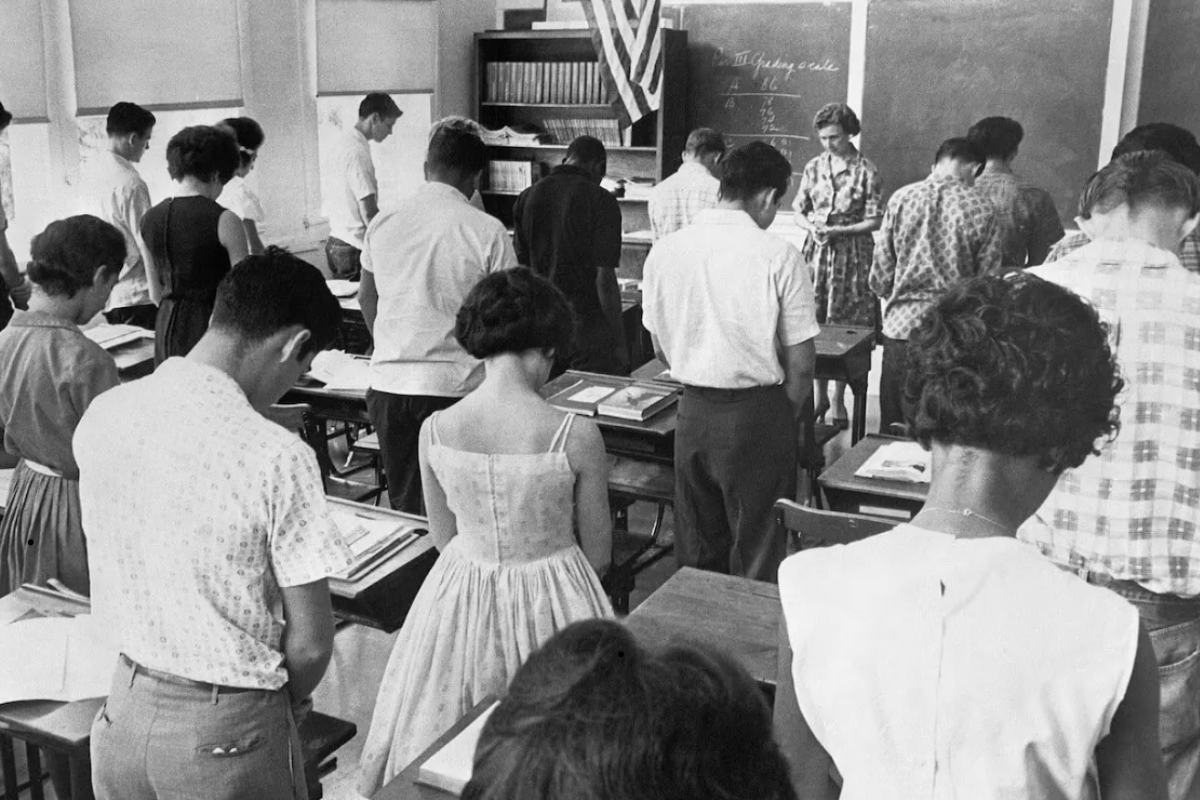
Students praying in a classroom in San Antonio, Texas, 1962.
Introduction
The Warren Court of the 1950s and 1960s pressed the bounds of judicial power like no court before or since, as it pushed transformative social and legal change on subjects ranging from school desegregation and the expansion of protections for the criminally accused to privacy rights grounded in conceptions of substantive due process. But no area of the Court’s jurisprudence illustrated the limits of its power more than the cases in which it took on religion in the public schools. The decision in Engel v. Vitale (1962) striking down teacher-led prayer in school not only inflamed public opinion against the Court, but was met with defiance in the form of non-compliance that endured in pockets across the country for decades to come.
Religion Before the Court
The process of selective incorporation turned the religion clauses of the First Amendment from mostly dormant, toothless provisions into subjects that frequently found their way onto the Court’s docket. The application of the Free Exercise Clause to the states in Cantwell v. Connecticut (1940) resulted in a wave of litigation involving the religious liberty claims of Jehovah’s Witnesses and other religious minorities. After the Court incorporated the Establishment Clause in Everson v. Board of Education (1947), it ruled on a slew of cases in the 1950s that coalesced around the growing Catholic presence in the country, their development of a parallel parochial school system, and questions over various forms of public support for those schools. The Court’s mid-century jurisprudence was hardly a model of consistency; the changing religious landscape in America led to tensions between Catholics and Protestants, among various Protestant traditions, and with minority religions, all of which spawned competing arguments among accommodationist and separationist camps on a range of issues implicating the Establishment Clause.
In Engel v. Vitale, the Court confronted a practice that had existed since the early days of the republic, namely the beginning of the common school day with religious exercises. Long standing and widespread religious practices in public schools included prayer, the reading of scripture, and even religious teaching. In 1951, the New York Board of Regents, which controlled the state’s educational system, drafted a non-denominational public prayer which it encouraged schools to adopt to start each day. Known as the Regents’ Prayer, it stated: “Almighty God, we acknowledge our dependence upon Thee, and we beg Thy blessings upon us, our parents, our teachers and our country.” The Herrick Union Free School District in New Hyde Park, New York adopted the proposal in July of 1958, and the prayer soon caught the attention of atheists, agnostics, and some religiously devout families who objected to religious expression in a school setting. In 1959, a group of parents of Herrick High School students, with the assistance of several legal organizations, filed a lawsuit against William Vitale, the president of the Herrick school board. Steven Engel, the name plaintiff, was the dad of a Jewish student, and the other plaintiffs represented diverse faiths, as well as none at all. Students could opt out of the prayer with a parent’s signature. Nevertheless, Engel and the other parents contended that even a voluntary teacher-led prayer violated the establishment clause. The families lost at the trial court level, and their appeal before the New York Court of Appeals was unsuccessful. They subsequently appealed to the U.S. Supreme Court, which granted review. On June 25, 1962, the Court issued its order overturning the lower court decisions and striking down the prayer policy.
Justice Black’s Majority Opinion
Writing for a 6-1 majority in favor of the families, Justice Hugo Black held that the Establishment Clause at least means that “in this country it is no part of the business of government to compose official prayers for any group of the America people to recite as a part of a religious program carried out by the government.” Black invoked the historical origins of the First Amendment, finding that governmentally composed prayers for religious services were a factor in causing “early colonists to leave England and seek religious freedom in America.” A central aim of the First Amendment was to guarantee that “the power and prestige of the state” would not “be used to control, support or influence the kinds of prayer the American people can say.” The government lacked the authority to prescribe “any particular form of prayer which is to be used as an official prayer in carrying on any program of governmentally sponsored religious activity.” In short, a government-written prayer by school children was "a practice wholly inconsistent with the Establishment Clause" and breached the "wall of separation between Church and State."
The Black opinion hinged on two primary arguments, the first of which would come to be known as the “anti-divisiveness” doctrine. Noting that governmentally established religions invariably were accompanied by religious persecutions, Black intoned that “whenever government [has] allied itself with one particular form of religion, the inevitable result [has] been that it [has] incurred the hatred, disrespect and even contempt of those who [hold] contrary beliefs.” Governmental sponsorship of religion inevitably drove a wedge of division between various religious traditions.
The second argument, later termed the “anti-corruption” rationale, focused on the degradation of religion that ostensibly came from governmental intrusion. Here Black took pains to portray the Court’s decision as an act of regard for religion, rather than hostility toward it. The Establishment Clause was anchored in the principle that religion was “too personal, too sacred, too holy, to permit its ‘unhallowed perversion’ by a civil magistrate.” Underlying the Establishment Clause was a belief that “a union of government and religion tends to destroy government and to degrade religion.” Putting an end to governmental control of prayer was borne of concern for religion, not from animus toward it. The drafters of the Establishment Clause sought to “quiet well justified fears . . . arising out of an awareness that governments of the past had shackled men’s tongues to make them speak only the religious thoughts that government wanted them to speak . . .” As a result, it was “neither sacrilegious nor anti-religious to say that each separate government in this country should stay out of the business of writing or sanctioning official prayers and leave that purely religious function to the people themselves . . .”
Black found the particulars of the administration of the prayer to be little import. Neither the fact that the prayer was non-denominational or that recitation by students was voluntary mattered to the constitutional question. Violation of the Establishment clause was not dependent upon any showing of direct governmental compulsion. Rather it was enough that there was “indirect coercive pressure upon religious minorities to conform to the prevailing officially approved religion . . .”
The Douglas Concurring Opinion
Justice Douglas added a short concurrence, in which he put forth the most radically separationist view of the Establishment Clause. He argued that any and all religious exercise in public settings were flatly unconstitutional. In taking that position, Douglas was foreshadowing the Court's decision in Abington v. Schempp a year later, in which the Court would strike the reading of the Bible in schools as violative of the Establishment Clause. Douglas cast his position in the language of neutrality, asserting that “[i]n the relationship between man and religion, the State is firmly committed to a position of neutrality."
Justice Stewart’s dissenting opinion
Justice Potter Stewart was the lone dissenter. He was harshly critical of Justice Black’s reliance on the Jeffersonian metaphor of the “wall of separation” between church and state. He found it unhelpful to rely on “the uncritical invocation of metaphors like the ‘wall of separation,’ a phrase nowhere to be found in the Constitution.” Rather what mattered was the “history of the religious traditions of our people, reflected in countless practices of the institutions and officials of our government.” As evidence, Stewart offered a litany of official governmental acts that reflected those religious traditions, including the opening of congressional sessions with prayer, a presidential oath that explicitly asked for the protection and help of God, and even the Court’s own practice of commencing each oral argument by invoking God’s protection. Stewart cited the religious references in the National Anthem and the Pledge of Allegiance, the usage of “In God We Trust” on coinage, and the annual declaration of a National Day of Prayer as further evidence of the country’s religious traditions. In light of these and other longstanding practices, Stewart found it inconceivable that an innocuous classroom prayer was somehow an unacceptable establishment of an official religion.
Steward echoed Justice Douglas’s dicta from a decade earlier that “We are a religious people whose institutions presuppose a Supreme Being.” He reasoned that New York’s rule was simply a recognition of the “deeply entrenched and highly cherished spiritual traditions of our Nation – traditions which come down to us from those who almost two hundred years ago avowed their firm Reliance on the Protection of divine Providence.” To deny students the occasion to join in the prayer was to deny them the opportunity to participate in the Nation’s rich spiritual heritage.
Significance of the Decision
Engel v. Vitale (particularly when coupled with the Abington Township v. Schempp decision of a year later banning Bible reading in school) proved to be the most controversial and contested in all of the Supreme Court’s religion clause jurisprudence. The immediate reaction was widespread public revulsion. Surveys revealed overwhelming majorities disapproving of the decision. There was extensive criticism from church and religious leaders, particularly among Catholics and southern evangelicals. Members of Congress and other political leaders attacked the decision and the Court that rendered it. A serious movement to amend the Constitution to undo the decisions quickly materialized. By the time Congress held hearings in 1964, nearly one hundred and fifty constitutional amendments to allow prayer in public schools had been introduced. Nor did the public gradually make their peace with Engel and Schempp, as is often the case. The deep unpopularity of the decisions has hardly abated over time. To this day, sizeable popular majorities continue to favor some form of prayer in public schools.
The attacks on Engel also were more than rhetorical. Significantly, they were accompanied by sustained disregard for the outcome. Many school districts in deeply religious parts of the country dealt with the decision by simply not obeying it. Local officials, particularly in the south and other rural areas, regularly ignored judicial prohibitions on school prayer and other religious practices. That disregard has persisted over time. A not insubstantial swath of the nation’s public school system can still be found engaging in practices contrary to Engel, including classroom prayer, moments of silence, lunchtime grace, and the like. Thus do the religion-in-schools cases demonstrate the inherent constraints on the Court’s ability to impose rules that fall too far outside the bounds of public opinion. Engel and Schempp are notable for the gap they produced between judicial edict and constitutional practice.
On a jurisprudential level, Justice Black’s meandering opinion in Engel bears significant responsibility for the confusion and lack of doctrinal clarity that plagued the Court’s Establishment Clause jurisprudence for the half-century that followed. A badly divided Court followed up on Engel with three decisions eliminating prayer from public educational settings – a moment of silence in Wallace v. Jaffree (1985), a commencement convocation in Lee v. Weisman (1992), and a student-led prayer at a high school football game in Santa Fe ISD v. Doe (2000). More recently, the Court has reversed course, showing far greater sympathy in allowing expressions of prayer in public settings (Town of Greece v. Galloway (2014); Kennedy v. Bremerton School District (2022)). The lack a consistent, logical throughline in the public prayer cases was amplified by the Court’s similarly incoherent treatment of Establishment Clause questions involving public religious displays and the issue of public aid to religious institutions.
Finally, the decision to remove prayer from public schools undoubtedly played a role in the “culture wars” that infected much of late Twentieth Century American politics. Rightly or not, many perceived the Court as hostile to natural expressions of religiosity in American public life. They saw the Court as attempting to purge religion from the public square in a country where religiosity was a central aspect of its character. The reaction to the decisions against religion in public schools certainly galvanized the religious political movement that came to be known as the religious right. The deep political divide over the role of religion in American political and public life is still evident in the “God gap” among the parties and their adherents. Indeed, among politically active religious conservatives, returning prayer to public schools continues to be a rallying cry come election time.
Conclusion
I have suggested the Justice Black’s perfunctory reasoning behind his incorporation of the Establishment Clause in Everson failed as a matter of textual fidelity and original purpose, that both the language and the history behind it support a view of church-state relations that was primarily a matter for the states. Moreover, the practical consequences of a top-down uniform law of church-state relations across all levels of government made the confusion and doctrinal hair splitting that characterized Establishment Clause jurisprudence in the latter 20th century inevitable. The specific context of public prayer makes the point. One wonders how a church-state jurisprudence that allowed for some diversity of practice among different communities around public religious expression might have spared not only the decades of doctrinal perplexity, but also the intense political battles that have consumed questions of religion in the public square.