Heart of Atlanta Motel v. United States 1964
Introduction
Brown v. Board of Education (1954) and the civil rights legislation of 1964 and 1965 served as bookends to a decade of civil rights achievements that came to be called the Second Reconstruction. Unlike the present time of congressional dysfunction and inaction, Congress was the driving force behind the culmination of the civil rights movement. Yet the impact of the Civil Rights Act would have been seriously dampened without the Supreme Court’s decision in Heart of Atlanta Motel v. United States (1964) legitimating Congress’s authority under the Commerce Clause to root out racial segregation by private actors in public spaces.
The Civil Rights Act of 1964, Public Accommodation Law, and the Commerce Power
Heart of Atlanta was the first major test of the public accommodations section (Title II) of the Civil Rights Act (CRA) of 1964. Title II entitled all persons to the “full and equal enjoyment . . . of any place of public accommodation . . . without discrimination or segregation non the ground of race, color, religion, or national origin.” The statue defined those public establishments to which it applied in sweeping terms; coverage extended to "any" establishment engaged in providing services to the public, including motels, hotels, restaurants, cafeterias, lunch rooms, theaters, and gas stations. A core focus of the CRA were those private business owners who had heretofore been unaffected by Supreme Court Fourteenth Amendment Equal Protection jurisprudence.
Recall that Congress was faced with a precedent from nearly a century earlier that had constrained the Fourteenth Amendment proscriptions on discrimination by narrowly defining state action so as to exclude private businesses from the reach of the amendment. The Supreme Court in the Civil Rights Cases of 1883 had limited the enforcement provisions of the Fourteenth Amendment only to actions by “the state” – as in state governments. That Court had held that Congress could not use Section 5 enforcement powers to bar segregation employed by private businesses. For this reason, Congress in drafting the Civil Rights Act of 1964 chose to rest its statutory authority on its power to regulate commerce among the several states, rather than the Fourteenth Amendment.
In the lead up to the CRA of 1964, Congress went to significant lengths to ensure there were findings that established the deleterious impact of racial discrimination on interstate commerce. It elicited a wealth of evidence that bolstered the nexus between segregation and interstate commerce. Evidence was introduced showing the difficulties faced by segregated cities in attracting new businesses. Organizations avoided selecting southern sites for their annual conventions. Professional sports teams were less likely to settle in the south, where tickets were sold on a segregated basis. The bottom line, according to Undersecretary of Commerce Franklin Roosevelt Jr., was that "segregation impose[d] unnatural limitations in the conduct of business which are injurious to the free flow of commerce. "
More significantly, extensive testimony revealed the substantial obstacles faced by Black families traveling from one city or state to another. Travelers had to map out trips in advance to detour around locales where racial discrimination was pervasive, adding miles, expense and unpredictability to their travel. The publication of Green Books informed Black travelers of those hotels, tourist homes, restaurants, night clubs, taverns, liquor stores, tailors, service stations, garages, and drug stores where they could obtain services. The mere existence of such travel guides served as compelling evidence to the harm segregation imposed on interstate commerce.
Heart of Atlanta Motel: The Facts of the Case
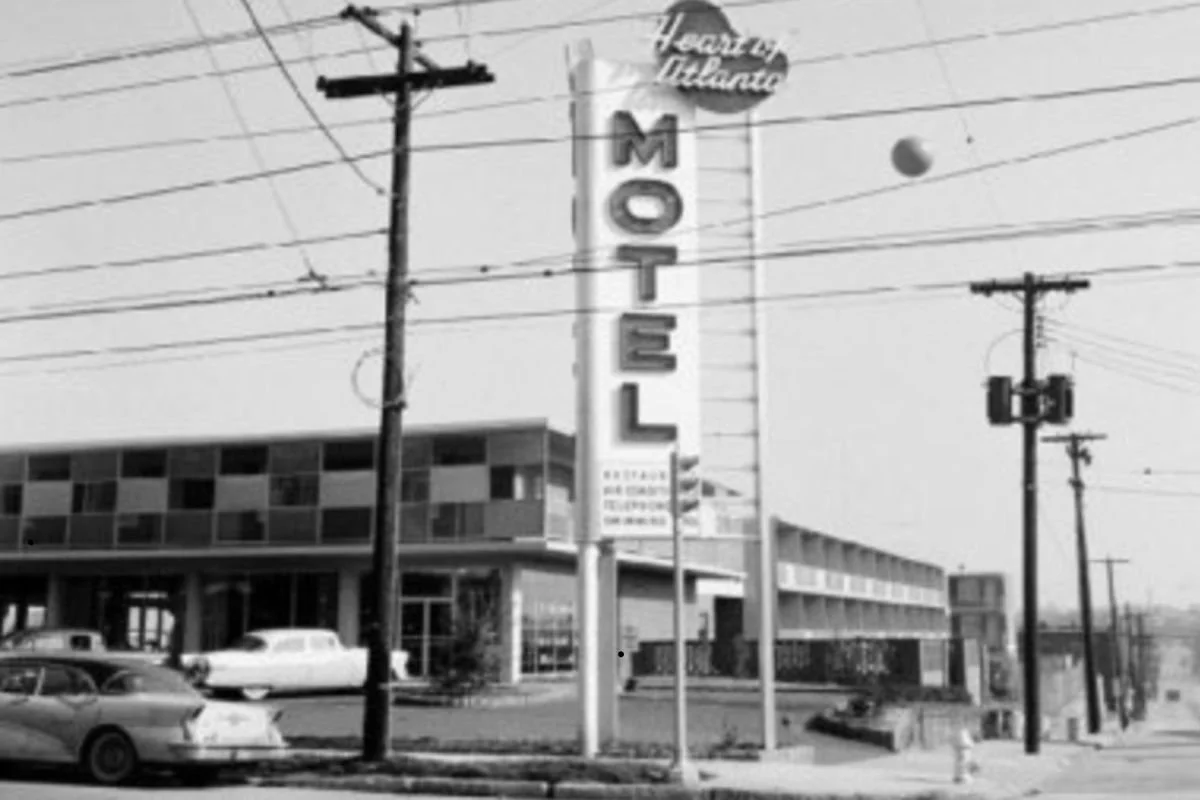
The Heart of Atlanta Motel was a 216-room inn regarded as one of the premier establishments on the eastern sea board. The motel was located in Atlanta, Georgia in close proximity to two interstate highways. The motel owner promoted the business via a national advertising campaign and maintained dozens of billboards along the interstate highways across the state. The motel regularly attracted convention trade from outside the state, and some three-quarters of the guests who stayed at the motel were from out-of-state. None of those guests were Black. The owner adamantly refused to furnish rooms to Black patrons and made it clear he had no intention of doing so in the future, the passage of the CRA notwithstanding. Instead, he filed a lawsuit challenging the constitutionality of the law and seeking declaratory relief to enjoin its enforcement. The lawsuit contended that Congress had no authority under the Commerce Clause to regulate the policies of private businesses such as a local motel. It also asserted that the compelling of the motel owner to lease to Black customers was a taking of his liberty and property without due process of law under the fifth amendment. In a final bit of legal trolling, the owner argued that forcing him to rent to Black travelers subjected him to involuntary servitude in violation of the Thirteenth Amendment. A lower court three-judge panel unanimously upheld the public accommodations law, and the motel appealed to the Supreme Court.
The Court’s Majority Opinion
On December 14, 1964, the Court announced its decision in Heart of Atlanta Motel v. U.S., ruling unanimously in favor of Title 11. Justice Tom Clark began his opinion by addressed the applicability of the ninety-year old Civil Rights Cases precedent, which he found to be inapt. In contrast to the 1964 Civil Rights Act, Congress in passing the Civil Rights Act of 1875 did not premise its authority upon the Commerce Clause. While the 1964 CVA was careful to limit its application to those businesses which had some direct relation to the flow of goods and people across state lines, the 1875 law broadly proscribed discrimination for businesses without regard for whether they were engaged in interstate commerce. Indeed, the earlier Court explicitly noted that the 1875 act was not conceived in terms of the commerce power. In other words, the Civil Rights Cases Court excluded the Commerce Clause from consideration as a possible source of congressional power in outlawing discrimination. Clark found the earlier opinion to be “devoid of authority” on whether the Commerce Clause empowered Congress ninety years later to regulate discriminatory practices found to substantially affect interstate commerce. Simply put, the holding in the Civil Rights Cases was no barrier to the constitutional status of Title II.
The Court then moved on to a consideration of whether Title II was a proper expression of Congress’s power to regulate commerce. Clark characterized that authority as a broad power to regulate interstate commerce, one which included "those activities intrastate which so affect interstate commerce ... as to make regulation of them appropriate means to the attainment of a legitimate end." The question regarding congressional authority under the Commerce Clause was straightforward. Did Congress have a rational basis upon which to conclude that racial discrimination by motels affected interstate commerce? And, if so, were the chosen means employed by Congress to regulate racial discrimination "reasonable and appropriate"?
Justice Clark applied a “substantial effects” test to determine whether the motel’s business operations amounted to interstate commerce. The standard to be met was “whether the activity sought to be regulated is ‘commerce which concerns more States than one’ and has a real and substantial relation to the national interest.” The power to regulate interstate commerce extended to the local incidents of activity which “so affect interstate commerce . . . as to make regulation of them appropriate means to the attainment of a legitimate end . . .” That included local activities “which might have a substantial and harmful effect” on broader interstate commerce.” Clark cited ample evidence in the congressional record for finding that racial discrimination, even if practiced by intrastate businesses, inflicted a "substantial and harmful effect" on interstate commerce. The motel’s catering to travelers from out of state, as well as the countless ways in which discrimination hampered Black travelers in moving across state lines confirmed for the Court that the motel’s practices of racial discrimination posed a genuine threat to interstate commerce.
Clark further broadened his reading of the Commerce Clause by empowering Congress to act to expunge “moral wrongs” that affected commerce. That included “the authority of Congress to keep the channels of interstate commerce free from immoral and injurious uses . . .” The motel owner’s policy of racial exclusion represented a moral wrong, in addition to “overwhelming evidence of the disruptive effect that racial discrimination has had on commercial intercourse.” In expanding Congress’s power to regulate commerce with additional authority through the Necessary and Proper Clause. Clark concluded that the means to be employed in removing obstructions to commerce were “within the sound and exclusive discretion of the Congress” subject only to the condition that “the means chosen . . . must be reasonably adapted to the end permitted by the Constitution.” The Court found the means so adapted in the Civil Rights Act.
Finally, the Court summarily dispensed with the motel owner’s Fifth and Thirteenth Amendment claims, finding that the public accommodations section of the CRA in no way deprived him of personal liberties or property rights guaranteed by those provisions. The Court held that private businesses operating in the public sphere had no inherent right to limit their customers based upon race, free of government interference.
The Douglass Concurrence
Justice Douglas, while joining in the opinion for the Court, drafted a solo concurrence that would have gone even further. Expressing a reluctance to simply rely on the Commerce Clause to support Title II, Douglas would have preferred to rest the outcome on the assertion of legislative power as authorized in section 5 of the Fourteenth Amendment. That enforcement provision gives to Congress the “power to enforce, by appropriate legislation, the provisions of” the Fourteenth Amendment. Deeming the free movement of people to be on a higher plane than that of goods and merchandise, Douglass argued for a measure of constitutional protection for the person that is far more important and fundamental, i.e. the Fourteenth Amendment rather than the Commerce Clause.
Douglas contended that basing the Court’s decision on the Fourteenth Amendment would have the salutary effect of “putting an end to all obstructionist strategies and allowing every person – whatever his race, creed, or color – to patronize all places of public accommodation without discrimination whether he travels interstate or intrastate.” Douglas considered it unnecessary to resolve “whether a particular restaurant or inn is within the commerce definitions of the Act or whether a particular customer is an interstate traveler.” In his mind, any business that practiced racial discrimination did so only with the coercive enforcement power of the state behind it, hence satisfying the “state action” requirement triggering the Fourteenth Amendment. Section 5 authority “would apply to all customers in all the enumerated places of public accommodation” thus closing the door on “this bitter chapter in American history.”
The Significance of the Decision
On the same day that Heart of Atlanta came down, the Supreme Court rendered its opinion in the companion case of Katzenbach v. McClung. That case similarly involved a Birmingham, Alabama restaurant’s refusal to serve Black customers. But unlike the Heart of Atlanta motel, the restaurant served no out-of-state customers. Nevertheless, the Court noted that “a substantial portion of the food served in the restaurant had moved in interstate commerce,” thus justifying congressional action. While Heart of Atlanta had cemented Congress’s authority to regulate local businesses whose activities had a “substantial effect” on interstate commerce, the Court in Katzenbach expanded Congress’s power to regulate local activity if it touched in whole or part on items that had previously moved in interstate commerce.
On one level, the decisions marked the Warren Court’s continuation of the New Deal Court’s reliance on a nearly unbounded Commerce Clause interpretation to permit congressional regulatory intervention into almost any facet of American national life. But the cases in tandem also provided additional impetus for Congress to aggressively legislate to advance civil rights. The Court played a legitimating role in Heart of Atlanta and Katzenbach, granting Congress wide berth as the primary actor in addressing major societal and legal problems.
The pair of decision also had the very practical effect of easing the maze of complications faced by Black southerners when they traveled, providing them with ease of mobility and greater access to accommodations and services. Moreover, by validating the federal government’s mandate to attack discrimination by private businesses that provided public services, the ruling fueled the continued dismantling on a much wider scale of the foundations of Jim Crow across the American south.
A Postscript – From “The Great Dissenter” to “Wild Bill”
The Heart of Atlanta Motel opinions were one more instance of a 19th century solo dissent by Justice John Marshall Harlan evolving into a baseline principle of American constitutional jurisprudence. Indeed, both the majority opinion and the Douglas concurrence in Heart of Atlanta found their antecedents in Harlan’s Civil Rights Cases dissent. Anticipating the argument that would underpin Clark’s opinion, Harlan inquired as to whether “Congress, in the exercise of its power to regulate commerce amongst the several states” could outlaw discrimination in public services or goods passing from one State to another.
But Harlan also foreshadowed Douglas’s bolder claim, contending that the enforcement provisions of the Fourteenth Amendment were intended to permit Congress to directly prohibit all race-based discrimination by states and individuals. He found the Court’s distinction between “state action” and “private discrimination” unduly formalistic (“entirely too narrow and artificial”), arguing that “[i]n every material sense applicable to the practical enforcement of the Fourteenth Amendment, railroad corporations, keepers of inns, and managers of places of public amusement are agents or instrumentalities of the State, because they are charged with duties to the public, and are amenable, in respect of their duties and functions to governmental regulation.”
That two Justices as different as Harlan and Douglas would find common ground around a novel principle of constitutional interpretation across generations of social and legal change was striking. At first glance, one would be hard put to find two jurists who diverged more in temperament, background, and political orientation. Harlan, born to a prominent slave-owning Kentucky family and himself a slaveowner, was devout in his faith, conservative in his politics, and deeply principled in his jurisprudential approach. Douglas, born in the Midwest and raised in the west, would abandon formal religion and become known for a libertine lifestyle that earned him the nickname of “Wild Bill.” He also would become one of the most progressive justices to sit on the Court, who by his own admission was highly outcome-driven in his judging. But the two justices shared a deep commitment to justice as they understood it, as well as a stubborn independent juridical streak that manifest itself in notable dissents and separate opinion. Harlan would be labeled “The Great Dissenter” for his prescient stances on civil rights, Jim Crow and de jure segregation, incorporation of the Bill of Rights, and Lochner-era substantive due process. Across his thirty-six year tenure on the Court (still the longest in history), Douglas authored the most opinions of any justice ever to serve on the High Court, dissenting by some estimates in nearly 40% of the cases for which he sat. Despite their being ideological opposites, Harlan and Douglas were visionaries who exhibited a courage to stand alone and who consequently left an outsized mark on the development of American constitutional law.