Jefferson’s Other Declaration of Independence
There is a question buried in the opening lines of the Declaration of Independence that almost no one asks. We are familiar with the self-evident truths, the unalienable rights, the long train of abuses. But the Declaration begins with something more philosophically puzzling: it announces that "one people" has decided to dissolve "the political bands which have connected them with another." It assumes, in other words, that the Americans already were a people before they declared independence — that some prior act of formation had already taken place. But when? And how?
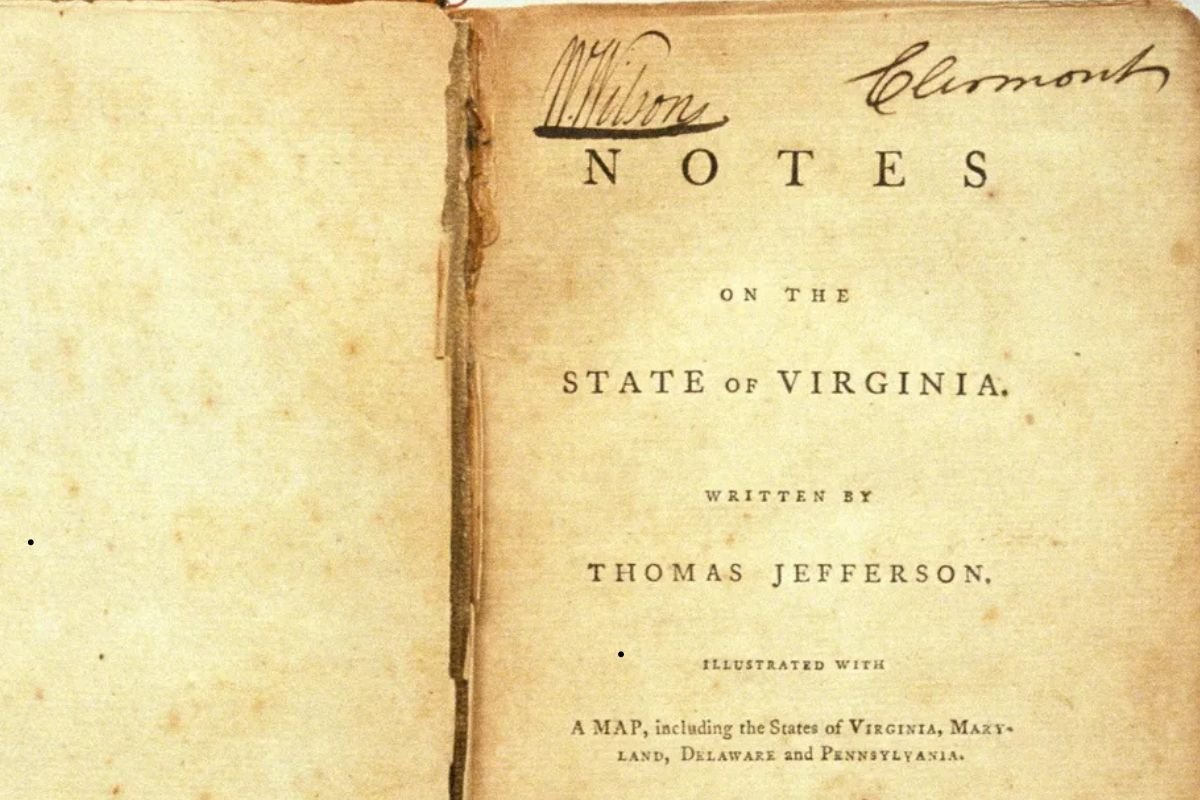
Jefferson never answered this question directly in the Declaration itself. That was not the document's purpose. But he did answer it — twice, in fact. The first was in A Summary View of the Rights of British Americans, outlined astutely on the Ford Forum by Jeff Polet. However, an account that most people missed can be found only in his only full-length book, Notes on the State of Virginia, written in 1782 and published in 1785. Hidden within Query XIII, a section purportedly about the origins of Virginia's constitution, is Jefferson's most complete account of what it means for a people to become a people. It is an account that deserves far more attention than it has received.
Three Foundings
Jefferson traces the origins of Virginia through three distinct constitutional moments, and the distinctions between them matter enormously.
The first came from Queen Elizabeth I's charter of 1584 to Sir Walter Raleigh. This was a grant for exploration and the extraction of natural economic resources. Raleigh and his company could claim land in America, provided they paid the Crown one-fifth of any gold and silver found. The colonists who came under this arrangement died as Englishmen, entirely dependent on the king's charter for their colony's existence. When Raleigh was imprisoned and the colonists vanished, the charter simply dissolved. No independent people had been formed, because none had ever been independent enough to form one.
The second founding came from King James I's charter of 1609. This one was more substantial. The king granted the Virginia settlers a significant level of political self-governance: e.g., their council could be chosen by majority vote, they could establish their own laws, and crucially, they were given significant economic freedoms. They were also explicitly granted "all the rights of natural subjects, as if born and abiding in England." The Virginians, under this arrangement, were politically and economically independent in important respects. But they were still seen and treated as Englishmen. Their identity, their laws, and their rights were all derived from the king's authority. Hence, they were displaced Englishmen, not a distinct people.
Jefferson marks the third founding as something categorically different. It began with a constitutional crisis: Oliver Cromwell's deposition of King Charles I in 1649. With the monarchy dissolved, Parliament assumed authority over the colonies — an authority Jefferson considered entirely illegitimate, since the original charters ran between the office of the monarch and the colonists, not between Parliament and the colonists. The Virginians found themselves, in a meaningful sense, in a state of nature. The structure that had protected their rights was gone.
Parliament had no rightful claim over them, and yet Parliament was moving to restrict their trade and govern their affairs.
Faced with this, the Virginians did something remarkable. Rather than simply submit to Parliament or wait for the monarchy's restoration, they convened their own assembly and secured their rights through their own conventions. Jefferson reproduced Virginia's 1651 Declaration of Rights in the Notes — the first time these documents had ever appeared in print. This moment, Jefferson argues, is when the Virginians became a distinct people: not when a king granted them rights, but when they declared those rights themselves, through their own institutions, independent of any external authority.
What Makes a People
The distinction Jefferson is drawing is subtle but useful. Political independence and economic independence, however substantial, are not sufficient to constitute a people. The Virginians had those under the 1609 charter and were still, in Jefferson's account, Englishmen abroad. What changed in 1651 was that they acted as a self-governing body to secure their own rights by their own institutions. They were no longer receiving their rights from the king but were declaring them for themselves.
Jefferson's reading of history is also an argument about legitimacy. When he later rebukes the British monarchs who violated the rights of the Virginia colonists, his rebuke rests precisely on this point: those kings had no jurisdiction over rights that the colonists had secured independently. The king could not revoke what the colonists had established through their own sovereign act. By 1651, there were effectively two peoples interacting — the Virginians and the English — each with the standing to negotiate with the other. The subsequent agreement between the Virginia assembly and the Rump Parliament, Jefferson implies, was a compact between peoples, not a relationship between a government and its subjects.
This also explains why Jefferson's account in Query XIII serves as something more than local Virginian history. He is explicit that the 1651 crisis affected not just Virginia but all the British colonies in America. With the monarchy dissolved, every colony entered a similar state of nature.
Every colony thus had to reconstitute its relationship to the mainland on its own terms. The Virginian founding as a people was thus, by extension, a template for all the colonies — laying what Jefferson describes as the legal groundwork for eventual independence.
From Virginia to America
Jefferson's narrative in Query XIII does not stop at 1651. It continues through the subsequent violations by later kings and parliaments, violations that parallel the grievances listed in the Declaration of Independence. The pattern Jefferson describes is threefold: the colonists secured their rights through their own institutions; British authorities repeatedly ignored and violated those rights; and the injuries compounded across generations until, with George III, they became intolerable.
Jefferson describes the moment of final rupture directly in the Notes: facing a choice between "resistance, or unconditional submission," the colonies chose resistance. They declared themselves independent states. They confederated into "one great republic." And here is where the question of American nationhood — not just Virginian nationhood — comes into view. This confederation was, at its founding, a military alliance. But Jefferson's language suggests something more: these were not merely allied states that would dissolve their partnership after the war. They had become "one people," united in a shared defense of rights against a common oppressor.
The Declaration of Independence, then, marks the moment when the Americans became a people in precisely the same way the Virginians had in 1651 — by gathering to declare their rights through their own political institutions. The difference was scale and circumstance. Where 1651 had produced a compact between Virginia and the Rump Parliament, 1776 produced a declaration to "a candid world." Where the Virginians secured their rights against parliamentary overreach during an interregnum, the Americans secured theirs against a king who had, in the words Jefferson used in the Declaration, "abdicated government here, by declaring us out of his Protection."
Jefferson himself wrote that the Declaration was meant to represent the "harmonising sentiments of the day.” It was not an invention of rights but a declaration of rights already understood to belong to a people already formed.
An Honest Reckoning
Jefferson's account is not without difficulties, and it would be dishonest to ignore them. His framework for people-formation — grounded in the declaration of rights through republican institutions — carried deep exclusions. Enslaved African Americans were denied the very institutions that, by his logic, would have constituted them as a people. Jefferson acknowledged the horror of slavery in Query XVIII, writing that he trembled for his country when he reflected that God was just. But his proposed solutions — gradual emancipation, followed by colonization to a separate territory — reveal how far his republican theory of nationhood fell short of its own premises.
Similarly, Jefferson placed the Indigenous peoples outside his framework of people-formation, categorizing them in the Notes under the section on Nature rather than civil society. He admired their physical and social capabilities while insisting they had not yet adopted the practices of land ownership and farming that would qualify them as rights-declaring peoples. The condescension here, whatever its era, is a flaw in his thinking that cannot be explained away.
While these tensions are real, they do not detract from the philosophical contribution Jefferson made in Query XIII. His account of people-formation offers a concrete, historical argument about what it actually means for a group of human beings to leave the state of nature and constitute a sovereign people. It is Lockean political philosophy applied to Virginian — and later, American—history. It is not enough to share a language, a territory, or even a cultural tradition. A people becomes a people when it gathers — through its own institutions, from its own authority — to declare and defend the rights that define its common life. That is a demanding standard, and Jefferson knew it.
It is worth remembering this when we read the Declaration not as a philosophical abstraction but as the act it was: a people declaring, to themselves and to the world, what they had already become.
Based on Phillip Pinell, “How a People Becomes a People: Memory and Identity in Jefferson's Notes on the State of Virginia,” American Political Thought, Vol. 13, No. 3 (Summer 2024).