Wesberry v. Sanders (1964)
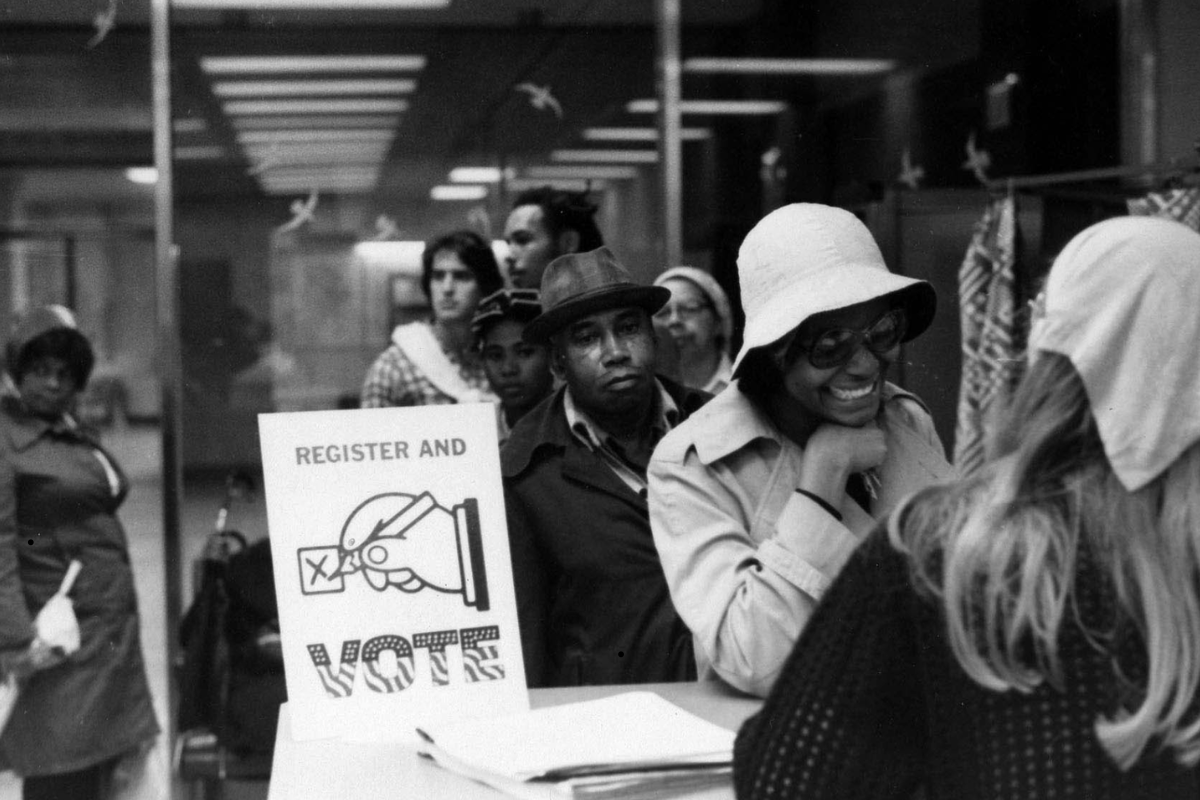
Courtesy of Atlanta University Center, Robert W. Woodruff Library Archives, Voter Education Project Organizational Records.
The Warren Court’s Jacobin Reimagining of American Constitutionalism
In its day, the Warren Court gained the reputation for being revolutionary. The charge is not always deserved or appropriate, but its reapportionment case law is true to the label. Chief Justice Warren considered the Court’s reapportionment decisions his greatest achievement while on the Court. He believed that malapportioned legislative districts were so detrimental to social and political progress that forcing states to reapportion their legislative districts on the principle of one person, one vote, would result in a new progressive era of public policy. The Warren Court’s reapportionment case law, however, is a good example of why the political aspirations of idealists rarely match political reality and rarely result in their intended outcomes. The Court’s good intention to end “vote-diluting discrimination” caused by malapportionment resulted in the proliferation of gerrymandering and the fierce competition between political parties to make congressional elections as uncompetitive and predetermined as possible. What began as an effort to make all votes in congressional elections mathematically equal ended in making most votes in such elections meaningless.
Background and Legal Issues in Wesberry v. Sanders
The Warren Court’s reapportionment revolution began with Baker v. Carr (1962) and Gray v. Sanders (1963). It continued with Wesberry v. Sanders (1964) and Reynolds v. Sims (1964). There is a progression to these cases. In Baker v. Carr, the Court overturned Colegrove v. Green (1946) which ruled that legislative apportionment was a political question and nonjusticiable; it was not appropriate for courts to decide. The idea that courts should avoid deciding political questions assumes that the legitimacy of courts depends on remaining distant from political controversy. If the public believes that the Supreme Court is deciding cases based on political preference or ideology, then the Court and Constitution itself are more likely to be perceived as mere instruments for political factions to use according to their respective interests. The political question standard suggests that courts should remain politically neutral to protect the integrity of judicial decision-making and the Constitution.
Gray v. Sanders ruled that state voting systems that were not based strictly on popular vote, (e.g., systems similar to the Electoral College), were unconstitutional. Such systems created the possibility of candidates losing the popular vote but winning the election. The Warren Court considered such outcomes to be contrary to the Fourteenth Amendment Equal Protection Clause and to the democratic principle of one person, one vote. In Wesberry v. Sanders, the Court ruled that when states apportion congressional districts that are unequal in population, they violate the Fourteenth Amendment and the principle of one person, one vote implied by Article I, Section 2 of the Constitution. Reynolds v. Sims came to the same conclusion regarding state legislative districts based on similar constitutional logic.
In fewer than three years, the Warren Court radically changed the meaning of American constitutional democracy in an attempt to remedy the problem of malapportionment, a practice used in many instances to discriminate against racial minorities who tended to live in urban centers.
The Court’s Ruling in Wesberry v. Sanders
James Wesberry Jr. and other Georgia voters sued the state, including Governor Carl Sanders, claiming that they were harmed by its malapportioned congressional districts. Their votes were diluted in value because they resided in districts that were significantly greater in population than other districts. In some instances, one district’s population was three times as large as another district. Such disparities were often created by the state’s failure over decades to alter congressional districts to account for urbanization trends. When a federal district court dismissed the case by following Colegrove v. Green, Wesberry appealed to the U.S. Supreme Court which ruled 6-3 in his favor. Justice Black wrote for the Court.
The Court’s ruling is based on one overarching assumption: the Constitution requires that legislative districts be apportioned based on equal population. Why? Because to do otherwise is to engage in “vote-diluting discrimination” that violates Article I, Section 2 of the Constitution. According to Justice Black, when the Framers determined the basis for representation at the Constitutional Convention, they followed the principle that “one man’s vote in a congressional election is to be worth as much as another’s.” This principle is implied by Article I, Section 2.
Justice Black summarized the Framers’ intent when he suggested that “[o]ne principle was uppermost in the minds of many delegates: that no matter where he lived, each voter should have a voice equal to that of every other in electing members of Congress.” Malapportioned legislative districts violate this principle by definition. The mathematical value of each voter’s vote must be equal. Here Justice Black was reaffirming the Court’s ruling in Gray v. Sanders that “one person, one vote” is the only constitutional basis for representation. He acknowledged that “mathematical precision” in apportioning legislative districts will have its limits. The point is that legislative districts cannot be designed with the intent to malapportion them; they must be configured to be as mathematically equal in population as possible.
Justice John Marshall Harlan II wrote a dissent that went to the heart of Justice Black’s argument. Harlan challenged the very notion that the Constitution required mathematical equality in apportioning congressional districts. He accused the majority of dealing in “abstractions” and ignoring “the realities of political life.” Justice Black imposed an odd and inaccurate construction of Article I, Section 2. Rather than requiring states to apportion legislative districts on the basis of strict population equality, Article I, Section 2 explains the distribution of representatives between the states. Each state receives a number of representatives based on its population, but Article I, Section 2, does not mandate any particular method of apportioning congressional districts within a state. In fact, Article I empowers states to determine their respective voting qualifications that affect the mathematical value of votes. The Court has confused the apportionment of seats in the U.S. House of Representatives with the apportionment of districts within the state. The evidence against the Court’s reading of the Constitution is the fact that the document guarantees each state at least one representative in the House. This requirement means that the mathematical value of votes in one state will not be equal to the value of votes in other states.
Wesberry v. Sanders Legacy
What is especially interesting about the Court’s ruling in Wesberry v. Sanders and its reapportionment case law in general, is that the Justices in the majority attempt to impose a strict mathematical conception of equality on the problem of legislative apportionment. In doing so, they ignore a central concern of the Framers that is embedded in the Constitution’s structure and principles, majority tyranny. Nothing in the Framers’ intent or the structure of the original Constitution suggests anything like the mathematical equality of votes in the way it is meant by the Court. The Electoral College, the U.S. Senate, the U.S. House of Representatives, the federal courts, the amendment process, presidential elections decided by Congress, and the impeachment process are not in any way based on the principle of equality as the Court understands it in its apportionment decisions. The same is true for the unwritten constitution. The filibuster, American political parties (including their respective presidential nomination processes), congressional committees, House and Senate rules, and the functioning of federal agencies and the military are not based on anything like mathematical equality or equal representation.
What is strikingly apparent about the legacy of the Court’s reapportionment case law is that it exacerbated the problem of party gerrymandering as Justice Harlan predicted in his Kirkpatrick v. Priesler (1969) dissent. There is irony in this consequence. Once the Supreme Court required that legislative districts of all types had to be apportioned on the basis of mathematical equality, gerrymandering proliferated. At the time of the Court’s ruling, almost 400 congressional districts violated the one person, one vote principle; they had to be reapportioned. Beyond the immediate need for reapportionment, the ruling meant that, with the exception of congressional districts in states with only one House seat, all congressional districts would have to be reapportioned at least every decade, providing greater opportunity for gerrymandering.
The proliferation of gerrymandering undermines the objective of the Court’s reapportionment decisions. Party gerrymandering decreases the number of competitive legislative districts making the actual value of votes—as opposed to their abstract mathematical value—closer to zero than to one. Non-competitive legislative districts are equal in population, but voters who belong to the political party that is in the minority in those districts have virtually no chance of electing the candidates they support. Moreover, gerrymandering distorts public support for the two political parties. States with roughly even numbers of registered Democrats and Republicans typically have lopsided party representation in their congressional delegation. The Court’s reapportionment rulings have, then, contributed to the very thing they were intended to prevent: vote-diluting discrimination. The Warren Court accomplished its abstract, idealistic outcome, one person, one vote, and in doing so it helped to make most votes in congressional elections meaningless because gerrymandering determines the outcome before any voter casts a vote.
Justice Harlan accused the majority in Wesberry of ignoring political reality; in Kirkpatrick v. Preisler, he was prescient.
The fact of the matter is that the rule of absolute equality is perfectly compatible with “gerrymandering” of the worst sort. A computer may grind out district lines which can totally frustrate the popular will on an overwhelming number of critical issues.
Every day, residents of congressional districts are born, they die, move in and out of the districts and in and out of the state. No two congressional districts have the exact number of voters because of their variegated demographics and the dynamics of population and voter registration changes. A current example illustrates the point. Utah’s 3rd Congressional District is among those with the lowest population of eligible voters because it has one of the highest birth rates of any district and, thus, one of the highest rates of non-voting population. Districts with high percentages of non-citizen populations (e.g., recent and illegal immigrants) and high rates of nonregistered voters also have a correspondingly low percentage of eligible voters. Districts with older populations with fewer non-citizen residents and higher rates of voter registration have a higher percentage of eligible voters. These and other demographic differences do not account for variations in voter turnout. Statewide voter turnout in the 2024 election varied by as much as 25 percentage points. Wisconsin and Minnesota had turnout rates of 76.93% and 75.9% respectively, while Hawaii and Arkansas had rates of 50.3% and 50.8% respectively. The variation of voter turnout rates between congressional districts is even greater in primary elections than in general elections. Such disparities exist between all legislative districts within and between states.
There are two relevant points to make about these facts. First, the Court’s reapportionment case law assumes that voting is only fair and constitutional when legislative districts are apportioned based on one person, one vote. Yet that standard can never be realized because of the dynamics of population and demographic characteristics and changes, voter registration rates, voter turnout rates, and the imprecision of the census. Second, the assumptions that Chief Justice Warren makes in his Reynold v. Sims opinion that a) “the weight of a citizen’s vote cannot be made to depend on where he lives” and b) “a majority of the people of a state [should be able to] elect a majority of that State’s legislators,” are clearly out of touch with the realities of demographic characteristics and voter turnout rates alone. The weight of voters’ votes is dependent on where they live because of these and other factors. The Supreme Court is powerless to change these realities. In every presidential election and most congressional elections a minority of a state’s population elects all candidates, including a majority of the state’s congressional delegation and a majority of its state legislators. The reason why is simple. The percentage of people in a state who vote is almost always too low to present the possibility of a majority of the state’s population electing a majority of a legislative body. In the 2024 presidential election only 45% of the U.S. population voted. Roughly half of those voters voted for Trump and roughly half for Harris. Each candidate received votes from less than 25% of the population. The closer election outcomes are (when votes have their greatest effect), the lower the percentage of the population that decides election outcomes. The only elections in which Chief Justice Warren’s principles are even remotely present are those in which one candidate gets all or most of the votes.
Does this analysis mean that there is no merit to the Court’s legislative apportionment case law? Not necessarily. What gets lost in the Court’s abstract analysis is the real issue in reapportionment cases. Chief Justice Warren calls it “invidious discriminations,” the drawing of legislative districts to significantly dilute the votes of minorities and other groups of voters. When such discrimination is based on race, it is clearly unconstitutional under the Fourteenth Amendment Equal Protection Clause, but it does not mean that all unequal legislative apportionments are, as the Court suggests, unconstitutional by definition. As Justice Harlan explains in his Reynolds dissent, there are a host of legitimate factors that justify drawing legislative districts that are unequal in population. These include ensuring that the districts maintain the integrity of existing city, town, and county boundaries. When Chief Justice Warren glibly remarks in his Reynolds opinion that “Legislators represent people, not trees or acres,” he is far from the mark. The trees, farmland, rivers, lakes and streams, streets, highways, homes, neighborhoods, businesses, churches, schools, parks, natural resources, and the very air that citizens breathe are part of the living fabric of legislative districts. The human beings who live in those places are not autonomous, isolated individuals living in a Hobbesian state of nature. The quality of their lives depends on the quality and vibrance of things that make their lives meaningful, prosperous, beautiful, and safe. To suggest a) that such things do not matter in the apportionment of legislative districts because they cannot vote, and b) the only thing that does matter is mathematical equality, is to engage in Jacobin abstraction.

Professor of Political Science at Middle Tennessee State University
Related Essays