
The Ford Inheritance: The Discipline of Just War Theory in an Era of Escalating Violence
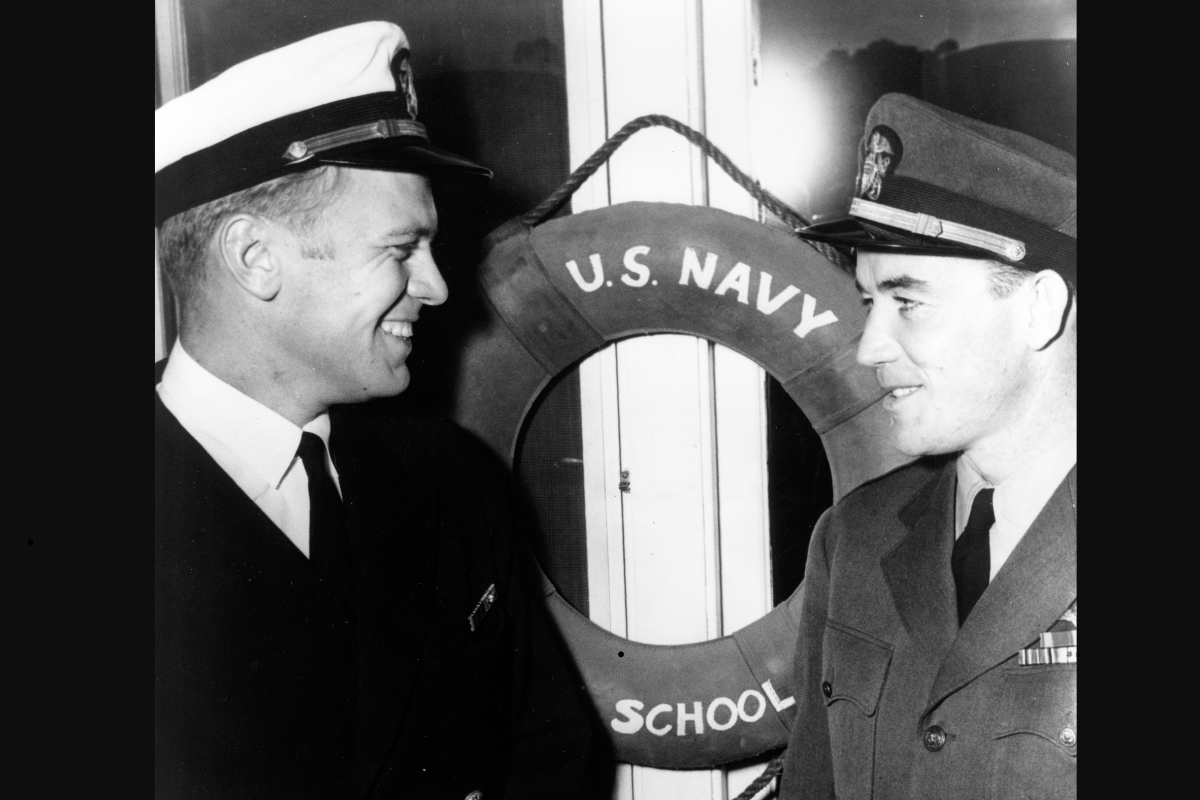
Lieutenant Gerald R. Ford, Jr., (left) poses with an unidentified officer.
On February 28, 2026, the United States and Israel simultaneously launched nearly nine hundred strikes on Iranian facilities over approximately twelve hours (Stewart et al., 2026). One of these strikes hit the Shajareh Tayyebeh girls’ elementary school in Minab, killing an estimated 170 people, most of them children between the ages of seven and twelve (Office of the United Nations High Commissioner for Human Rights [OHCHR], 2026). Approximately six weeks later, a short-lived cease-fire is now unraveling; an American naval blockade has effectively shut down commercial traffic into and out of Iranian ports; and analysts throughout Washington are beginning to examine why a confrontation that many believed could be resolved through diplomatic efforts has turned into the most extensive American military engagement in the Middle East since the 2003 invasion of Iraq (Gambrell, 2026; Sanchez & Madhani, 2026). Regardless of the ultimate outcome of this confrontation, the episode has already raised a question that has far too frequently been put off in the lengthy years since the conclusion of the Cold War: by what standards shall we evaluate America’s use of force?
In the Western world, the answer to this question has been some variation of what we refer to as just war theory for over sixteen centuries. This tradition was initially established by St. Augustine as he grappled with the sack of Rome (Augustine, 426/1972), developed further by Thomas Aquinas (1485/1947), carried forward into Protestant politics by Martin Luther and the Reformers, and came to America as part of the civic traditions brought here by scholars such as Paul Ramsey (1968), Reinhold Niebuhr (1940), and Jean Bethke Elshtain (2003). As stated earlier, just war theory is not pacifism. Rather, it is a strict set of inquiries that all nations must respond to prior to using force (the jus ad bellum), while engaging in conflict (the jus in bello), and after having engaged in conflict. Prior to the initiation of violence, the jus ad bellum asks six distinct questions. First, is the reason for going to war “just”? Second, does a legitimate authority exist which has given approval for the use of force? Third, is the intent behind initiating force to establish peace rather than to exercise dominance? Fourth, is there a reasonable expectation that the use of force will achieve its desired goals? Fifth, is force being used as a last resort? Sixth, is the benefit sought in using force commensurate with the harm anticipated to occur? Once war begins, the jus in bello asks two additional questions. First, are combatants distinguishable from non-combatants? Second, are the means employed to engage in conflict proportional to military necessity? These criteria are not mere suggestions or guidelines. Rather, they have influenced (or prevented) each American president’s decision-making regarding the use of force in every modern conflict.
No previous American president felt more acutely aware of the burden of these criteria than Gerald R. Ford. He took the oath of office on August 9, 1974, under extraordinary circumstances (Gerald R. Ford Presidential Foundation, n.d.). The Vietnam War was rapidly disintegrating; Congress had approved the War Powers Resolution over President Richard Nixon’s veto only the previous November (Congressional Research Service, 2025); and the American public had lost its interest in implementing a large-scale foreign policy at the initiative of the president. For Ford, based upon his nearly twenty-five years of experience in the House of Representatives and eight years serving as its minority leader (United States House of Representatives, n.d.), his natural inclination was to view these limitations as positive attributes to be respected rather than as impediments to be overcome.
Two events in Ford’s short tenure as president illustrate how a responsible steward of the just war criteria applies them to decisions made in real time. On May 12, 1975, Khmer Rouge forces seized an American merchant ship, the SS Mayaguez, off the coast of Cambodia (Gerald R. Ford Presidential Library and Museum, n.d.-b). Believing the crew to be held captive on the nearby island of Koh Tang, President Ford ordered a military rescue mission. The operation recovered all thirty-nine crew members, though the Khmer Rouge had in fact released them during the course of the rescue; forty-one American servicemen nevertheless lost their lives in the operation, including twenty-three killed in a helicopter crash in Thailand during the staging phase (Guilmartin, 1995). Critics charged that the mission was disproportionate to its objective. Supporters argued that it demonstrated to potential adversaries that America would stand up for its interests and reputation. While supporters and critics alike have valid arguments supporting their respective positions, what is relevant for our purposes is that this event was undertaken, discussed, and remembered within the same frameworks provided by the just war tradition: proportionality, necessity, and accountability for lives lost in achieving these objectives. Only three months later, on August 1, 1975, President Ford participated with thirty-four other national leaders in signing the Helsinki Final Act (Gerald R. Ford Presidential Library and Museum, n.d.-a). The Accords established commitments by signatory states, including the Soviet Union, that corresponded directly with elements of the just war legacy: equal sovereignty of states, inviolability of borders, peaceful resolution of disputes, and non-violence except in self-defense. Critics at home characterized Ford’s participation as legitimizing Soviet borders and acting irresponsibly. However, Ford recognized that establishing mutually agreed-upon standards for evaluating adherence to principles constitutes itself a powerful tool.
To apply these criteria to what has transpired since February 28 indicates that, although there are substantial points on both sides of this ledger related to Iran’s nuclear ambitions, its support for armed organizations operating throughout the region, and its violent responses to protests by its own citizens, defenders of U.S. actions indicate that preventing Iran from acquiring nuclear capabilities is legitimate reason to initiate military action against Iran. Critics argue that acting preventively against a nuclear program that has not yet produced a nuclear device stretches “just cause” closer to “preventive war,” an option historically rejected by traditionalists (Elshtain, 2003; Ramsey, 1968). Additionally, the fact that the executive acted unilaterally without new Congressional authorization and without consulting the United Nations Security Council raises questions about legitimate authority that Ford would have recognized quickly due to his background as a former member of Congress (House of Commons Library, 2026). Furthermore, considering that U.S.-Iranian negotiations were underway in Oman at the time the U.S. and Israel initiated military strikes creates uncertainty concerning whether force was applied as a last resort, regardless of how one evaluates the merits of negotiations among the parties involved. Finally, civilian casualties suffered by residents living near Iranian military installations create another critical concern regarding what obligation exists toward innocent civilians injured or killed by U.S. and Israeli military activity.
It appears inevitable at times such as these to draw conclusions either that just war theory fails to provide adequate guidance relative to modern warfare or has simply been abandoned as irrelevant by those who practice warfare today. Both conclusions appear premature. Just war theory has adapted previously. It incorporated changes resulting from developments such as gunpowder, the establishment of nation-states, total war, and nuclear weapons, so presumably it can incorporate developments resulting from contemporary advances in warfare technology such as hypersonic missiles, cyber warfare, and algorithms for targeting enemy systems and forces. What just war theory cannot accommodate is apathy. Publics demanding compliance with the criteria will need leaders who believe that compliance with those demands represents a responsibility inherent to their position.
Ford’s approach illustrates how a practical application of the just war tradition would require a person with Ford’s characteristics: not a strategic thinker per se, but someone with a lawyer’s respect for procedure, a legislator’s propensity for consultation, and an experienced veteran’s aversion to losing lives for reasons other than clear objectives. Whether Ford succeeded or failed is beside the point; it is important that he attempted to frame his decision-making processes within an established framework of inquiry as mandated by tradition, and that he framed his reasoning within a sequence (proportionality, necessity, accountability for lives) as defined by tradition. The manner in which future generations of Americans determine whether or not they wish to employ force, and, if they elect to employ force, whether they require themselves to systematically pose questions to themselves consistent with tradition, will influence the tradition that is passed on. Given that Ford received the presidency under difficult conditions and returned it to the people stronger than when he accepted it, Ford would understand the implications of this issue as well as we do.

Dr. Joshua Longmire, Assistant Professor of Leadership and Director of the M.A. in Leadership and M.A. in International Relations.
Related Essays
Ever since Ford pardoned Nixon, the perspective of the press and the nation changed.