Mapp v. Ohio (1961)
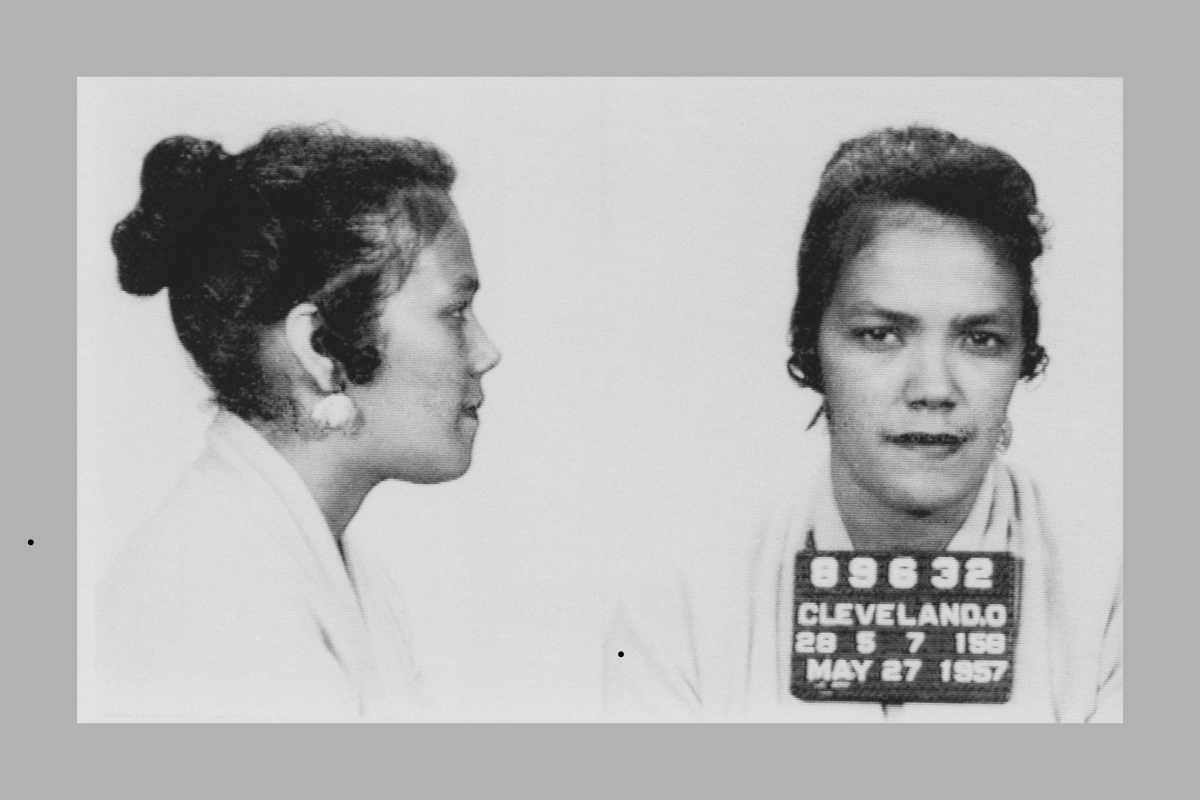
Arrest Photo of Dollree Mapp. Cleveland Police Department, May 27, 1957.
Introduction
In 1961, the appeal of a young woman who had been convicted of possession of obscene materials landed on the steps of the U.S. Supreme Court. The resulting decision in Mapp v. Ohio would prove to be the cornerstone of the Warren Court’s sweeping expansion of the constitutional rights of the accused. The case began the nationalizing of the procedural protections of the Fourth, Fifth and Sixth Amendments. It also triggered a fierce public backlash, as critics claimed the Court was shackling law enforcement and the administration of criminal justice. Despite the decades-long efforts to narrow Mapp and its impact, the foundational protections it established against unlawful governmental intrusions have survived.
The Rise of The Exclusionary Rule and the Question of Incorporation
The Fourth Amendment of the Bill of Rights is the linchpin of the procedural protections for those accused of a crime, declaring that “The right of the people to be secure in their persons, houses, papers, and effects, against unreasonable searches and seizures, shall not be violated . . .” The prohibition against illegal searches and seizures played little part for much of our country’s history, as law enforcement faced no real consequences for violating the Fourth Amendment. Police typically were not held liable or subject to penalty for their actions, nor was improperly seized evidence excluded from trial. Until the early Twentieth Century, the only remedy for violations of the Fourth amendment had been to sue officers for trespass or tort damages, which was rarely successful.
That changed in 1914, when the Supreme Court in Weeks v. U.S. established the exclusionary rule in federal criminal cases. The Court in Weeks determined that when a search was conducted “without sanction of law,” courts ought not to affirm improper police action by admitting illegally seized evidence into trial. Under the exclusionary rule, evidence improperly acquired by federal law enforcement in violation of the Fourth Amendment could not be used in federal criminal trials.
As the Court began its work of selectively incorporating First Amendment rights in the 1920s and ‘30s, it was only natural that there would be a push to apply Weeks to state criminal trials as well. While a handful of states adopted their own version of the exclusionary rule, most resisted extending the Weeks rule of exclusion to their criminal trials. Then New York appellate Judge Benjamin Cardozo, one of the most highly respected state court judges, memorably stated in a 1926 case the argument for resisting the exclusionary rule in what would become an oft-cited adage. “The criminal is to go free because the constable has blundered . . . A room is searched against the law, and body of a murdered man is found . . . The privacy of the home has been infringed, and the murderer goes free.”
The Supreme Court eventually took on the question of the exclusionary rule’s application to state prosecutions in Wolf v. U.S. (1949) The Wolf decision hung on the tension between the goal of fair procedure and the demands of federalism, with the Court by a narrow 5-4 margin coming down on the side of the latter. Writing for the Court, Justice Felix Frankfurter concluded that, “in a prosecution in a State Court for a State crime, the Fourteenth Amendment does not forbid the admission of evidence obtained by unreasonable search and seizure.” The Court started down the path of incorporation, but only traveled part ways. The majority acknowledged that Fourth Amendment protections against arbitrary policy intrusions upon one’s privacy were basic to a free society and hence enforceable against the states via the Fourteenth Amendment Due Process Clause. But the Court refused to hold that the exclusionary rule was a necessary part of the Fourth Amendment. States were free, but not compelled, to exclude illegally seized evidence. The exclusionary rule was but one method of enforcing search and seizure law, and not a mandatory one. And many states that had rejected the exclusionary rule “had not left the right of privacy without other means of protection” of the Fourth Amendment. Provided states employed remedies such as a private tort action or internal police disciplinary measures, the Court concluded that it did not violate due process for states to “introduce illegally obtained evidence in state trials.”
The Prosecution of Dollree Mapp
The case that would lead to the upending of the Wolf rule involved a young woman with a checkered past and a history of run-ins with the police. Dollree Mapp was a 28-year-old black woman who lived in an upstairs Cleveland, Ohio apartment with her 15-year-old daughter. The police knew her from her involvement in gambling and organized crime activities in the city. So it was hardly a surprise when the local police received an anonymous tip a that bombing suspect was hiding in Mapp’s building, and that there were betting slips and other gambling equipment on the premises. When police knocked on Mapp’s door, she refused to let them in unless they could produce a warrant. After waiting several hours and with the help of reinforcements, the police again approached the apartment and demanded Mapp let them in. When she did not immediately answer, they broke a back window and forced open a locked door. When Mapp demanded they show her a warrant, an officer waved a piece of paper he claimed to be a warrant. Mapp grabbed the paper and stuck it down her blouse, setting off a tussle with the police. Once they recovered it, the police handcuffed Mapp and proceeded to search the house. As they did so, Mapp’s lawyer arrived, but was denied access to the house nor was he allowed to consult with Mapp. The search yielded some betting slips in a trunk in the basement, along with a few “obscene” materials in the form of pamphlets, books and pictures. Mapp was initially charged with illegally possessing betting materials, but was acquitted. Several months later, when she refused to cooperate with police in the prosecution of organized crime figures, Mapp was charged and subsequently convicted for possession of pornography.
Mapp appealed her conviction to the Ohio Supreme Court, which found the police’s conduct in clear violation of the Fourth Amendment search and seizure provisions. The Court described the search as offending notions of fundamental fairness on such a level as to “shock the conscience.” Nevertheless, the Court held that, because the evidence was not taken from Mapp through the use of “brutal or offensive physical force against her,” her conviction was upheld. Mapp appealed to the U.S. Supreme Court.
The Majority (Plurality?) Opinion
A badly fractured 6-3 Supreme Court overturned Mapp’s conviction as violative of the Fourth and Fourteenth Amendments. Justice Tom Clark wrote for what was in actuality a bloc of four, with Warren, Brennan and Douglas joining with Justice Clark’s reliance on the exclusionary rule, and with Justice Back joining in the result but for different reasons. The Court’s decision to extend the exclusionary rule to all state criminal trials was a surprise to many, including the lawyers and justices who left it mostly unaddressed in oral arguments. The advocates before the Court had focused on whether the Ohio anti-obscenity statute under which Mapp was convicted was overly broad and hence a violation of her free speech rights. The justices in conference agreed that the Ohio statute violated the First Amendment. It was only afterwards that a “rump” caucus of justices worked to expand the basis for overturning the conviction beyond the First Amendment to invoke the Fourth Amendment. Thus was an obscenity case transformed into a search and seizure case.
Clark opened his opinion by revisiting the Wolf decision in light of what had transpired in the twelve years since its issuance. He emphasized the growing trend in favor of the exclusionary rule at the state level. Of the nearly two-thirds of the states who were opposed to its use at the time of Wolf, more than half of them had adopted it in whole or in part. The Court in Wolf had permitted states to craft their own sanctions short of exclusion to protect citizens from Fourth Amendment violations as incorporated by the Fourteenth Amendment Due Process. Clark concluded that those “other means of protect[ing]” the right of privacy employed by states had proven to be “worthless and futile . . .”
Clark built upon Wolf’s underlying holding that the Due Process Clause had “incorporated” the substantive protections of the Fourth Amendment against the states, taking it a step further. Since the Wolf Court had selectively incorporated a general Fourth Amendment right of privacy against the states through the Fourteenth Amendment, Clark determined that “it is enforceable against them by the same sanction of exclusion as is used against the Federal Government.” Clark argued that once the Court had extended the substantive due process protections to all searches – state and federal – both logic and constitutional necessity compelled recognition of the doctrine of exclusion as an essential part of that right. Otherwise the right to be free of intrusions on one’s privacy by state-level police would “remain an empty promise” and “a form of words” without worth and “undeserving of mention in a perpetual charter of inestimable human liberties . . .” The exclusionary rule was neither a “mere rule of evidence” nor a product of the Court’s “supervisory powers.” Rather it was a “constitutionally required” doctrine.
Clark stressed the deterrent effect of the rule, asserting that the only effective way “to compel respect for the constitutional guaranty” was to remove “the incentive to disregard it.” The application of the exclusionary rule to the states not only made “very good sense,” but it was demanded by the imperative of “judicial integrity so necessary in the true administration of justice.” If the practical effect of the exclusionary rule in some instances allowed a guilty person to go free, Clark intoned, it was the law that set him free, and “[n]othing can destroy a government more quickly than its failure to observe is own laws . . .” Quoting Justice Brandies, Clarked lectured, “Our Government is the potent, the omnipresent teacher. For good or for ill, it teaches the whole people by its example . . .If the Government becomes a lawbreaker, it breeds contempt for law; it invites every man to became a law unto himself; it invites anarchy.” The basic rights secured by the Due Process Clause could not be allowed to be “revocable at the whim of any policy officer who, in the name of law enforcement itself, chooses to suspend its enjoyment.” Thus did the Court explicitly overrule Wolf, holding that “all evidence obtained by searches and seizures in violation of the Constitution is . . . inadmissible in a state court.”
The Black Concurrence
Justice Black concurred with the plurality that the Fourth Amendment prohibition on unreasonable searches and seizures was enforceable against the states. However, he viewed the exclusionary rule not as a command of the Fourth Amendment but as a “judicially created rule of evidence . . .” He failed to see that the exclusionary rule was required by the Fourth Amendment alone, given the absence of express language or text that might support such a finding. The Constitution’s “basic command against unreasonable searches and seizures” was not sufficient by itself to warrant the exclusionary rule. Taken together with the Fifth Amendment’s ban against compelled self-incrimination, however, “a constitutional basis emerges which not only justifies but actually requires the exclusionary rule.”
The Harlan Dissent
The dissent by Justice Harlan criticized the Court’s decision on multiple grounds. Raising several methodological objections, Harlan chastised the Court for disregarding its own procedural rules in relying on an argument that had received virtually no attention in the briefs and oral arguments. He characterized the Court’s indifference to established precedents as a blatant example of unbridled judicial activism. Harlan could discern no clear constitutional principle that supported the incorporation of the exclusionary rule; it was simply a creation of the sitting Justices. Harlan found it unconvincing that more states were embracing the exclusionary rule, given that half of them still adhered to the common-law non-exclusionary rule. Moreover, it was simply irrelevant. What mattered was not the desirability of the rule, but whether states retained the freedom constitutionally to follow it or not. Harlan considered the decision an improvident and unwarranted intrusion on the states’ prerogative to develop their own solutions to instances of unlawful search and seizure. He decried the “one size fits all” that resulted from incorporation. The “flexible contours of the Due Process Clause” weighed against forcing upon the states such remedies “to suit [the court’s] own notions of how things should be done.” Stressing the importance of the “proper balance between state and federal responsibility in the administration of criminal justice,” Harlan contended that states needed to free to determine those remedies that might prove to be most efficacious in their state.
The Implications of the Decision
The practical effects of Mapp v. Ohio were immediate and revolutionary in scope. The impact on the criminal justice system from a decision that imposed the exclusionary rule on the entire country cannot be overstated. Litigation over admissibility of evidence exploded, with an exponential growth in defense motions to suppress evidence and appeals from convictions claiming to have been based on illegally obtained evidence. If the application of the rule to the states was intended to alter police conduct, it succeeded spectacularly. It established a clear deterrent against illegal searches. State police procedures changed dramatically, with wide ranging reforms of search and seizure practices and investigative practices to avoid suppression of evidence. Likewise the courts, with judges paying far greater attention to the sufficiency of warrants, probable cause standards, and search incidents.
Mapp v. Ohio is also rightly regarded as having launched the Warren Court’s revolutionary expansion of criminal procedural protections. It was the opening salvo in a decade of decisions by which the Court nationalized guarantees in the Bill of Rights that regulated police conduct and vastly expanded the rights of the criminally accused. It strengthened privacy and procedural safeguards across the board, and reinforced the principle that constitutional rights must be enforced by practical remedies that have real teeth.
On a political level, the Mapp ruling had a more contested legacy. Critics almost immediately began attacking the rule for resulting in the release of guilty defendants. By the mid-1960s, a backlash was already gaining traction among those who argued that Mapp unduly limited the investigative power of the police and threatening public safety in the process. Arguably, what some saw as clear judicial overreach in Mapp bore the seeds of its gradual erosion. By the time Richard Nixon was running for president in 1968, he was effectively demonizing the liberal Supreme Court and its criminal justice decisions for rising crime rates. He promised, if elected, to put “strict constructionist” and “law and order” justices on the Supreme Court. As President, Nixon was able to make good on that promise, placing four new justices on the Court and beginning the ideological makeover of the Court that included a drawback on criminal rights. The two “Minnesota Twins” who Nixon put on the Court (Justices Burger and Blackmun were childhood friends who both hailed from the great state of Minnesota), while parting ways on countless other issues, shared an intense dislike of the exclusionary rule and were committed to its undoing. Nixon appointee and later Chief Justice William Rehnquist was equally dubious of the exclusionary rule, as was the fourth Nixon appointee, Justice Powell. Kennedy appointee Byron White, who was elevated to the Court in 1962, never flagged during his three decades on the Court in his opposition to the exclusionary rule.
By the time Powell joined the Court in 1972, then, there already existed a majority of the Court that was skeptical of the exclusionary rule. Unsurprisingly, the work of the Burger and Rehnquist courts over the span of the next three decades would be to trim the sails of the exclusionary rule and to do what they could to sap it of its vitality. While the basic commitment to the foundational principle has survived, the Court has limited its application in a variety of settings (in grand jury proceedings and habeas corpus hearings) and through the carving out of exceptions such as “good faith,” “reasonable mistake,” and the “inevitable discovery” doctrine. Perspective on the legacy of Mapp vary widely, from those deem it to have gone too far in undermining the prosecution of bad people to those who see the scaling back of the rule over the decades as eviscerating a foundational constitutional guarantee against unwarranted governmental intrusion into one’s privacy. Suffice it to say that the judicial efforts to doctrinally balance public safety goals and the social costs of the exclusionary rule with the preservation of a real deterrent against police misconduct will surely continue. In the end, however, Mapp v. Ohio is deserving of its landmark status for having secured genuine constitutional protections for criminal suspects that previously had too often existed only in the abstract.