Cooper v. Aaron (1958)
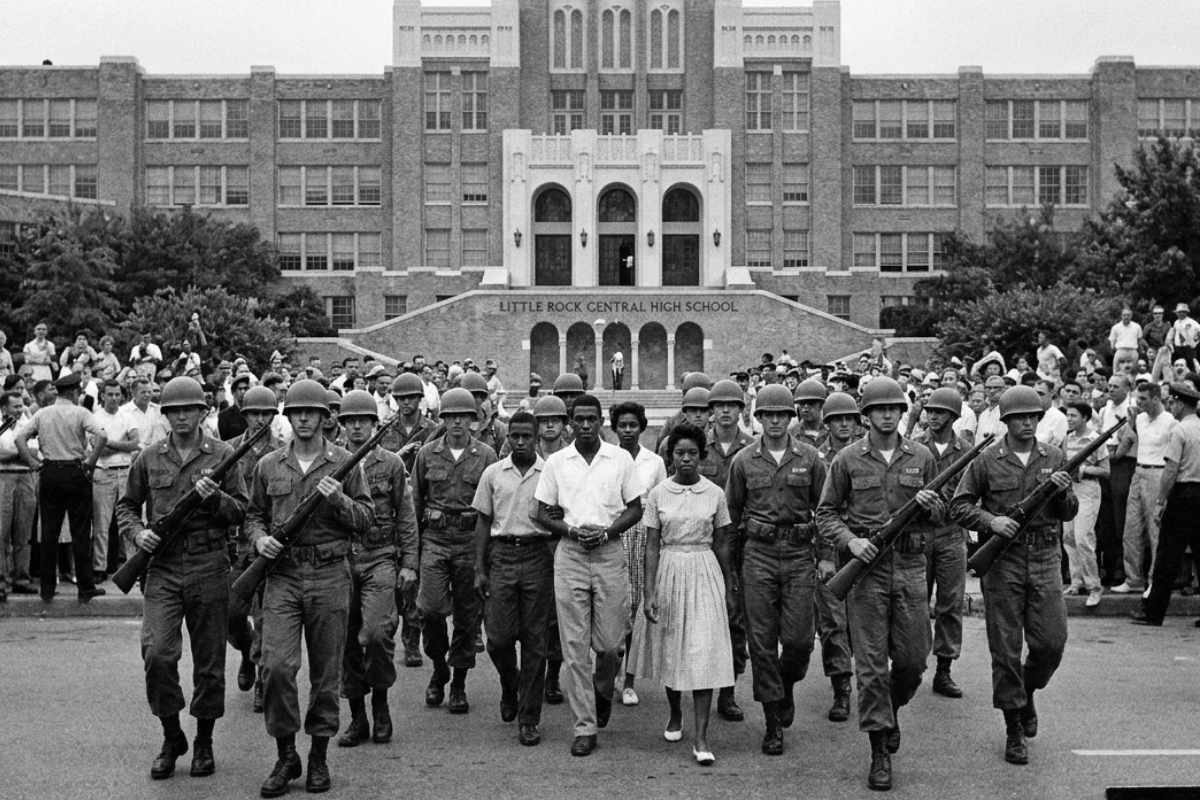
Image courtesy usconstitution.net
The Ascendence of the Court in Tumultuous Times
Supreme Court decisions vary in their legal and extra-legal effects. Some cases receive very little attention when they are decided or in the decades subsequent to the announced ruling. Such cases may have a significant effect on the case’s litigants but be relatively insignificant regarding the development of case law or the role of the federal judiciary in the American constitutional system. Many cases have only a negligible effect on politics, society, or economics, while others have a dramatic effect on political, social, and economic life. Cooper v. Aaron (1958) is significance in all regards. The case was instrumental to the development of civil rights case law, it had a profound political effect, and it marks the pinnacle of Supreme Court power or something close to it.
The context for Cooper v. Aaron includes the political and cultural reaction to the Court’s two Brown decisions in 1954 and 1955. Those cases ruled unanimously that the separate but equal regime embraced by Plessy v. Ferguson (1896) was contrary to the Fourteenth Amendment. As a consequence of the Brown decisions, public schools had to be racially integrated. At this juncture in judicial decision making, two factors are vital to understanding the importance of Cooper v. Aaron. First, it is one thing for a court to rule that schools must be desegregated; it is another matter to desegregate schools when there is ardent opposition to racial integration that includes civil unrest and violence. The Justices on the Brown Courts were well aware of the possibility that their legal mandates would be met with resistance. Moreover, Chief Justice Earl Warren believed that resistance to desegregation would be minimized if the Justices were united in their desegregation rulings. To achieve this objective, the Chief Justice made a compromise, the prudence of which has been debated for decades. In exchange for unanimity, he gave ground on the implementation of the ruling. In the final sentence of Chief Justice Warren’s Brown II opinion, he articulated a standard for school districts to follow regarding the timing and pace of integration: “with all deliberate speed.” The standard was used by desegregation opponents to delay, resist, and in some cases feign cooperation.
Second, the racial integration of public schools was not possible without support from the executive branch. The Court is powerless to enforce its decisions. It depends on the willingness of the president to coerce, if necessary, compliance with Supreme Court decisions. Presidents’ enforcement of legal rulings tends to vary with the political landscape. While the Justices of the Supreme Court are unelected and appointed for life in good behavior—they are largely insulated from democratic pressure—presidents are elected and depend on a popular mandate for the success of their policies. There is a structural tension between the judicial and executive branches of government that was evident in the aftermath of the Brown decisions. The Brown Courts were asking President Eisenhower to risk popular support to enforce a decision that was applauded by some and opposed by others. Eisenhower’s support for desegregation was inconsistent, which likely diminished the effect of the Court’s unanimous Brown decisions. Cooper v. Aaron is a result of the equivocation, chaos, resistance, and turmoil that occurred in the wake of the Brown decisions.
The Legal Issues in Cooper v. Aaron
In the aftermath of the Brown decisions, resistance to the racial integration of public schools varied. In Little Rock, Arkansas, there were efforts to defy or delay the Court’s mandate. Chief Justice Warren’s “all deliberate speed” standard opened the door for opponents of integration to stall. It was not always possible to differentiate stalling from good faith efforts to develop plans for desegregation. Both behaviors were part of the Little Rock School District’s response to the Brown decisions.
In response to Brown I, Virgil Blossom, Little Rock School Superintendent, implemented a desegregation plan that limited integration to one high school, Central High School. In September 1957 as the school year was about to start, Governor Orval E. Faubus, defying a federal court order, deployed the national guard to prevent black students from attending Central High School. John Aaron, one of the black students who wished to attend Central High School, and eight other black students had to be escorted into school by federal troops to begin the 1957-1958 school year. President Eisenhower federalized the National Guard and deployed the 101st Airborne to ensure that Aaron and his black classmates could enter the school safely. Some of the troops were stationed at the school for the entirety of the school year.
In February 1958, Little Rock School Board President William Cooper and other members of the Little Rock School Board requested a two-and-a-half-year timeframe that would stall the desegregation of Central High School while a desegregation plan was developed. The school board was encouraged by Governor Faubus to delay the process of school integration. In June 1958, U.S. District Judge Harry J. Lemley ruled for the Little Rock School Board granting the requested delay. In August 1958, Lemley’s decision was overturned by the U.S. Eighth Circuit Court, which granted a thirty-day hold on the ruling to allow the Supreme Court the opportunity for expedited review of the case. Cooper and the school board appealed the Circuit Court decision to the Supreme Court.
The timing of the case was problematic given its close proximity to the beginning of the school year. The Supreme Court expedited the case hearing oral arguments just three days after accepting the case. The Court had to decide if the Little Rock School Board’s request for a two-and-a-half-year delay was within the Brown II guidelines.
The Court’s Ruling in Cooper v. Aaron
The Court ruled unanimously for Aaron reaffirming its Brown rulings. Justice Brennan wrote the opinion, but it was signed by all nine Justices, the only time in Supreme Court history that occurred. The opinion was also unusual in that it noted that since the first Brown decision three new Justices—John M. Harlan II, William J. Brennan, and Charles E. Whittaker—replaced three Justice who voted in Brown I—Sherman Minton, Stanley F. Reed, and Robert H. Jackson. The three new Justices, the opinion read, “are at one with the Justices still on the Court” who participated in Brown I.
The Court made its ruling clear in the first paragraph of the opinion:
We are urged to uphold a suspension of the Little Rock School Board’s plan to do away with segregated public schools in Little Rock until state laws and efforts to upset and nullify our holding in Brown v. Board of Education have been further challenged and tested in the courts. We reject these contentions.
The Court did not shy away from addressing the resistance to its Brown decisions. It stated that the “constitutional rights of respondents are not to be sacrificed or yielded to the violence and disorder which have followed upon the actions of the Governor and Legislature.”
The Brown decisions stated in no uncertain terms that the Equal Protection Clause of the Fourteenth Amendment prohibits racial segregation in public schools. The rights of black students to attend Central High School cannot be denied for the sake of law and order. Justice Brennan invoked Chief Justice John Marshall’s statement in Marbury v. Madison (1803), “‘It is emphatically the province and duty of the judicial department to say what the law is.’” Justice Brennan pushed Marshall’s point to an extreme by stating two corollary points. First, the judiciary is supreme in determining what the Constitution means. Second, “the interpretation of the Fourteenth Amendment enunciated by this Court in the Brown case is the supreme law of the land, and Art. VI of the Constitution [the Supremacy Clause] makes it of binding effect on the States.” These are statements of judicial supremacy.
Cooper v. Aaron Legacy
On September 29, 1958, the Cooper v. Aaron decision became law. Rather than comply with the Supreme Court’s ruling, voters in Little Rock passed a referendum on September 27, to close their public high schools. On September 29, Governor Faubus closed the public high schools in Little Rock. Litigation followed. The high schools were reopened by a newly elected school board the following school year, but an entire school year was lost.
There are at least two parts of Cooper v. Aaron that have had a lasting effect. The Court was determined not to bow to public pressure in its resolve to desegregate public schools. The Fourteenth Amendment is clear, separate school facilities for blacks and whites are inherently unequal. The era of de jure racial segregation in public schools ended with the Brown decisions. Cooper v. Aaron made this point clear. No amount of resistance to desegregation would be tolerated. The Court’s determination expressed in Cooper v. Aaron was important to ensure that the legal ground gained in the Brown decisions would not be lost.
The Court’s statement of judicial supremacy, that everyone must follow its interpretation of the Constitution, invited criticism. The Court is not the only one with the responsibility to interpret the Constitution or its rulings on it. While the Justices on the Brown and Cooper Courts were united in their reading of the Constitution, Justices often disagree profoundly on the meaning of the Constitution from Court to Court and Justice to Justice in particular cases. Whatever can be said about particular Supreme Court rulings, they are fraught with the same problems of imperfection that plague all human endeavors to seek the true, the good, and the beautiful. The imperfection of human reason suggests that more humility is warranted than what the Court expressed in Cooper v. Aaron. The Court’s frustration with resistance to its Brown rulings is understandable. Yet, the Court would have done well to remember that in the American Constitutional system, powers may be separated but the branches and levels of government work best when constitutional consensus is reached. Although the Court is not designed for compromise, Justices can nonetheless exercise judicial diplomacy to foster cooperation between the branches and levels of government. Exerting supremacy over others is not diplomatic.

Professor of Political Science at Middle Tennessee State University
Related Essays