What are We Celebrating?
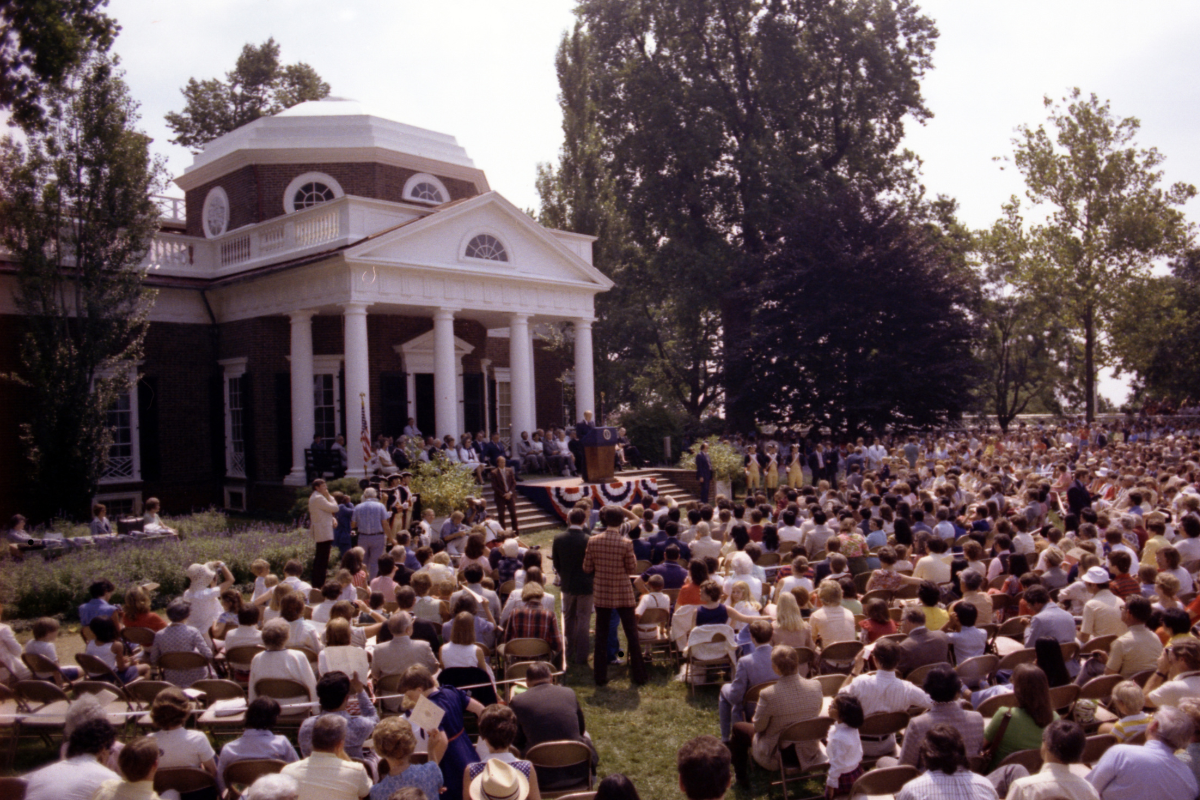
President Ford welcomes 100 new American citizens in a Bicentennial naturalization ceremony at Monticello, the historic home of Thomas Jefferson. Charlottesville, Virginia. July 5, 1976.
Americans are awash with events and concerts and talks and festivities celebrating the 250th anniversary of the Declaration of Independence. But we really should take a moment to ask, “What are we celebrating?”
When historians focus on the Declaration of Independence, they often look primarily at the three-quarters of the document that makes up a list of 27 grievances against King George that precipitated the American Revolution, “excesses of government power,” President Gerald Ford called them during the nation’s bicentennial. And that is an important list:
He has … sent hither swarms of Officers to harrass our people,...
He has kept among us, in times of peace, Standing Armies….
For protecting them, … from punishment for any Murders which they should commit….
For cutting off our Trade with all parts of the world:
For imposing Taxes on us without our Consent…
But that is not why we’re celebrating.
In 1841, in the Amistad case, the Supreme Court explained that the United States was created to promote justice based upon “the great principles of the revolution” as laid out in the Declaration and Constitution. It is those principles that have sustained our reverence for the Declaration, and the nation, over these 250 years.
And those principles are both great and revolutionary.
In the first line of the Declaration, Thomas Jefferson pronounces that Americans are “one people.” Across broad ethnic, religious, language, cultural, and class differences, we are one people. What unites us is belief in and support of the principles of the Declaration and then, as now, Jefferson was announcing that what unites us is more important than what divides us.
And in the second paragraph of the Declaration, we are assured that “governments are instituted among men, deriving their just powers from the consent of the governed.” Government’s power comes from the people, not from God to a king who reigns over a quiescent people by divine right. In America there will be no kings!
But, while the Declaration announces these important American principles, they, too, are not why we are celebrating.
What moves us in the Declaration is that self-evident “truth,” “preserved in human hearts” according to Ford, that “all men are created equal, that they are endowed by their creator with certain unalienable rights, that among these are life, liberty, and the pursuit of happiness.”
That one phrase – “all men are created equal” – some of the most beautiful and most well-known words in the English language, has seized the minds and imaginations of Americans and peoples around the world for 250 years.
But as soon as we pause in our appreciation for that great truth, we are confronted with another horrific truth. Thomas Jefferson, the man who wrote that immortal and profound phrase, enslaved over 600 humans. He bought; he sold; he had some whipped and punished, of course not doing the task himself.
American slavery is a betrayal of the self-evident truth the Founders declared and to which we cling.
We are left confused, angry, deeply disappointed. We want to cry out “Mr. Jefferson, how could you? How could you? You knew of slavery’s vile and horrific nature. You knew that it violated this most solemn human right.” We are left grappling with the Founders’ hypocrisy and failure.
But that is a dangerous and inappropriate place to stop.
Americans can and should embrace the principles of the Declaration, but in doing so, we must also acknowledge and embrace the fact that the Founders failed.
And those trying to erase the failures from our history are doing the nation a great disservice.
Think about Jefferson’s tombstone with an epitaph that he wrote: “Here was buried Thomas Jefferson: author of the Declaration of American Independence, of the Virginia Statute for Religious Freedom, and father of the University of Virginia.”
Jefferson wanted to be remembered for his contributions to political freedom, religious freedom, and public education, what he understood to be the very foundation of a functioning republic. And he and the Founders failed on all three:
on political freedom, most obviously with the foul institution of slavery, but also with women’s rights, Native Americans’ rights,…
on religious freedom, having established the great principle of separation of church and state, our government continued to interfere with religion for many years. America was infected with anti-Semitism, anti-Catholicism,… In 1818, Jefferson wrote Mordecai Noah, a Jewish man, that “altho’ we are free by the law, we are not so in practice.”
on public education, while Jefferson was deeply devoted to the University of Virginia, he had proposed a three-tiered system of public education and always insisted that the primary schools – educating all “free” children (boys and girls) – were the most important because “education of the common people” provided “the most security for the preservation of a due degree of liberty.” But Virginia did not have broad public education until the 1870s.
They failed. Jefferson says it. They knew it.…
But, they didn’t abandon the principles. They understood that the principles of the Declaration were aspirational, something that must continually be fought for if never quite fully achieved, and those principles were more important than the failures. Jefferson put his faith in future generations – in us – to continue the fight for the Founding principles.
Every year, on July 4th, people from all over the world are naturalized as U.S. citizens at Jefferson’s Monticello. When I had the opportunity to give tours at Monticello, I would ask guests if they thought those people understand that Jefferson owned slaves, understand that the Founders failed to implement fully the Declaration’s fundamental principles. And, of course, the new citizens understand that. But they decide nonetheless that it is worth taking an oath to support the nation founded on those principles; they pledge themselves to work on those principles, because they understand that the principles are more important than the failures.
Today, we continue to struggle to implement fully the principles of the Declaration and fail to fully realize their promise. How do we implement political rights: who gets to vote, when and how? And how do we properly balance religious freedom and separation of church and state? How should we structure and fund public education? And how do we make real in our government and our society the promise and truth that “all men are created equal.”
Perhaps no one understood better this tension between principle and reality than Abraham Lincoln. At Gettysburg, mere months after more than 7000 Americans had given their lives there, Lincoln proclaimed that the nation was “conceived in liberty and dedicated to the proposition that all men are created equal.” At the time, the nation was engaged in a great Civil War “testing whether that nation or any nation so conceived and dedicated could long endure.” Ultimately, over 600,000 Americans died in that war and untold damage was done.
Lincoln was painfully aware of the failings. In 1859, before the war began, he wrote one supporter “Those who deny freedom to others, deserve it not for themselves; and, under a just God, can not long retain it.” Lincoln was writing about many of the Founders.
But in that same letter, Lincoln also wrote:
All honor to Jefferson – to the man who, in the concrete pressure of a struggle for national independence by a single people, had the coolness, forecast, and capacity to introduce into a merely revolutionary document, an abstract truth, and so to embalm it there, that to-day and in all coming days, it shall be a rebuke and a stumbling-block to the very harbingers of reappearing tyranny and oppression.
Lincoln understood the value of principle.
He also understood the importance of grappling with failures. In Lincoln’s time, as today, people were using the Founders’ failure to implement fully the principles of the Declaration in an effort to undermine the principles themselves.
“The principles of Jefferson are the definitions and axioms of free society and yet they are denied and evaded, with no small show of success. One dashingly calls them ‘glittering generalities.’” – they didn’t really mean that….
“Another bluntly calls them ‘self-evident lies’” – we know that all men are not really created equal….
“and others insidiously argue that they apply to ‘superior races.’” – so we can’t be held to those principles….
Such attacks anchored the Confederacy formed to protect slavery. James Hammond, a South Carolina senator and enslaver, was vocal: “I repudiate, as ridiculously absurd, that much-lauded but nowhere accredited dogma of Mr. Jefferson, that ‘all men are born equal.’”
Lincoln understood these attacks for what they were: “These expressions…are the vanguard, the miners and sappers of returning despotism.” American freedom depends not on our never failing, but on our continuing to try to live up to the principles of the Declaration. Lincoln understood this and that principles matter, even when we fall short, perhaps especially when we fall short, and that the failures are not a reason to reject the aspirational principles themselves.
Think of it this way: Thomas Jefferson’s sight was very limit; he saw white men. But his vision was expansive.
That is why the women at Seneca Falls were quoting Thomas Jefferson and the Declaration of Independence. That is why Frederick Douglass in the run-up to the Civil War was quoting Thomas Jefferson. That is why in the 1960s civil rights struggle, Martin Luther King and the Black Panthers were quoting Thomas Jefferson. That is why over 100 nations, in their own declarations of independence or constituitive documents quote the American Declaration of Independence and Thomas Jefferson. Not because we have achieved those principles but because they are principles worth fighting for. In spite of failures, those principles are essential if we are to progress.
Jefferson is famously remembered as an optimist – “I like the dreams of the future better than the history of the past” he wrote. His optimism was grounded in his belief in progress, that we would continue to strive for American principles and continue to more fully implement those sacred truths.
So what do we do with the failures?
For many years the answer was to ignore them; to tell a triumphal version of American history without blemishes, without failures. This is bad history, and it does the nation a disservice as progress demands that we learn from our failures.
Today, many would focus only on the failures as the story of American history. They would remove from the pantheon of American statesmen all those who participated in the foul institution of slavery. This, too, is bad history, and, as Lincoln warned, risks undermining the principles that we cherish and returning to tyranny.
As a nation, our only real choice is to study and learn from the failures as we continue to endless struggle to live-up to the principles.
Martin Luther King said that the Declaration of Independence was a “promissory note” to America, a promise of what this nation could be. But to collect on that promise, we must engage in our own struggle to implement its principles. King also wrote that “the arc of the moral universe … bends toward justice.” Notice that we never reach full justice. Our job, using the principles of the Declaration, is to seek to bend that arc.
That’s what we celebrate this year.
I hope that Americans take the opportunity of this anniversary to read the Declaration of Independence, to consider for a moment why we – and others around the world – have honored that document for 250 years. And we should take the opportunity to rededicate ourselves to the principles of the Declaration so that, as Lincoln said on that day at Gettysburg so many years ago, “government of the people, by the people, for the people, shall not perish from the earth.”
*Dr. Ragosta, author of For the People, For the Country: Patrick Henry’s Final Political Battle, is the former acting director of the International Center for Jefferson Studies at Monticello.
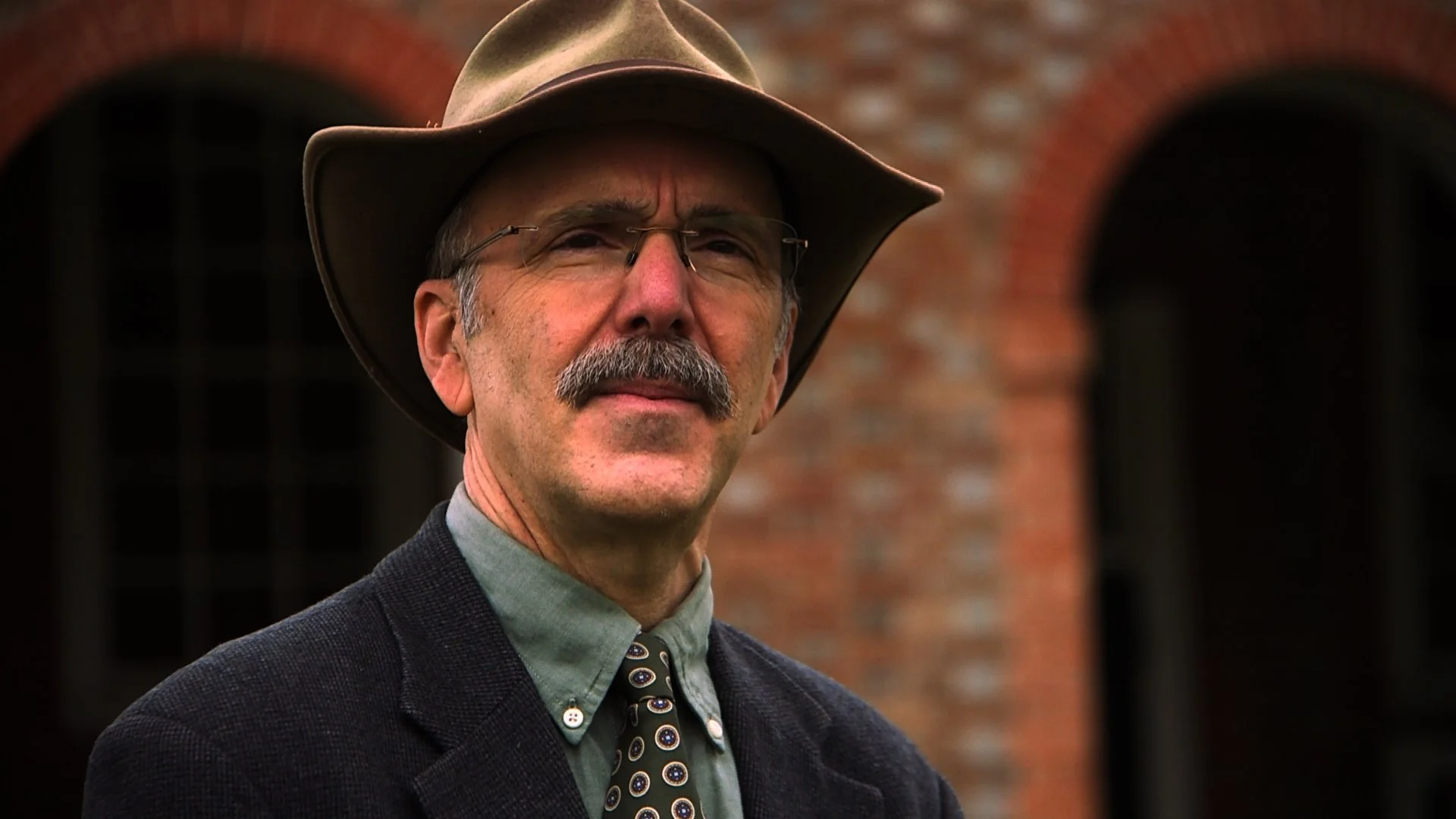
Inaugural James Madison Fellow at Montpelier and a Fellow at Virginia Humanities. Faculty Director of the Summer Jefferson Symposium at the University of Virginia.
Related Essays