The Creative Balance: Still Relevant at Fifty
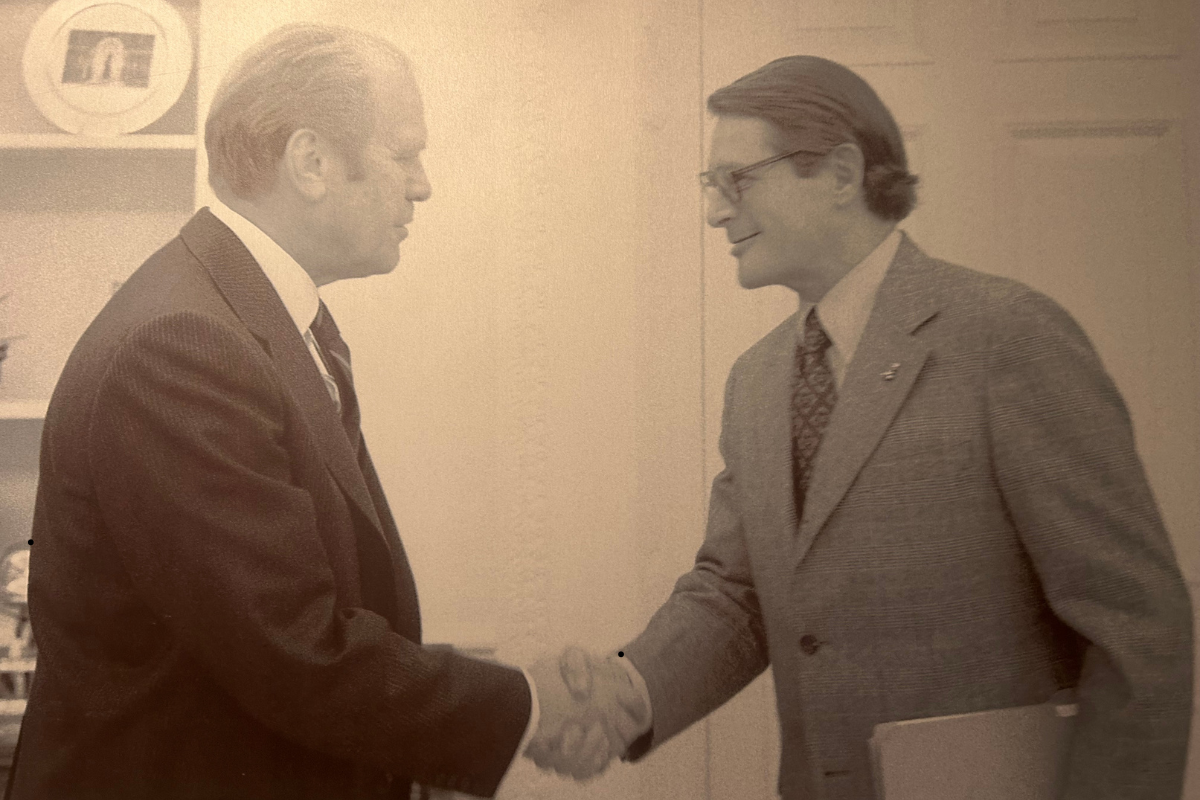
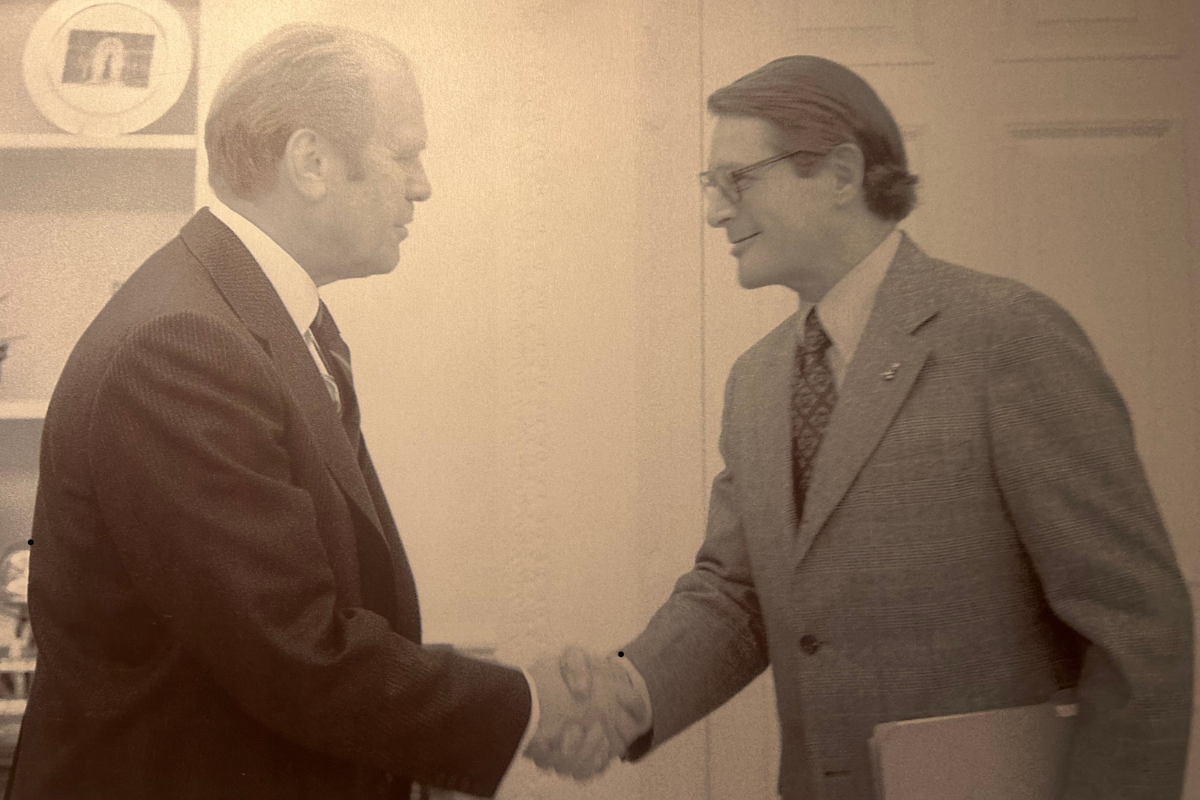
Elliot Richardson (1920-1999) was Gerald R. Ford’s Secretary of Commerce when his book The Creative Balance was published in 1976, just in time for the presidential primary and general election.
The premise was ten years in the making, and the opportunity to finally put his views into writing was the result of Richardson’s resignation as U.S. attorney general on October 20, 1973, during Watergate’s ‘Saturday Night Massacre.’ The unemployed Richardson, age 54, then found a temporary home at the Smithsonian Institution’s Woodrow Wilson International Center for Scholars, where he completed two-thirds of the manuscript in 1974.
Appearing on “Meet the Press” (April 28, 1974) to discuss his political future, Richardson referenced his project saying, “We can and should move in a direction that emphasizes the rebuilding of community and greater reliance on governmental units that are subject to the voice of the individual.” During this time, Richardson was also on the lecture circuit speaking to college audiences, civic groups and Republican gatherings; these experiences informed his manuscript. Not only was Richardson “making up for my loss in salary;” he was testing the waters for a presidential bid should Ford decide not to run in 1976.
During Ford’s Presidency, Richardson returned to the government as Ambassador to Great Britain in 1975. During this time, he spent evenings and weekends completing the manuscript while watching stateside political developments. When Ford decided to run, Richardson quickly announced his support. Ford’s subsequent cabinet changes gave Richardson his fourth cabinet post as Commerce Secretary in 1976. With Vice President Nelson Rockefeller’s decision not to remain on the ticket, Richardson joined the short list of potential Vice Presidential candidates.
The 390-page Creative Balance begins with an introduction celebrating our Republic’s innovative founding ideas: limited national government, systems to prevent the abuse of power and hold all branches of government accountable to the people. Although not a Watergate book, the opening chapter covers Richardson’s unprecedented task of simultaneously investigating both President Richard M. Nixon and Vice President Spiro T. Agnew. Though critical of Nixon, it was also respectful—as were his public comments.
Not intended as a memoir, the book is filled with anecdotes from his political campaigns and government posts, especially his two assignments at Health, Education and Welfare (HEW) as Assistant Secretary under Eisenhower and Secretary under Nixon. To some readers, these career highlights are of as much interest as the book’s theme itself. For example, Richardson wrote that he was disappointed to discover that HEW programs had tripled in size and complexity in the twelve years between his stints there.
Richardson disliked ‘liberal’ and ‘conservative’ labels, writing that “these categories have become almost completely irrelevant to the genuinely significant problems of the present and the future” (xxvii). He attacked cynicism and believed that ‘process’ issues hurt ‘program’ issues. Moreover, he wanted to curb executive encroachment. Even though his sections on technology and work are outdated, the book’s sub-title remains relevant, “Government, Politics, and the Individual in America’s Third Century.”
In a Harvard thesis the writer believes the book “confirmed his reputation for thinking inventively about government.” Other descriptions capture the challenge in reaching a general audience. To Donald Carr, the book is “eclectic political philosophy.” George Will writes, “Precise thought and modulated expression are his virtues, and those of his new book.” Geoffrey Kabaservice describes the book as a “dense, eat-your-spinach tract” that “eschewed autobiography in favor of high-minded ideas about government and citizenship expressed in elaborate prose.” Michael Koncewicz concludes these “philosophical essays,” like his speeches, “disappointed many who had hoped for an insider’s takedown of the Nixon administration.”
On the other hand, James P. Pfiffner, who worked with Richardson, reflects that Richardson “treats the separation of power design of our government in a nuanced way” and that this “is a particularly good time to remind people of the vast difference between now and a half century ago. Elliot’s book is extremely relevant to understanding how much the U.S. government has changed since then … the impressive reaction to Nixon’s (and LBJ’s) abuses by Congress and the Executive Branch (e.g. especially in Department of Justice) have been undermined and reversed in the ensuing decades.”
Fifty years later, The Creative Balance—written by a politician with local, state, and federal experience who believed politics to be the most difficult of the arts and the noblest of professions—is relevant for its personal reflections and aspirational spirit.
1 Richardson’s other books are The Uses and Limitations of Law (1982) and Reflections of a Radical Moderate (1996).
2 Elliot Richardson oral history with Richard L. Holzhausen, April 25, 1997, Gerald R. Ford Presidential Library, p. 8.
3 Donald Carr points out that Richardson was “a true moderate who reasoned through each issue rather than one who found the center by averaging the difference between extremes,” Elliot Richardson: A Man of Principle, 2024, p. 259.
4 Vivek Viswanathan, Crafting the Law of the Sea: Elliot Richardson and the Search for Order on the Oceans, Harvard University, 2009, pp. 88-89.
5 Donald Carr, Scribner’s American Lives, vol. 5, 2002, p. 482.
6 George Will, The Washington Post, June 27, 1976.
7 Geoffrey Kabaservice, The Guardians, 2004, pp. 441, 461.
8 Michael Koncewicz, They Said No to Nixon, 2018, p. 170.
9 James Pfiffner, e-mail, Jan. 22, 2026. See his profile on Richardson in Public Integrity, Summer 2003, pp. 251-269.

Tom Vance has an MA in U.S. History from Western Michigan University with a concentration in biography.
Related Essays