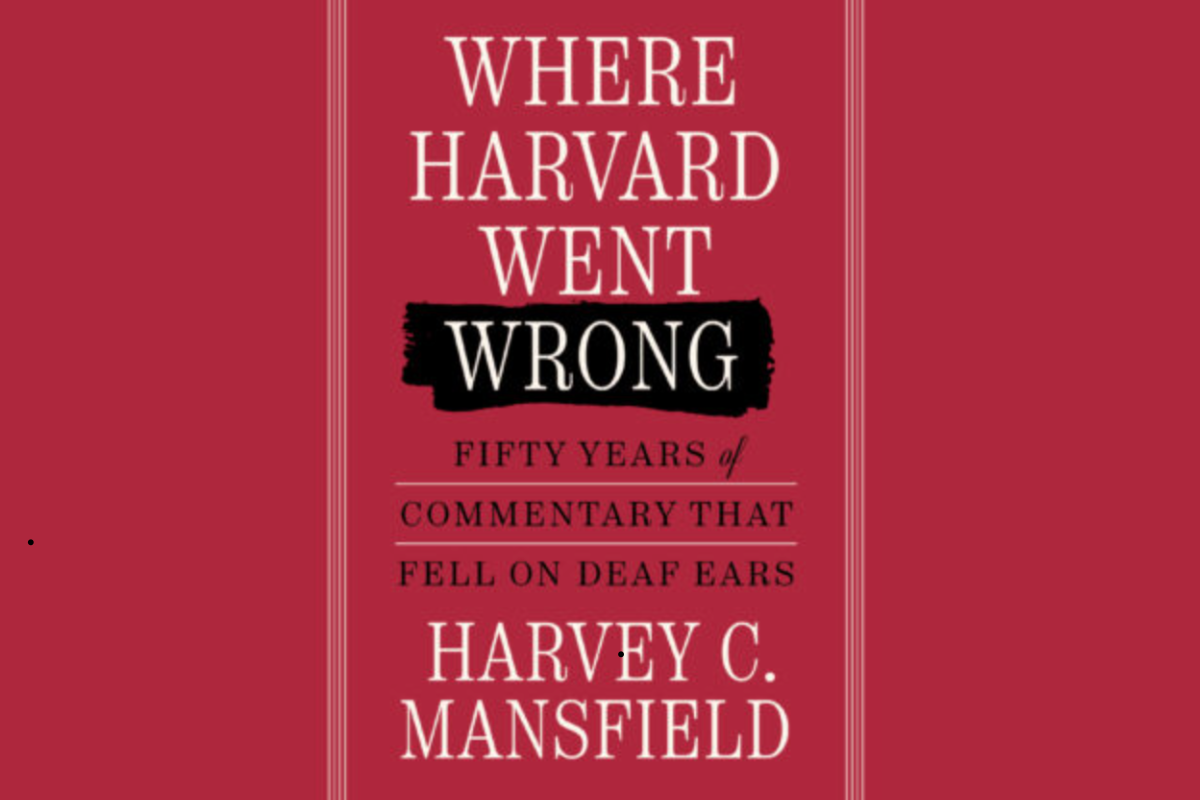
A Review: Harvey C. Mansfield, Where Harvard Went Wrong: Fifty Years of Commentary that Fell on Deaf Ears
The wave of rioting, illegal encampments, class disruptions, and anti-Semitic harassment that swept American college campuses starting right after the 2023 invasion of Israel by Hamas terrorists has stimulated widespread public outrage – paralleled only by the response to the student riots of the late 1960’s. But as Harvey C. Mansfield demonstrates in Where Harvard Went Wrong, the politicization of the campuses, starting with America’s most prestigious one, and the supine character of most college administrators’ response to student misbehavior and intolerance, has deeper roots that call for an examination of the underlying corruption of the ideal of liberal education that led to it.
It would be hard to find anyone better equipped to uncover those roots, as exhibited at Harvard, than Mansfield. Indubitably America’s most distinguished scholar among his generation of the history of political philosophy and the author of books and essays on such authors as Machiavelli, Burke, and Tocqueville, along with themes including constitutionalism, party government, “the spirit of liberalism,” the development of the idea of the modern executive power, and (most controversially) manliness, Mansfield taught at Harvard from 1962 until his retirement in 2023, having first enrolled at the school as a freshman in 1949. Amid his criticisms of the institution, he repeatedly expresses his deep love for it. Yet, especially after receiving tenure, Mansfield distinguished himself not only as a great teacher but as the enfant terrible of the faculty, repeatedly speaking out at its assemblies against policies he showed to be unjust and unwise – even as his remarks (as his subtitle indicates with some exaggeration) “fell on deaf ears.”
Where Harvard Went Wrong contains 17 chapters, all but one previously published, including seven that appeared in 2025 at the invitation of the Harvard Crimson, the university’s official student newspaper. All but one chapter date from the period since 1990. The exception is a collection of speeches that Mansfield presented at meetings of the faculty assembly, occupying over a quarter of the book’s length, dating from 1975 to 2006. (It is the central chapter.)
Mansfield identifies himself as a conservative, and was widely regarded as such during his years on Harvard’s faculty. Yet he was not a “movement” conservative, in the sense of one who devoted either his teaching or his writing to persuading others to become political conservatives. This fact can be readily seen by looking to his previous book, The Rise and Fall of Rational Control (2026), based on the lectures he gave in a course he regularly taught on modern political philosophy. Each of its eight chapters offers a close reading of a series of major thinkers from Machiavelli to Nietzsche. While each chapter identifies difficulties in a philosopher’s arguments (which led his successors to “correct” him), Mansfield gives a sympathetic hearing to each thinker’s position, including even that of Marx, whose earliest. most “philosophical” writings he focuses on.
In other words, Mansfield was genuinely a teacher and scholar, not an ideologue. In fact, the central themes of Where Harvard Went Wrong might just as easily have been labeled “liberal” rather than conservative as late as the early 1960s. These include the need for colleges to provide some balance in the political points of view espoused by members of the faculty, along with visiting speakers, so students get to hear both sides of an argument; the need for grading policies that reflect the quality of individual students’ work, rather than following the Lake Wobegon practice of giving high grades to practically everyone; and admissions and hiring policies that assess only an applicant’s merit and capacity to perform well (as student or professor), without regard to extraneous factors like race, ethnicity, religion, sex, or economic class.
In his preface Mansfield identifies the core of Harvard’s corruption by recalling the University’s 2025 commencement ceremony. At that event every speaker (student orators, the president and deans, and invited guests) “intoned the talk of the left wing of the Democratic Party,” with honorary degrees similarly awarded solely to spokesmen for the left who celebrated “the goals and practices” of so-called “diversity” (which in practice means homogeneity of approved opinions). As Harvard’s “unfortunate” president Claudine Gay (subsequently to suffer public humiliation when, along with the presidents of MIT and Penn, she was unable to state unequivocally when testifying at a Congressional hearing that the advocacy of violent antisemitism violated university policy) had previously put it, the old “Ivory Tower” view of the university was to be replaced by viewing it as “part of society.”
In contrast to Gay’s effectual proposed surrender of the university’s independence, which might have pleased Senator Joe McCarthy, Mansfield’s central remedy for Harvard’s “present pervasive partisanship” is “to make the university bipartisan,” open to the expression of views of both left and right. He distinguishes this proposal from often-heard calls for the university to be “nonpartisan or neutral,” since even though “almost all partisans think they are nonpartisan …. neither the fact of partisanship nor the pretense of nonpartisanship can be eliminated from political discourse.” Hence, while renouncing so-called “affirmative action” policies in the usual sense of that phrase, Mansfield calls for a form of affirmative action in faculty hiring for conservatives that will ensure that students in various departments get to hear both sides of current and historical issues. (As a government major/ history minor who also took courses in philosophy, literature, and economics at Cornell University in the early 1960’s, I can unequivocally state that I was given that opportunity. Nor, even in the case of professors whose political orientations could be known from their out-of-class activities, could more than one or two have been said to devoting classes to espousing those positions. Guest speakers similarly expressed a considerable variety of serious political and academic points of view, without fear of censorship,)
I can sample here only a few of Mansfield’s most trenchant observations. The claim that academic life should be “woke,” in the supposed name of promoting equality, he notes, is really “a political attack on the distinctions that normal people make and live by,” such as between man and woman, educated and ignorant, honest and criminal. In contrast to the pride or even “arrogance” that Harvard faculty and students were once thought to exhibit, being “woke” is a matter of sheer power, for instance by compelling the acceptance of “transgender identity” as normal.
In another chapter Mansfield exposes the problem of the replacement of free speech as a goal with today’s “freedom of expression.” Whereas speech entails making arguments using words and sentences that can be considered and answered in that form, inviting us to use reason to assess the claims (hence Aristotle’s identification of logos as the quality that makes us naturally political or self-governing animals), the substitution of “free expression” subsumes speech under the noise of “boasts, threats, and slogans,” “communicat[ing] only by disrupting its listeners.” Academic freedom, properly understood, should be understood as “a constraint on free expression,” rather than allowing the latter to suppress the former. (Again, protesters’ shout-down of speakers is an expression of power, not human freedom.)
One of Mansfield’s most persistent crusades at Harvard for the last half-century, he reports, was his battle against grade inflation, which by 1975 had already resulted in 85 percent of students graduating with honors. The policy seemed to be that “the principle of merit used to get into Harvard would be abandoned once students arrive there.” The result of abandoning merit-based grading is that students are “assessed” instead by their classmates’ judgment of academically irrelevant characteristics like athletic performance or invitations to prestigious social clubs. In contrast to the misleading message that grade inflation sends students that “you’re at the top – just like everyone else,” Mansfield (following Tocqueville’s example) observes that “democracy works only by adapting certain inequalities of excellence to qualify its main principle of equality.” (Although Harvard, I note, recently capped the number of A’s that can be awarded, in their tricky way administrators set no limit to A-minuses.)
Here is a selection of other themes that Mansfield addresses in his speeches at faculty meetings. He notes the moral hypocrisy of a proposal that Harvard “divest” its investments in South Africa on account of apartheid, in contrast to the faculty’s failure to criticize the genocide that Communists had recently inflicted in Cambodia. Decades later, Mansfield questions why Harvard invited Chinese President Jiang Zemin to offer an address – this not long after his government’s massacre of its citizens at Tiananmen Square. Having learned that in return President Jiang would present Harvard with a complete set of China’s newly published Twenty-Four Histories, complete with Mao Zedong’s comments, Mansfield asks whether Harvard would likewise have honored visitors bearing the works of Stalin or Hitler.
Perhaps Mansfield’s most controversial speeches were his presentations in 1986 and 1992, respectively, arguing againt the establishment of majors (called “concentrations”) in women’s studies and environmental studies. Calling the former proposal an “almost pitiflul surrender to feminism,” Mansfield rejected the claim that it would embody “a multiplicity of approaches and an openness to debate,” noting that the reading list proposed for the central course in the subject contained only a succession of contemporary feminist tracts, with nary a reference to Plato, Aristophanes, or Jane Austen; no scientific studies on the psychology or biology of sex differences; and “of course, no conservative critics of feminism.” And he denied that women’s studies was “really a subject,” since the things women had most in common concerned men, so the proposed curriculum contained works of feminist theory that “were as much about men as they were about women,” but only the feminist point of view would be considered. Mansfield similarly opposed the Environmental Studies major for its manifest bias, since he was confident that the major would not include “a course that highlighted the enormous waste and expenditure of most environmental regulation and the resulting cost to everyone’s liberty.” But above all, Mansfield opposed the major for its emphasis on “current problems.”
Mansfield contrasted that focus with Harvard’s true mission, which was to offer an education in the liberal arts, which would enable students to understand and reflect on the “permanent problems,” especially as these are explored in the Great Books of the Western tradition. But rather than favoring any (utopian and possibly undesirable) attempt to transform Harvard’s undergraduate curriculum into one based solely on those works, he offers specific recommendations, in a 2004 essay on “A More Demanding Curriculum” that he contributed to a volume on how to “refresh” the school’s “core program” so as better to achieve the school’s proper mission. Mansfield first cites the “Red Book General Education in a Free Society,” issued in 1945 by a committee appointed by President James Conant, aimed at promoting “cohesion,” overcoming the excessive specialization of the curriculum by addressing the relation between natural science and the humanities, and emphasizing “the requirements and hopes of American democracy.” The failed attempt to achieve those goals led to the adoption in 1978 of a new “Core Curriculum.” Unfortunately, in practice, the Core’s emphasis on student “choice” wound up simply as a set of distribution requirements, i.e., taking specialized courses in a variety of disciplines.
Mansfield’s essay concludes with a set of proposals for better achieving the proper goals of a core curriculum: (1) A course on the history or philosophy of science that would consider its relation to common sense and to religion; (2) a genuine “internationalism” that would avoid that would avoid the assumption that other cultures (e.g. Islamic radicalism) are fundamentally like our own, and would also beef up foreign-language requirements; (3) courses on American history and government that emphasize our founding principles and institutions along with the history of our foreign policy; (4) religion, focusing on the relation between reason and revelation or religious history; (5) military history; (6) education on “the beautiful things,” (7) Western civilization, here emphasizing the relevance of great thinkers from antiquity to the present while addressing the concerns of women and minorities; and (8) the study of “greatness” itself, as opposed to a debilitating relativism.
Both Mansfield’s criticisms and his reform proposals make this a book eminently worthy of study by all who are seriously concerned with the promotion of human excellence and the preservation and enhancement of constitutional government.
Harvey C. Mansfield, Where Harvard Went Wrong: Fifty Years of Commentary that Fell on Deaf Ears. New York: Encounter Books, 2026.

Professor Emeritus of Political Science, College of the Holy Cross