Miranda v. Arizona (1966)
Order and Liberty in Tension
The Warren Court’s rights of the accused case law changed the balance of power between law enforcement and criminal defense. Prior to the litany of criminal rights cases decided by the Warren Court, the scales were tipped in favor of police and prosecutors. After it was done reconstructing the criminal justice system, the balance tipped in the opposite direction. The Warren Court bent over backwards to ensure that individuals accused of crimes were afforded the constitutional rights guaranteed by the Bill of Rights. Some of its decisions went beyond ensuring the enforcement of constitutional rights by reading into the Constitution limitations on police and prosecutors that are not required by the Constitution but have the characteristics of judge-made law or policy. Miranda v. Arizona (1966) is one such case. It created a regime of rights of the accused and limitations on law enforcement that are closer to policy than constitutional law.
The Warren Court believed that law enforcement officials were sacrificing the rights of the accused to get confessions and convictions, and to close cases. In its view, too many innocent people were falsely accused and incarcerated. Too many guilty criminals were coerced to confess. Law enforcement needed to be held accountable by creating greater transparency and accountability. Chief Justice Warren, who wrote the majority opinion in Miranda, cited the Wickersham Commission’s Report on Lawlessness in Law Enforcement that identified police interrogation tactics and practices that were inconsistent with the protection of the rights of the accused. Warren noted the use of “beatings, hanging, whipping” as well as “sustained and protracted questioning incommunicado in order to extort confessions.” Critics of the Court’s ruling pointed out that these tactics and practices were not used on Ernesto Miranda when he was in police custody. The Court, in other words, did not focus on the cases (there were four companion cases) before it but acted more like a legislature by creating a broad policy to remedy a problem that was exaggerated for effect. Chief Justice Warren’s opinion is 60 pages. He addresses the Miranda case on page 52.
Background and Legal Issues in Miranda v. Arizona
Ernesto Miranda, a twenty-three-year-old man, was arrested, tried, and convicted for the kidnapping and rape of an eighteen-year-old girl, Patricia Weir. Miranda committed his first crime in grade school and later dropped out of high school. His criminal behavior resulted in being remanded to reform school. By the time he was eighteen, he had a lengthy criminal record, including sex offences. As a person of interest in the kidnapping and rape of Weir, Miranda was identified by the victim in a police lineup, was interrogated, and confessed to the crimes without his attorney present. Miranda’s request to speak to his attorney was denied by the police and the police denied that attorney access to Miranda. Based on his confession, he was convicted of those crimes and sentenced to 20-30 years in prison. Miranda appealed his conviction on the grounds that his constitutional rights were violated when police failed to inform him of his right to legal counsel and his right to remain silent.
The central legal issue in Miranda v. Arizona is whether the police obtained Miranda’s confession in accordance with constitutional standards during incommunicado interrogation. Did they violate those standards when they failed to inform him of his Fifth and Sixth Amendment rights to remain silent, to not incriminate himself, and to an attorney? His low-level of education and psychological evaluation, which included a schizophrenia diagnosis, were factors that the Court considered.
The existing standard for determining the admissibility in criminal court of confessions by the accused was the “totality of the circumstances” test developed in Haynes v. Washington (1963) by Justice Goldberg. Under the totality of circumstances standard, Judges had the discretion to determine if confessions were coerced based on the particular circumstances of the accused, police behavior, and style of interrogation. Such a flexible standard made some Justices, Chief Justice Earl Warren included, uneasy. They preferred a more abstract, bright-line rule that was clear-cut and left little room for discretion. In their view, police misconduct was evidence that greater restrictions on interrogation were required to protect the rights of the accused. Without a bright-line rule, it was difficult to determine if confessions were truly voluntary or coerced. Poorly educated, indigent individuals were especially vulnerable under the totality of circumstances regime. Moreover, the federal courts did not have the capacity to hear numerous appeals from the states and to serve as a check on lower courts’ use of the totality of circumstances standard.
The Court’s Ruling in Miranda v. Arizona
The Court ruled 5-4 for Miranda. As noted, Chief Justice Warren wrote for the Court in what has become one of the most consequential Supreme Court rulings in American history. The decision changed the requirements that police and prosecutors had to follow in order for confessions to be permissible in criminal trials. The Chief Justice explained the new requirements that were designed to protect the Fifth and Sixth Amendment rights of the accused. Early in his opinion, Warren stated that
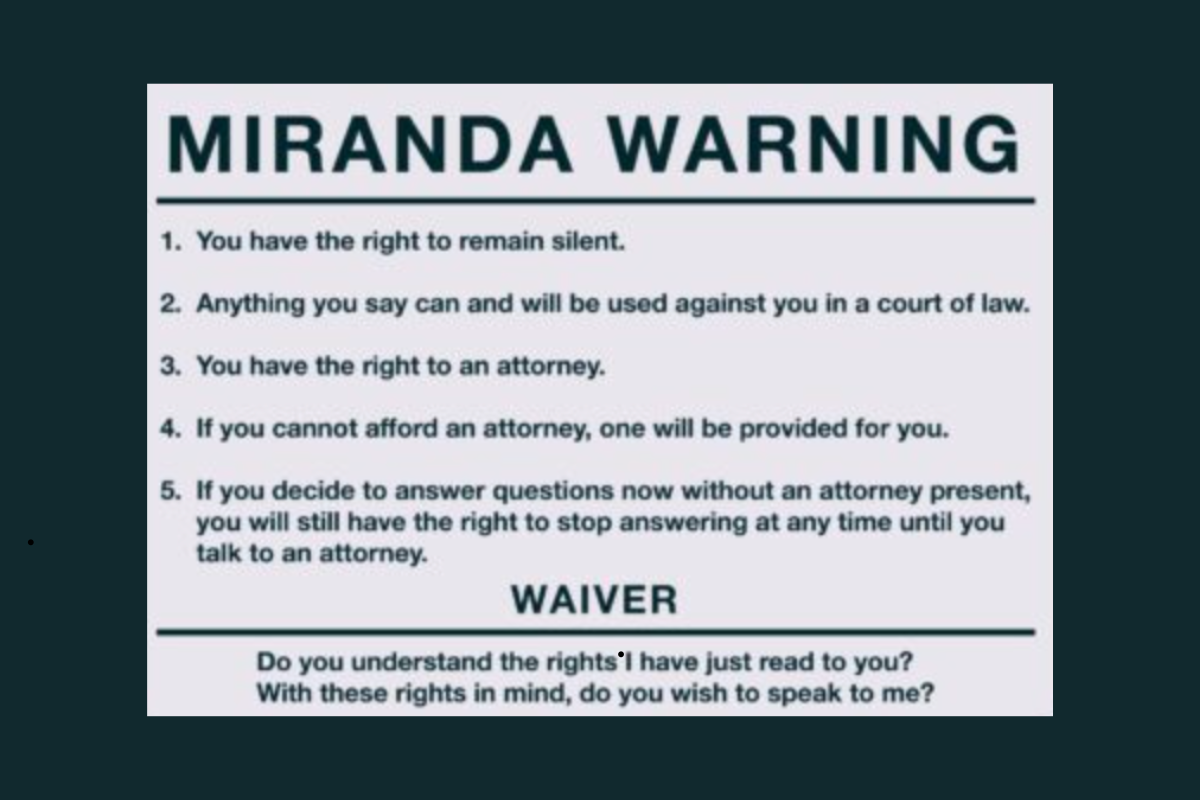
Prior to any questioning, the person must be warned that he has a right to remain silent, that any statement he does make may be used as evidence against him, and that he has a right to the presence of an attorney, either retained or appointed. The defendant may waive effectuation of these rights, provided the waiver is made voluntarily, knowingly and intelligently. If, however, he indicates in any manner and at any stage of the process that he wishes to consult with an attorney before speaking there can be no questioning.
Chief Justice Warren justified these requirements by noting the tendency of police to coerce confessions in circumstances that make it difficult for the accused to exercise their constitutional rights. He made reference to the use of the “third degree,” “relentless questioning,” and “deceptive stratagems,” that are used by police to “persuade, trick, or cajole” suspects into confessing to crimes without employing their constitutional rights. He added that “custodial interrogation exacts a heavy toll on individual liberty and trades on the weakness of individuals.” Without a balance between the tactics and advantages of the police and safeguards for the rights of the accused, the criminal justice process does not comport with the Constitution. The Constitution requires that procedural safeguards are in place before custodial interrogation can be deemed constitutionally legitimate. The specific safeguards comprise the list of rights that we know today as Miranda rights. They stem from Chief Justice Warren’s opinion. The criminally accused
must be warned prior to any questioning that he has the right to remain silent, that anything he says can be used against him in a court of law, that he has the right to the presence of an attorney, and that if he cannot afford an attorney one will be appointed for him prior to any questioning if he so desires. Opportunity to exercise these rights must be afforded to him throughout the interrogation. After such warnings have been given, and such opportunity afforded him, the individual may knowingly and intelligently waive these rights and agree to answer questions or make a statement. But unless and until such warnings and waiver are demonstrated by the prosecution at trial, no evidence obtained as a result of interrogation can be used against him.
Chief Justice Warren acknowledged that Miranda rights could be waived but only under the proviso that it was done “knowingly and intelligently” by the suspect and that the police demonstrated that the rights were waived. If the suspect revoked such a waiver of rights, the police were required to cease interrogation.
Justices Harlan and White wrote dissenting opinions that question the constitutional basis of the ruling and highlight its likely consequences. Justice Harlan stated that the obvious consequence will be the significant reduction of confessions. He adds that “Nothing in the letter or the spirit of the Constitution or in the precedents squares with the heavy-handed and one-sided action that is so precipitously taken by the Court in the name of fulfilling its constitutional responsibilities.” The Constitution guarantees in the Fifth Amendment that no person “shall be compelled in any criminal case to be a witness against himself.” It does not, however, specify that such a right extends beyond a trial to include custodial interrogation. Justice White added that “In some unknown number of cases, the Court’s rule will return a killer, a rapist or other criminal to the streets and to the environment which produced him, to repeat his crime whenever it pleases him. As a consequence, there will not be a gain, but a loss, in human dignity.”
Miranda v. Arizona Legacy and Analysis
Miranda was the culmination of cases such as Malloy v. Hogan (1964) that incorporated the Fifth Amendment protection against self-incrimination to the states and Escobedo v. Illinois (1966) that required attorneys for interrogation of the accused when requested. Gideon v. Wainwright (1963) required attorneys when requested at trial. Miranda integrated the expanded rights of the accused into one central doctrine that police and prosecutors were required to follow.
Miranda was reaffirmed in Dickerson v. United States (2000), a case that some expected would overturn it. In between Miranda and Dickerson, the Court clarified and trimmed at the edges of the original ruling in several cases including Michigan v. Tucker (1974), New York v. Quarles (1984), and Oregon v. Elstad (1985). Chief Justice Rehnquist’s majority opinion in Dickerson suggested that the Miranda decision became more reasonable once the ensuing cases created exceptions and clarifications to its seemingly straight-line rule. In that sense, there are two Miranda standards: 1) the original Miranda ruling that may have overreacted to the circumstances in which it was decided, and 2) the now controlling Miranda that includes numerous exceptions and clarifications that comes closer to balancing the protection of the rights of the accused and the ability of law enforcement to keep the public safe from dangerous criminals.
Ernesto Miranda was retried after the conclusion of Miranda v. Arizona and convicted based on a confession he gave to his common law wife. Once out of prison, he was killed in a fight over a poker game in a barroom bathroom. Miranda’s killer was read his Miranda rights and used his right to remain silent to avoid prosecution. He was arrested but released for lack of evidence.

Professor of Political Science at Middle Tennessee State University
Related Essays