50 Years of US-Chinese Relations
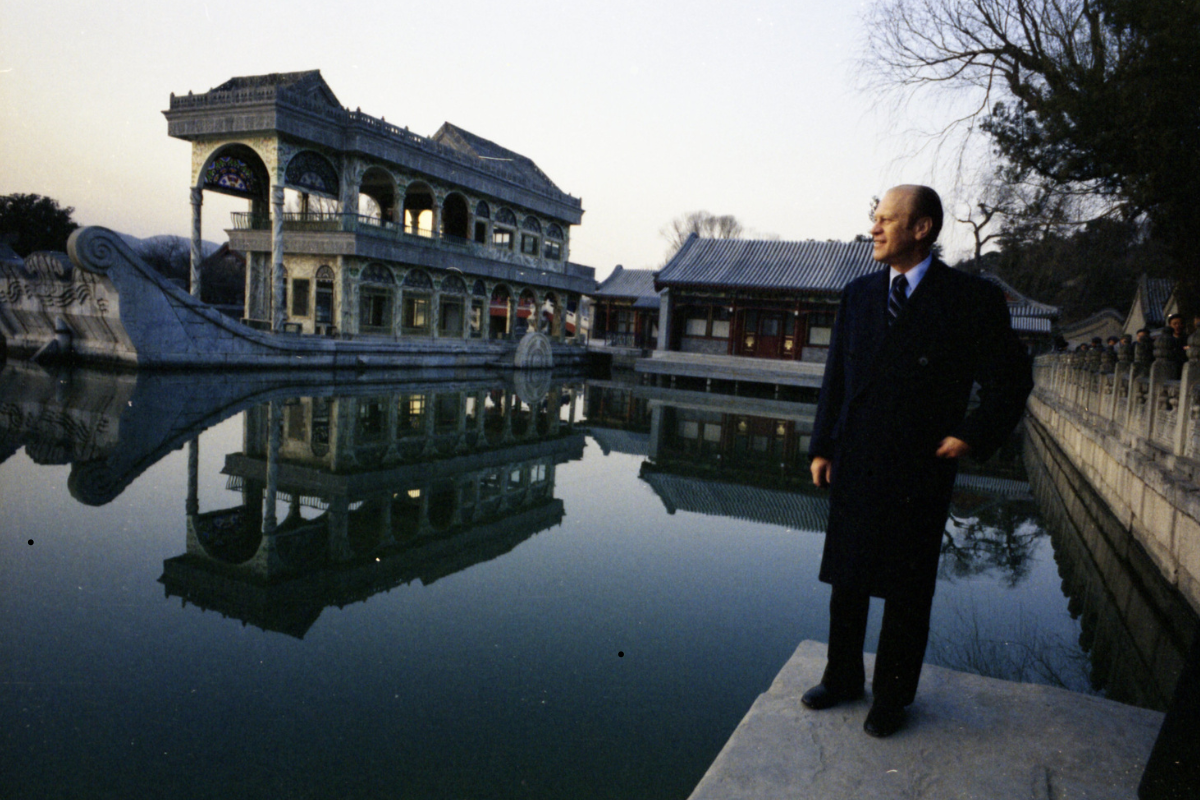
President Gerald R. Ford, China Visit on December 4, 1975
Fifty years ago, in the early days of December 1975, US President Gerald Ford, first lady Betty Ford, and their daughter Susan visited Peking, intending to build on the “new relationship” between the US and China first announced by President Nixon three years earlier. Also accompanying Ford were Secretary of State Henry Kissinger and George Bush, the future president, whom Ford had recently nominated as director of the CIA.
During the visit, Ford and his team met with Chairman Mao Zedong and Vice Premier Deng Xiaoping, emphasizing the common ground between the two countries and engaging in “friendly, candid, substantial, and constructive” talks. Ford reaffirmed the US aim to normalize diplomatic relations, a goal eventually achieved under Ford’s successor, Jimmy Carter.
By 2001, the relationship between the two countries had developed to the point that the US granted China “permanent normal trade relations,” opening the door to the mass importation of Chinese products and leading over time to erosion of the US manufacturing base. Since 2018, the US has backed away from this policy by imposing tariffs and other barriers to trade, recognizing China as one of its foremost adversaries.
For decades, however, the US underwrote massive growth in the Chinese economy. In 1978, the gross domestic product of China, the world’s most populous nation, accounted for about 2% of the world economy, but by 2010, just three decades later, it surpassed Japan as the world’s second-largest economy. During that time, China’s economy grew at an annual rate of about 9 percent, far exceeding global growth rates.
Simply put, China could manufacture goods at much lower cost than the US and many other industrialized nations. Americans went on a massive spending spree of Chinese products, driving up the annual trade deficit with China from $6 billion in 1985 to a peak of $382 billion in 2022. The precise number of US jobs lost is a topic of debate, but some estimate upward of 4 million during the first two decades of the 21st century.
Of course, the US was doing more than merely purchasing Chinese goods. It was also policing the world’s shipping lanes, enabling China to transport its products all over the world without needing to create and maintain a military to guarantee the security of its ships. Moreover, the US was also sharing both capital and technology with China, in some cases unwillingly, due to Chinese disregard for US intellectual property and patent laws.
For a variety of reasons, however, the outlook for China is no longer so bright. For one thing, the US is pulling back from its role as guarantor of global security, which requires other nations, including China, to boost military spending. Moreover, rising living standards in China have increased costs of production there, opening the door to lower-cost competitors such as India, Vietnam, and Mexico.
Yet China faces even more fundamental problems that may undermine its status as the US’s chief rival. For one thing, it is undergoing a demographic implosion. Rising living standards and the nation’s misguided “one-child” policy are producing a collapse in the number of workers, with the overall population expected to fall by half. The ratio of employed people to retirees will fall from 10-to-1 20 years ago to below 1-to-1 by 2080.
Another deep-seated problem is China’s top-down economic model, which has grown even more top-heavy under its current leader, Xi Jinping. One example of the Communist Party’s inefficient management is massive over-investment in real estate, which has led to the creation of vast “ghost cities” of unoccupied housing. So much household wealth is tied to real estate that China faces a long-term consumer spending crisis.
In addition, the nation’s preference for investment over spending has resulted in excessive industrial capacity, which in turn has led to price wars. As more and more producers compete for a limited number of consumers, profits fall, which only further undercuts both the job market and consumer confidence. This is exacerbated by a growing bias toward state-owned businesses, which shifts work away from more productive firms.
Autocracy itself is part of the problem. In an effort to avoid embarrassment and unrest, China is publishing less and less data on its economy’s performance, such as youth unemployment rates. This contributes to an environment of uncertainty, making the nation’s domestic consumers increasingly reluctant to spend. The government’s efforts to stimulate consumer spending have been largely ineffectual.
China is seeking to lift itself out of these difficulties by boosting exports even further. Yet at the same time, the US, Europe, and other trade partners are turning to increasingly protectionist measures, imposing tariffs on such exports as Chinese electric vehicles, which are perceived as threats to domestic industrial capacity. As hostility to China has risen, “Made in China” has become a symbolic liability.
As President Xi has suppressed divergent points of view and increasingly consolidated both political and economic power, China has been undermining its own ability to learn from its mistakes, develop new creative approaches, and adapt to changes taking place both inside and outside its boundaries. Those few who might dare to raise hard questions are disinclined to do so, knowing they are likely to be silenced.
By comparison, the US finds itself in an advantageous position. We are decades behind China in terms of the demographic implosion, enjoy ready shipping access and great geographic protection from the Atlantic and Pacific oceans, and our political and economic systems are much better at learning from mistakes and creating innovative new approaches. Moreover, we are simply a far freer society.
Efforts to boost US-China relations under Ford offered many advantages to US consumers, but they also turned out to entail substantial costs, such as losing American jobs and promoting the growth of a Communist nation that has emerged as one of America’s foremost foes. Sadly, China’s increasingly besieged government may soon find it necessary to create a spectacle, such as war with Taiwan, to distract attention from its own failings.

Chancellor's Professor of Radiology, Pediatrics, Medical Education, Philosophy, Liberal Arts, Philanthropy, and Medical Humanities and Health Studies, as well as John A Campbell Professor of Radiology, at Indiana University.
Related Essays