An amusing feature of the culture wars is that one doesn’t even need to see a film before critiquing it. Veiled allegations flew in the weeks before Christopher Nolan’s The Odyssey hit the big screen, touching on casting choices, marketing, and the fact that he hadn’t hired any Greeks for his film.
It seems lamentable that every movie, artwork, or public statement must be divisible into one of two categories: our version of things, or their version of things.
Fortunately, we might characterize Nolan’s film as his version of things. It is not an ideological parable; it is a finely told story, skillfully obtuse about the heart of its message, and framed by two powerful images: the trojan horse, upon which the film opens, and Odysseus sailing into the sunset with his beloved Penelope, upon which the film closes. One symbolizes the idolization of war, the other the elusiveness of peace.
Nolan’s version is both faithful and unfaithful to the epic poem of Homer.
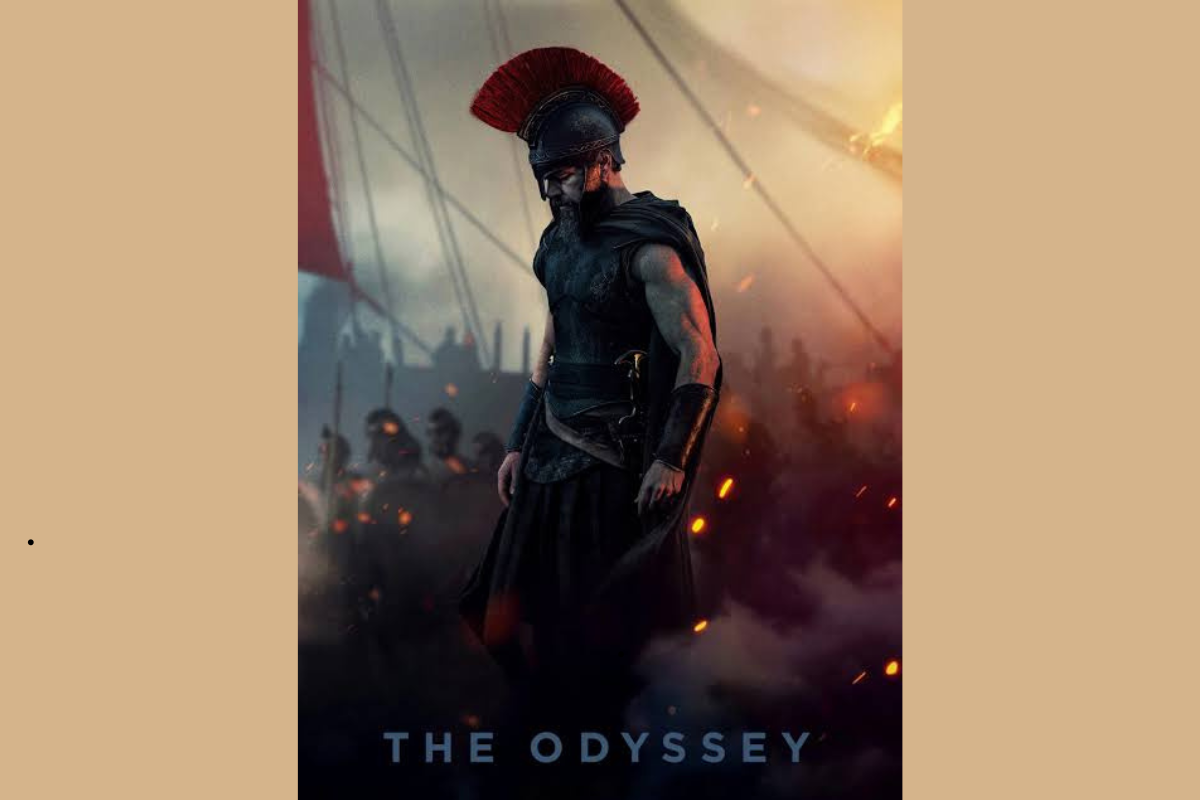
His Odysseus (played by an admirably muscular Matt Damon) is certainly less complicated than Homer’s hero, and understandably more modern.
In Nolan’s telling, Odysseus is a guilt-ridden and psychologically traumatized veteran, indelibly marked by war and unable to escape his own responsibility for it. Perhaps for the sake of time, Nolan’s film removes the role of the Phaeacians entirely, and thus, Odysseus recounts his wanderings to the goddess Calypso instead.
I would not be the first to observe how closely Calypso resembles Odysseus’ psychotherapist, gently asking him questions, by turns encouraging him to remember or forget and professing a love for him which never seems more than a confession of concern for the pain he is enduring.
Nolan also excises the island of the Lotus-eaters, instead incorporating the role of the lotus through Calypso, who feeds Odysseus the flower in order to make his suffering “more of the body than the mind”—that is, in order to aid his mental escape from the horrors of his past.
It is from this detail that I’d hazard a general observation of the film, and at the risk of oversimplifying point out how the film's events navigate the perspectives and judgments of its female characters.
There is no doubt that Odysseus and his men constitute the action/adventure side of the film; Odysseus and his men do things, but it is the female characters of the film—in dialogue with Odysseus himself—who offer clear opinions on what the men are doing or havedone.
At bottom, this is a movie about war, not about wandering or homecoming. Nolan chooses to open his film with the image of the horse and the sack of Troy. Duplicity and violence are the framing for the movie.
The first profound conversation, on the other hand, occurs between Telemachus (Tom Holland) and his mother Penelope (Anne Hathaway), where she expresses fear for Ithaka’s future safety absent a king.
Telemachus naively reminds her they are part of the greatest civilization which has ever existed, but Penelope rejoins that even if their palace is built of stones “older than knowledge”, the institution does not mean anything without the people’s respect for its meaning.
The scene’s dialogue, best in the film, seems too topical to be “prescient,” but it serves as a pithy summary of the film’s quiet implications regarding war as an enemy of civilization.
Penelope tells Telemachus she may have to remarry, reminiscing about a final conversation she’d had Odysseus. She recalls her own desperate suggestion that Odysseus take her and the baby Telemachus and flee, in “your fastest ship with your bravest crew. . . and chase the escaping sun”, but Odysseus rejects her plan. Instead, he asks her to take a new husband should he not return.
This episode is an invention of the movie but perfectly consistent with its larger themes: war destroys a man’s ability to fulfill the peaceful and necessary offices of manhood: father, husband, king.
War requires those who are left behind to plot the replacement of those who went off, an impossible burden for a woman who truly loves her husband, for a child who truly needs his father.
I’d like to dwell also on the role of Circe the Enchantress, another incident with which Nolan takes considerable creative liberties. Here is where the movie comes closest to a horror film, particularly in the very graphic, almost lewd, transformation of the men into pigs.
After Odysseus arrives at her cabin and is invited in, it is she who, in the climactic moment, grabs the dagger of Odysseus and lunges at him, screaming at him for daring to send men to threaten her in her “own home”; she reminds him of how they’ve raped and pillaged across the world for him, taunting him about their animalistic nature, only too willing, she accuses, to engage in such monstrous behavior.
Odysseus, almost ironically, asks her, “Did my men hurt you?” She cries, “They would have.”
The bizarreness of this incident is not merely in its total irrelevance to Homer’s account of Circe, but even more so because the movie does not earn the plausibility of Circe’s interpretation of the men.
Indeed, the movie explicitly shows the soldier Eurylochus, when he first encounters Circe, reassuring her that “no one is going to hurt you”, attempting to relieve the anxiety she apparently feels at seeing armed and armored men.
On the contrary, Circe’s reaction seems a somewhat obvious pun on the stereotypically irrational feminist fear of the “predatory male”.
The Circe of Nolan may be a witch, but she is decidedly not a goddess, and her perspective, which she states quite plainly, is that men are swinish, closer to wild animal than to the species of woman. Whether we are to interpret this as the film’s perspective or not, Circe’s opinion is clear: war shows men to be brutes and her job is to reduce them to a controllable state.
There is also, as has already been mentioned, the perspective of Calypso, who simply wants to help Odysseus escape his mental anguish. The film never mentions their having sexual relations, only that Calypso rebuilt Odysseus’ body but “could not bring” herself to rebuild his mind, for that would entail his having to suffer by remembering—remembering the war but also what he had lost by going to war.
It is only through the intercession of Zeus that Calypso relinquishes Odysseus, and despite the thrilling and well-crafted action between Odysseus’ escape from her island and his arrival in his own palace, we must wait until Penelope requests to speak with the disguised Odysseus-as-beggar to hear another “opinion” about war and its consequences.
Here is where the “traumatized veteran” arc reaches its zenith, as Odysseus confesses his terrible guilt brought on by his responsibility for tricking the Trojans, violating “everything good” with the pretense of honor and respect, bringing “ten years of rage” onto a city in the space of a single night. As Odysseus recounts, “To burn the walls of Troy was to burn the world entire”—a line just a tad too cheesy for me, but meant to impress upon us how war destroys the entire world of the one who fights it.
The violence may take place in one city at a discreet time, but it is also internalized, carried about, randomized in the life of the veteran until it destroys even the peaceful and beautiful parts of his memory and soul.
Again showing how different his characters are from Homer’s, Nolan’s weary and slightly bitter Penelope condemns Odysseus: “I’ve been living in Odysseus’ ruins long enough.” It is after these lines that she announces her famous “bow and arrow” challenge to suitors; if war has ruined Odysseus, it has also ruined Penelope’s hope of receiving Odysseus back.
Needless to say, this is not the end of the story; in a deeply satisfying conclusion, Odysseus himself answers Penelope’s challenge, revealing his true identity just in time to defend his wife, son, and country from final devastation. No doubt there is some special meaning being conveyed, that even if one’s soul, memory, reputation, and very sense of self is snatched from one for a time, once it has been reclaimed, no matter how damaged, the obligations and duties attached to the self persist.
Odysseus is still the King of Ithaka, though he forgot it for 7 years. He is still the husband of Penelope, though he was lost for 20 years. One is only ever a veteran of others’ wars; the battle for one’s home, one’s identity, one’s child and wife is a combat which cannot be forfeited and which makes one whole.
The last we see is the escaping sun, and Odysseus’ ship escaping after it. Having defended his own, having passed it to his son, he is at peace. For generations of darkness to come, all the people will possess is song, Odysseus tells us, to remember the days of trade and writing and peace, but yet, civilization will rise again.
The verdict?
Christopher Nolan has produced a very fine, layered film. So much must be left out here, including the beautiful and realistic action sequences which make this epic so viscerally entertaining.
Some have chosen to read the film as almost occult in its mysterious symbolic wisdom. Jonathan Pageau has implied that it is no mistake, the centrality of the trojan horse as the original image in the film: Nolan has tricked the entire postmodern, Hollywood culture into celebrating a film about filiation, loyalty, bravery, courage, and womanly fidelity.
Penelope remains faithful to civilization (embodied in Ithaka), guarding its inheritance faithfully, making it possible for Odysseus, when returns, to defend his home rather than simply slaughter for the sake of revenge.
Some have dismissed The Odyssey as technically impressive but intellectually hollow.
Whatever you think of it, I can say with fair assurance that it won’t be a waste of time, and if that is Mr. Nolan’s only accomplishment—to make sitting in a theatre for three hours worthwhile—then his accomplishment, while not quite Homer’s, is certainly not insignificant.

2026 Edmund Burke Fellow with the Academy of Philosophy and Letters
Related Essays