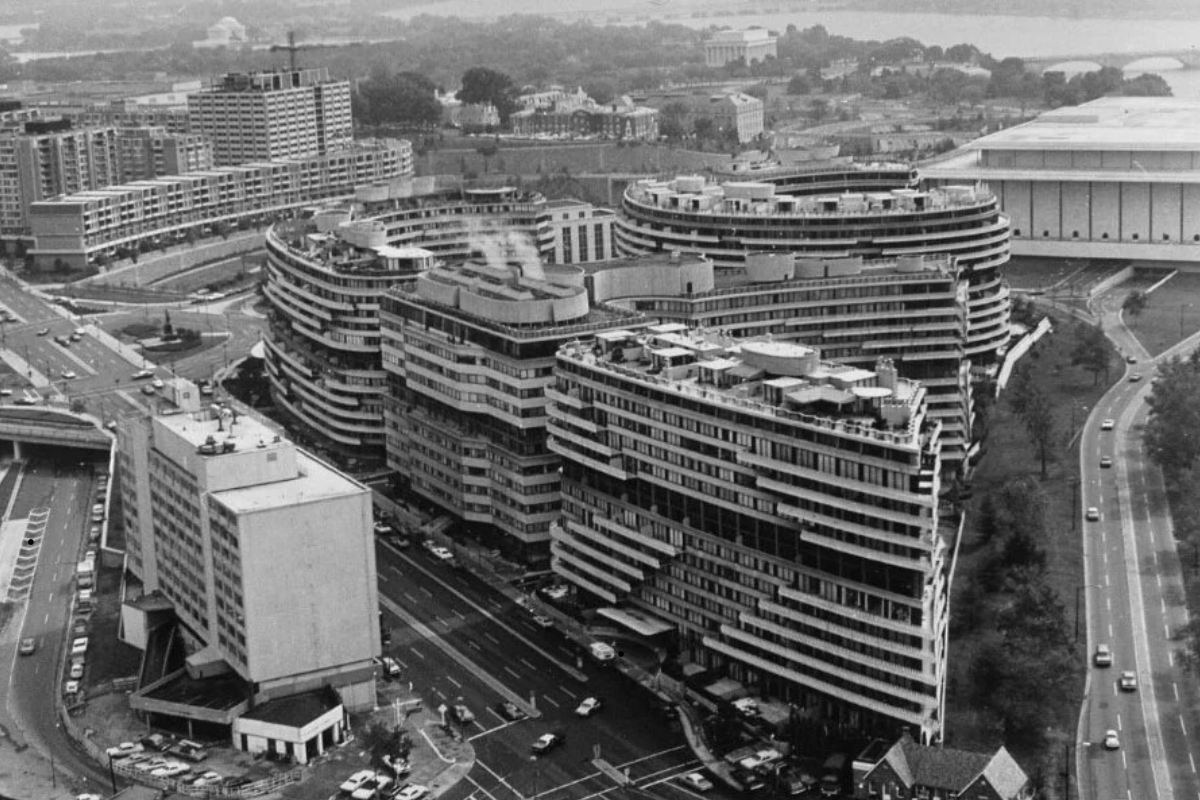
The Watergate Hotel. A break-in into the campaign headquarters of the Democrat Party in the hotel and its consequences led to the Watergate scandal in the 1970s.
The Ascension of Executive Power and Constitutional Limits
Executive power was on such a steady and steep incline in the twentieth century that Arthur Schlesinger Jr. argued in his 1973 book The Imperial Presidency that the American president had become more powerful than the leader of any nation, with the “possible” exception of Mao Zedong of China. Schlesinger qualified his argument by limiting it to foreign affairs. He favored a strong president in domestic affairs modeled after FDR. He worried that executive overreach in foreign affairs would create a reaction that resulted in weakening the president’s domestic powers. Schlesinger’s book was published in the middle of the Watergate crisis. It drew public attention to the problem of escalating executive power as well as the lack of accountability in the executive branch generally. The Watergate crisis tested the constitutional system of checks and balances and the resolve of the Supreme Court to ambitiously guard its power of judicial review.
Schlesinger was, perhaps, so enamored with big government’s ability to cure social and economic ills that he lost sight of the Founders’ moral realism. Both Federalists and Anti-Federalists were skeptical about political power. Alexander Hamilton captured the Founders’ widespread skepticism about power when he remarked that “A fondness for power is implanted in most men, and it is natural to abuse it when acquired.” This underlying view of the human condition helped to justify the American Constitution and its elaborate system of separated powers and checks and balances.
While serving as president, Thomas Jefferson wrote to Wilson Cary Nicholas in a September 7, 1803, letter that “Our peculiar security is in the possession of a written Constitution.” He added: “Let us not make it a blank paper by construction.” Jefferson suggested that in a constitutional system of government created by a written constitution, government power was strictly limited. Taken at an extreme, Jefferson’s view leads to the conclusion that there are no implied powers, only enumerated powers. In Federalist 45, James Madison struck a similar note regarding federal power. There he wrote that “The powers delegated by the proposed constitution to the federal government, are few and defined. Those which are to remain in the state governments, are numerous and indefinite.”
Hamilton, however, was not so legalistic in his conception of federal power. In Federalist 23, in the context of discussing national security powers, he argued that “the means ought to be proportionate to the end; the persons from whose agency the attainment of any end is expected, ought to possess the means by which it is to be attained.” In Federalist 33, Hamilton defended both the Necessary and Proper and Supremacy Clauses because he deemed them harmless. They state what should be obvious: constitutional power grants government the means to do the things it is empowered to do, and once law is created it is supreme in the sense that citizens and government officials are obligated to obey it. The constitutional sanction to create law and the duty to abide by law are not without conditions. A “forced construction” of government’s constitutional authority does not make an unconstitutional law constitutional. Government must abide by the limits of its power as defined by the Constitution. Hamilton explained in Federalist 78 that judicial power “operates as a check upon the legislative body,” and on executive power to ensure “a steady, upright, and impartial administration of the laws.” Interpreting the law “is the proper and peculiar province of the courts.” This final point was echoed by Chief Justices John Marshall and Warren Burger in Marbury v. Madison and Nixon v. U.S. respectively.
Executive Privilege
It is widely recognized that in addition to its enumerated powers, the federal government possesses two other types of constitutional authority. First, it has implied powers, which stem directly from specifically expressed constitutional grants. Second, it has inherent powers, which do not need to be written into the Constitution because they are ingrained in the very nature of sovereignty and legislative, executive, and judicial power. There is, however, debate about the extent and limits of both implied and inherent powers.
Executive privilege is the inherent power of executives to withhold information from or refuse to testify before legislatures and courts, which was at the center of U.S. v. Nixon (1974). The power extends to requests from courts for information including requests for executive branch officials to testify before Congress or federal courts. Executive privilege is justified by the need to protect national security secrets as well as the conversations between the president and his advisors. These and other matters require the president to balance the subpoena power held by the legislative and judicial branches that can potentially be used to undermine the legitimate functioning of the executive branch. George Washington was the first president to claim the power to deny requests by Congress for information.
Like all powers, executive privilege is not absolute. Until U.S. v. Nixon, however, the federal courts did not give much consideration to its limits. Two previous cases, United States v. Burr (1807) and United States v. Reynolds (1953) resulted in limited rulings regarding executive privilege. In the former case, President Jefferson refused to appear before the U.S. Circuit Court for Virginia in Aaron Burr’s treason trial and only complied with part of a request for information from the court. Chief Justice Marshall, riding circuit in the case, ruled that presidents must comply with the court’s request for information that is vital to a criminal trial. Presidents, however, are not like typical citizens; their duties require courts to exercise deference. They can withhold information that is sensitive if it is not vital to a criminal proceeding. In the latter case, the Supreme Court accepted the claim by the Eisenhower Administration that it possessed the power of executive privilege, but it also ruled that the Supreme Court had jurisdiction in such cases to decide if the president’s claim to privilege was justified. In Reynolds, the widows of three B-29 bomber pilots who crashed testing new technology were denied access to the government’s accident report. The Court agreed with the Eisenhower administration that release of the report would jeopardize national security. What is clear from these cases is that claims to executive privilege are justiciable. What is unclear are the boundaries of executive privilege.
Background and Legal Issues in U.S. v. Nixon
When five Watergate burglars were caught breaking into the headquarters of the National Democratic Party housed in the Watergate Office Building, it began a chain of events that led to U.S. v. Nixon. One of the burglars was employed by President Nixon’s reelection campaign. The president and members of his staff engaged in a coverup of their involvement in the efforts to steal information from the Democratic Party and plant listening devices in its headquarters. As it turned out, Nixon did not need an advantage in the 1972 election. He won 49 states in the largest electoral college victory of the twentieth century since FDR’s 1936 election. The break-in might have been deemed as typical American politics, but the coverup was another matter. The possibility that the president was complicit in such unseemly, self-serving, and criminal behavior inspired the media and Congress to investigate the Nixon administration’s involvement in the Watergate affair. If the president was involved in the cover-up, impeachment was an option. No American president, to this day, has ever been impeached and removed from office. The Court’s ruling in U.S. v. Nixon, however, led to the first and only resignation of a president.
The central legal issue in U.S. v. Nixon was the president’s claim that executive privilege was absolute. It was, he thought, entirely his prerogative to comply with judicial, congressional, or special prosecutor requests for copies and transcripts of Oval Office recordings of conversations that could implicate the president in the Watergate cover-up. At trial and in their briefs, special prosecutor Leon Jaworski and Counsel to the Special Prosecutor Philip A. Lacovara argued against Nixon’s claim that executive privilege was an absolute power. Following the precedent established in United States v. Reynolds, they claimed that executive privilege is a limited power because federal courts can determine the constitutional legitimacy of specific claims made by presidents to privilege information.
The president’s counsel, James St. Clair, relied on the notion that the separation of powers prohibits the legislative and judicial branches from infringing on the president’s power of executive privilege. The president has unilateral power to decide if information from the executive branch should be shared with other branches of government. To suggest otherwise, was to destroy the integrity of the president’s relationship to his advisors and to jeopardize national security secrets. The check on the president was impeachment. That process, however, did not require the president to share executive branch information with Congress. The Watergate dispute was a political dispute between the president and Congress and did not warrant the Supreme Court’s intervention.
The Court’s Ruling in U.S. v. Nixon
The focal point of U.S. v. Nixon was the extent of executive privilege. President Nixon claimed that the recordings of Oval Office conversations were covered by executive privilege, and, consequently, Congress, special prosecutors, or the federal courts could ask, but the president could refuse to comply with requests for information.
The Supreme Court voted 8-0 for the U.S. arguing that while presidents possess the inherent power to withhold information from Congress and the courts, the power is limited; the president’s power in this regard did not exist outside the constitutional system of checks and balances. Relying, in part, on U.S. v. Reynolds, Chief Justice Warren Burger, who was appointed by Nixon, argued that the dispute between the two branches of government was justiciable and that executive privilege could not be used to suppress information that was important to an impeachment trial that involved alleged criminal behavior by the president.
The ruling was justified by a balancing test described by Chief Justice Burger:
In this case we must weigh the importance of the general privilege of confidentiality of presidential communications in the performance of his responsibilities against the inroads of such a privilege on the fair administration of criminal justice.
The president’s request to quash the subpoena from the special prosecutor requesting copies of the Oval Office tapes of conversations between the president and his advisors must, then, be subject to this balancing test. When the president’s claim of privilege is measured against the special prosecutor’s claim of access to evidence vital to a criminal procedure, the Court concluded that
when the ground for asserting privilege as to subpoenaed materials sought for use in a criminal trial is based only on the generalized interest in confidentiality, it cannot prevail over the fundamental demands of due process of law in the fair administration of criminal justice. The generalized assertion of privilege must yield to the demonstrated, specific need for evidence in a pending criminal trial.
Unlike Reynolds, the president was not invoking executive privilege to protect specific national security secrets. His claim to privilege was general. He aimed to protect the integrity of conversations between presidents and their advisors. Because in camera (private) examination of the conversations was assured by the special prosecutor, it was possible for the content of the conversations to remain private. Consequently, the special prosecutor could use information that was vital to the criminal proceeding without compromising the integrity of what would otherwise be privileged conversations between the president and his advisors.
U.S. v. Nixon Legacy and Analysis
Sixteen days after the Court’s ruling in U.S. v. Nixon the president resigned from office and Vice President Gerald R. Ford was sworn in as the 38th president. Ford pardoned Nixon a month after assuming office.
While U.S. v. Nixon focused on executive privilege, another inherent power, executive prerogative was in the background. Executive prerogative is a more extensive power than executive privilege because it gives executives power to suspend the laws or even break them when necessary for the good of the nation. In the context of the Civil War, President Lincoln stated in his April 4, 1864, letter to Albert G. Hodges that “measures, otherwise unconstitutional, might become lawful, by becoming indispensable to the preservation of the constitution, through the preservation of the nation.” During his interviews with David Frost after leaving office, Nixon not only quoted Lincoln’s statement in support of his actions, but he claimed that circumstances surrounding the Vietnam War justified the exercise of executive prerogative. Nixon used poor judgment in this regard. He conflated the good of the nation with his personal political success. The Watergate break-in and cover-up were an indication that the president had lost touch with the state of American politics and culture, not to mention his claim that a silent majority supported his policies.
The Watergate burglars were unsuccessful in their efforts to steal information or plant listening devices in the DNC headquarters, and yet, Nixon won the 1972 election in a landslide. He clearly overestimated the threat to American order and overstated the similarities between the Vietnam War and Civil War circumstances. He used Machiavellian means, but lost sight of Machiavelli’s own standard for judging such cases: “In the actions of all men, and especially of princes, where there is no tribunal to which to appeal, one judges by the result.” The results of Nixon’s use of executive prerogative included his resignation, a depreciation of the rule of law, and the denial of what Machiavelli deemed the grand prize of all great political leaders, glory. Judging by these results, the actions that led to U.S. v. Nixon were those of a desperate not a prudent leader.

Professor of Political Science at Middle Tennessee State University
Related Essays