
A Review: On Statesmanship
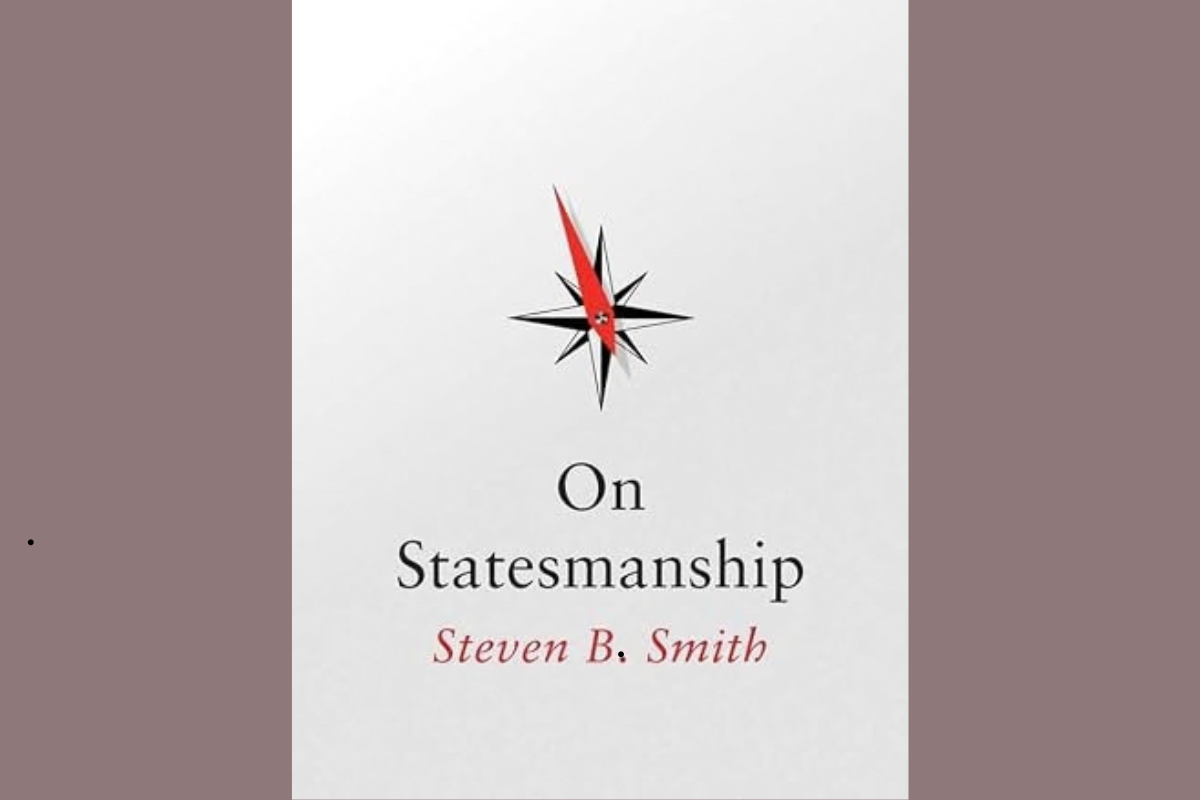
Steven B. Smith, On Statesmanship. New Haven: Yale University Press, 2026.
Steven Smith’s goal is to “rehabilitate” the “neglected” or “old-fashioned” notion of statesmanship from its contemporary neglect. Smith, who is Cowles Professor of Political Science and Philosophy at Yale, laments the near-disappearance of statesmen in the proper sense from the contemporary world at a time when they are most needed, given the likelihood that “American hegemony” may be giving way to something like a return to the “traditional world of great-power rivalry.” As he observes, “not every head of state is a statesman.” Rather, statesmanship is an art possessed by relatively few leaders: with the exception of Volodymyr Zelensky, Smith regards our “last great statesmen” as Ronald Reagan, Mikhail Gorbachev (both for negotiating a peaceful end to the Cold War ), Nelson Mandela, and Yitzhak Rabin. They were preceded by a plethora of earlier 20th-century statesmen including Churchill, FDR, DeGaulle, and Gandhi, along with numerous national leaders almost on their level. In their place, we find ourselves confronted with a world of authoritarians, such as Trump, Xi, Putin, Modi, and (until recently) Orbán.
The presence of some statesmen on Smith’s list is certainly debatable (how far did Gorbachev really aim to ending the East-West conflict, rather than being left no choice by Reagan, and how likely is it that Rabin, had he not been assassinated, could have negotiated a lasting peace between Israel and the Palestinians?) But overall, his complaint seems sound.
Smith attributes the recent disappearance of statesmen to the collapse of world communism, which gave rise to widespread belief in a so-called end of history, in which the spread of democracy, free markets, and (largely) open borders would engender an end to “power politics,” making statesmanship unnecessary. That belief, of course, was an illusion. But Smith blames contemporary political science for its neglect of the crucial distinction between statesmen and demagogues, owing to the influence of social-science positivism, which separates so-called facts and values, thus focusing on the ostensibly neutral study of “power” or “management.” “By focusing on causal models rather than the cultivation of judgment,” he observes, “political science abnegates its responsibility for educating citizens” who are capable of making that distinction – as well as preparing future statesmen. And the attempted reduction of true political leadership to power-seeking or management neglects the psychology of Washington and Lincoln, Pericles and DeGaulle, who had greater ends in mind. But while insisting on that distinction, Smith also warns against confusing the statesman with the political “visionary” or “idealist” who aims to impose a “master vision” by force, if necessary, noting that “political idealism remains one of the most potent sources of tyranny.”
By contrast, the true statesman as Smith conceives him is guided by an awareness of his country’s history (and hence of the highest achievements of which its people are likely to be capable), and also by leading “through moral responsibility and self-restraint” rather than force and fraud. Smith distinguishes three kinds of statesmen: the greatest, founders and lawgivers “who shape a people or who guide their countries through times of national crisis,” such as Moses, Solon, and Pericles in antiquity, or Washington, Lincoln, Ben-Gurion, and Churchill in modern times; reformers, who work “within an established set of laws and institutions,” including Deng Xiaoping and Mandela; and “preservers” like Burke, Metternich, and Disraeli, who serve as “guardians of continuity” during “ periods of social disruption.”
Smith’s classifications are obviously somewhat blurry: for instance, as China’s chief military leader in 1989, Deng supported the bloody suppression of the Tiananmen Square demonstrations: so much for “moral responsibility and self-restraint.” But Smith’s broader point is unexceptionable: that the statesman is “above all” an “educator,” who “transmits” to his people an understanding of their country’s “regime” – the “rules. laws, and institutions” that constitute its “identity” – as they apply in the circumstances of his time. And Smith rightly adds that what we call “democracy” in modern times is more precisely described as “constitutional government,” since unlike its ancient counterpart, it is designed to respect the rights of all individuals, rather than impose the rule of the demos over the rest of society (a recipe for permanent class conflict). (Unfortunately, this distinction is often forgotten today in the rhetoric of America’s Left, members of which have called for the abolition of such countermajoritarian institutions as the Senate, an independent judiciary, and the Electoral College.)
As well, Smith distinguishes between the comprehensiveness of the ancient city, which aimed (in Aristotle’s account) to regulate all aspects of citizens’ lives, with a view to inculcating virtue in them, and the modern conception of limited government. He properly attributes this change, in large measure, to the rise of “competing religious doctrines, each claiming a monopoly on the truth,” another recipe, in the absence of an “agreement to disagree,” for permanent conflict as well as oppression. As Smith puts it, “the modern constitutional state system was based on a series of separations: between the state and society, between government and religion, between the individual and the citizen.” The separation of government and religion in turn facilitated both the separation of powers (as espoused by Montesquieu) and the doctrine of representation, according to which the people, while remaining sovereign, delegate the business of government to (elected) representatives, able to focus their time on deliberating about public policy. (Again, one might question how far the members of today’s Congress, though assisted by large staffs, actually devote themselves to this business, as opposed to constituency service and enlarging the scope of government in pursuit of re-election.)
Smith adds to the changes wrought by modern constitutional theory the rise of political parties as a respectable (rather than seditious) enterprise, aimed at reducing the influence of demagogues thanks to their subordination to party loyalties. The most important expositor of this doctrine was Edmund Burke (seconded, I would add, in the 1820s by Martin van Buren). But Burke’s very role in this regard demonstrates that he was more than a mere “preserver” of established institutions.
In his chapter on “The Art of the Statesman,” Smith challenges Hannah Arendt’s cynical assertion of the inherent opposition between politics and truth, citing in response cases like Liz Cheney’s voting to impeach Donald Trump, at the cost of her political career, and Tony Blair’s support for the Iraq War, despite its lack of support among many in his party. But he warns that the greatest threat to political truth-telling in our time is the Nietzschean doctrine that there is no objective truth – leading individuals to begin their cases with prefaces like “As a Black person,” “As a Jew,” or “As a gay person,” thus dismissing from the outset the possibility of rational, intersubjective inquiry. (In this context he cites Barack Obama’s regret, following his first term, that his “biggest failure” had been “not to tell a story” – quite an insult, one would think, to the intelligence of the American people.)
In a chapter on “The Ethics of Statesmanship,” Smith situates the statesman’s outlook as standing midway between the extremes of “realism manqué” and “political idealism, or conviction ethics.” By the former term, he refers to the view he attributes to Max Weber and Machiavelli “that violence, or the threat of violence, constitutes the essence of politics.” In response to the hyperbolic claim that all political action entails the problem of “dirty hands,” Smith observes that “policy decisions are not the same as moral contests between good and evil” or even the more difficult problem of choosing “between two conflicting goods,” as Daniel Webster did by co-sponsoring the Compromise of 1850, which included an abominable Fugitive Slave Law (despite his lifelong opposition to slavery), for the sake of preserving the Union.
By contrast, political idealism, or ideological politics, is exemplified by the Abolitionists, whose slogan was “No Union with Slaveholders” – preferring a breakup of the Union to keep their own hands “clean,” though that breakup would have ended any hope of ultimate emancipation. Even more dangerous was the sort of revolutionary idealism that brought about the rise of totalitarian dictatorships in post-World War I Europe. (For an echo, I add, consider the chanting by American college students of the slogan “From the River to the Sea,” typically even without knowing the identity of the bodies of water in question, let alone the genocide it would entail.) In contrast, Smth espouses what Weber called an “ethic of responsibility,” which entails “taking ownership of decisions that will predictably inflict harm on others,” for the sake of a greater good – as in Truman’s decision to drop the atomic bombs on Japan, probably saving millions of both American and Japanese lives (at the cost of denunciation by apolitical moralists like the Oxford philosophy professor G.E.M. Anscombe).
Smith devotes an entire chapter to the statesmanship of Abraham Lincoln, “our most philosophically minded president” (but not in Anscombe’s sense). As he emphasizes, Lincoln saw the presidency as “not only a political office … but a means of shaping” public opinion. Professing to borrow his political sentiments from the opening paragraph of the Declaration of Independence, he at the same time transformed the doctrine of human equality from an ostensibly self-evident truth to a “proposition,” according to the Gettysburg Address, that Americans must aim at achieving through their actions. At the same time Smith rightly defends Lincoln’s actions against claims from today’s Right and Left against the charge that he undermined the Constitution, rather than adapting it (as in his declarations of martial law) to a situation in which the very survival of the Constitutional order was at stake. (It may be, however, that Lincoln’s sometime expressions of humility, as in his claim to have been more controlled by events than the reverse, or what Smith calls his reversion to “God talk” late in his career, were more a function of the need for a superior statesman to conceal the awareness of his superiority, in a nation dedicated to the doctrine of equality. Smith wrongly rejects as well Harry Jaffa’s demonstration of the gently satirical element in Lincoln’s 1842 address to the Washingtonian Temperance Society: he was a more subtle rhetorician than Smith sometimes appreciates.)
In his final chapter, “Statesmanship and Civic Knowledge,” Smith laments that “constitutional democracies” seem to have “lost their purpose,” with meritocracy, long rightly “considered an engine of mobility,” now rejected by the left “as a driver of inequality and hierarchy,” while the “postliberal” or “national conservative” right blames Lockean liberalism as a source of hedonism and greed, and appeals – in contrast to Lincoln – to an exclusionary “national identity … grounded in a prior ethnic, linguistic, or religious consensus.”
As Smith notes, America’s current situation calls for a renewed form of civic education that would avoid both these extremes. Unfortunately, his criticism of the two sides is somewhat one-sided. Setting aside the Natcons (still a fringe group), it isn’t true that Trump’s 1776 Report, in combating the sort of antiliberal propaganda recently installed in the National Museum of American History, “ignore[es] or downplay[s] the role of slavery and Jim Crow laws in our past,” Similarly disappointing is Smith’s dismissal of constitutional “originalism,” which ordains endeavoring to read the text of the Constitution in light of its words’ meaning, as well as its authors’ broad intent. (To be governed instead by the arbitrary whims of contemporary Supreme Court justices would be a far greater abdication from constitutional, republican government.)
On the other hand, Smith rightly laments that works like the New York Times’s 1619 Project, now distributed in thousands of the nation’s schools, aims to reduce the nation’s past entirely to racial and class oppression. He adds that its rejection of America’s past reflects a “quest for loathing’ that culminates in nihilism. And he notes that one of the two leading obstacles to the restoration of civic education is the leftist ideological “groupthink“ (including DEI) that now dominates American universities (and therefore, I add, instills an anti-civic bias in the curricula of primary and high schools). The other obstacle to widespread civic learning, he maintains, is the dominance of STEM in university programming: while STEM skills are undoubtedly useful, the inherently progressive nature of science prevents it from enabling students to appreciate the “wisdom and enlightenment” that can still be gleaned from the past, especially regarding politics and morals, and from philosophy and literature. As he notes, while “the modern research university … is one of the glories of higher education,” it represents “a dramatic departure from the older model of colleges as sites of moral instruction” – a tradition that is still preserved (in attenuated form) in Chicago’s Basic Program of liberal arts, Columbia’s Contemporary Civilization, and Yale’s Directed Studies (in which Smith teaches). Dismissing the objection to such programs as “Eurocentric,” Smith argues “there is a strong case for maintaining the priority of the Western tradition,” since it is unique in consisting “not simply of a set of calcified and customs,” but in a collection of texts dating from antiquity that together embody a self-critical, questioning attitude. And he notes with approval the recent development of schools of civic education at public institutions like the Universities of Florida, Texas, and North Carolina and Arizona State – while emphasizing the importance of ensuring “that these new programs not be directed toward narrowly political or partisan aims.”
Overall, this is a learned, accessible, and much-needed work. In conclusion, however, speaking of the Great Books, I will raise one quibble: twice Smith cites Platonic dialogues (the Republic and Gorgias) in a way that attributes (sometimes outlandish) remarks made by Socrates to Plato himself (which would be like citing Macbeth’s “life is a tale told by an idiot” to Shakespeare’s own thought). The fact that two of Socrates’ most ridiculous proposals for an ostensibly just city in the Republic (the abolition of the family and of private property) are borrowed from Aristophanes’ comedy Ecclesiazusae supports the interpretation of Allan Bloom (among others) that the work is actually a critique of political utopianism, while to take seriously Socrates’ equation of rhetoric with the lowly art of pastry-baking in the Gorgias one would have to disregard the highly rhetorical (and often unsound) arguments he himself frequently uses to “defeat” his interlocutors. Plato’s dialogues exemplify precisely the questioning rather than dogmatic character that Smith rightly attributes to the Western tradition of learning.

Professor Emeritus of Political Science at Holy Cross College
A list of Presidents with Congressional, Military or Law experience and a breakdown of who had family ties to the White House, and more.