South Dakota v. Dole (1987)

New Federalism?
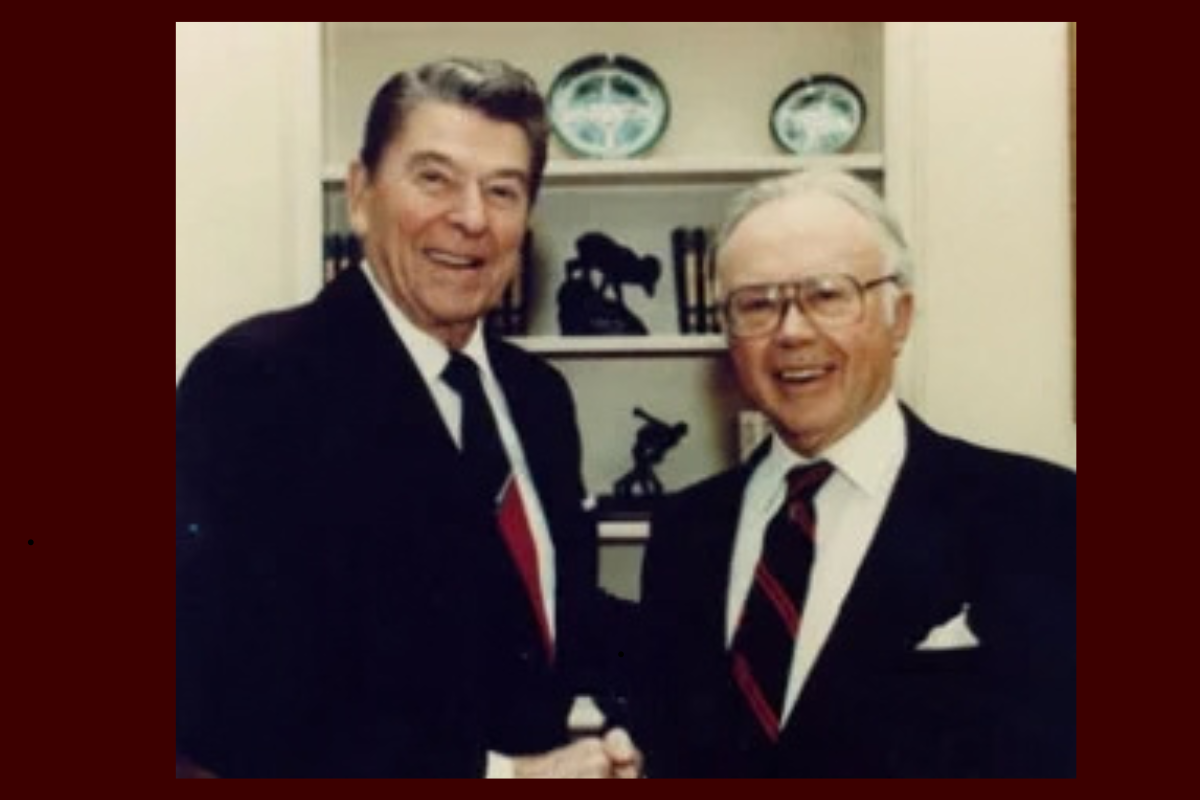
When Ronald Reagan ran for president in 1980, one of the themes of his campaign was reducing the size and scope of the federal government. He suggested dismantling the Department of Education, cutting federal regulations that hamstring business innovation and efficiency, and returning power and administrative responsibility from the national government back to state and local governments. The last of these initiatives was called New Federalism. It assumed that the centralization of power had reached a crisis point. Consequently, it was time to reverse the trend of centralizing power accelerated by FDR’s New Deal and LBJ’s Great Society and devolve power back to its constitutionally appropriate level.
The Reagan administration’s success regarding New Federalism was mixed, in part, because some of its cabinet secretaries were opposed to, or only passively committed to, devolution. They favored using national power to promote conservative public policy. The Department of Education was not dismantled, in large part because Reagan’s Secretary of Education, William J. Bennett, made it friendlier to politically conservative causes. Reagan’s Secretary of Transportation, Elizabeth Dole, had some of the same tendencies as Secretary Bennett. Why let federal government power aggrandized by Democrats go to waste, when it could be used to advance worthy Republican policy objectives?
Background and Legal Issues in South Dakota v. Dole
In 1984, Congress passed and President Reagan signed the National Minimum Drinking Age Act as an expansion of the Surface Transportation Assistance Act. The law gave the Secretary of Transportation the power to withhold five percent of a state’s federal highway funds in the first year (1986) and ten percent every subsequent year if it did not set its legal minimum drinking age at 21. Supporters of the law justified it by arguing that teenagers who were learning to drive and were newly licensed to drive should not be legally authorized to drink alcohol. The fact that some states had legal drinking ages as low as 18 meant that young drives in states with higher minimum drinking ages were apt to drive across state boundaries to buy and consume alcohol. The purpose of the law was to reduce automobile accidents and deaths caused by young drunk drivers. The political problem for the Reagan administration was that the law centralized power rather than decentralized it as was expected given the president’s commitment to New Federalism and devolution. To square the circle, the administration argued that raising the minimum drinking age was voluntary. The federal government was not forcing states to comply with a federal regulation but merely providing a financial inducement to do so.
In 1984, when the law went into effect, 21 states had a minimum drinking age of 21 and 29 states had minimum drinking ages below 21. South Dakota’s minimum drinking age was 19 for 3.2 beer. The state challenged the constitutionality of the National Minimum Drinking Age Act by arguing that it violated both the Spending Clause of Article I, Section 8 and the Twenty-first Amendment. Congress is not given the power under the Spending Clause to regulate the drinking age because the Twenty-first Amendment gives that regulatory power to the states. Under the new law, South Dakota would lose $4 million of its federal highway funds in the first year and $8 million in each year thereafter. A federal district court ruled for Dole as did a federal appeals court. South Dakota then appealed to the U.S. Supreme Court.
The Court’s Ruling in South Dakota v. Dole
The Supreme Court ruled 7-2 for the federal government. Chief Justice Rehnquist, who was elevated to that position by President Reagan wrote for the majority. The Court largely ignored South Dakota’s Twenty-first Amendment claim because, as Rehnquist explained, in passing the National Minimum Drinking Age Act, Congress did not create a national minimum drinking age. It simply created a financial incentive for states to comply with the federal government’s preference for a 21-year-old minimum drinking age. In other words, Congress did not directly create a national minimum drinking age. It used a “relatively small financial inducement,” an “indirect inducement,” to encourage but not compel states to comply. He argued that the federal incentive provided “mild encouragement” rather than unconstitutional coercion. States were not being forced to raise their drinking age; they had a choice in the matter. Chief Justice Rehnquist acknowledges that Steward Machine Co. v. Davis (1937), ruled that there is a point at which “pressure turns into compulsion.” That point, however, is not reached by the conditions on spending (he characterized them as “mild inducements”) that are part of the National Minimum Drinking Age Act.
Congress can attach conditions to federal funding that are closely related to its purpose and that serve the general welfare. Encouraging states to raise their minimum drinking age in order to reduce automobile accidents and deaths promotes the general welfare. In focusing on Spending Clause power, Chief Justice Rehnquist acknowledged that Congress’s power was not absolute. The Court’s case law has identified four conditions that must be met for restrictions on federal spending to be constitutionally legitimate. First, limits on spending must promote the general welfare as the General Welfare Clause, which is in the same sentence of Article I, Section 8 as the Spending Clause, requires. Second, the Congress’s conditions must be unambiguous so that states can determine the consequences of refusing to comply. Third, conditions on federal grants to state and local governments are likely unconstitutional if they are not sufficiently related to the purpose of the spending. Fourth, federal spending must comply with other parts of the Constitution in addition to the Spending Clause.
South Dakota did not challenge the National Minimum Drinking Age Act based on the first three of these limits on Congress’s spending power. Consequently, the ruling hinges on the fourth limit, that the condition must be consistent with other parts of the Constitution. South Dakota argues that the drinking age condition violates the Twenty-first Amendment. Congress cannot use conditions on federal spending to circumvent constitutional limitations; specifically, it cannot use such conditions to exercise power that is forbidden to it by the Twenty-first Amendment. Nor can Congress use its spending power to coerce states into engaging in unconstitutional acts. Encouraging states to raise the drinking age to 21, however, is not unconstitutional because it does not violate the Twenty-first Amendment or the Tenth Amendment. United States v. Butler (1936) supports this claim by suggesting that limits on Congress are “less exacting” regarding its spending power compared to its direct regulatory power.
The Dissent
Justices Brennan and O’Connor dissented. They argued that the National Minimum Drinking Age Act circumvents the Twenty-first Amendment by regulating the sale of liquor, a power granted to the states. Moreover, Justice O’Connor suggested that requiring states to raise their minimum drinking age as a condition to receiving full federal highway funding is not reasonably related to the purpose of the expenditure of federal funds.
When Congress appropriates money to build a highway, it is entitled to insist that the highway be a safe one. But it is not entitled to insist as a condition of the use of highway funds that the State impose or change regulations in other areas of the State’s social and economic life because of an attenuated or tangential relationship to highway use or safety.
Congress’s spending power is only effectively limited if the conditions that it places on states are closely related to the purpose of the spending. This principle was violated by the National Minimum Drinking Age Act. Raising the minimum drinking age is too far removed from building and maintaining highways to be closely related.
South Dakota v. Dole Legacy and Analysis
Chief Justice Rehnquist’s opinion in South Dakota v. Dole has not held up well over the years. By 1988, just four years after the ruling and two years after the law’s deadline for state compliance, Wyoming became the final of the fifty states to raise its minimum drinking age to 21. In that short period of time, all 29 states that were not in compliance with the federal minimum drinking age changed their laws to conform to the federal standard. It is difficult to argue, as the Chief Justice did, that the law was not coercive, that pressure had not turned into compulsion, when compliance became universal a mere two years after the federal deadline for state compliance. Whatever the prudence of raising the minimum drinking age, the way the Reagan administration went about it undermined its commitment to New Federalism and devolution. The temptation to use centralized power for worthy causes was too great for many of Reagan’s cabinet secretaries and for the president himself to resist.
In some respects, the National Minimum Drinking Age Act foreshadowed similar hypocritical behavior by Republican administrations as well as the rise of national greatness conservatism that not only abandons devolution, but also openly embraces centralized power and the virtues of big government.

Professor of Political Science at Middle Tennessee State University
Related Essays