Regents of CA v. Bakke (1978)
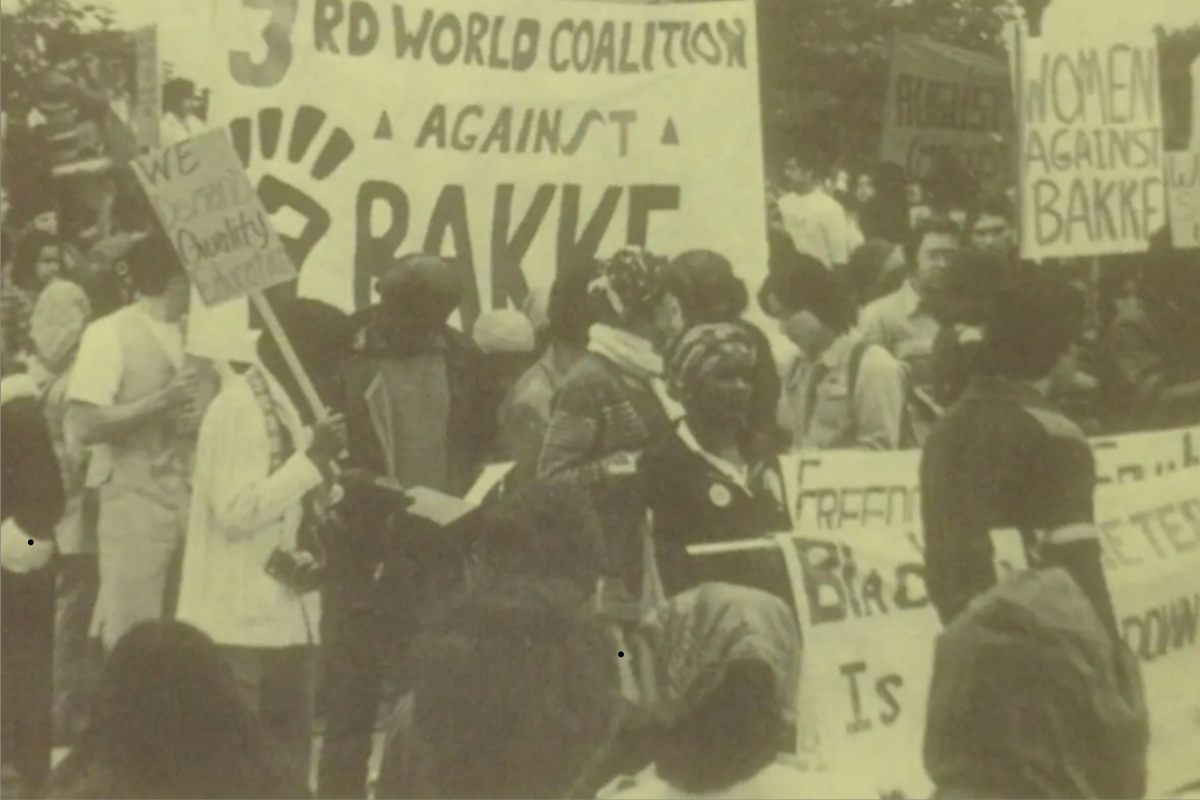
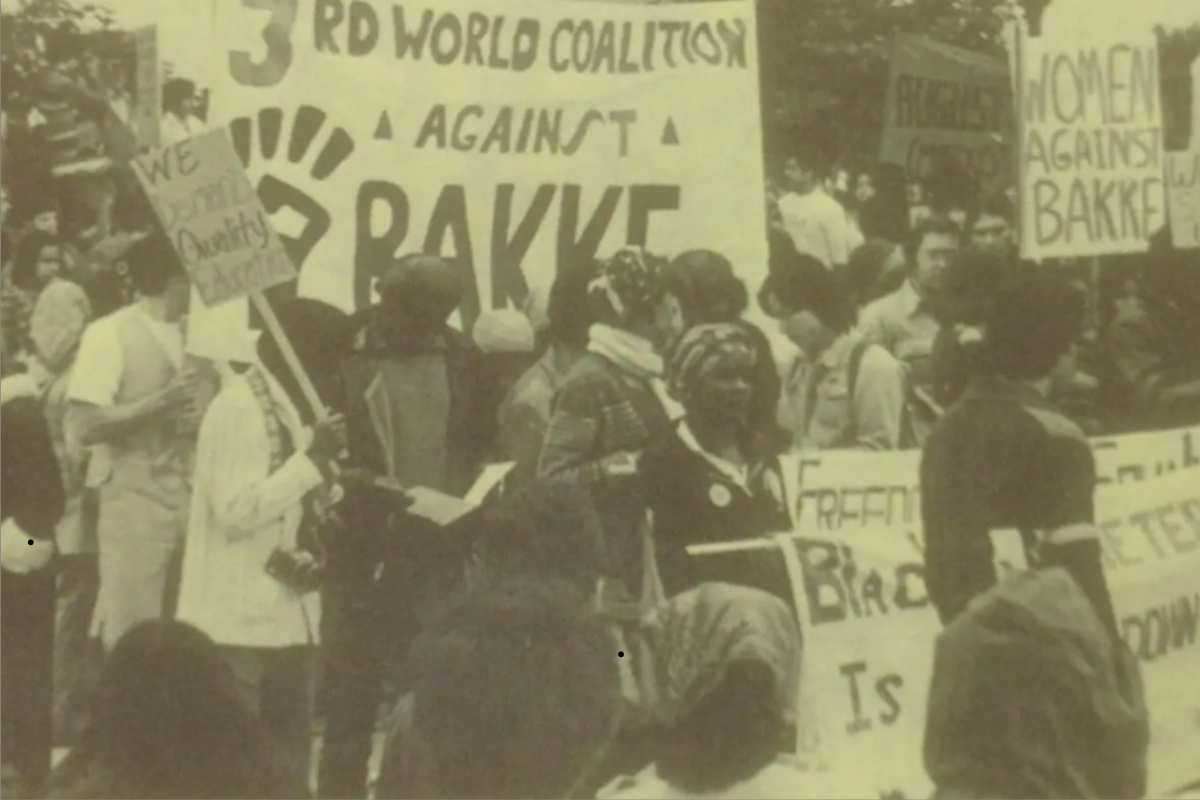
Protest against the California Supreme Court's decision in Bakke, Los Angeles, May 7, 1977 Photo Credit: Unknown Author, Public domain, via Wikimedia Commons
Introduction
The tale of Regents v. Bakke, the Supreme Court decision that cleared a path for affirmative action in the context of university admissions, is a remarkable one. It featured two badly divided but resolute factions whose refusal to compromise denied the Court a clear majority. Instead, it featured Justice Powell, the lonely voice in the middle whose solo opinion bridged the competing blocs, producing an outcome few liked but which single-handedly molded the legal framework of affirmative action in American higher education for the next 45 years.
The Onset of Affirmative Action Programs in America
The great civil rights legislation of the mid-1960s heralded a historic victory over two centuries of the de jure segregation of slavery and Jim Crow. It also marked a pivotal shift in the civil rights movement to addressing the deep racial disparities that plagued society across virtually every measure, whether it be educational achievement, jobs and wages, or socio-economic standing more broadly. President Kennedy had introduced the policy of affirmative action in his 1961 order prohibiting government contractors from discriminating on the basis of race, directing them to “take affirmative action to ensure that applicants are employed . . . without regard to their race, creed, color, or national origin.” Title VI tracked that order. It prohibited discrimination “on the basis of race, color, or national origin” in the administration of any program or activity receiving federal aid. By the late 1960s, it also was being relied upon by federal contractors, government employers, and universities to implement affirmative action policies to boost racial minorities and women in hiring and promotion, contract set-asides and university admissions.
In the educational context, affirmative action was designed to increase “underrepresented minorities” in colleges and professional schools. While admissions officials spoke of “goals” for expanding minority enrollment, their efforts often took the form of programs that reserved a precise number of seats in an incoming class for minority candidates. The University of California Davis was one such institution. Its medical school, newly established in 1968, experienced an immediate difficulty in drawing minority students. During the first two years in operation, the student body had only two Black students and a single Hispanic. Its response was a two-tier admissions process that set aside sixteen of its target of 100 admitted students for applicants who qualified as “disadvantaged.” While the definition of “disadvantaged” was not limited to minority students, in practice all sixteen of the seats were filled by minority applicants.
By the early 1970s, affirmative action was already sparking a backlash among the white majority. Claiming “reverse discrimination,” whites began to pursue legal challenges premised upon both the Fourteenth Amendment Equal Protection Clause and Title VI. Channeling Justice John Marshall Harlan in his famous 1896 Plessy dissent, “colorblind” interpretations of the Constitution gained currency as a basis for objecting to the use of race in screening applicants for employment or college admissions. Allan Bakke was one such litigant.
Bakke was a thirty-two year-old mechanical engineer who had graduated from the University of Minnesota with honors, served as a marine in Vietnam in command of an anti-aircraft missile unit, and subsequently completed a masters degree in engineering at Stanford. He was working as an aerospace engineer at a NASA research center when he turned his attention to a career as a doctor. He prepared for medical school by taking evening classes to satisfy pre-requisites in biology and chemistry, while volunteering in the emergency room at his local hospital. In the fall of 1972, he applied to eleven medical school, including UC Davis, but was rejected by every one. Not to be deterred, Bakke applied again in 1973, but again was unsuccessful. When Bakke learned of the special affirmative action admissions program at Davis, he began to consider a legal challenge. He was an admittedly strong candidate. His undergraduate GPA and MCAT scores were comparable to other admittees, and surpassed those of every admittee under the special affirmative action program.
Bakke commenced litigation in June of 1974, claiming that the special track for minority students violated both the equal protection guarantee of the Fourteenth Amendment and the Civil Rights Act. The trial judge agreed with Bakke, and the California Supreme Court upheld the ruling, striking down the admissions program as violative of the Fourteenth Amendment and ordering Bakke’s admission to medical school. But the Court stayed the order to give the university regents time to appeal to the High Court. It would take until the fall of 1977 for the case to arrive at the Supreme Court, by which time the politics swirling around affirmative action had reached a fever pitch. By then, numerous institutions, including universities, corporations, minority advocacy groups and the federal government’s affirmative action bureaucracy, were deeply invested in affirmative action. On the other side were broad majorities of the public who were deeply skeptical of affirmative action. The salience of the issue was evident in the 58 amicus briefs that were filed, the most in the Court’s history at the time. It seemed that whatever the Court decided, the issue would remain a contentious one.
The Decision
It took the Supremes nine months to produce a decision. The outcome, announced on June 28, 1978, was hardly a model of clarity; the vote was a confusing split of 4-1-4, with the Court issuing six opinions totaling 153 pages in the Supreme Court Reporter. In what is referred to as a doctrinal or “two majority” paradox, Justice Lewis Powell cast the pivotal deciding vote by joining two separate four-justice coalitions, yielding a unique 5–4 split in two opposing directions. On one side, a 5-4 conservative majority (including Justice Powell) ruled that the rigid 16-seat quota system violated Title VI of the Civil Rights Act, and ordered Bakke to be admitted to UC Davis. But Powell also was the decisive fifth vote with the liberals in recognizing diversity as a legitimate justification for affirmative admissions policies. In the absence of a clear majority opinion, Powell’s solo opinion striking a narrow middle ground would come to shape educational affirmative action analysis for the next 45 years.
The Pro-Affirmative Action Dissents/Concurrences
Justice Brennan authored the primary opinion in support of UC Davis, in which Justices Marshall, White and Stewart joined. The four-justice bloc concluded that race-conscious admissions program violated neither the Fourteenth Amendment nor Title VI, and they would have upheld the policy in its entirety. Brennan focused on Title VI, adopting the position that it went no further than the Fourteenth Amendment. The purpose of Title VI was to prevent discrimination against blacks in federally funded programs, not to require racial neutrality. Indeed the regulations around Title VI required remedial action where there was proof of racial discrimination, so could hardly be read to bar voluntary affirmative action programs.
Brennan and his fellow dissenters rejected the notion of colorblindness, given that race had too often been used to “stigmatize and oppress minorities.” He urged the Court not to “let colorblindness become myopia which masks the reality that many ‘created equal’ have been treated within our lifetimes as inferior both by the law and by their fellow citizens.” For this reason, Brennan reached the conclusion that “[r]acial classifications are not per se invalid under the Fourteenth Amendment.” This played out in Brennan’s take on the applicable level of scrutiny. Statutes that imposed burdens on minority groups necessarily had to be subjected to the most exacting scrutiny. But Brennan argued for a less stringent “heightened” or “intermediate scrutiny” of those affirmative action programs that benefited disadvantaged minorities without stigmatizing the majority. That middle standard of review only required that the program be “substantially related to an important” governmental objective.
"[to justify] racial classifications established for ostensibly benign purposes ...an important and articulated purpose for [their] use must be shown . . .[and] any statute must be stricken that stigmatizes any group or that singles out those least well represented in the political process to bear the brunt of a benign purpose."
In a key departure from the Powell decision, Brennan determined that the burden was satisfied by race-conscious remedies aimed at combating prior societal discrimination, “whether its own or that of society at large.” Since the UC Davais did not stigmatize any group, it was legally permissible.
Justices Marshall and Blackmun contributed short opinions to support UC Davis’s admissions policy. Marshall, the first and only African American at the time to sit on the Court, zeroed in on the dark history of slavery and its legacy. He characterized the societal ills suffered by Blacks in the present to be “the tragic but inevitable consequence of centuries of unequal treatment. Measured by any benchmark of comfort or achievement, meaningful equality remains a distant dream for the Negro.” Blackmun too made an urgent plea for special treatment of long-disadvantaged racial minorities, arguing that “to get beyond racism, we must first take account of race.” For Blackmun equality demanded that “we must treat [some racial groups] differently. We cannot – we dare not – let the Fourteenth Amendment perpetuate racial supremacy.”
The Stevens Pro-Bakke Dissenting/Concurring Opinion
The Stevens opinion (with Burger, Stewart and Rehnquist joining) was short and relatively straightforward. Stevens and his brethren reached the simple conclusion that Title VI demanded colorblindness. To Stevens, the meaning of the statute’s ban on exclusion was crystal clear. “Race cannot be the basis of excluding anyone from participation in a federally funded program.” Under the medical school’s special admissions program, Bakke was clearly excluded on the basis of his race. The setting aside of seats exclusively for racial minorities violated the text and spirit of Title VI. In light of this, Stevens saw no need to engage in further analysis under the Fourteenth Amendment.
The controlling Powell Opinion
Powell opened his opinion by responding to UC Davis’s lawyers and the Brennan opinion on the applicable standard of scrutiny. Their position was that strict scrutiny was warranted only when there was unequal treatment of “discrete and insular minorities” (as established in the famous Carolene Products footnote 4 and the “preferred freedoms” doctrine). Powell unhesitatingly rejected the view that discrimination against members of the white "majority" for "benign" purposes was not suspect. He found that “the guarantee of equal protection cannot mean one thing when applied to one individual and something else when applied to a person of another color.” In a memorable line, Powell found that the country had moved well beyond the notion that “the guarantee of equal protection to all persons permits the recognition of special wards entitled to a degree of protection greater than tan accorded others.” Racial and ethnic distinctions of any kind were “inherently suspect” and demanded the “most exacting judicial examination.” In other words, the affirmative action policy demanded both a “compelling state interest” and “narrowly tailored means to advance that interest.”
Powell then turned to the question of whether UC Davis’s special admissions track satisfied strict scrutiny. It is here where Powell, in Solomonic fashion, struck a compromise that gave something to both blocs of fellow justices. On the compelling interest question, the university had advanced four interests to justify the program. The first three of those aimed to redress the racial imbalance in medical schools and the medical profession due to general societal discrimination against the minority group, and to increase doctors working in underserved communities. Powell found these unpersuasive, in the absence any evidence of discrimination traceable to the medical school. UC Davis could not rely on claims of broad societal discrimination to justify the racial classification in its admissions policy.
However, Powell did find the fourth interest put forth by the university to be compelling, that of “obtaining the educational benefits that flow from an ethnically diverse student body.” He granted to universities the right to choose those students who will contribute the most to the ‘robust exchange of ideas.’ Powell cast this right in terms of academic freedom, which had long been viewed “as a special concern of the First Amendment.” And a university's academic freedom "includes the selection of its student body."
The question remained whether the special admissions program was narrowly tailored to advance the medical school’s interest in educational diversity, whether there was a “tight fit” between purpose and the means designed to realize it. Powell concluded that there was not. The “fatal flaw” in the program was “its disregard of individual rights as guaranteed by the Fourteenth Amendment.” Fourteenth Amendment equality had always been cast as an individual right, not a group one. But quotas and set-asides like that employed by UC Davis reflected racial group categorizations rather than individualist ones, and a facial intent to discriminate on the basis of those group distinctions. The quota system was a complete exclusion of any candidate who did not fit the specified minority identities, something not necessary to achieve reasonable educational diversity.
Powell went on to establish the parameters for a properly tailored use of diversity in admissions decisions. Ethnic and racial diversity could be considered, but only as one element in a range of factors that would help shape a heterogeneous student body. A program focused solely on ethnic diversity would hinder genuine diversity, not help it. Hence race could be deemed a “plus” to be considered along with grades and test scores, as well as other plus factors. Davis could “take race into account” but it could not be the sole or primary determinant for admission.
The Impact of the Decision
Bakke is a fascinating instance of a single justice’s views having an outsized influence on notions of equality that would last for decades. Powell’s solo opinion became the framework for crafting race-based remedies, not only for admissions, but also for race-conscious redistricting and minority set-asides. The details that would ensure programs passed constitutional muster were clear. Quotas were out, “holistic individual reviews” were in. Race could be taken into account, but could not be decisive. And just as Powell’s opinion straddled two opposing camps of arguments, so too Bakke has had two inheritances. On one hand, Powell upended the prevailing view that the Equal Protection Clause was primarily to assist “discrete and insular minority groups” who had historically been the victims of discrimination. Before Bakke, it was generally thought that the Fourteenth Amendment would render differing results depending on the identity of the aggrieved party. But despite Bakke’s finding that equal protection rendered all race-based classifications suspect and subject to strict scrutiny, the upholding of the use of race in admissions had remarkable staying power. Strict scrutiny is a standard that few programs can survive. Affirmative action not only survived, but Bakke constitutionalized the value of diversity to such an extent that diversity is utterly pervasive on university campuses, both rhetorically and as policy.
Yet the Bakke duality of strict scrutiny for all racial classifications balanced with diversity as a legitimate rationale guaranteed that affirmative action would always generate critique and contestation, inside and outside of the courts. It rendered the constitutional footing of affirmative action always precarious, as evidenced by the narrowly divided margins that decided most subsequent affirmative action cases that reached the Court. Powell’s Bakke compromise laid the grounds for an unceasing battle over affirmative action, both politically and legally.
Those battles implicated a host of debates, often philosophical in nature, at times unanswerable. If affirmative action was meant to be a temporary remedy, when had society reached a point where such policies had outlived their utility? This was behind Justice O’Connor’s (in)famous line in Grutter anticipating that we would not need race-conscious remedies in twenty-five years. It led to Chief Justice Roberts’ rejoinder to Blackmun’s view that racism demanded racially differentiated treatment, as Roberts lectured that "[t]he way to stop discrimination on the basis of race is to stop discriminating on the basis of race." (Parents v. Seattle School District 2007). If Roberts was correct, were there ways to redress the racial disparities in socio-economic achievement, education, and jobs without being explicitly race-based? Bakke also set justices against each other as they sought to claim the mantle of Brown v. Board for their point of view. Thus did Justice Thomas liken the badge of psychological inferiority that he insisted settled on Black recipients of affirmative action to that which was the pillar of Warren’s reasoning in Brown.
Powell’s settling on educational diversity as the only justification for affirmative action would prove its eventual undoing. In ruling for a group of Asian students challenging the admissions programs at Harvard and North Carolina, Chief Justice John Roberts finally ended the 45-year experiment in diversity-driven admissions. Writing that university programs promoting diversity "lack sufficiently focused and measurable objectives warranting the use of race," Robert concluded that they failed to satisfy strict scrutiny under the Fourteenth Amendment. The 2023 ruling effectively ended race-conscious affirmative action policies in higher education admissions nationwide.
A Postscript: The Rise and Fall of Affirmative Action at Harvard
Harvard, the most august of elite educational institutions in America, made several appearances in the Bakke case. The first was when UC Davis appealed its circuit court defeat to the Supreme Court, at which point it called upon Harvard law professor Archibald Cox to represent it. Cox had acquired a certain measure of legal celebrity from his role as the first independent special prosecutor in the 1973 Watergate investigation of President Richard Nixon. It was Cox who, when it was revealed that there were secret recordings of Oval Office conversations, sparked a constitutional showdown with the president over production of the presidential tapes. Nixon’s initial refusal to release the tapes triggered the October 20, 1973 “Saturday Night Massacre” resulting in Cox’s firing, sparking nationwide outrage and stoking calls for impeachment. Cox’s successor Leon Jaworski pushed the showdown to the Supreme Court, whose order to Nixon to surrender the recordings would ultimately force him to step down in the face of sure impeachment and conviction.
Perhaps more significantly, Justice Powell actually contrasted the problematic UC Davis program to Harvard’s, which Powell explicitly held up as a model for a narrowly tailored program. Harvard’s admissions policy eschewed quotas, instead considering race as one factor to be weighed competitively against any number of other factors considered potentially relevant. In a choice bit of constitutional irony, it was Harvard’s law school affirmative admissions policy that would be challenged in court by a group of Asian students, where both Harvard’s specific program and the general justification of diversity would meet their end (Student for Fair Admissions v. Harvard). In this sense, Harvard was a useful stand-in for the persistence, but also the ultimately fatal weakness, of diversity-driven affirmative action policies.