Roe v. Wade (1973)
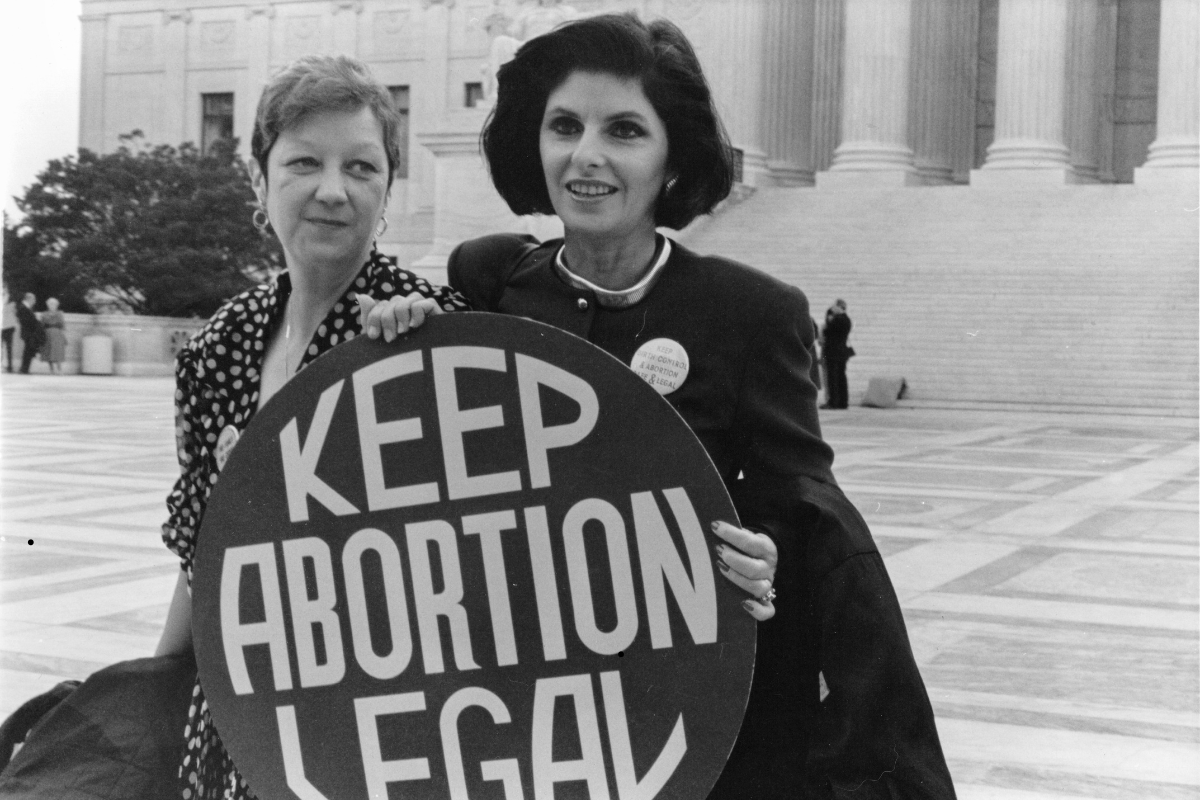
Norma McCorvey (Jane Roe) and her lawyer Gloria Allred on the steps of the Supreme Court, 1989
Photo Credit: Lorie Shaull from St Paul, United States, CC BY-SA 2.0 via Wikimedia Commons
Ground Zero of the Culture War
Political culture is defined and shaped by moral attitudes, views of how life should be lived and the ethos that gives them life. While some attitudes may be prevalent at a given time, disagreement between competing individuals and groups is an inherent characteristic of political culture, so much so that in Federalist 10 James Madison considered the causes of factious conflict to be “sown in the nature of man.” Eliminating the disputes factions cause would require the destruction of liberty, giving each citizen the same views, a cure worse than the disease. For Madison, the best we can hope for is to control the effects of factions by creating a large republic with many representatives who “refine and enlarge the public views.” Harmonizing competing interests is the task of legislatures. The large number of representatives, different modes of election, different constituencies, staggered elections, and the institutional design of Congress prepare it to mitigate and harmonize conflicting interests. Institutional arrangements are insufficient by themselves to mitigate competing views and interests. Republican virtue is necessary for representatives to transcend mere partisanship and foster the common good. And yet, Madison adds, “in many cases” statesmen will be unable to adjust competing interests to the common good.
In a constitutional republic, competition between ideas and policy conceptions can be healthy because no one group or interest has a monopoly on truth. In a well-functioning constitutional republic, competition leads to compromise and consensus, the work at the heart of constitutional politics. Yet, some issue positions and cultural forces clash in ways that strain the very ties that bind individuals and groups into a particular constitutional society. The presence of such issues and forces tends to divide and polarize rather than unite and harmonize. Abortion is one of these issues and forces. Both sides of the debate tend to argue from positions of rights and, not surprisingly, both sides are disinclined to see merit in their opponents’ arguments and are, thus, unwilling to compromise. If a woman has a right to an abortion, one side claims, then government should have no authority to limit it except for ensuring that the medical procedure is safe, covered by insurance, and affordable to all. If a fetus is a human being, then something like the opposite is true. Government should protect innocent human life with few exceptions, to protect the life of the mother, rape and incest, or severe medical condition beyond hope. These are not competing views that lend themselves to constitutional compromise. They are more apt to push to zero-sum extremes.
While the Supreme Court typically considers such divisive political issues to be inappropriate for courts to decide, it makes exceptions to the general rule. Abortion has been one such regrettable exception. The Supreme Court entered the fray of abortion policy and attempted to create something like a constitutional compromise, an endeavor for which it was not designed. The result was a series of abortion cases that failed to settle the controversy or even the Court’s own case law. Rather than heal the political and cultural wounds caused by the abortion divide, the Supreme Court’s case law kept tearing at those wounds and feeding the cultural turmoil surrounding it by giving abortion a national stage on which the Justices played the part of uncompromising, polarized opponents. Consider as an example Justice Blackmun’s statement in his Planned Parenthood of Southeastern Pennsylvania v. Casey (1992) opinion regarding Chief Justice Rehnquist:
In THE CHIEF JUSTICE’s world, a woman considering whether to terminate a pregnancy is entitled to no more protection than adulterers, murderers, and so-called ‘sexual deviates.’ Given THE CHIEF JUSTICE’s exclusive reliance on tradition, people using contraceptives seem the next likely candidate for his list of outcasts.…”
The Court’s abortion case law is one of its great failures. Why? Because in trying to resolve an intense political and social debate by forging a judicial compromise, the Court exacerbated the polarization that drives the abortion debate. For decades after Roe v. Wade (1973), abortion had an oversized influence on American politics. It was at the center of appointments to the federal courts, elections, budget negotiations, and foreign humanitarian aid. In entering the abortion fray, the Court lost sight of the difference between legislative and judicial power and the difference between unitary and federal systems of government.
This essay will analyze Roe v. Wade with subsequent abortion cases such as Thornburgh v. American College of Obstetricians (1986), Webster v. Reproductive Health Services (1989), Planned Parenthood v. Casey (1992), and Dobbs v. Jackson (2022) in mind. The cases that stem from Roe shed light on the problems that were inherent to the Court’s effort to settle a political issue on which the Constitution is silent.
Background and Legal Issues in Roe v. Wade
The legal dispute between a twenty-one-year-old pregnant woman who wanted an abortion, Norma McCorvey (Jane Roe), and Dallas District Attorney Henry Wade, who was responsible for prosecuting violators of a Texas law that prohibited abortion, was, in one sense, straightforward. McCorvey was a single, divorced mother who wanted to terminate her pregnancy. Texas law prohibited abortion except in cases when necessary to save the mother’s life. McCorvey was introduced by an adoption attorney to two recent law school graduates, Sarah Weddington and Linda Coffee who were interested in finding a pregnant woman who was willing to challenge the Texas abortion law in court. McCorvey agreed to do so even though she was informed that the case would not be resolved in time for her to have an abortion.
Weddington and Coffee believed that abortion was a constitutional right protected by several amendments including the First, Fourth, Ninth, and Fourteenth Amendments. Their legal argument derived from the one made in Griswold v. Connecticut (1965), a case that discovered a constitutional right to privacy that extends to the right of married couples to use contraception. Griswold was, then, a foundation for Roe. Both cases involved questions of reproductive rights and government’s use of police powers to limit them. Federal circuit courts came to conflicting decisions on the constitutionality of state laws prohibiting abortion, setting the stage for the Supreme Court to clarify the issue.
The Court’s Ruling in Roe v. Wade
The Supreme Court ruled 7-2 for Roe. Justice Blackmun wrote for the majority and carved out a middle ground between an individual’s unlimited right to abortion and the state’s power to prohibit abortion in all or most instances. Blackmun devoted a significant part of his opinion to the history of abortion from ancient times to the mid-twentieth century. From this historical review he drew two central conclusions. First, existing criminal abortion laws are recent. Second, abortion laws were historically based on the distinction between pre- and post-quickening. Before quickening—before it was assumed that the baby could move on its own in the womb, and was, thus, alive—the destruction of a fetus was considered a misdemeanor. After-quickening abortions, however, were treated as second-degree manslaughter. Justice Blackmun added to his historical analysis that modern medical practices make abortion safer in the early, pre-quickening stages of pregnancy, and riskier in the later, post-quickening stages of pregnancy.
In Blackman’s view, the Court had to balance the right of a woman to have an abortion with the legitimate interest of the state in regulating both medical procedures to ensure their safety and protecting the life of the emerging fetus. A woman has a constitutional right to abortion. That right, however, is not absolute. Rights can be limited by “compelling state interests.” A woman’s right to abortion is limited by the state’s compelling interest in protecting the emerging life of the fetus. Blackmun used a trimester framework to determine where such boundaries are drawn. In the first trimester of pregnancy, a woman has the constitutional liberty to decide with her physician if she wants to abort her pregnancy. In the second trimester, states cannot prohibit abortion, but they can place restrictions on it. In the final trimester, states can restrict or prohibit abortion if they choose.
The Court used not law but biology and medical science to determine the line that separates when a woman’s Fourteenth Amendment right to terminate a pregnancy ends and the state’s interest in protecting life begins. Justice Blackmun explained that “With respect to the State’s important and legitimate interest in potential life, the ‘compelling’ point is at viability. This is so because the fetus then presumably has the capability of meaningful life outside the mother’s womb.” Because the Texas law in question does not recognize this balance of rights and interests, it is unconstitutional.
Roe v. Wade Legacy and Analysis
Roe v. Wade was one of the most controversial decisions made by the Supreme Court. Justice Blackmun was not so naive to believe that it would settle the abortion issue. It was clear, for example, that federal courts would have to determine exactly which state regulations of abortion after the first trimester were consistent with Roe. The trimester framework did not create clear lines of demarcation given that Blackmun’s intent was to use them to identify something like the pre- and post-quickening distinction. As medical technology advanced, babies could live outside of the womb at earlier and earlier stages of development. By the time the Court decided Planned Parenthood v. Casey, about two decades after Roe, the trimester framework gave way to the undue burden test. The new line separating a woman’s right to abortion from a state’s power to prohibit it was not the end of the second and beginning of the third trimester, but viability determined by technology, again, a moving target. Casey did not overturn Roe, but it tipped the balance between the right to abortion and the power to prohibit it in the direction of the latter. The Casey ruling infuriated both supporters and opponents of abortion rights because it contracted the right but did not overturn Roe. Roe and Casey were both overturned by Dobbs v. Jackson about fifty years after Roe.
The unsettled nature of Roe was caused by more than one factor. Persistent opposition to legalized abortion explains why efforts to control the federal judiciary eventually contributed to Roe being overturned. In some respects, Roe was an unstable precedent from its inception. Abortion is not an enumerated constitutional right, and it does not have the same cultural support as the right to use contraception that was identified in Griswold. However murky the Court’s legal argument for the implied right of privacy and contraception was in Griswold, the ruling did not face widespread political resistance as did Roe. The difference in the two cases is that the use of contraception by married couples was not being prohibited even in Connecticut where an old and precatory law was struck down by the Court. Using contraception to prevent pregnancy is not the same as exterminating a living fetus as a form of contraception. The legal arguments in the two cases may seem nearly identical: there is a constitutional right to privacy that extends to reproductive rights whether contraception or abortion. Opponents of the loose, living constitutionalism argument made on behalf of contraception might complain about the constitutional logic used by the Court to discover a constitutional right to contraception, but they could live with the outcome of the decision because it changed very little, if anything, in the conduct of Americans. Using the same basic argument to legalize abortion, including late-term abortions that required partial-birth abortion techniques, was anything but inconsequential. Resistance to Roe included different factors but none was more effective than something admitted by Justice Blackmun in Roe and Justices O’Connor, Kennedy, and Souter in Casey, a fetus is a living or potentially living human being that government has a legitimate interest in protecting. Balancing the right to life with the right to abortion was not something the Court was well suited or designed to do. Abortion is an issue for which legislatures are better suited and designed to decide, which is not to say that a legislative solution was or is necessarily possible that harmonizes the competing interests. Abortion, and its corresponding conflicting interests, may be one of those issues that Madison refers to in Federalist 10 as being beyond the ability of legislators to harmonize in accordance with the common good. The historical journey of abortion through the federal courts is also a reminder of an insight provided by Alexander Hamilton, Orestes Brownson, and Russell Kirk, the written constitution is given life and meaning by the unwritten constitution; the formal law is shaped by the informal cultural attitudes, customs, and ethos that govern the minds and imaginations of political leaders.

Professor of Political Science at Middle Tennessee State University
Related Essays