Jack Ford’s Leadership with “Presidentials” Helped Win President Ford’s GOP Nomination
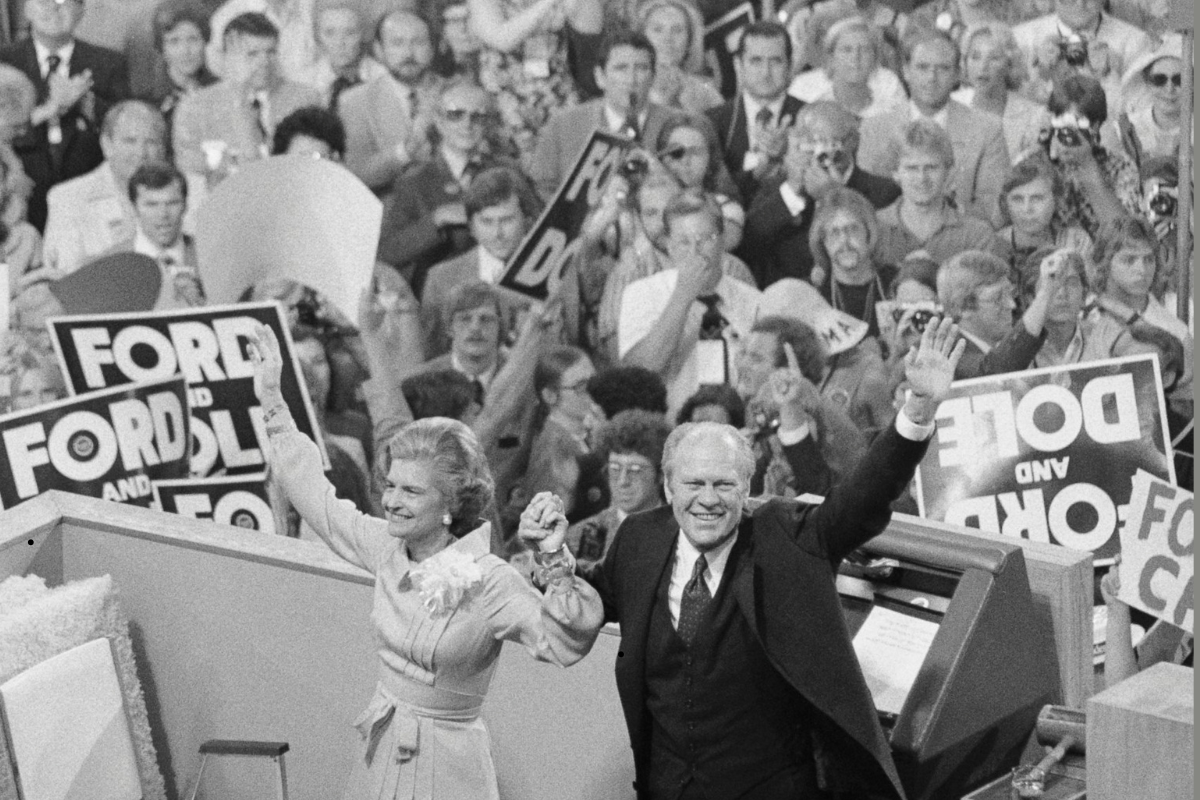
President Gerald Ford, holding hands with his wife Betty, turns to the cheering crowd behind the podium at the closing session of the GOP convention, Aug. 19, 1976. Bettmann Archive/Getty Images
In the 1970s, Jack Anderson’s syndicated column “The Washington Merry-Go-Round” appeared in an estimated 1,000 newspapers. His daily readership was estimated at over 40 million.
In a late July 1976 column, Anderson wrote about the work of Jack Ford to organize a national youth group to support his father’s presidential campaign at the 1976 GOP National Convention in Kansas City. The group was called “The Presidentials.” As an undergraduate at Auburn University, I was one of the lucky ones to be selected as a “Presidential.”
Anderson wrote that Jack “sent out 10,000 letters to young, freshly-scrubbed Americans. He’s trying to recruit 500 of them to cheer for his father at the Kansas City convention.” Ford wanted help for his father against GOP primary challenger Ronald Reagan, the former California Governor, at the Convention.
“Young Ford’s letter offers them the chance to be ‘Presidential.’ For this opportunity, they have to pay a $130 fee. They also have to pay their own transportation costs [to Kansas City]. But once in Kansas City, their expenses will be picked up by the President’s campaign committee,” Anderson wrote.
“The ‘Presidentials’ will be admitted inside the convention hall, Jack Ford promises. They won’t actually be allowed on the convention floor, but they’ll participate in rallies and demonstrations. Or, to use Jack Ford’s words, they will “provide the enthusiasm my father will need to win [the nomination for president].”
“The ‘Presidentials’ should be easy to spot on your television screen. They’ll be young, probably somewhat hoarse, dressed in red-and-white tee-shirts emblazoned ‘President Ford ’76’.”
In 2012, I wrote to archivists at the Gerald R. Ford Library and Museum for records about the Presidentials. In a July 2, 2012, letter, archivist William H. McNitt wrote that information about the group “is scattered in a variety of locations that are not indexed by the name of the organization.”
In 2013, archivist Elizabeth Druga located a folder “Youth Program at National Convention – Secondary Draft” in Box 73 of the President Ford Committee Records. She provided a single-page document with a three-sentence mention of the group. The mention appears under the heading: “Media Events and Special Events.”
“Jack Frost of Campaign ‘76 has developed youth graphics for use and recruitment of volunteers to the Convention and to be used during the convention week to get the youth effort a separate identity. The youth effort will be called Presidentials and the graphics have been designed in red and white to complement the President Ford Committee’s [blue and white] graphics. In order to have the full impact of Presidential support at the Convention, all youth supporters should be identified as such.”
The Presidentials, approximately 1,000, arrived at Kansas City International Airport on Sunday, August 15, 1976. Our orientation was at the Trade Mart, also called “the old airport.” It was a small city airport
After orientation, our group was bused to Ottawa University (OU) in Ottawa, Kansas, located approximately 50 miles from Kansas City. After OU President Wayne Angell, who later served on the Federal Reserve Board of Governors, greeted us, we were assigned to our dorm rooms.
Early on the morning of August 16, Presidentials were bused back to the Trade Mart for an important meeting with President Gerald R. Ford. It was an exciting event as many of us had never met a U.S. President. According to Public Papers of the President, Gerald R. Ford, 1976, pages 727 and 728, President Ford said:
“Your parents, your grandparents, have made a great effort over their lifetime to make this a good country. But they wanted to make it a good country for one single reason – because they wanted their children and their grandchildren to have a better America for themselves than they did for themselves. That is what you want for your children…”
The 1976 Convention happened just over a month after the nation’s Bicentennial. President Ford said: “But it is my feeling that in our third century – and I think this came through during that wonderful Fourth of July celebration – we have to make the third century of America, the century of the individual, so that … we have the opportunity for that individual, wherever he or she may live, … [to] have peace abroad and peace at home; … where a quality of life is meaningful to each and every one of us; where a job is not just a government – promised job, but a job with some real commonsense, with an opportunity for advancement and permanency; a third century, where you and your children and grandchildren can have a vision for a broaden opportunity …”
Aside from President Ford, other cabinet administration officials visited with the “Presidentials” at the Trade Mart. Secretary of State Henry Kissinger received an energetically supportive reception. One young female Presidential from California ran on stage and kissed a smiling Dr. Kissinger. This photo made the national press.
Every night of the 4-day Convention at Kemper Arena was exciting and exhausting. When told TV cameras were aimed at the Presidentials, we stood, waved our “President Ford ‘76” placards, and shouted “Ford.” As Jack Anderson predicted, we quickly became hoarse. Still, we shouted every night.
Every night, the Convention ran into the early morning hours. Often, after our bus trip back to Ottawa, we had little time for sleep before the early morning bus back to the Trade Mart to prepare for the evening’s work at Kemper Arena.
At the Convention, we saw First Lady Betty Ford dance with singer Tony Orlando. We saw Hollywood legend Cary Grant introduce the First Lady to the Convention delegates. Again, it was exciting and exhausting.
On the last night of the Convention, after President Ford defeated challenger Ronald Reagan, many Reagan delegates left the Convention. Since the national TV audience would notice a partially filled arena as Ford accepted his Republican nomination, the Ford Campaign cleared Presidentials to work on the Convention Floor.
It was exciting to wave placards and shout “Ford” standing only feet away from the podium where the President and First Lady stood. We had new placards for “Ford/Dole ’76” after the president selected U.S. Kansas Senator Bob Dole as his vice-presidential running mate.
After the Convention, many members of the Presidentials returned to their states to campaign for the Ford/Dole ticket. We were encouraged to write letters to local newspapers about our experiences.
Since the digitization of 1970s-era newspapers, I found several articles about my fellow Presidentials. On August 19, 1976, the Waterville Times, a newspaper in Waterville, New York, located in central New York’s Oneida County, reported that “Presidential” Edward Kennard had left for the Convention on August 15.
On August 26, 1976, The Waterville Times reported that “Repub. Convention A Tremendous Experience” for local resident and “Presidential” Edward Kennard. Jack Ford, Treasury Secretary William Simon, U.S. Senator Barry Goldwater (R-AZ), Barry Goldwater, Jr., singers Pat Boone and Tony Orlando, and actors Efrem Zimbalist, Jr. (TV’s “FBI”) and Ken Curtis (“Festus” on TV’s “Gunsmoke”) were among the conventioneers Kennard recalled meeting. He said he was “exposed to the real game of politics.”
“All in all, [Edward Kennard] thinks that if he ever recuperates from the hot humid days and sleepless nights, he would think favorably about participating in another national convention,” the Waterville Times reported. “It was a tremendous experience, the ballyhoo, excitement, plus the seriousness and fervor of the delegates, and behind the scenes, workings of the Convention made the business of politics more understandable.” It appears from Kennard’s quotes that he was still excited weeks after the Convention.
On September 16, 1976, the Geneva (New York) Times, a newspaper in upstate New York’s Finger Lakes Region, noted that Mrs. Thomas Biddle attended the Convention with daughter Susan and son Jack, both of whom were members of the Presidentials. Susan and Jack “threw the beachballs into the audience on the last night” of the Convention. Mrs. Biddle said her family met the Ford family as well as Robin Dole, Bob Dole’s daughter, and Tony Orlando.
As more small-town newspapers are digitized, researchers may find many more testimonials from the young “Presidentials” who helped President Ford win the GOP nomination for President at the 1976 GOP National Convention. Their stories would make an interesting collection.
I am grateful to Jack Ford for his vision and leadership with the “Presidentials.” We made a difference at the Convention and in the 1976 Presidential election.

James Patterson is a former U.S. diplomat, life member of the American Foreign Service Association.
Related Essays