Why Read Thoreau?
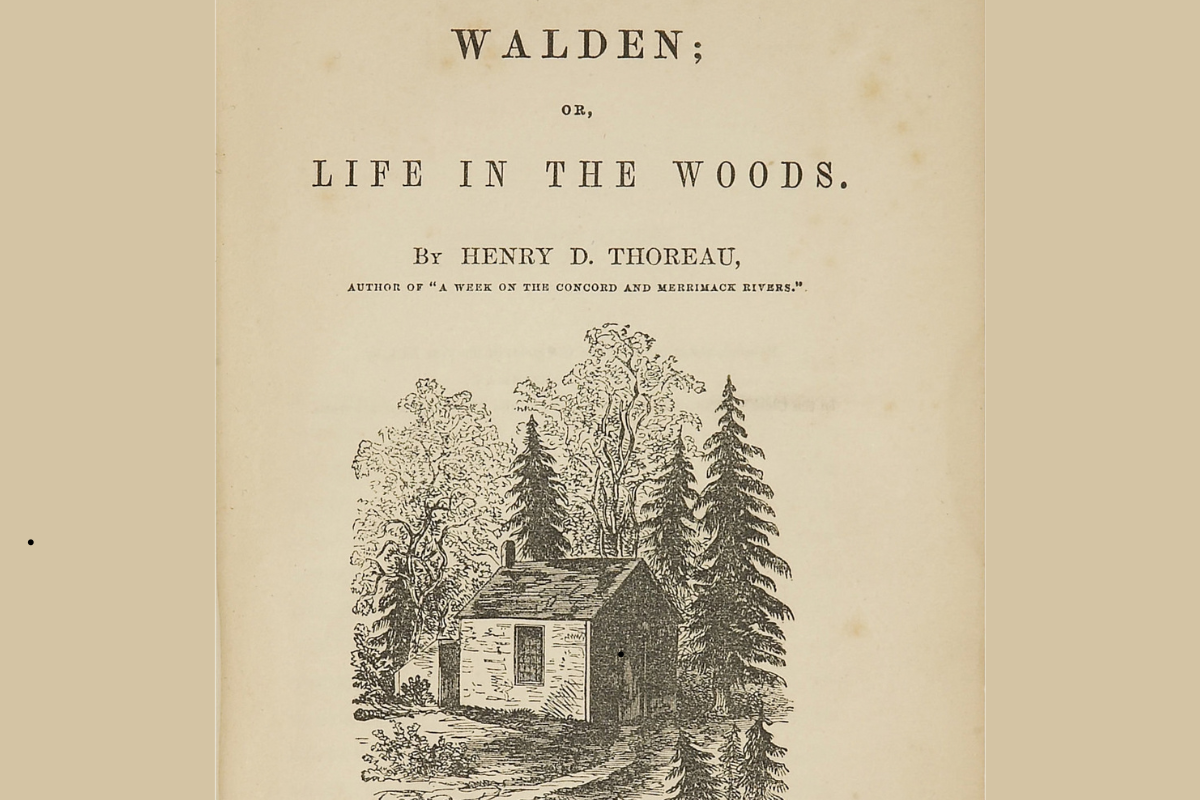
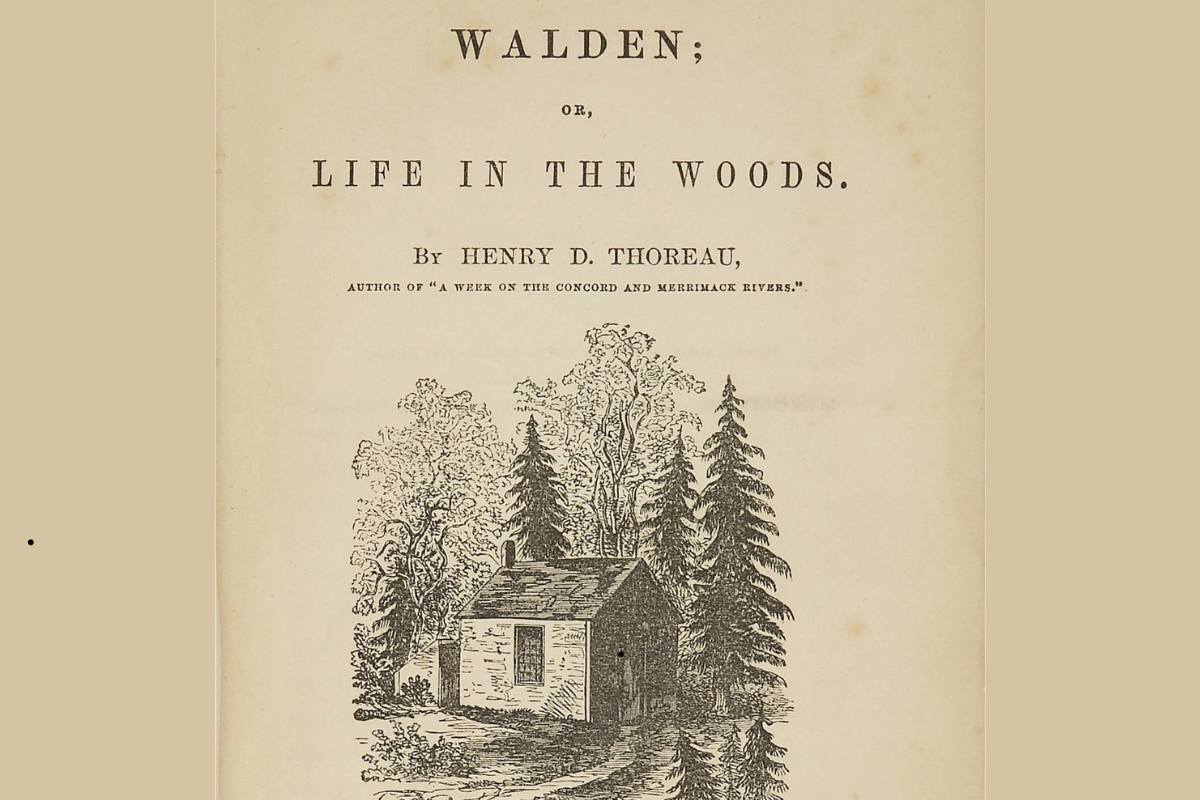
Hating on Henry David Thoreau for some folks seems as much a national pastime as is Duke-loathing during March Madness. The latter is reasonable; the former is inscrutable and wrongheaded.
The complaints against Thoreau are predictable: Walden Pond wasn’t that far from Mommy’s kitchen. Thoreau spent most of his short life at home, working for the family business. (The Thoreaus were pencil-makers, their son a pencil-neck.) He was a failed school teacher. He contradicted himself. He was little more than a proto-hippie. His vaunted chastity was not a matter of choice but—as the daguerreotypes suggest—the consequence of an unfortunate natural endowment.
I’ll grant all of this and more. But to believe it, to care about it and cling to it jealously, you have to read Thoreau with your eyes shut and your brain off.
E.B. White, a devout but slightly embarrassed Thoreauvian (more on that anon), allowed that Thoreau was often “pure scold,” and so he was. He had the habit of spanking his readers and believing that they would thank him for it and then keep right on reading and being spanked.
“However mean your life is, meet it and live it,” he says toward the end of Walden; “do not shun it and call it hard names. It is not so bad as you are.”
Who talks like this to his reader?
But your life, he goes on to say, “looks poorest when you are richest. The fault-finder will find faults even in paradise. Love your life, poor as it is. You may perhaps have some pleasant, thrilling, glorious hours, even in a poor-house.”
I’m quoting from the end of Walden and therefore getting ahead of myself. Not all of the book’s durable lines come from the conclusion, and many occurring earlier on are popular even with people who do not open books at all. Those lines are known thanks in part to the air time they got on the silver screen from a dead comedian playing an erstwhile beloved but later discredited high school English teacher.
“The mass of men lead lives of quiet desperation,” quotes Mr. Keating (Robin Williams) in Dead Poets Society, and watching this second-rate film you can tell that it has never occurred to Keating’s young pupils that their prep school, which like all schools believes its own press too much and has a habit of patting itself on the back, is actually preparing each student to be an isolated version of mass man leading a desperate life.
(Keating stops short of the sequel to that: “What is called resignation is confirmed desperation. From the desperate city you go into the desperate country, and have to console yourself with the bravery of minks and muskrats. A stereotyped but unconscious despair is concealed even under what are called the games and amusements of mankind. There is no play in them, for this comes after work. But it is a characteristic of wisdom not to do desperate things.” Spank!)
You can see, having read this, why in the end it makes perfect sense for the Sage of Walden to ask: “Why should we be in such desperate haste to succeed, and in such desperate enterprises?” Who, crawling from one stoplight to another, belching into the air the same noxious fumes that everyone else’s mechanical Jacobin is belching in the pure free air, has not thought to ask this? Who cannot help wondering why we consent to live the way we do? “Money,” Thoreau rightly says, “is not required to buy one necessity of the soul.”
Even the cretins know that Thoreau “went to the woods because [he] wished to live deliberately.” Few know that he left them for as good a reason: “Perhaps it seemed to me that I had several more lives to live, and could not spare any more time for that one.”
The landscape itself suggested as much: “It is remarkable how easily and insensibly we fall into a particular route, and make a beaten track for ourselves. I had not lived there a week before my feet wore a path from my door to the pond-side; and though it is five or six years since I trod it, it is still quite distinct.”
Here is where the inattentive reader misses part of Thoreau’s message, if not his genius. We are not his only pupils. He himself is one of his pupils. That worn path is an indictment, and Thoreau mentions it not in mere self-effacement but in self-condemnation. I have done the very thing I came here not to do, he tells himself: I have made a beaten path for myself and then followed it.
Case in point: One of Thoreau’s favorite emblems is sleep. “Moral reform is the effort to throw off sleep,” he says, and he is at great pains to remind us that, no matter how early we rise, there is always a more “auroral hour” than we have yet “profaned.” If we do not know this we have “despaired of life.” “To be awake is to be alive,” he says. And then: “I have never yet met a man who was quite awake. How could I have looked him in the face?”
I think the anti-Thoreauvians are, as I said, cretins—not in the sense given by the timid up-to-date moralizing Oxford English Dictionary (the word is “derogatory and potentially offensive”) but in the sense that even the suspect second edition of the OED boldly allowed back when such things were allowed: “One of a class of dwarfed and specially deformed idiots found in certain valleys of the Alps and elsewhere.”[1]
(That little tangent is not as gratuitous as it sounds. Thoreau was more than a dilettante with languages, and he loved to trace or in some cases to guess at etymologies.)
So cretinous are the anti-Thoreauvians that they would even miss his astute commentary on living arrangements that by our standards hadn’t even come into existence yet, if indeed you compare what he’s describing to what we have become habituated to: nowadays (that is, in Thoreau’s days) a man invites you into his house, which someone else has built. Not Thoreau at Walden: he even built his own chimney out of “repurposed”—vile word!—bricks.
Here is Thoreau going off, as we like to say, on elaborate architectural designs that make a virtue of secrecy and confinement—where “to be a guest is to be presented with the freedom of the house” and yet “to be carefully excluded from seven eighths of it, shut up in a particular cell, and told to make yourself at home there,—in solitary confinement.” In such a place “hospitality is the art of keeping you at the greatest distance.”
Why, for example, should there be no open kitchen as there was in Thoreau’s cabin, where everything was on view? “There is so much secrecy about the cooking as if [your host] had a design to poison you.” Thoreau allows that he has been on many man’s premises but seldom in a real house. “Backing out of a modern palace will be all that I shall desire to learn, if ever I am caught in one.”
Spank!
(Elsewhere Thoreau says, “Most men appear never to have considered what a house is, and are actually though needlessly poor all their lives because they think that they must have such a one as their neighbors have.”)
I realize that not everyone wants or can make do with the one-room Thoreauvian shack, and I acknowledge that Thoreau is picking a fight here only he wants. But again that’s not the point. Walden is an extended occasion to think—to think pretty much about everything—because on Thoreau’s account pretty much no one thinks about anything.
The key to understanding Thoreau’s turn of mind comes in the section titled “Higher Laws.” It is here that we see why Thoreau picks fights no one else seems to want. Having told us early that he can live without the post office (“I think,” he rightly says, “that there are very few important communications made through it”) he later allows that we might very well take the same well-trodden path to the post office every day—provided that each day it is a new person who takes that same old walk. Likewise you should not seek new clothes but, rather, a new wearer of clothes.
Because, for Thoreau, we are always being called to a higher life:
“Most of the luxuries, and many of the so called comforts of life, are not only not indispensable, but positive hindrances to the elevation of mankind.”
“The millions are awake enough for physical labor; but only one in a million is awake enough for effective intellectual exertion, only one in a hundred million to a poetic or divine life.”
“Our inventions are wont to be petty toys, which distract our attention from serious things. They are but improved means to an unimproved end, and end which it was already but too easy to arrive at; as railroads lead to Boston or New York.”
Concerning the telegraph, that gee-whiz proto-technology that manifests today as “texting,” Thoreau was properly scornful. “We are in great haste to construct a magnetic telegraph from Maine to Texas; but Maine and Texas, it may be, have nothing important to communicate…. We are eager to tunnel under the Atlantic and bring the old world some weeks nearer to the new; but perchance the first news that will leak through into the broad flapping American ear will be that Princess Adelaide has the whooping cough.”
I don’t know about you, but it is difficult for me to find a single flaw in this remark, from the “broad flapping” ear to the trivia that goes into it. Thoreau had phone addicts pegged long before they were an itch in their daddy’s pants.
After a certain amount of this opining you know that Thoreau will not remain silent on the modes of production. “I cannot believe that our factory system is the best mode by which men may get their clothing. The condition of the operatives is becoming every day more like that of the English; and it cannot be wondered at, since, as far as I have heard or observed, the principle object is, not that mankind maybe well and honestly clad, but, unquestionably, that corporations may be enriched.”
Although Thoreau claims to have seen a woodchuck once and to have “felt a strange thrill of savage delight, and was strongly tempted to seize and devour him raw”—for wildness was an obsession of his (“in wildness is the preservation of the world,” he wrote in “Walking”)—although Thoreau said this, he also believed that the human race was on a trajectory to leave off eating animals. “There is something essentially unclean about this diet and all flesh…. The practical objection to animal food in my case was its uncleanness; and, besides, when I had caught and cleaned and cooked and eaten my fish, they seemed not to have fed me essentially.” There were no physical ill-effects. It’s just that some foods and drinks “were not agreeable to my imagination. The repugnance to animal food is not the effect of experience, but is an instinct…. I believe that every man who has ever been earnest to preserve his higher or poetic faculties in the best condition has been particularly inclined to abstain from animal food, and from much food of any kind.”
You might credit this—I’ll credit it—without having any intention of following Thoreau. I don’t think he was wrong to say that “it is hard to provide and cook so simple and clean a diet as will not offend the imagination; but this, I think, is to be fed when we feed the body; they should both sit down at the same table.”
Are TV dinners and Door Dash and gas-station fried chicken agreeable to your imagination? If so, I’m pretty sure I know what Thoreau would say about you. I myself would say it.
I even think I get Thoreau’s point when he says “I have found repeatedly, of late years, that I cannot fish without falling a little in self-respect.” Again, I have every intention of going fishing again (and again and again), but I’ll allow that Thoreau has put his finger on a certain tincture of wontonness that can color the way a man disports himself. “I have tried it again and again,” he goes on to say. “I have skill at it, and, like many of my fellows, a certain instinct for it, which revives from time to time, but always when I have done it I feel that it would have been better if I had not fished. I think that I do not mistake.”
For this and for many other reasons E.B. White called Thoreau an “upright man.” White admitted that a group of confirmed Thoreauvians would be a disagreeable ragtag crew, but for him Thoreau was the kind of man you might, perhaps somewhat against your own will, seek approval from. Maybe, allowing for time travel, you could walk around with Thoreau and show him the sights. Maybe you could say to him, “See? We haven’t done such a bad job after all.”
There’s a thought experiment that won’t take you very long!
White’s essay is titled “A Slight Sound at Evening.” I like to recommend it as the first thing you read after finishing Walden, for in it White says one of the most sensible things anyone has ever said about Thoreau—namely, that he was driven by two opposing impulses: one to enjoy the world and the other to set it straight. White stops short of implying that very few of us know how to do either, truly to do either, for he was no scold. But you know that Thoreau, had he said it, surely would have been implying that you have no idea how to enjoy the world, the real world, the given world. With Thoreau on your mind and his habit of thought in your noggin, you’re in a position to take the beating you deserve.
For, in truth, you could not walk around with Thoreau and show him the sights and expect his approval. His censure would be even more severe now than it was in 1854. You call staring at your phone enjoying the world? You’re worse than a cretin; you’re a conformist. As Thoreau’s sometime teacher Ralph Waldo Emerson once said of such people, “every word they say chagrins us and we know not where to begin to set them right.”
Thoreau was more direct: “The greater part of what my neighbors call good I believe in my soul to be bad.” Or, to put it another way, the distance between us and those who would set us straight is greater than we can imagine. You might say it is entire.
Our reformers would, all of them, I’m sure, make terrible dinner companions. I can’t imagine how tedious it would be to play a round of golf with Martin Luther. And Thoreau’s censure of a contoured fairway would be unbearable. But on paper that ugly guy looks pretty good.

Jason Peters joined Hillsdale’s faculty in the fall of 2021 after spending 25 years at Augustana College, where he was Dorothy J. Parkander Professor in Literature.
Related Essays