Press Feeding Frenzy Over Ford’s 1976 ‘Free Poland’ Statement
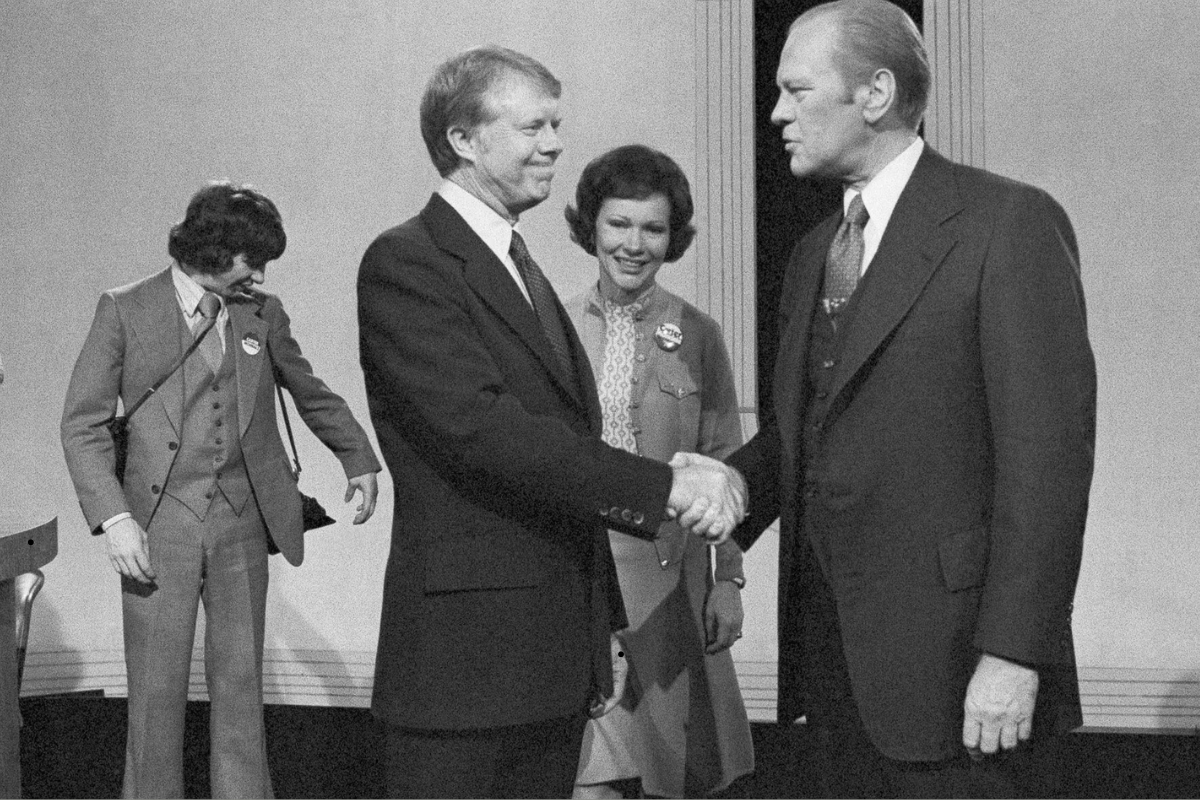
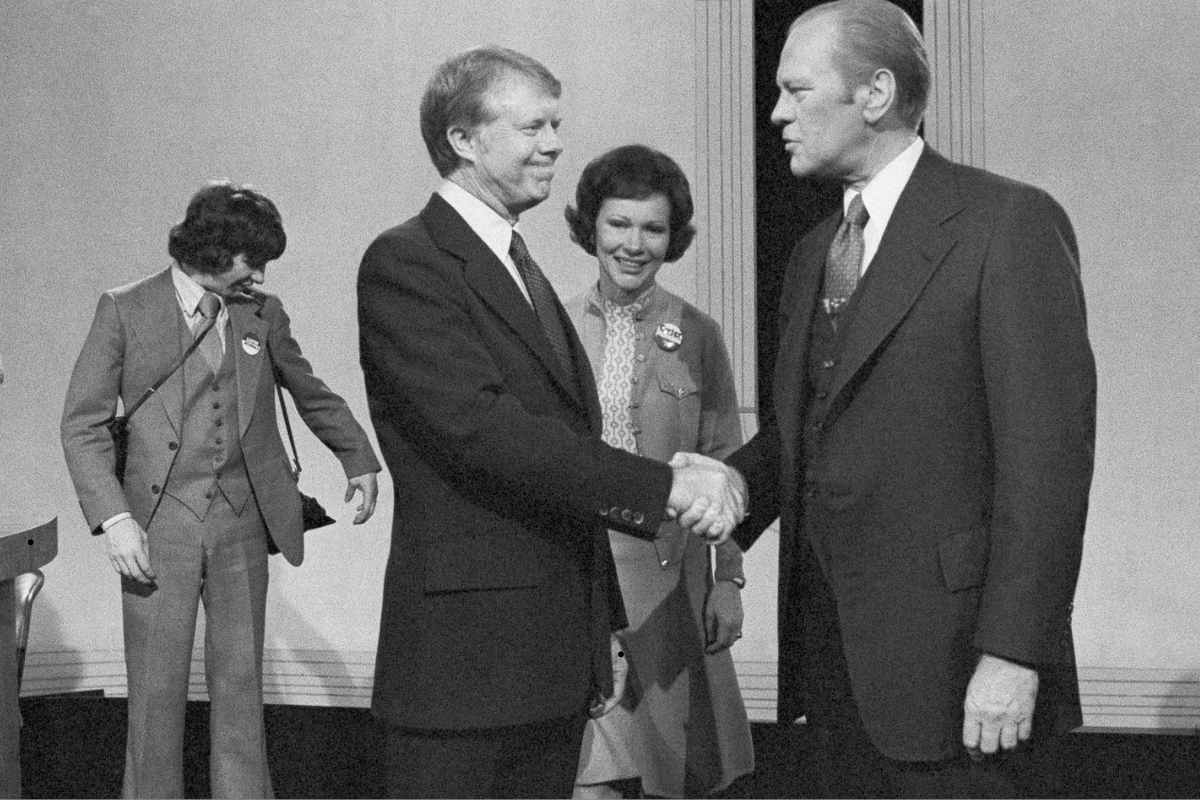
Jimmy Carter and Gerald Ford shake hands after their October 6, 1976, debate in San Francisco. (AP)
Larry Sabato’s 1991 book “Feeding Frenzy: How Attack Journalism Has Transformed American Politics” offers an enlightening defense of President Ford’s statements about Eastern Europe after signing the 1975 Helsinki Accords.
Representatives of 35 nations signed the Helsinki Accords, agreeing to respect human rights and fundamental freedoms and to cooperate in various common areas, including economics, science, and humanitarian aid. Leaders for all European countries, except Albania, signed the accords. Ford signed for the United States. General Secretary Leonid Brezhnev signed for the Soviet Union. The Helsinki Accords were an important and historic achievement in world affairs.
In a 1975 column titled “Soviets Alone Gain by Helsinki Accord,” conservative William F. Buckley found nothing to like in the 30,000-word document. He wrote: “The most appropriate gesture, at Helsinki, would have been to decline to accept an English translation of the 106-page document. Why not just let it circulate in Russian for the personal delight of Leonid Brezhnev? After all, who else has anything to celebrate?” Buckley supported Ford’s GOP presidential primary opponent, Ronald Reagan.
The New York Times was on the same page politically as Buckley. “Helsinki Accord nothing but words,” the Times said.
The second presidential debate of 1976 was held in San Francisco on October 6. Debate topics were limited to foreign affairs and defense. President Ford, who served in Congress from 1948 to 1973, considered himself an expert in these two areas. In his plainspoken way, he said these areas were his “long suit.”
During the debate, a New York Times reporter said Ford had “virtually signed in Helsinki an agreement that the Russians have dominance in Eastern Europe.” The President replied, “If we turn to Helsinki … 35 nations signed an agreement, including the Secretary of State for the Vatican.
“I can’t under any circumstances believe that his holiness the Pope would agree, by signing that agreement, that the 35 nations have turned over to the Warsaw Pact nations the domination of Eastern Europe. It just isn’t true…”
Mr. Ford went on to say, “There is no Soviet domination of Eastern Europe, and there never will be under a Ford administration!” Upon further questioning, President Ford said: “I don’t believe that the Yugoslavians consider themselves dominated by the Soviet Union.
“I don’t believe that the Romanians consider themselves dominated by the Soviet Union. I don’t believe that the Poles consider themselves dominated by the Soviet Union.
“Each of these countries is independent, autonomous; it has its own territorial integrity. And the United States does not concede that those countries are under the domination of the Soviet Union.”
President Ford’s statements about Eastern Europe, which became known as his gaffe about “free Poland,” are discussed by Sabato’s in “Feeding Frenzy.” He compares journalists going after scandals to sharks who, once they see blood in the water, go into a frenzy. He cites several political examples in the book.
Ford’s 1976 debate response about Soviet domination over Eastern Europe, especially Poland, created such a frenzy. After the debate, Ford did not think he had made an error in his reply. David Gergen, a Ford aide, said the “presidential bubble” insulated Ford from the harmful reality about his statements.
In 1975, ABC’s Sam Donaldson said he had “figured out what [Ford] was trying to say [about Eastern Europe].” However, the president was, according to Donaldson, “at best … ambiguous, and at worst his statements suggested he didn’t understand what was happening in Eastern Europe.”
Other reporters also told Sabato that they understood Ford’s meaning, but the “Poland Frenzy” was unforgiving. The press understood Ford, but they failed to inform the public that he was right about a complex foreign policy matter on which he was an expert. The “free Poland” frenzy was a form of “fake news” about a non-controversial statement.
“In truth, Ford’s assertion was not the blooper it was portrayed as being, and the events of the late 1980s proved it,” Sabato writes. During the 1980s, the Soviet Union dissolved. Eastern Europe turned away from communism.
Because of the press feeding frenzy over Ford’s comments, he lost ground in presidential polls against Carter. Sabato writes that the press delivered a steady “drumbeat of negative coverage” about the Ford campaign. The frenzy helped Carter win the White House.
After the collapse of the Soviet Union and Eastern Europe’s turn toward the West, former President Ford wrote an excellent 47-paragraph op/ed for the Washington Post. Titled “Gerald Ford on Poland’s Changes: ‘I told you so’”, published October 11, 1989, the former president noted the changes in Eastern Europe and said he was “prouder than ever to have signed the Helsinki Accords.”
“I did not symbolize an America abandoning the hopes and aspirations of the captive nations, as many pundits, and some former governors charged at the time,” Ford wrote. “Rather, I acted for 200 million Americans by countersigning the Eastern Europeans’ own initial and cautious declarations of independence, with formal Soviet concurrence.”
Rarely does a non-binding diplomatic agreement like the Helsinki Accords produce the magnificent results that it delivered. Ford’s faith in the Helsinki Accords gave faith and hope to millions yearning for freedom. During the tough political climate of 1975/76, Ford never abandoned his faith in America or the “hopes and aspirations of the captive nations.”

James Patterson is a former U.S. diplomat, life member of the American Foreign Service Association.
Related Essays