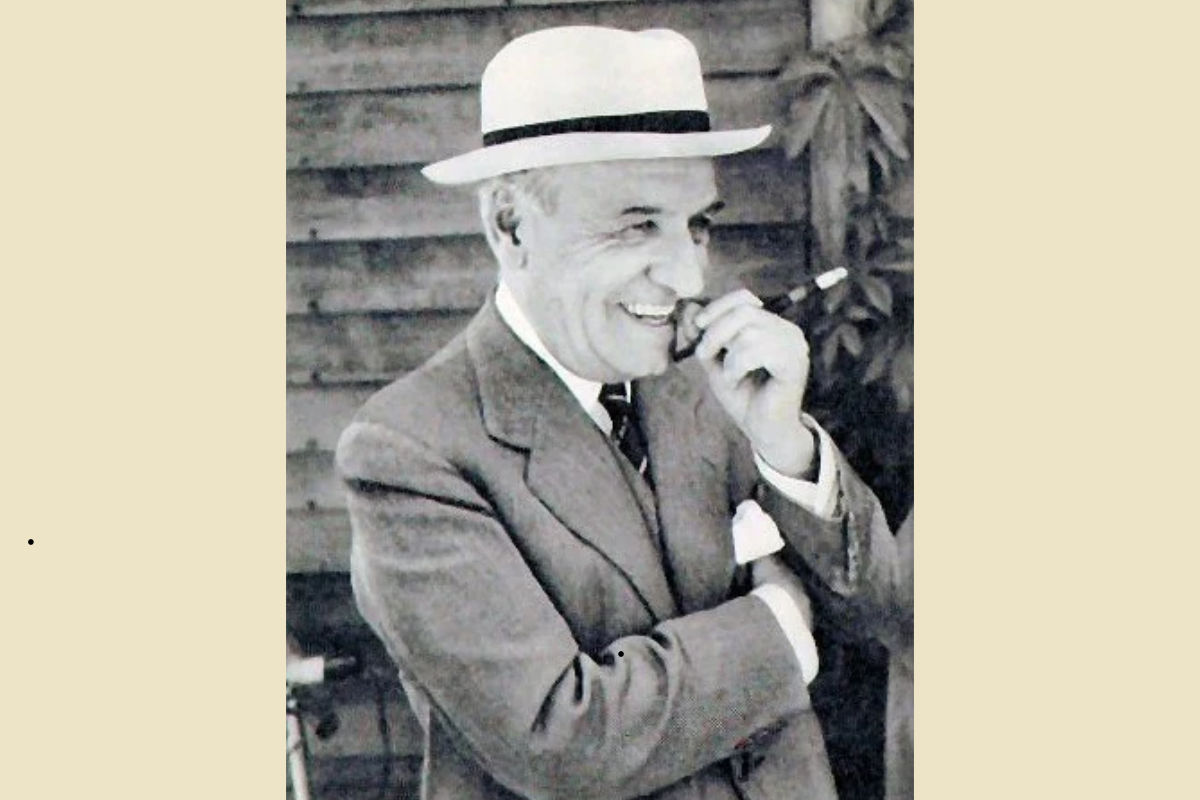
Spanish Philosopher Jose Ortega y Gasset in 1948
Liberalism has long been ambivalent towards the nation-state. Since the aftermath of the Second World War, national identity has been associated with the nation-state, which itself was blamed as the catalyst of atrocities during this period. Since the mid-twentieth century, any discussion of the nation or the nation-state has been associated with the modern phenomenon of “nationalism,” which in turn brings up images of brutal and vicious race-based slaughter. Even mere references to the nation—the community of citizens within a certain regime, not necessarily united on the basis of blood—have been viewed with skepticism by members of the academy.
It is perfectly reasonable to show skepticism towards race-based nationalisms. However, the bias against the nation as such is perplexing. It is erroneous to conflate the parochial nationalisms of the 20th century with the embrace of a civic national identity that includes people beyond one’s kith and kin.
The 1990s saw an explosion in what is now termed “liberal nationalism,” associated with figures like Yael Tamir, David Miller and Will Kymlicka. Defenders of liberal nationalism want to preserve national belonging without letting it curdle into ethnic exclusion. Critics reply that this is wishful thinking: scratch any nation’s civic self-image and you'll find blood, soil, and a shared past doing the real work of drawing the boundary between “us” versus “them”
Both sides, however, tend to assume something they rarely examine — that a nation is essentially a shared enterprise running unbroken from past to present. The hard question they skip is what happens when that thread snaps. What holds a political community together when its history is contested, its unifying story has collapsed, and its members can no longer agree on what came before?
A useful, if unfashionable, place to look for an answer is early twentieth-century Spain — specifically, the philosopher José Ortega y Gasset, who spent his career grappling with exactly this problem after Spain's empire fell apart.
A Nation Loses Its Story
In 1898, Spain lost a short war with the United States and, with it, the last fragments of an empire that had once spanned the globe. The psychological wound went far deeper than the military defeat. For three centuries, being Spanish had meant belonging to an imperial civilization. Once that empire was gone, an old and uncomfortable question resurfaced: what is Spain, if not an empire?
Spaniards reached for two very different answers, and Ortega thought both were dead ends. The first was nostalgia. Spain's Restoration-era political establishment spent decades manufacturing pride in the golden age of Ferdinand and Isabella, Charles V, and Philip II, hoping that pageantry about past glory might paper over present decline. Ortega considered this not merely wrong but actively harmful — a raid on history that produced imitation and stagnation rather than renewal. Nostalgia asks a nation to become its museum.
The second answer came from Spanish Krausism, a movement of intellectuals inspired by an obscure German philosopher who believed Spain could be regenerated by applying abstract, rationalist blueprints to Spanish life. Ortega found this equally unconvincing, for the opposite reason: it floated free of how people actually live, replacing lived experience with philosophical scaffolding imported from elsewhere.
Between politicized nostalgia and philosophical abstraction, Ortega thought that Spain needed a third option, grounded in what a nation actually is when you strip away both the imperial fantasy and the rationalist blueprint.
The Past as Circumstance
Ortega’s answer centers on a concept he called razón histórica, or “historical reason”: a way of understanding human life that takes seriously the fact that people are historical beings without treating history as destiny.
His starting point is a now-famous ontological declaration from his first book, Meditaciones del Quijote (Meditations on Quixote), that “I am myself and my circumstances.” Against Descartes’s strict separation between mind and body, for Ortega a person is not a free-floating rational agent; nor is a person simply a product of forces beyond their control. A person is an “I” acting within a set of inherited conditions — e.g., family, language, region, memory — that they did not themselves choose but must nonetheless work with. The past, in this view, does not predetermine what you must do but rather shapes the field within which you decide what to do next.
Ortega extends this picture from individuals to nations. A people’s history, he argues, is the accumulated circumstance from which a shared future gets built. Memory, for Ortega, is never really backward-looking. Even when we seem to be dwelling on the past, we are doing so in service of something we want to bring about. We remember forward, so to speak. This is why he insisted that human life is a process of successive action, not a static condition. Humanity is always oriented toward what comes next, and even our relationship to yesterday is organized around that orientation.
This move puts Ortega in productive tension with the most famous liberal account of the nation: Ernest Renan’s description of a nation as a “daily plebiscite,” or a community sustained by shared memories and the ongoing consent to keep living together. Renan’s formula has always appealed to liberals precisely because it seems to avoid ethnic exclusivism via its characterization of nationhood as the choice to affirm one’s past.
Ortega thought Renan did not go far enough. Renan still treats the nation as something a people fundamentally is, built from a common past, that they then choose to continue. Ortega flips the emphasis: a nation is something people do, and the past matters only insofar as it supplies the raw material — the circumstances — for a future project. This is more than a mere semantic difference. A community that understands itself as the custodian of a shared past will defend that past. A community that understands itself as engaged in a shared future-directed project has something more urgent to protect: not what already exists, but what its members are still trying to build. As Ortega put it, in defending the nation “we defend our tomorrows, not our yesterdays.”
This reframing explains how a nation can survive a ruptured history — e.g., a lost war, a collapsed empire, or a discredited founding myth — without either denying that history or having their future completely determined by it. The rupture becomes one more circumstance to be metabolized into the ongoing project, rather than a wound that nostalgia must suture or an embarrassment that liberal disavowal must hide.
Belonging Without Blood
This also gives Ortega a distinctive answer to the charge that all nationalism is secretly ethnic nationalism wearing civic clothes. This is a charge pressed forcefully by critics like George Kateb who argue that the standard liberal distinction between “good” civic nationalism and “bad” ethnic nationalism fails under scrutiny, since every nation draws on some inherited cultural particularity.
Of course, Ortega does not deny that inherited particularity is real. Regional temperament, language, and local history genuinely shape people and genuinely create friction. His own account of Spain's internal fractures between Castile and Catalonia and the Basque Country recognizes this friction readily. All the same, Ortega views these inherited traits as conditions of national life rather than its content. Put differently, they constrain and color how people pursue a shared future without supplying the reason for pursuing it. What binds a nation together is the shared, forward-looking project itself — something that people with genuinely different ethnic/racial backgrounds, temperaments, and regional loyalties can each help build, precisely because none of them needs to erase what makes them different in order to participate.
This is also why Ortega was skeptical of any single region or elite simply imposing its vision on the rest. His critique of Castile’s historical dominance over Spain in Revolt of the Masses was not that Castile should not have led Spain, but that it failed at leading because it absorbed the provinces through administrative centralization instead of drawing them into a project they helped create. Genuine national unity, for Ortega, requires that the parts of a country recognize a shared horizon as partly their own doing, not a mission dictated from the capital.
Why This Still Matters
None of this resolves all tensions in liberal nationalism. Orteg’ss framework leaves open hard questions about who gets to articulate a nation’s “shared future” and how we would know a proposed vision reflects the community’s own latent commitments rather than one group’s preferences dressed up as everyone’s destiny. Fair critics have pointed out that any appeal to a common national project risks smuggling in the cultural assumptions of whoever is doing the imagining.
But Ortega’s framework gives liberal nationalism something that, in general, it has lacked: that is, a non-essentialist temporal framework. It explains why a nation is not simply invalidated by a broken or contested history, why national belonging need not collapse into ethnic sameness, and why the past can matter to a political community without functioning as its jailer. Writing from the wreckage of an empire, Ortega arrived at the insight that a people held together by where they are going can survive almost any rupture in where they have been. In an era when so many nations are once again arguing bitterly over their own histories, that insight is worth recovering for future meditation.