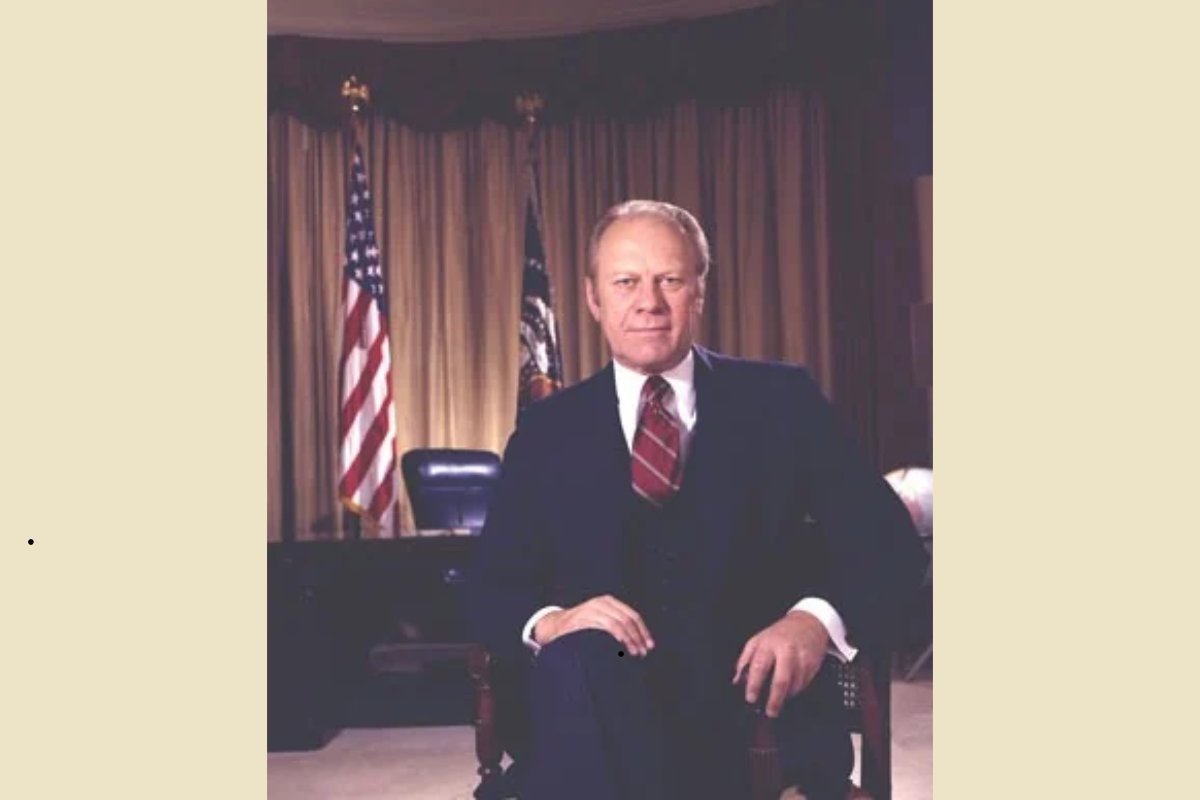
The legacy of Gerald Ford remains with us. He is not a president who is frequently referenced in the day-to-day political battles that consume America. It is not necessarily the case that he is seen as having forged the cultural and ideological identity of his party in the way that presidents such as Ronald Reagan, Barack Obama and now Donald Trump might be said to have done for theirs. But as America moves towards the final years of a tumultuous political era, the pain of our moment will require a grace in our public life that makes contact with the hard lessons we have learned as a country over this period of time. For an example of what leadership may look like in such a moment it is worth reflecting upon the historic example of President Gerald Ford.
President Ford took office following the resignation of Richard Nixon. Nixon resigned in the face of impending impeachment, owing to his role in covering up the break-in at the Watergate Hotel, where Nixon campaign operatives broke into the headquarters of the Democratic National Committee in an effort to gain some advantage for Nixon’s campaign.
“It’s the cover-up, not the deed that’s the real problem here,” George McGovern, Nixon’s opponent in the 1972 presidential election in which the break-in occurred, reportedly opined later on. It was a scandal that rocked America, undermining our nation’s faith in government in ways that it has never fully recovered from.
Former Republican House Minority-leader Gerald Ford had already experienced the unique circumstance of having been appointed vice-president of The United States by Richard Nixon in order to replace former vice-president Spiro Agnew, who himself resigned from office owing to an entirely unrelated corruption scandal of his own. With Nixon’s resignation, Ford assumed the office of the presidency…a responsibility he had never sought. In fact, Ford was planning on retiring from politics after returning to Congress for one final term following the end of the Nixon administration.
Instead, Ford assumed the mantle of the presidency without the vote of the American people, and was handed a problem unlike any given to a president of the United States before.
The problem, in a nutshell, was what to do with Richard Nixon. But more fundamentally, Ford was faced with the question of how to lead a nation divided in a time in which corruption had not only sapped faith in government but left both Congress and millions of Americans howling for not only accountability, but retribution. Yet the process of holding the former president accountable would be long, its end point unclear, but would ensure “ugly passions would again be aroused. And our people would again be polarized in their opinions.” So Ford said in his national address announcing his pardon of Richard Nixon.
“As a man, my first consideration is to be true to my own convictions and my own conscience. My conscience tells me clearly and certainly that I cannot prolong the bad dreams that continue to reopen a chapter that is closed. My conscience tells me that only I, as President, have the constitutional power to firmly shut and seal this book. My conscience tells me it is my duty, not merely to proclaim domestic tranquility but to use every means that I have to insure it.”
President Ford pardoned Richard Nixon on September 8th, 1974, ensuring his own political unpopularity and his eventual defeat at the hands of Jimmy Carter during the presidential election of 1976. But Ford also set an example worth reflecting upon as we approach a likely new shift in the balance of power in Washington towards the end of arguably the most acrimonious political era in living memory.
It is striking to consider just how quaint the Watergate Scandal appears to Americans today when viewed through the lens of our country in 2026. Whether the subject is Donald Trump or Joe Biden, each side has cause to claim that the other is guilty of Watergate level scandals many times over. But what is clear is that, in addition to the widespread perception of corruption that Americans hold towards their government, we have become addicted to a mode of politics that is unconcerned with grace and compassion towards our political opponents and our fellow Americans on every level of society.
As Gerald Ford knew, compassion could not be a justification for setting aside accountability. “I deeply believe in equal justice for all Americans, whatever their station or former station,” Ford said in that address. He then stressed the difficulty of rendering impartial justice to a former president in unprecedented circumstances that would surely strain the comity of the nation. “The law, whether human or divine, is no respecter of persons; but the law is a respecter of reality.” That reality, again, was that the fair delivery of due process to Nixon was not assured, but the division of the American people was.
The parallels are not perfect. But, should Democrats in Congress have the opportunity to once again pursue investigations and accountability for President Trump following the results of the midterms, they will be faced with a version of this choice between accountability and inflaming the partisan passions that undermine governance. These are heavy things to weigh.
Yet in a larger sense, this is a choice that we all face as we come to the turning of the page in our politics one way or the other.
One can believe that Gerald Ford was wrong in pardoning Richard Nixon, that Democrats must pursue accountability for corruption in the present moment, or that Republicans should have pushed harder for accountability for the Biden administration, while still understanding what Ford knew so well. That is that we must have compassion for our fellow Americans, and consider what will be required to allow our nation to heal from the wounds of controversy and corruption, so that the American people themselves can achieve a state of domestic tranquility with each other.
This question applies not only to Democrats weighing a new impeachment, but to Republicans vying with each other over the future of their party and how to hold each other politically accountable for the mistakes of the past. It applies to Democrats having the same conversation in their party. And it applies to each of us in our relationships with one another: do we seek a path towards reconciliation with each other? Or do we not?
In that sense, our modern divisions and battles with corruption are a tragedy such as Ford described the tragedy of Watergate: “…an American tragedy in which we all — all have played a part.”
Accountability in government is necessary. But it takes grace to turn the page.