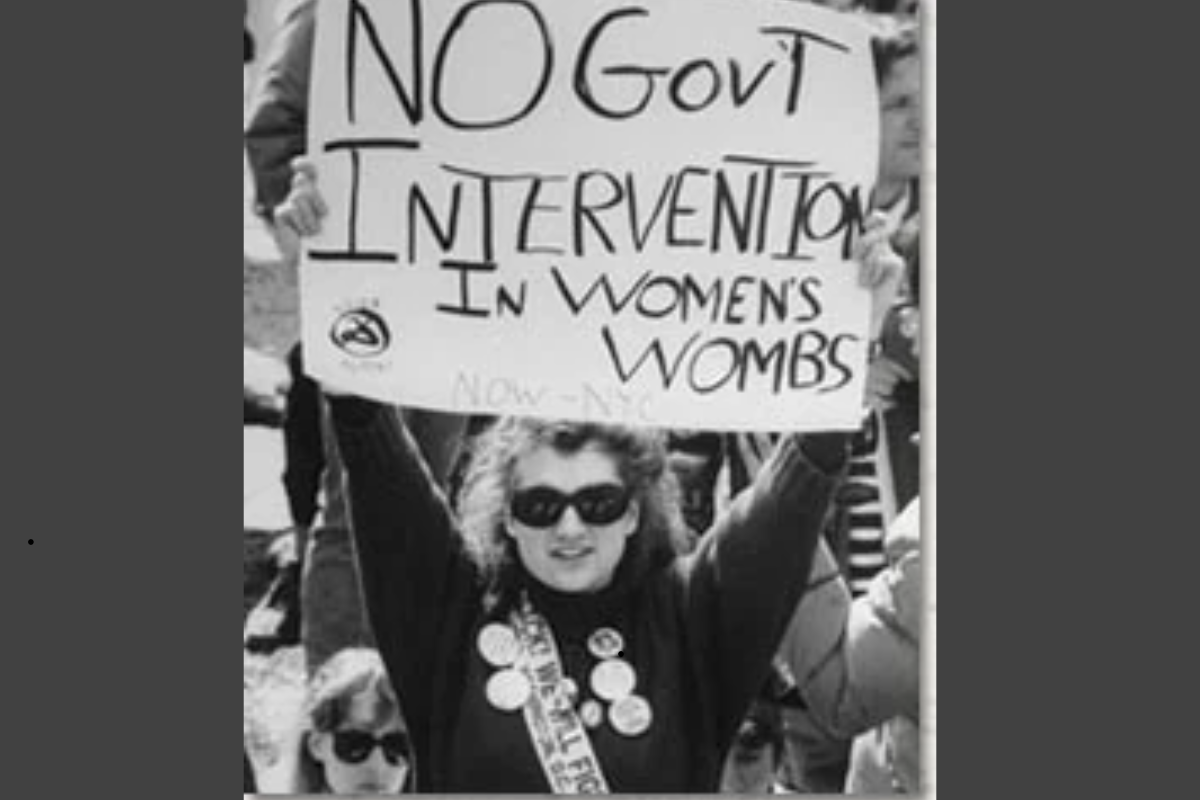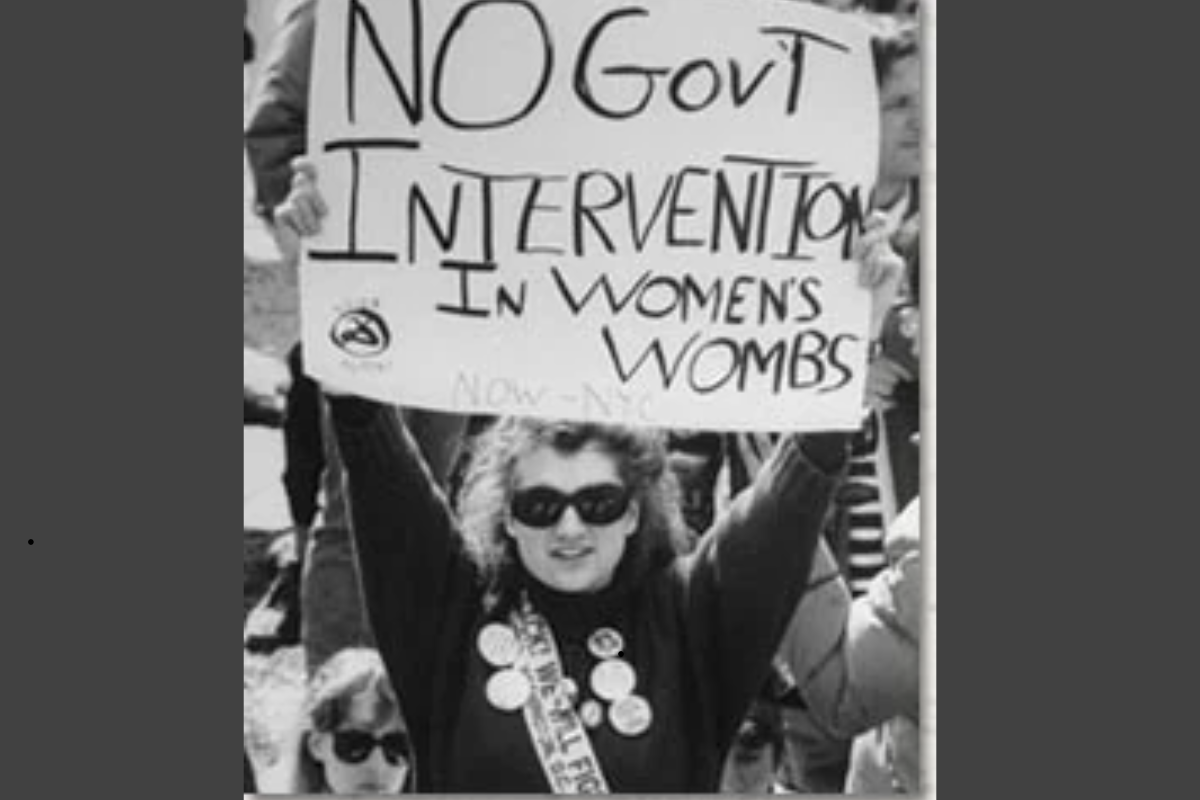
In 1992, the Supreme Court revisited the abortion issue in Casey v. Planned Parenthood. Above, pro-choice activists demonstrate in favor of the 1973 Roe decision.
Photo by Robert Sherbow, reproduced courtesy of TIME & LIFE Pictures
Introduction
On the twentieth anniversary of Planned Parenthood v. Casey (1992), St. Thomas University law professor Michael Stokes Paulsen penned a pair of polemic essays for The Public Discourse declaring Casey to be the “worst constitutional decision of all times.” In defying virtually all the legal prognosticators by upholding abortion rights laid down in Roe v. Wade, Casey was sure to generate controversy. Nor was it just what the Court did, but how it did it. The controlling opinion waxed theoretical about judicial legitimacy and drifted into flowery musings on the meaning of the universe and the meaning of life, sounding more like an undergraduate philosophy seminar than the highest Court in the country. Nevertheless, Casey’s central holding would stand until 2022, when the conservative supermajority finally dealt the death blow to the constitutional basis for abortion rights in Dobbs v. Jackson Women’s Health Organization.
The Pro-Life Movement and the Erosion of Roe
The 1973 Roe decision creating a constitutional right to an abortion was not immediately controversial. An inchoate pro-life movement only gradually took shape, as evangelical Christians who became increasingly politically engaged in the wake of the Carter presidency began to take up the pro-life cause. Disappointment with President Carter led them to shift their support to candidate Ronald Reagan in the 1980 presidential election. By then, opposition to abortion had become a defining issue for religious conservatives, and evangelical support for Reagan played an important part in his landslide electoral victory. By the early 1980s, the battle lines around abortion were hardening, with increasingly polarized and contentious clashes that would eventually manifest in legislative debates at the federal and state levels, protest politics and marches on Washington, ballot initiatives across the country, electoral politics, and much more.
The pro-life movement was active on two fronts in its attack on Roe. One was the narrowing of the legal parameters for abortion in state laws. Pro-life activists toiled quietly at the state level to pare back the broad abortion rights established in Roe. In the 1980s, those efforts resulted in numerous state laws that made access to abortion more difficult. The second, and perhaps more significant, aim was the Supreme Court itself. Realizing that the surest way to undo the Roe abortion rights regime was through a remade Court, newly established conservative religious organizations such as the Moral Majority exerted pressure on the Reagan White House to keep abortion front and center in the administration’s judicial appointments.
The confluence of the two legal strategies produced something of a decade-long pincer movement that weakened Roe. The enactment of restrictive state-level laws meant a steady of trail of cases for the Court to take on. Meanwhile the Court hearing those cases was increasingly dominated by Republican nominated justices. During the two decades that followed Roe, six new justices would join the Court, all of them appointed by Republican Presidents. (The bad luck of the hapless Carter administration extended even to the Court, where Carter was denied even a single appointment during his term.) By 1992, Justice Byron White was the lone Democratic appointee remaining on the bench, and he cast a dissenting vote in Roe.
The result was an incremental but inexorable shrinking of the pro-abortion rights majority during the 1980s. In City of Akron v. Akron Center for Reproductive Health (1983), the Court delivered a strong reaffirmation of Roe, but the 7-2 vote in Roe had become a 6-3 margin. Several terms later, the Court in Thornburgh v. American College of Obstetricians and Gynecologists (1986) struck down post-viability abortion regulations, but the majority had further declined to 5-4.
Thus did Roe appear ever more fragile, hanging by a single vote. When the Court in 1989 accepted for review a Missouri law that imposed stricter restrictions on abortion, many anticipated the end of Roe. The law at issue in Webster v. Reproductive Health Services defined fetal life as beginning at the point of conception, and prohibited the use of any public funds, facilities or personnel in the performing of abortions. The Supreme Court decision upholding the law by a 5-4 vote marked a further erosion of abortion rights and revealed the Court’s greater willingness to accept more severe abortion restrictions. But the fractured Webster Court stopped short of explicitly overturning Roe. Yet the decision provided little basis for optimism among the defenders of Roe. Justice Blackmun bemoaned the development in his Webster dissent, stating that “the women of this Nation still retain the liberty to control their destinies. But the signs are evident and very ominous, and a chill wind blows.”
The Pennsylvania Abortion Restrictions and Planned Parenthood v. Casey
The chill wind would blow even stronger following Webster, when Justices Brennan and Marshall, the two remaining liberal stalwarts on the Court, announced their retirements (in 1990 and 1991, respectively). When Republican President George Herbert Walker Bush replaced them with Justices David Souter and Clarence Thomas, it seemed inevitable that the Court would bury Roe and return the issue of abortion to state legislatures at its earliest opportunity.
That came quickly, when a challenge to restrictions in Pennsylvania’s abortion statute reached the Court. Pennsylvania had amended its Abortion Control Act in 1989 to add a handful of new limits on abortions. Those included a 24-hour waiting period, required informed consent after the woman had been told the risks of abortion, imposed parental consent mandates for minors, and demanded spousal notification for married women.
By the time Planned Parenthood v. Casey arrived at the Supreme Court, Justice Harry Blackmun, who had authored Roe, was the only member of the Roe majority still on the Court. In short, the demise of Roe seemed a certainly. But when the decision came down on June 29, 1992, a splintered Court backed most of the law while simultaneously upholding Roe. Later published accounts revealed that the initial vote in conference had yielded a five-member majority in favor of overturning Roe and upholding the law in its entirety. In the interregnum between conference and the announcing of the decision, Justices O’Connor and Souter (who had joined with the liberals in opposing the end of Roe) successfully plied pressure on Justice Kennedy to switch his vote and join them in salvaging Roe. The result was an unusual one, with Kennedy, Souter and O’Connor jointly authoring the controlling opinion. Justices Blackmun and Stevens wrote concurrences to form a majority, while the four dissenters favored overturning Roe and affirming the statute in whole.
The Controlling Plurality Opinion
The constitutionality of the specific statutory provisions at issue would prove almost an afterthought. Much of the plurality opinion focused on the central question of the survival of Roe v. Wade. The plurality opinion quickly got to the bottom line, stating “at the outset and with clarity” that the essential holding of Roe “should be retained and once again reaffirmed.” Clearly grounding the right in the Fourteenth Amendment Due Process Clause, the plurality pointed to precedent that had extended constitutional protection to those decisions “relating to marriage, procreation, contraception, family relationships, child rearing, and education . . .” The private realm of family life was one which the state could not enter, and it included the fundamental right to make decisions “whether to bear or begat a child.” The plurality continued:
These matters, involving the most intimate and personal choices a person may make in a lifetime, choices central to personal dignity and autonomy, are central to the liberty protected by the Fourteenth Amendment. At the heart of liberty is the right to define one’s own concept of existence, of meaning, of the universe, and of the mystery of human life. Beliefs about these matters could not define the attributes of personhood were thy formed under compulsion of the State.
Channeling its inner empath, the plurality contemplated the pain and anxieties that accompanied a woman’s carrying a child to term, describing the sacrifices borne by women as ennobling but also “too intimate and personal” for the state to insist that she bear. Rather the “destiny of the woman” could only be “shaped . . . [by] her own conception of her spiritual imperatives and her place in society.”
The plurality then turned its attention to the principle of stare decisis. In a stunning admission, the justices acknowledged that they may well not have agreed with Roe as an original matter. Nevertheless, “prudential and pragmatic considerations” underlying stare decisis demanded that they affirm Roe’s central holding. The Court laid out four principles for determining whether the rule of law permitted the overturning of a prior decision. First, had the rule proven to be unworkable? Second, had it induced reliance to such an extent that there would be undue hardship were it overruled? Third, had principles of law been so altered as to leave the rule a mere remnant of an abandoned doctrine? Finally, had the facts on the ground so changed as to rob the rule of significant application or justification? The plurality determined that Roe’s holding had not proven unworkable, and had in fact engendered such reliance in organizing intimate relationships that overturning it would inflict serious harm.
The Court then pivoted to a general discussion of the damage it would likely suffer institutionally were it to overturn Roe. It began by noting that its very legitimacy depended upon its making “legally principled decisions” that were “sufficiently plausible” as to be accepted by the country. That was especially the case when the Court had decided an “intensely divisive” case such as Roe. Roe had “rare precedential force” due to the Court having called “the contending sides of a national controversy to end their national division by accepting a common mandate rooted in the Constitution.” It would take “the most convincing justification” to overturn Roe, lest it be viewed as “anything but a surrender to political pressure . . .” To overrule Roe under such circumstances “would subvert the Court’s legitimacy beyond any serious question.” In short, a primary reason for upholding Roe was explicitly to avoid “the cost of both profound and unnecessary damage to the Court’s legitimacy, and to the Nation’s commitment to the rule of law.”
The plurality finally got down to delineating the right it was upholding. Just what constituted Roe’s essence would prove to be hotly contested. In its reframing of Roe, the plurality characterized the core right as first consisting of a recognition of the woman’s right to choose an abortion pre-viability free of “undue interference” from the state. Second, the state was empowered to restrict abortions after fetal viability, provided there were exceptions for those pregnancies that endangered the life or health of the woman. Finally, the Court recognized the state’s legitimate interest from the beginning of the pregnancy both in the health of the woman and the life of the fetus. However, the Court cast aside the trimester framework of Roe. It deemed that framework as unnecessarily rigid, particularly in undervaluing the state’s interest in fetal life from the onset of a pregnancy. States were free to enact legislation designed to promote the state’s interest in potential life, including measures “aimed at ensuring that a woman’s choice contemplates the consequences for the fetus.”
The Court replaced the trimester regime with an “undue burden” standard. This meant the state could impose pre-viability regulations designed to persuade a woman to choose childbirth over abortion provided it did not constitute “a substantial obstacle” to her ability to choose an abortion. Such rules were meant to “inform the woman’s free choice, not hinder it.” Applying the undue burden rule to the Pennsylvania law, the Court upheld four of the five provisions. Only spousal notification failed the new standard, since the husband had “no enforceable right to require a wife to advise him before she exercises her personal choices.” To give the spouse such a right was akin to “the kind of dominion over his wife that parents exercise over their children.”
The Blackmun concurrence
Unsurprisingly, Justice Blackmun offered a partial concurrence that would have struck down the Pennsylvania law in its entirety. He envisioned a dark Roe-less future, as “four Justices anxiously await the single vote necessary to extinguish the light.” Blackmun lauded the joint opinion of Justices O'Connor, Kennedy, and Souter as an act of “personal courage and constitutional principle.” Blackmun described the authority of the state, by restricting the right to terminate a pregnancy as “conscript[ing] women's bodies into its service, forcing women to continue their pregnancies, suffer the pains of childbirth, and in most instances, provide years of maternal care.” His opinion was devoid of any acknowledgement of other rights that might be implicated by the act of terminating a pregnancy, namely those of the developing life. Blackmun closed his opinion with a deeply personal warning.
I am 83 years old. I cannot remain on this Court forever, and when I have stepped down, the confirmation process for my successor well may focus on the issue before us. That, I regret, may be exactly where the choice between the two worlds [of the plurality and the dissents] will be made.
The Rehnquist dissent
Justice Rehnquist penned the primary dissent, asserting that Roe was wrongly decided and ought to be overturned consistent with traditional approaches to stare decisis. Rehnquist criticized the Court’s lumping of abortion in with “marriage, procreation, and contraception.” Unlike those matters, abortion involved “the purposeful termination of a potential life.” As such, it was “sui generis, different in kind from the others that the Court has protected under the rubric of personal or family privacy and autonomy.” Even if for sake of argument one recognized a principle of substantive due process, abortion hardly qualified as a fundamental right rooted in the “historical traditions of the American people.” To make his point, Rehnquist surveyed state laws in place when the Fourteenth Amendment was enacted, finding almost three-fourths of the states to have had laws limiting or banning abortion.
Finally, Rehnquist scoffed at the plurality’s ruminations on judicial legitimacy. He observed that the concern over possible institutional damage if the Court to overturn a controversial precedent was equally applicable to a decision to adhere to precedent due to pressure by supporters of Roe. Indeed, the plurality’s swapping out of the trimester scheme for an “undue burden” rule created “largely out of whole cloth” indicated the Court was hardly taking its own “paeans of praise for legitimacy” seriously. Its theory of precedent was essentially undermined by the Court’s own rejection of key elements of Roe itself. If Roe continued to exist, it was “only in the way a storefront on a western movie set exists: a mere façade to give the illusion of reality.”
The Impact of the Decision
The legacy of Planned Parenthood v. Casey is decidedly mixed, and can be difficult to suss out free of one’s views on the issue of abortion that was at the center of the case. On the most basic level, Casey effectively extended the life of constitutionally grounded abortion rights for an additional three decades. Within nine months of Casey, the country had elected a pro-abortion rights President in Democrat Bill Clinton. Within two years, Clinton had appointed a pair of solidly pro-Roe justices (Ginsburg and Breyer) to the Court. Casey stemmed what had appeared to be an inevitable tide toward Roe’s elimination. Hence it is rightly considered one of the two pillars (along with Roe) of abortion rights jurisprudence.
On the other side of the coin, Casey replaced the trimester standard with a more lenient rule, thus paving the way for greater state-level abortion restrictions than there had been there had been pre-Casey. The more forgiving “undue burden” test permitted states to express a greater interest in developing fetal life even before the point of viability. Moreover the ambiguity inherent in the undue burden standard also arguably produced more subjective decision making that lacked sound principle. While the trimester scheme smacked of judicial legislating, it at least had a certain logic that was wholly absent with the undue burden rule.
Indeed, the plurality’s seeming obsession with the Court’s legitimacy would prove ironic, as other facets of Casey itself seemed more likely to undermine judicial legitimacy than to bolster it. The plurality’s own admission that they likely would not have agreed with Roe when it was first decided suggested a rigid adherence to stare decisis even in the face of judicial error. Moreover, the Court’s overt decision to uphold Roe lest it be perceived as bowing to politics was in fact itself a response to politics rather than principled or reasoned constitutional judgment. Its attempt to bequeath Roe with special precedential status led to such absurdities as a sitting U.S. senator referring to it as a “super duper” precedent in Chief Justice Roberts’ confirmation hearing. Finally, the plurality’s waxing poetic about the “mysteries of life” and “the meaning of the universe” and a woman’s “own conception of her spiritual imperatives” was rightly derided, if not outright ridiculed. Notions of “reasoned judgment” by the justices hardly fit with such language. One need not agree with Stokes Paulsen’s damning characterization of Casey to conclude that the plurality opinion was undermined by questionable logic, theorizing and methodology. Little wonder that Casey did little to ease that ongoing conflict and contestation around abortion, both in legal theaters and in those of politics and public opinion. If the Casey plurality thought it could call the “contending sides of a national controversy to end their national division by accepting a common mandate” from the Court, it was badly deluded.