Federalist 84
In 1991 Mary Ann Glendon, Harvard law professor, published Rights Talk, a book that examined our obsession with rights. The fact that readers might find it strange that I call it an obsession rather makes Glendon’s point. She argued that we cast political discussions and disagreements almost exclusively in the language of rights, and this impulse has deleterious consequences for public life. Rights are social conventions, and while not as inconsequential as Jeremy Bentham's claim that they amount to little more than “nonsense upon stilts,” they get easily distorted. Originally emerging around the 11th century as a kind of grease in the friction of political disagreement, rights talk now seizes up the machinery of conversation. Rather than viewing a rights claim as a protective gesture against arbitrary power, we tend to see rights claims as closely tied to identity, and in the process we make them absolute. Our rights claims tend to be a little more than fig leaves over our naked self-interest. Clashing interests, however, can easily be negotiated; clashing rights make negotiation infinitely more difficult, as we witness in our abortion debates. One might compromise on interests, but not on rights. Over-reliance on rights talk can lead to strange conclusions: do we really want the exercise of any right to be “safe, legal, and rare?”
Rights talk plays no serious role in normal human affairs. My wife and I have navigated 42 years of marriage without ever claiming a right over against one another. The efforts of our children when they were young to claim a right were both charming and risible. Their rights claims did not challenge arbitrary power so much as legitimate authority. We live now in a time of rights proliferation: every social and political impulse we have gets dressed up as a right, to which the listener is expected to yield. We regard it as a way of strengthening a claim, but in fact the volume of them attenuates the value of all rights claims. Does one actually have a right not to be stood too far away from when engaged in conversation, as the University of Wisconsin insisted?
To the degree historians give the anti-federalists any credit, they do so with reference to the final passage of a bill of rights. Granted, some anti-federalists did advocate vigorously for its inclusion, some insisting the constitution be amended prior to ratification and others willing to take passage on a promissory note. These same historians, however, typically miss the point of anti-federalist insistence.
As I said: in normal circumstances rights claims create more problems than they solve. They have little purchase in churches, schools, ballfields, or tree forts. In the context of a townhall meeting, where citizens engaged in face-to-face self-governance, rights talk would have been considered intrusive. Only when faced with a distant, complex government, one bereft of transparency and accountability and infused with tremendous powers -- precisely the kind of government the anti-federalists feared the constitution created -- do rights talk become serious and necessary business. Normal political activity at scale has little need for the fiction.
Glendon argued that rights talk also had an isolating effect: all too often we are abandoned to the exercise of our rights. Women in America have the world’s most untrammeled right to an abortion but exercise that right in a social world where all support aside from a doctor has been legally effaced. In a world where citizens enjoy a healthy associative life, as Alexis de Tocqueville argued, mutuality and cooperation rule; but as associative life is hollowed out (the passive voice is intentional) the social world polarizes into an overweening centralized government that intrudes into every area of life and rights-bearing individuals who will welcome the soft despotism so long as they can enjoy the indulged desires provided and protected by an ever-increasing panoply of rights. Politics is dolefully reduced to the dull conflict between weak citizens and a powerful government, and we expect rights to maintain the balance between the two. Rights themselves become more private (Griswold v Connecticut) and less public, as we witness in the eviscerating of associative and property rights.
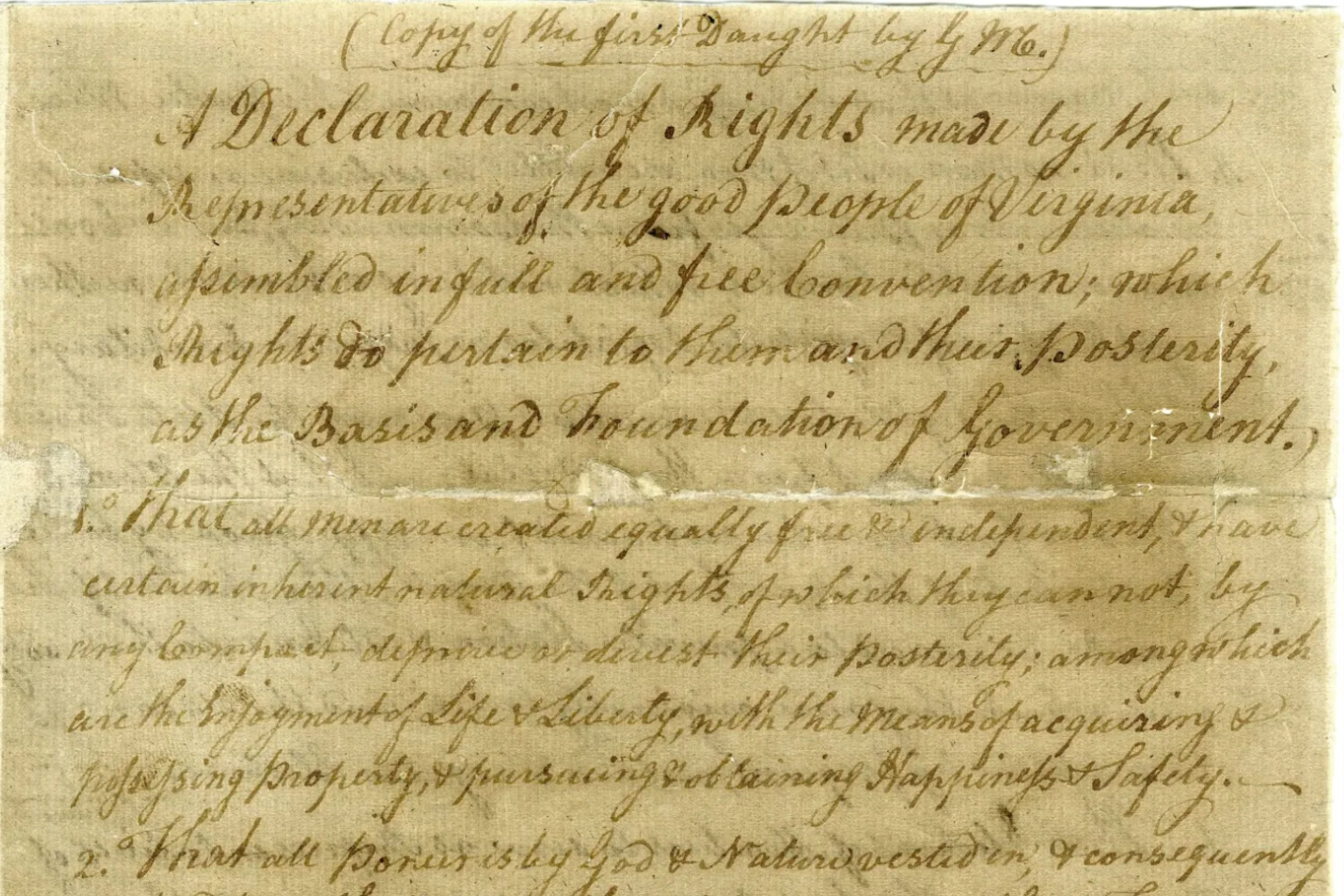
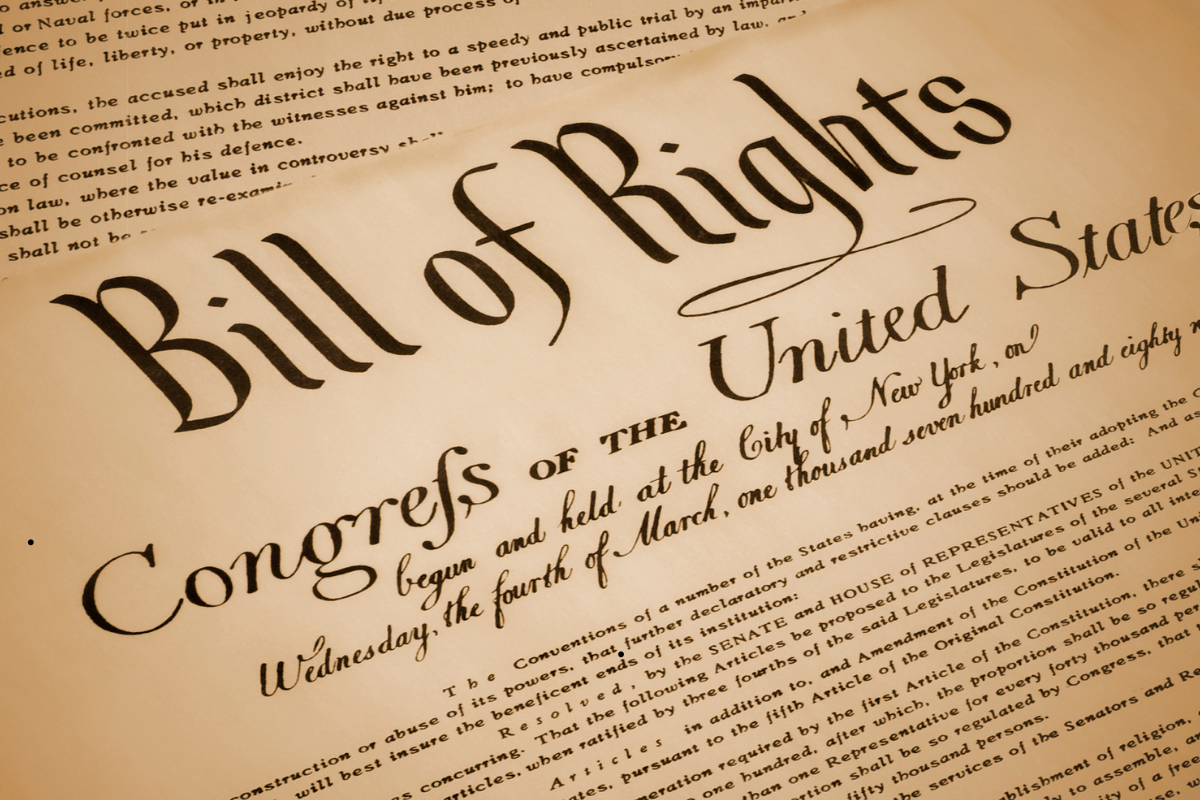
Many readers sharing the tendency to resort to rights talk may be surprised to know that Publius, most specifically Hamilton in #84, opposed a bill of rights. Mind you, the rights listed in the first 10 amendments were not cut out of whole cloth but stitched from the common-law going back to Magna Carta and referred to in the bulk of the Declaration of Independence. In some ways the anti-federalist insistence simply served as a reminder of what Americans had fought for.
What could Hamilton possibly have objected to? For one, Hamilton claimed, the constitution already combined explicit prohibitions concerning matters most likely to violate Republican principles: prohibitions against suspending the writ of habeas corpus (detaining without cause) or issuing bills of attainder (preemptive findings of guilt), or ex post facto laws, and, most tellingly in Hamilton's case, prohibitions on titles of nobility, the one prohibition he reemphasized, as if that alone secured and defined republicanism. “Nothing need be said to illustrate the importance of the prohibition of titles of nobility. This may truly be denominated the corner-stone of republican government; for so long as they are excluded, there can never be serious danger that the government will be any other than that of the people." I'll give him the benefit of the doubt that he didn't envision robber barons or contemporary elites.
Hamilton was not insensitive to the historic rights under the common law. The "only use" of the Declaration, he opined, was to "recognize the ancient law" that limited "the power of the government itself." The very idea of a bill of rights, he claimed, pertains between kings and subjects, not between republican government and citizens, for there could be no distance between those two, as in a monarchy. Rights thus had little relevance for the American experiment, which may have had some historical truth but also seemed to critics shortsighted. A Bill of Rights, Hamilton argued, had "no application to constitutions professedly founded upon the power of the people and executed by their immediate representatives and servants." The people who authored the constitution, he continued, "retain everything" and "surrender nothing, and thus have no need of particular reservations" concerning government power, even if in the nature of the thing creating a central government requires some surrendering of liberty.
Discarding the fact that at the time of the constitution’s ratification seven states had bills of rights in their constitutions, Hamilton tried to convince his New York readers that their Bill of Rights sounded "much better in a treatise on ethics than in a constitution of government," apparently forgetting that Aristotle wrote his Ethics as a propaedeutic to his Politics. And in a rather remarkable claim, Hamilton averred that the preamble with its vague broadsides was "a better recognition of popular rights" than a Bill of Rights would be. I have no idea how that would be the case. Hamilton went further, arguing that a Bill of Rights is not only "unnecessary" but "dangerous," because such an addendum would imply "exceptions to power not granted," and adding a Bill of Rights to the constitution would afford "a colorable pretext to claim more [powers] than were granted. For why declare that things shall not be done which there is no power to do? Why, for instance, should it be said that the liberty of the press shall not be restrained, when no power is given by which restrictions may be imposed?”
Why indeed? Anti-federalists pointed to the doctrine of implied powers, a doctrine Hamilton vigorously defended in debates concerning the creation of a national bank. The principle Hamilton articulates in #84 is sound enough: we didn't tell you that you could do something so you can't do it. It didn’t take long after ratification for Hamilton to argue that the constitution conferred implied powers on the government. The application of the principle of expressed powers, as the anti-federalists repeatedly warned, failed when considering both the commerce clause and the necessary and proper clause, also known tellingly as the elastic clause.
Hamilton further considered rights too vague and difficult to define or to limit. The Supreme Court has struggled mightily to develop tests concerning the freedom of the press and speech and so forth. For example, is a clear and present danger sufficient to restrict the right to speak? What constitutes a clear and present danger? The Court has changed its test multiple times when it comes to religion cases. This goes to Glendon's point that rights talk often tries to write checks their accounts can't cash; or, in other words, they don’t always make managing political disagreement easier.
Keep in mind Hamilton's goal was ratification without delay, and bringing up a bill of rights prior to ratification was inconvenient. Thus he insisted, unconvincingly, that the constitution was in itself a Bill of Rights, restricting as it did government power. That's assuming basic republican principles of self-government at scale. Not totally insensitive to that issue, Hamilton resorted to analogy: people in their states had little idea of what their state governments were doing, which is of course why a majority of states constitutions had a bill of rights, so why would it be so necessary they know what the federal government was doing? In any case, "people don't know what their government is doing" is not the soundest justification one might imagine for dropping explicit protections of liberty.
Without a bill of rights, what sort of security might people enjoy as regards their liberties? Having insisted at the convention that the very existence of the states was contrary to the constitutional plan, Hamilton now argued that the states could act as a bulwark against federal expansion of power. "The vigilance of the state governments" would enable them to act as "so many sentinels over the persons employed in every department of the national administration." The state governments would act as communicative intermediaries and interpose themselves between citizens and the federal government. This “rivalship” of power between the states and the federal government, Hamilton hoped, would be sufficient to protect liberty. Hamilton optimistically predicted this would mean that people would now know more about how the federal government operated than they would about their states or local governments. He also counted, again optimistically, on the news media to be a trusted relayer of information concerning the actions of the federal government. Obviously he couldn't have anticipated our current, thoroughly corrupted media environment, but his confidence in the highly partisan press of his time acting as an effective watchdog was obviously misplaced.
Hamilton drew further solace from the fact that the national legislature would be only part time. If only. It would be nice if Congress actually worked one month a year. Implicit in that observation, however, is an awareness that a fully functioning federal government is a threat to self-governance. While Hamilton may have seen a more energetic government as the great task of the day, the anti-federalists saw the maintenance of liberty as the central requirement of all ages. A bill of rights wouldn’t guarantee the survival of liberty, but liberty’s existence would be more tenuous without one.

Director of the Ford Leadership Forum, Gerald R. Ford Presidential Foundation
Related Essays