Swann v. Charlotte-Mecklenburg Board of Education (1971)
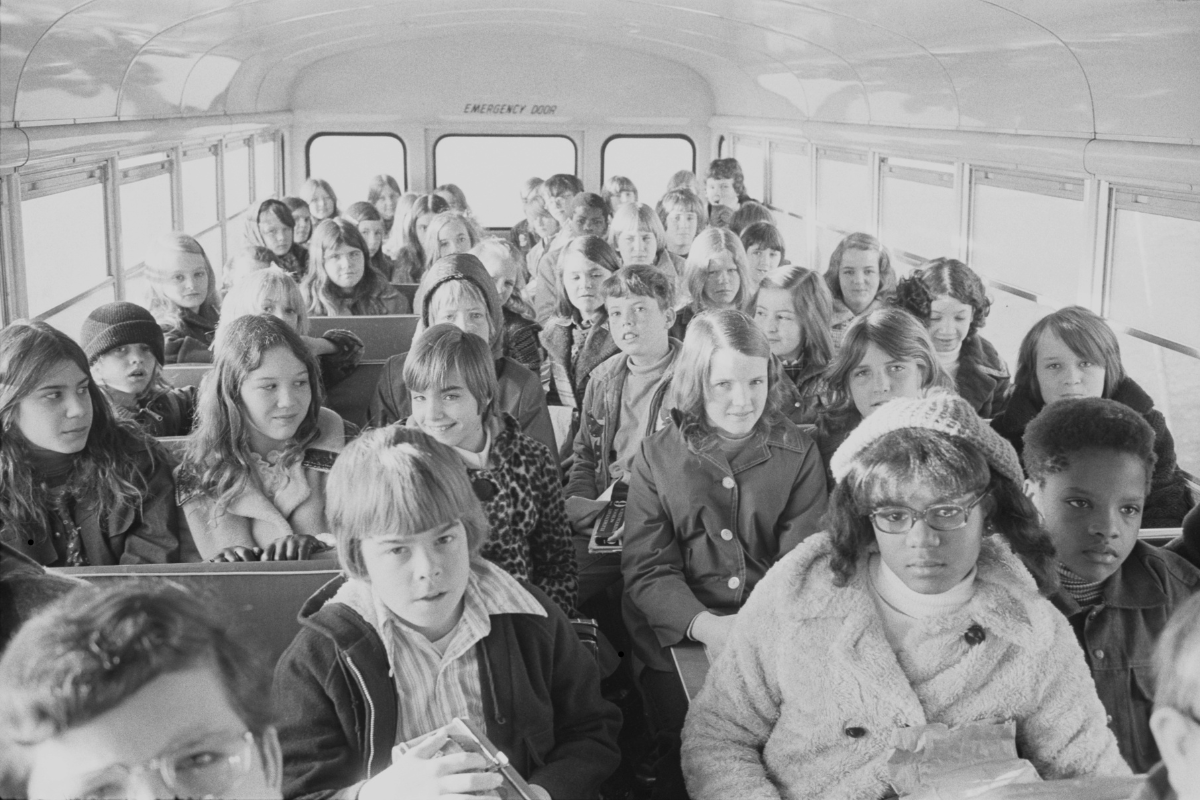
Integrated busing in Charlotte in 1973
From Equal Opportunity and Equal Access to Outcome-based Affirmative Action
The Supreme Court played a central role in both the Jim Crow regime of racial segregation and the civil rights movement that dismantled it. In the first instance, the Court gave legal cover to governments that engaged in racial discrimination. Plessy v. Ferguson (1896) is counted among the Court’s infamous decisions because it gave constitutional legitimacy to de jure racial discrimination. As if in search of redemption in the following century, the Court took the lead in removing legal obstacles to racial equality in a series of cases that culminated in Brown v. Board of EducationI (1954), BrownI I (1955), and Cooper v. Aaron (1958). Resistance to its racial equality rulings was something like penance for its rulings in Dred Scott v. Sanford (1857) and Plessy.
In these redemptive rulings, the Court was intent, at first, on creating equal opportunity and equal access for racial minorities. When those efforts which created freedom of choice for parents and students in public schools did not result in their desired outcomes, due largely to the resistance of segregationists, the Court engaged in something akin to a legal crusade. It was as impatient with the pace of desegregation in the twentieth century as it was tolerant of segregation in the nineteenth century. The Warren and Burger Courts were unsatisfied with promoting equal opportunity and creating equal access for all races. They incorporated a more aggressive and results-oriented approach to racial equality by insisting on equality of results and allowing federal courts to mandate the details of specific remedies that appeared to some to be legislative rather than judicial in nature.
Swann v. Charlotte-Mecklenburg Board of Education (1971) was a giant step in the direction of results-based affirmative action and what became known as government by judiciary.
Background and Legal Issues in Swann v. Charlotte-Mecklenburg Board of Education
In Brown v. Board of Education I, the Court ruled government-created racially segregated schools (dual school systems) to be a violation of the Fourteenth Amendment. Brown II gave some latitude to local governments to create and implement desegregation plans. Cooper v. Aaron and Green v. County School Board (1968) marked the end of the Court’s willingness to tolerate delays in the implementation of desegregation. Likewise, Alexander v. Holmes (1969) ruled that “the obligation of every school district is to terminate dual school systems at once and to operate now and hereafter only unitary schools” open to students of all races.
Desegregation proved more difficult than the Court anticipated. The Court underestimated the resistance to its rulings and the complexity of changing local social and political behavior by means of centralized legal rulings. In some instances, schools were racially segregated by design. In other circumstances, they were segregated, or mostly segregated, not by the design of government policy but by the voluntary demographic distribution of races in neighborhoods and, thus, school zones. School districts that were completely or nearly all black or white because of demographic patterns did not represent the same legal problem regarding equal opportunity and equal access as government-designed dual school systems. In the case of the former, removing legal barriers to equal access would maintain or increase de facto segregation in public schools.
When Darius and Vera Swann moved to Charlotte, North Carolina in 1964 and tried to enroll their son, James, in Seversville Elementary School (an integrated school), their request was denied by the school board. They were told to enroll James in an all-black school farther from their home after which they could request a transfer to the integrated elementary school. The Swanns initiated a lawsuit in federal district court in which Judge James Braxton Craven Jr. ruled for the school district. After that ruling in 1965, the Supreme Court decided Green v. County School Board emphasizing that “The burden on a school board today is to come forward with a plan that promises realistically to work …now…until it is clear that state-imposed segregation has been completely removed.” At the time of the Green v. County School Board ruling, roughly 10,000 of the Charlotte-Mecklenburg school system’s 24,000 black students attended integrated schools.
The Swanns believed that they stood a better chance of winning their case after the Green ruling. They filed their lawsuit again in federal district court. This time Judge James Bryan McMillan ruled in their favor after rejecting a desegregation plan offered by the school system. A court-approved plan (the Finger plan) created by a court-appointed expert (Dr. John Finger) was chosen in its place. That plan bussed 13,000 additional children, requiring the use of 100 additional buses at a purchase cost of $1,000,000 and an annual operating cost of $500,000. When that ruling was appealed to the U.S. Court of Appeals, the court split 3-2-1 and differentiated between older (high school and junior high school) and younger (elementary school) students. Older students would be bused to ensure racial integration. While elementary school teachers would be reassigned, elementary students would not be reassigned to new schools and bused longer distances, because it was believed that doing so was an unreasonable burden on them and their families. The Swanns appealed that part of the decision to the Supreme Court.
The Court’s Ruling in Swann v. Charlotte-Mecklenburg Board of Education
The Court ruled 9-0 for the Swanns. At issue was the constitutionality of forced busing of school children proposed in the Finger plan as a remedy for racial segregation in public schools. More specifically, the Court considered whether the Fourteenth Amendment permitted the use of forced busing across school zone lines. In other words, is “the pairing and grouping of noncontiguous [school] zones” a permissible instrument for desegregating public schools under the Fourteenth Amendment? The Court’s opinion was written by Chief Justice Burger.
What was not in question in Swann was the legitimacy of the Court’s ruling in Brown or the legal necessity of desegregating public schools in the school system. The challenge in the Charlotte-Mecklenburg School district was that two-thirds of black students attended schools that had no white students or were less than one-percent white. An additional obstacle to the Court’s objective “to eliminate from the public schools all vestiges of state-imposed segregation” by using forced busing as a remedy were two provisions in the 1964 Civil Rights Act that a) prohibited the “assignment of students to public schools in order to overcome racial imbalance” and b) prohibited racial balancing “in any school by requiring the transportation of pupils or students from one school to another or one school district to another in order to achieve such racial balance, or otherwise enlarge the existing power of the court to insure compliance with constitutional standards.”
These parts of the 1964 Civil Rights Act seemed to prohibit what the Court wanted the Charlotte-Mecklenburg school board to do, reassign students and bus them across school zone boundaries to achieve desegregation. Chief Justice Burger interpretated the Civil Rights Act to mean that the stated limits on desegregation plans only applied to de facto segregation. Courts can, however, order school boards to use busing to remedy de jure segregation created by “state-enforced dual systems.” Since the school districts in question were engaged in de jure segregation, the restrictions on busing did not apply. What mattered, Burger argued, was the mandate of the Fourteenth Amendment that “no State shall ‘deny to any person within its jurisdiction the equal protection of the laws.’” Moreover, the Court’s rulings including and stemming from Brown required the dismantling of dual school systems that divide students by design based on racial classifications.
Chief Justice Burger noted, however, the limits on the Court’s power to remedy de jure racial segregation in public schools. For example, “The constitutional command to desegregate schools does not mean that every school in every community must always reflect the racial composition of the school system as a whole.” In fact, schools that are of one race or mostly one race, not by design but by demographic distribution, can be deemed consistent with the Court’s ruling in Brown. Without a constitutional violation such as school board-designed racial segregation, there is “no [legal] basis for judicially ordering assignment of students on a racial basis.” The Court is not, however, limited in its power to validate the use of forced busing as a remedy to the problem of state-created, racially divided dual schools.
Swann v. Charlotte-Mecklenburg Board of Education Legacy and Analysis
The Court’s ruling in Swann v. Charlotte-Mecklenburg Board of Education was met with political resistance. In March 1972, almost one year after the Court’s ruling, President Nixon delivered a nationally televised address opposing forced busing. While he supported desegregation of schools, he reiterated his opposition to forced busing to achieve that end.
I am opposed to busing for the purpose of achieving racial balance in our schools. I have spoken out against busing scores of times over many years.
And I believe most Americans, white and black, share that view.
But what we need now is not just speaking out against more busing. We need action to stop it. Above all, we need to stop it in the right way—in a way that will provide better education for every child in America in a desegregated school system.
While Congress did not go as far as President Nixon proposed, it passed Title VIII of the Education Amendments of 1972 creating restrictions on federal funding for court-ordered busing.
The effects of forced bussing was mixed. The Court’s ruling in Swann v. Charlotte-Mecklenburg Board of Education contributed to “white flight,” the movement of white families out of cities and into suburbs that were predominantly white. Consequently, many urban school districts were even more racially divided after Swann than before it. Busing also contributed to the closing of historically black schools that provided jobs and opportunities for blacks that segregated schools did not offer. Busing exacerbated political polarization that existed because of the Vietnam War and the social upheaval caused by the cultural revolution surrounding it. Busing did, however, have positive effects. Government resources were more evenly divided between black and white students, the achievement gap between black and white students shrank, and incarceration rates for blacks who attended integrated schools declined. Court-mandated busing contributed, as well, to the rise of conservative candidates for local, state, and national offices who argued against social engineering and government by judiciary. Ronald Reagan is notable among these candidates.

Professor of Political Science at Middle Tennessee State University
Related Essays