Tinker v. Des Moines Independent Community School District (1969)
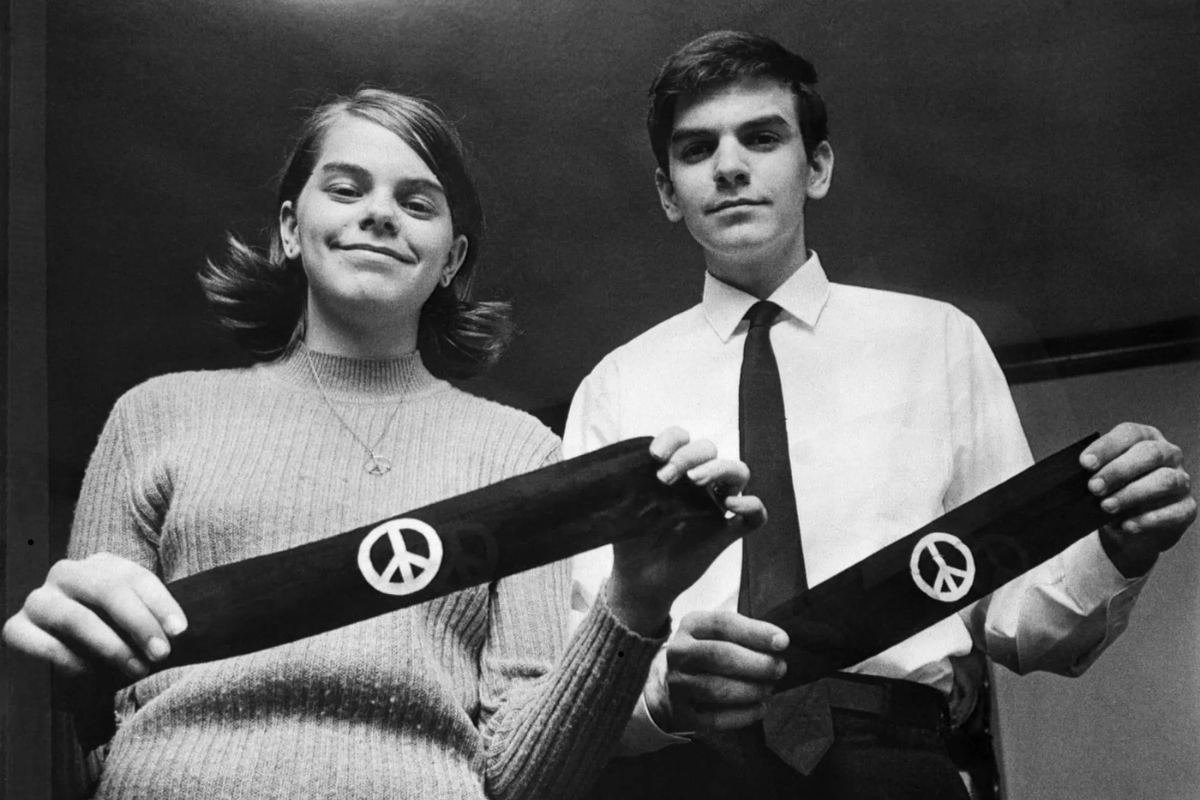
Mary and John showing the black armbands which they wore to school.
Two distinct lines of constitutional jurisprudence can be traced back to the seminal decision of Tinker v. Des Moines Independent School District (1969), in which the Court upheld the freedom of secondary school children to protest America’s involvement in the Vietnam War by wearing black arm bands to school. On one hand, the decision left no doubt that students carried with them into the school constitutional liberties grounded in the Bill of Rights, which school administrators could not easily constrain or deny. Second, the Court’s treatment of the wearing of arm bands as akin to pure speech ensured the relevance of the First Amendment to non-verbal symbolic speech or expressive conduct.
Prior to Tinker, the Court had said little about the schoolhouse civil liberties of students. In West Virginia State Board of Education v. Barnette (1943), the Court had entertained an objection by children of Jehovah’s Witness families to state laws mandating the saluting of the flag and reciting of the pledge of allegiance as daily school activities. Reversing a decision from just five years earlier (Minersville School District v. Gobitis, 1940), the Court in Barnette interpreted the salute as a means of communicating ideas that qualified as a form of speech to which the First Amendment applied. Neither the inculcation of patriotism nor the goal of national unity was sufficient constitutionally to oblige students to salute the flag over their religious objections. The Court in Barnette was concerned with compelling students to engage in expressive conduct that was not their own. In Tinker, the Court would consider the corollary question of whether schools could deny students the right to participate in non-verbal speech inside the school.
The Vietnam War, Symbolic Protest and the First Amendment
By the mid-1960s, growing opposition to the Vietnam War was beginning to manifest itself in a variety of protest activities. The toughest constitutional cases for the courts in weighing the propriety of governmental actions against such protests were those that involved symbolic speech rather than spoken word. The first major case involving symbolic speech to reach the High Court came just a year before its Tinker decision and concerned demonstrations involving the burning of draft cards, which young men were legally required to carry at all times. As the burning of cards by war resisters became more commonplace, Congress amended the Selective Service Act to criminalize the destruction or mutilation of one’s draft card. When David O’Brien burned his card in 1966 in protest of the war, he was arrested, convicted and sentenced to prison. In U.S. v. O’Brien (1968), the Court sided with the government over O’Brien’s free speech claims. It reasoned that a sufficiently important governmental interest in regulating the nonspeech elements of conduct could justify incidental limitations on First Amendment freedoms. In this instance, the challenged statute easily fell within a constitution power granted to the government, namely the raising of a standing army. Moreover, the law was unrelated to the suppression of free expression; rather the issuance of the draft cards, and their protection from destruction, served to safeguard an important governmental interest in the “smooth and efficient functioning of the draft system.” Finally, the restriction was incidental in nature, going no further than what was necessary to protect the governmental interest. While the O’Brien test proved foundational for First Amendment analysis, the Court in the expressive conduct cases quickly pivoted to a posture far more protective of symbolic speech.
Wearing Black Arm Bands in School: A Silent Protest or Disruption in Learning?
In 1965, a group of Des Moines, Iowa parents and their secondary school students met to plan a protest that would involve a two week fast, during which time the children would wear black arm bands to school. School administrators where the students attended got wind of the plan, quickly adopting a policy banning the wearing of arm bands and announcing that students who wore them to school would be suspended. While most complied with the edict, a handful of students, including John and Mary Beth Tinker, followed through with the protest and were promptly suspended. With the assistance of the legal services of the ACLU, the Tinkers filed a lawsuit in federal district court. The court dismissed the complaint on the grounds that the school policy was a reasonable regulation of student behavior in school, and the Eighth Circuit affirmed. The plaintiffs appealed to the U.S. Supreme Court, which accepted the case for review. On February 24, 1969, it ruled in favor of the students by a 7-2 vote, finding that the suspensions constituted a violation of the students’ speech rights.
The Majority Decision
In writing for the majority, Associate Justice Abe Fortas situated the conflict at the intersection of two competing interests. On one hand, the question undeniably implicated “the comprehensive authority of the States and of school officials . . . to prescribe and control conduct in the schools.” At the same time, neither “students [n]or teachers shed their constitutional rights to freedom of speech or expression at the schoolhouse gate.” Hence school authority had to be exercised consistent with the dictates of the First Amendment.
In resolving that conflict, Fortas characterized the wearing of the arm bands as “direct, primary First Amendment rights akin to ‘pure speech’” entitled to a high degree of protection. On the flip side, the Court viewed the school policy as largely motivated by a speculative fear of disruption. The actions of the school authorities were seemingly based upon a desire to “avoid the controversy which might result from the expression, even by the silent symbol of armbands, of opposition” to the war in Vietnam. But it was not enough that the protest caused some “discomfort and unpleasantness.” That the wearing of the arm bands might “start an argument or cause a disturbance” was a risk the Constitution required us to take. The test laid down by Fortas protected students’ speech absent a showing that it “materially and substantially interfere[d] with the requirements of appropriate [school] discipline.” While some hostile comments had been directed at the Tinkers, there was no indication that their gesture intruded upon the work of the schools or the rights of other students. The wearing the arm bands was “a silent, passive expression of opinion, unaccompanied by any disorder or disturbance on the part of petitioners.” In the end, the record was devoid of facts that might reasonably have led the school officials to “forecast substantial disruption of or material interference with school activities, and no disturbances or disorders on the school premises in fact occurred.”
Nor did it help that the administration appeared to have singled out arm bands for special approbation. Political campaign buttons and other signs were allowed, while only black arm bands were targeted. One could conclude from the selective focus that the school was particularly concerned with the message behind them. This smacked of unacceptable viewpoint discrimination. In closing, Fortas gave a ringing endorsement of student rights in school settings.
In our system, state-operated schools may not be enclaves of totalitarianism. School officials do not possess absolute authority over their students. Students in school as well as out of school are ‘persons’ under our Constitution. They are possessed of fundamental rights which the state must respect . . . In our system, students may not be regarded as closed-circuit recipients of only that which the State chooses to communicate.
Justice Black’s Dissent
Justice Hugo Black penned a sharp dissent, in which Justice Harlan joined. By this time, the crotchety eighty-four year old Black was in his thirty-second year on the Court; his dissenting opinion effectively channeled the spirit of the stern, hectoring schoolmarm. He rejected the notion that “any person has a right to give speeches or engage in demonstrations where he pleases and when he pleases.” Teachers and students had no more a right to carry into school a “complete freedom of speech and expression than an anti-Catholic or anti-Semite carries with him a complete freedom of speech and religion into a Catholic church or Jewish synagogue.” At issue was whether “students and teachers may use the schools at their whim as a platform for the exercise of free speech” and whether the courts will take upon themselves the “function of deciding how the pupils’ school day will be spent.” Black was skeptical that federal judges were more to be trusted than school administrators to make such determinations.
Straying far from the majority’s description of a peaceful, quite non-disruptive protest, Black lectured the Tinker children that “uncontrolled liberty is an enemy to domestic peace.” He painted a bleak picture of what was sure to happen in school buildings across the country in the wake of the majority decision.
One does not need to be a prophet . . . to know that after the Court’s holding today some students in Iowa schools and indeed in all schools will be ready, able, and willing to defy their teachers on practically all orders. This is the more unfortunate for the schools since groups of students all over the land are already running loose conducting break-ins, sit-ins, lie-ins, and smash-ons.
The result would be to subject every public school in the country “to the whims and caprices of their loudest-mouthed, but maybe not their brightest, students.”
The Impact of the Decision
The Tinker decision was a watershed for free speech and other constitutional protections for students and teachers in classrooms and on campuses. Students were persons deserving of constitutional freedoms and not “closed-circuit recipients of only . . . those sentiments that are officially approved” of by the State.” They had a voice in their own that could not be muzzled simply because officials did not like what they had to say. The decision established a baseline for the constitutional protections of public school students; administrators needed concrete evidence of a “substantial disruption or material interference” with school activities before they could punish or prohibit student speech. An “undifferentiated fear or apprehension of disturbance” was not enough. Nor could school officials censor speech they simply did not like or found offensive, which raised the specter of viewpoint discrimination.
Tinker did not, however, lead inexorably to an ever-expanding universe of student speech rights, as some might have hoped. As the Court grew more conservative following a string of Republican presidential appointment, it was as likely to pare back or cabin school speech rights in deference to school authorities as it was to expand them. Hence the Court in Bethel School District v. Fraser (1986) upheld a school’s punishment of a student whose speech in a mandatory public assembly violated the school’s policy against “obscene, profane language or gestures.” Several years later, the Court affirmed a school principal’s decision to edit out of a student newspaper materials he deemed inappropriate. Since the paper was part of a journalism class, the Court granted the school control over the paper’s content in the interests of “legitimate pedagogical concern[s]." Hazelwood School District v. Kuhlmeier (1988)
Notwithstanding these erosions in Tinker as precedent, it retains its vitality as the leading authority on contemporary public school student speech rights. As recently as 2021, the Court by an 8-1 margin sided with a cheerleader who vented her anger at being demoted from the varsity squad by taking to a local coffee shop, where she posted a profane video on Snapchat and was suspended from the team. Applying Tinker to social media, the Court was skeptical of the school’s authority to regulate off-campus speech; rather primary responsibility for policing such speech remained with the parents. Mahanoy Area School District v. B.L. (2021)
Tinker likewise propelled the Court into the murkier realm of non-verbal, expressive conduct and the degree to which it is worthy of First Amendment protection. The Warren and Burger Courts proved highly protective of such expressive conduct. In Cohen v. California (1971), the Court overturned the conviction of an anti-war protester who roamed the halls of the local courthouse while sporting a jacket with “F*** the draft” written on it. In Texas v. Johnson (1989) and Snyder v. Phelps (2011), the Court insulated speech in the form of flag burning and deeply offensive protests at a military funeral, respectively, despite possible emotional harm the speech might inflict “thrust upon unwilling or unsuspecting viewers.” Yet between these cases, the Court decided in Hill v. Colorado (2000) that the emotional vulnerability of those accessing abortion clinics were sufficient to justify a buffer zone around which pro-life protesters could not share information or carry signs.
Thus, while the Court has generally tilted in a strongly pro-speech direction, even in the realm of expressive conduct, a series of questions complicate the analysis. For example, to what extent need the conduct convey some intelligible message or idea, if at all? Is the propriety of the expressive conduct based upon the speaker’s intended message, or how a reasonable viewer might interpret it? Can any speech be prohibited simply on grounds of public decency or incivility, perhaps under a “public decorum” exception to free speech? Can speech rights be ever be limited based on the impact upon the unwilling hearer? The cases on expressive conduct seem not to make allowances for the sensibilities of the hearer or viewer (Texas v. Johnson, Snyder v. Phelps) until they do (Hill v. Colorado) (suggesting the justices’ personal policy predilections might be at play). When does the state have a legitimate interest in constraining speech apart from the suppression of the ideas themselves? And might the speaker ever be compelled to employ alternative means of conveying the same idea, as Justice Rehnquist argued in his Texas v. Johnson dissent?
A Postscript: BONG HiTS 4 JESUS
The Court has found artful ways to avoid directly confronting these questions, leading to a degree of incoherence and inconsistency at a time when questions around campus speech and political and social protest seem to be proliferating exponentially. The problem was front and center in Morse v. Frederick (2007), a case in which student rights and symbolic speech considerations converged. Morse featured the behavior of four public school students in Juneau, Alaska who, with their class, were allowed out of school to attend a school-sponsored Olympic torch relay event. When the boys unfurled a fourteen-foot high banner that read "BONG HiTS 4 JESUS" their principal snatched the flag and suspended the students. While the Supreme Court’s 5-4 decision supporting the suspension is defensible, the reasoning on both sides can charitably be described as suspect. Writing for the majority, Chief Justice Roberts created a categorical exception to Tinker for speech that school officials reasonably could interpret as promoting illegal drug use. Yet the testimony of the boys gave away the game, as they admitted their silly message was aimed solely at getting them media attention at a nationally covered event. That such a message could reasonably read as advocating the use of drugs seems a stretch. But Roberts’ dubious analysis was arguably matched by the four dissenters’ willingness to attribute constitutional status to a sign its authors admitted was pure gibberish. In short, we seem a long way from notions of a “marketplace of ideas” in which speech rights were grounded. Given our deeply contentious political and social environment, one trusts the Court might soon have a vehicle by which it might add some clarity and commonsense to this area of constitutional jurisprudence.