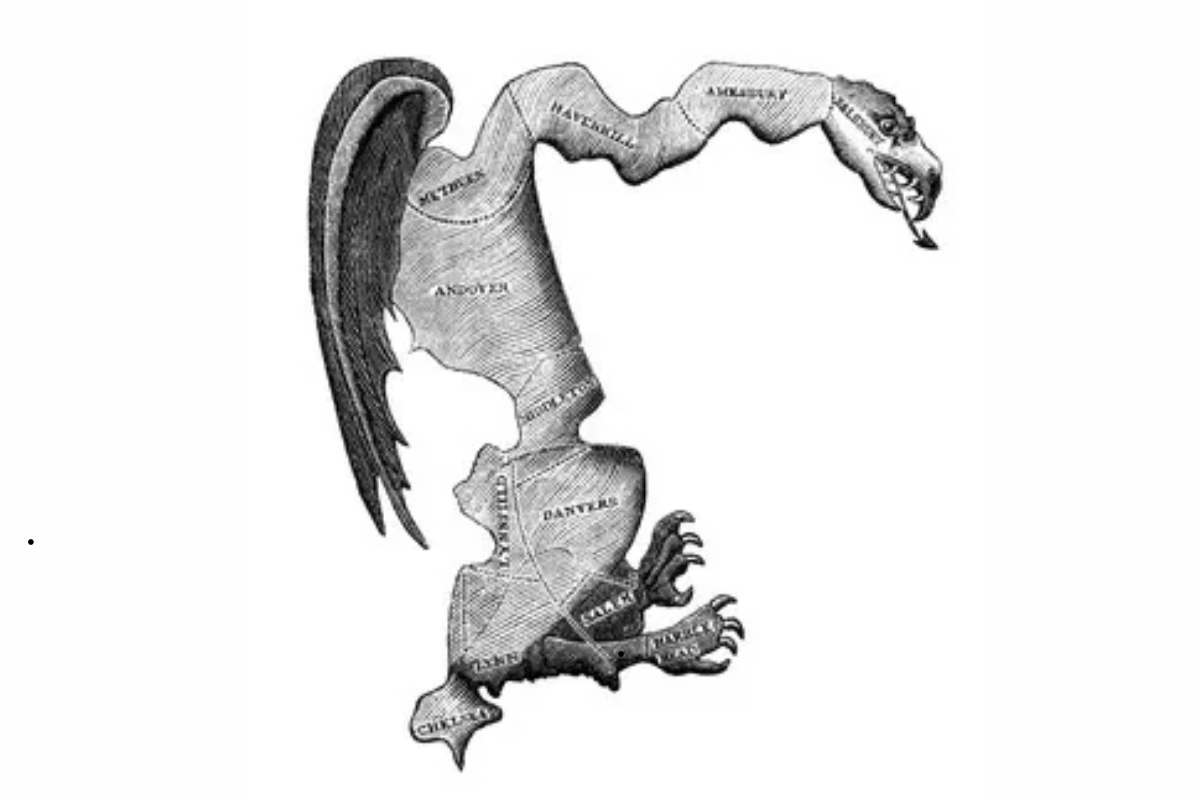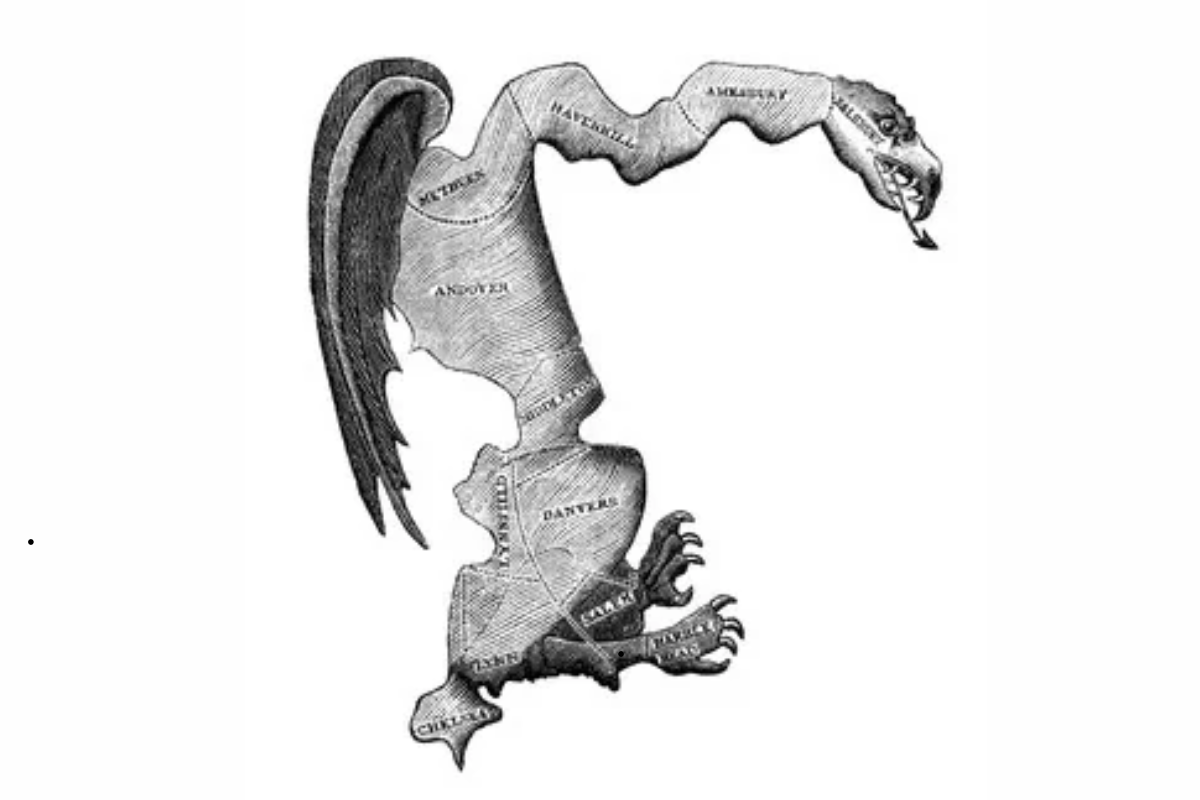
The Gerry-mander,” political cartoon by Elkanah Tisdale, Boston Gazette, 1812.
Introduction
The Voting Rights Act of 1965 was hugely consequential in advancing the electoral interests of Black Americans. Once the Supreme Court okayed the pre-clearance scheme of the VRA in South Carolina v. Katzenbach (1966), Black participation in elections soared. Within a few years of Katzenbach, Black voting rates were within single digits of White turnout. But higher voting did not immediately translate into significant increases in Black representation in Congress. That would take amendments to the VRA and the Justice Department’s insistence on the creation of majority-minority districts as a requirement of pre-clearance. Shaw v. Reno (1993) revealed a Court struggling to reconcile the demands of the VRA with basic Fourteenth Amendment commitments to equal protection for all.
Race-Based Districting: From A Tool of Black Oppression to A Path to Black Representation
Race-conscious line drawing has a long and checkered past in American politics. Its origins trace back to the post-Civil War era, when southern states employed it to suppress the influence of newly enfranchised Black voters. Once federal oversight of Reconstruction ended with the 1877 Compromise, southern states were free to redraw electoral maps without federal interference. By the early 1880s, Black voters were either being packed into districts or, if they were a majority community, cracked into multiple districts, as a way of minimizing their influence on congressional and state-level representation. By 1900, Black representation in Congress had disappeared completely.
The first half of the 20th Century was marked by severe malapportionment, due to Southern states’ simple refusal to reapportion seats. At the same time, the federal courts viewed legislative redistricting as a political question beyond their remit (Colgrove v. Green 1946). The consequence was a six-decade long freezing of districts that gave shrinking white rural populations disproportionate influence over voting and electoral representation. Cracks in this system of oppression began to surface with post-World War II increases in Black registration and voting in areas of concentrated Black populations. A key development occurred when the Alabama state legislature responded to rising Black voting registration in 1957 by gerrymandering the city boundaries of Tuskegee to essentially excise all Black residents. It produced a unanimous Supreme Court decision in Gomillion v. Lightfoot (1960) holding that redrawing municipal boundaries to exclude Black citizens from elections violated the Fifteenth Amendment. Gomillion signaled that the Colgrove Court’s view of redistricting as a nonjusticiable “political thicket” was on its last legs. In relatively short order, the Court had opened the door to federal oversight of redistricting (Baker v. Carr, 1962) and had imposed the “one person, one vote” standard (Wesberry v. Sanders, 1964). With the 1965 passage of the VRA and its pre-clearance requirements, it was only a matter of time before race-conscious redistricting would be employed for positive rather than nefarious purposes.
The Voting Rights Act: From Ballot Access to Effective Representation
The VRA had been primarily concerned with eliminating practices such as literacy tests and poll taxes that denied Black access to the voting booth. In the face of the post-VRA rise in Black registration and voting, southern jurisdictions responded with at-large and multi-member districts that minimized the effectiveness of the Black vote by subsuming it in larger white majorities. But in Allen v. State Board of Elections (1969), the Court ruled that VRA pre-clearance also applied to redistricting and at large voting mechanisms. Thus did the focus of the VRA shift to preventing dilution of the Black vote. The efforts of civil rights minded legislators and activists got a boost from the Supreme Court in White v. Regester (1973), when it struck down as violative of the Fourteenth Amendment a multi-member district which was found to undermine the opportunity of minority voters to elect representatives of their choice. The reach of White was limited, however, by the Court’s subsequent ruling in City of Mobile v. Bolden (1980), which limited section 2 of the VRA to instances where lawmakers had intentionally adopted a plan for a racially discriminatory purpose. Establishing discriminatory intent proved a high bar in court, resulting in the stalling of vote dilution lawsuits across the country.
Congress quickly responded to the “discriminatory intent” problem of Mobile v. Bolden, amending the VRA in 1982 to prohibit redistricting plans that had the effect of abridging the right to vote, regardless of intent. Utilizing a “totality of the circumstances” test, courts were to consider whether a redistricting map had the practical impact of diluting minority voting strength. The Supremes blessed the “discriminatory impact” amendments in Thornburg v. Gingles (1986), upholding a challenge by Black voters to a North Carolina redistricting plan that featured several multi-member districts. Writing for the Court, Justice Brennan affirmed that discriminatory effect alone was sufficient to establish a Section 2 violation. The Court provided a clear framework for vote dilution claims. First, the minority group had to be sufficiently large and geographically compact to constitute a majority in a single-member district. Second, the group had to be politically cohesive, that is, likely to vote as a bloc for particular candidates. Finally, the white majority likewise had to vote as a bloc in numbers sufficient to defeat the minority group's preferred candidate. In short, when redistricting was overlaid upon social and historical conditions to deny minority voters an equal opportunity to elect their preferred candidates, race-conscious remedies were appropriate
Gingles came just in time for the redistricting cycle following the 1990 census. A number of states, with the cooperation of the Justice department, relied on Gingles to draw majority-Black and majority-Hispanic congressional and state legislative districts. The creation of majority-minority districts picked up steam in 1992, with the incoming Clinton administration’s interpretation of pre-clearance as requiring states to create majority-minority districts where minority voters comprised a majority of the population. Pre-clearance now demanded the drawing of electoral districts so as to produce Black seats in Congress or state legislature roughly in proportion to the relevant Black population. Pre-clearance was now used to ensure Blacks an equally effective vote, as measured empirically by the number of Black officeholders. (Republicans were happy to join in the effort; the packing of Democratic minority voters to create new majority-minority districts had the corollary effect of weakening other Democratic incumbents and enhancing opportunities for Republican candidates in adjacent districts.)
Shaw v. Reno (1993) and the VRA in Tension with the Fourteenth Amendment
The Justice Department’s expansive interpretation of the VRA preclearance was wildly successful in putting minorities in Congress. In 1993, the number of Black members rose from twenty-eight to forty, a handful of them from states that had not had a Black congressmember since the 1800s. The number of Hispanics similarly increased from fifteen to twenty-one. The aggressive implementation of a policy requiring majority-minority districts also put the VRA in sharper relief with the Equal Protection Clause of the Fourteenth Amendment. The Court would be asked to resolve that tension in Shaw v. Reno, a dispute over the state of North Carolina’s redistricting plan.
The 1990 census had given North Carolina an additional seat in Congress via reapportionment. Its congressional redistricting plan was subject to preclearance; the state had last had a Black congressman in 1901 and had an extensively documented history of denying minority voting rights. The state’s initial proposed plan, which accounted for a single majority-Black district, was rejected by the Justice Department for failing to "give effect to black and Native American voting strength." In response to the AG’s objections, the state redrew the map to add a second majority-Black district, which was approved by the Justice Department. However, the state had to work to come up with a second majority-minority district. Unlike most Black communities which tended to be densely concentrated in urban areas, North Carolina’s Black population was widely dispersed, with Black citizens comprising a majority of the population in only five of the state’s 100 counties.
Justice O’Connor’s description of the second majority-minority district was telling.
[the district] is approximately 160 miles long and, for much of its length, no wider than the I-85 [interstate] corridor. It winds in snake-like fashion through tobacco country, financial centers, and manufacturing areas “until it gobbles in enough enclaves of black neighborhoods.” . . . Northbound and southbound drivers on I-85 sometimes find themselves in separate districts in one county, only to “trade” districts when they enter the next county. . . One state legislator has remarked that “’if you drove down the interstate with both car doors open, you’d kill most of the people in the district.’”
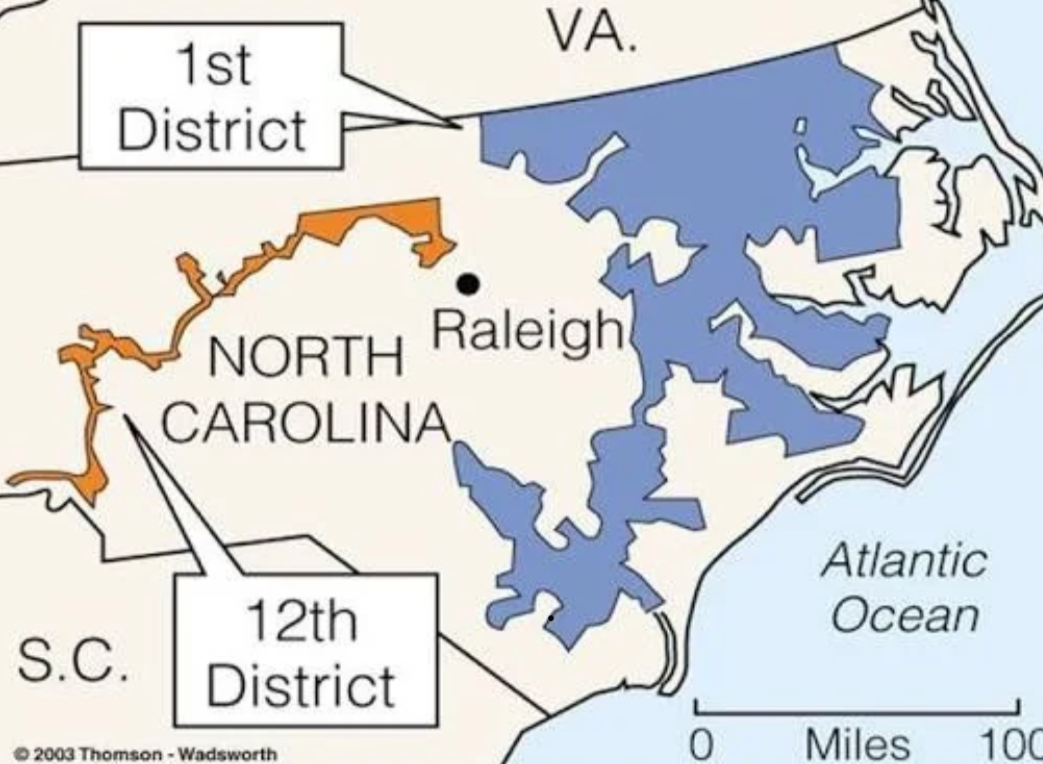
It was this bizarrely shaped district to which Ruth Shaw and a group of white voters objected. On April 23rd, 1993, the Court issued a narrow 5-4 ruling siding with Shaw and her fellow plaintiffs.
Justice O’Connor’s Majority Opinion
Justice O’Connor settled on a standard of strict scrutiny, concluding that “district lines obviously drawn for the purpose of separating voters by race require careful scrutiny under the Equal Protection Clause regardless of the motivations underlying their adoption.” O’Connor found the mere fact of the district’s irregular shape sufficient to allow “no other explanation than that it was drawn to segregate voters on the basis of race.” This was a particular problem when “a disperse minority population” was concentrated in a single district in disregard of “traditional districting principles such as compactness, continuity, and respect for political subdivisions.”
For O’Connor, reapportionment was an area of constitutional law where “appearances do matter.” A plan that corralled individuals of the same race in a single district who otherwise were “widely separated by geographical and political boundaries . . . [had] little in common with one another but the color of their skin.” O’Connor used provocative language, finding that the bizarre district bore an “uncomfortable resemblance to political apartheid.” Nor was it simply appearances. It perpetuated a perception that “members of the same racial group . . . think alike, share the same political interests, and will prefer the same candidates at the polls.” It amounted to impermissible racial stereotyping, which could in turn exacerbate “the very patterns of racial bloc voting that majority-minority districting is sometime said to counteract.”
O’Connor foresaw a pernicious side effect of extreme race-based line drawing on the elected official. She worried that a district drawn to mirror the interests of a single racial group could lead the official elected by that district to “believe that their primary obligation is to represent only the members of that group” rather than the whole of the constituency. O’Connor found the notion “antithetical to our system of representative democracy.” O’Connor’s test for allowing white voters to maintain an Equal Protection challenge to a facially race-neutral reapportionment plan was if it could not rationally be “understood as anything other than an effort to separate voters into different districts on the basis of race, and that the separation lacks sufficient justification.”
The Dissenting Opinions
Justice White crafted the primary dissenting opinion. He would have refused to find a cognizable constitutional claim for the white plaintiffs. Constitutional violations compelled a finding that the plan deleteriously impacted the political strength of the complaining political or racial group such that “the challenged action have the intend and effect of unduly diminishing their influence on the political process.” For White, the central question in gerrymandering cases was “whether a particular group has been unconstitutionally denied its chance to effectively influence the political process.” This in turn required “strong indicia of lack of political power and the denial of fair representation” to the point that the group was “essentially . . . shut out of the political process.” This could not be said of the white complainants. White also disagreed with the majority’s discomfort with the district’s bizarre shape. He castigated O’Connor for “focusing on looks rather than impact.” While “district irregularities may provide strong indicia of a potential gerrymander,” they “have no bearing on whether the plan ultimately is found to violate the Constitution.”
Justice Blackmun added a short dissent reinforcing White’s objection. He saw the purpose of the Equal Protection Clause to protect only those group historically discriminated against, rendering it inapplicable to the White plaintiffs. Justice Stevens argued that Equal Protection in this context was a one-way ratchet. There could be no violation when “the majority acts to facilitate the election of a member of a group that lacks such power because it remains underrepresented in the state legislature.” A violation occurred only when the group doing the line drawing sought to “enhance the power of the group in control . . . at the expense of any minority group . . .” Justice Souter similarly limited unconstitutional gerrymanders to those drawn for the purpose of enhancing the power of the group in control of the districting process at the expense of any minority group, thereby adding to the unequal distribution of electoral power.
Significance of the Opinion
Shaw v. Reno revealed a Court uncomfortable with the unconstrained resort to majority-minority electoral districts. Justice O’Connor’s test was hardly a model of workability. Line drawers were precluded from “excessive reliance on race as evidenced by a marked departure from ‘traditional districting principles.’” Voters in multiple states across the south responded to Shaw by challenging severely irregular majority-minority districts, giving the Court opportunity to settle on a more practicable rule when it returned to the subject two years later in Miller v. Johnson (1995). The Court appeared to move away from O’Connor’s obsession with the shape of a district in favor of a focus on motive. Redistricting was presumptively unconstitutional when race serves as the “predominant” factor in drawing district lines. But when the revised North Carolina plan returned to the high Court in Shaw v. Hunt (1996), it was again struck down by a divided Court.
In subsequent years, the Court labored to articulate a clear and discernible line for how much race-based districting was too much. Nothing quite symbolized the Court’s struggles like the tortured history of the North Carolina plan it rejected in Shaw I and II. When the Court struck down another revised North Carolina redistricting plan in Cooper v. Harris (2017), it marked the fifth time the High Court had reviewed North Carolina’s maps since Shaw v. Reno. If ever confirmation was needed of Justice Frankfurter’s admonition in Colgrove against entering the “political thicket,” Shaw’s legacy seemed to provide it.
Ultimately, the Court was undone by the competing demands of VRA preclearance and Fourteenth Amendment Equal Protection. In the Court’s defense, the legal tension between compliance with the VRA and conformance with standards of Equal Protection raised knotty conceptual questions around political representation. Justice O’Connor sensed this when she queried how the state can appropriately “combat the symptoms of racial polarization in politics . . . [without approving of] unnecessary race-based state action that appears to endorse the disease." Justice Kennedy in 2017 echoed a related concern, stating that "[t]he harms that flow from racial sorting include being personally subjected to a racial classification as well as being represented by a legislator who believes his primary obligation is to represent only members of a particular racial group." The larger sweep of the Court’s jurisprudence in the realm of election law has often shown it to be less than competent in its application of democratic theory. The Court’s bailiwick can hardly be expected to include a nuanced solution to the competing notions of descriptive and substantive political representation raised by race-based redistricting conflicts.
A Postscript – Louisiana v. Callais (2026) and the Future of Minority Electoral Success
The 2025-26 term gave the Court another opportunity to solve the race-based redistricting puzzle. At issue in Louisiana v. Callais was whether the state’s congressional map that created a second majority-Black district was an unconstitutional racial gerrymander under the Fourteenth Amendment. By a 6-3 margin, the Court struck down the plan, holding that the VRA did not require a second majority-minority district. Legal scholars and civil rights organizations decried the decision, interpreting it as an abandonment of the commitment to majority-minority districts. Doomsayers forecast a “back to the future” scenario whereby Black electoral influence would be written out of redistricting plans.
Louisiana v. Callais may well have struck a fatal blow to race-based redistricting; extraordinary race-specific remedies designed to advance equality will not be looked upon kindly by a Court committed to color-blind approaches to equality. But the 2026 mid-term elections hardly bear out the dire predictions. The number of Black congressmembers held steady at 66. Seven Black senators were elected, including the first Black senator in the state of Mississippi since Reconstruction. The election of four Black governors (including those in southern states like Georgia and Florida) brought the total of Black governors to a historic high of seven. Hispanic candidates enjoyed similar success. The Hispanic Caucus for the next congressional session will total 55, twelve more than the previous high of 43. Chief Justice Roberts was derided for his admonishment to “stop discrimination on the basis of race . . . [by] stop discriminating on the basis of race.” (Parents Involved in Community Schools v. Seattle School District, 2007). But while it will surely take more than a single election cycle to fully realize the implications of Callais, the smashing electoral success of minority candidates suggests the hope for a post-racial future is not a mere pipedream.