NY Times v. Sullivan
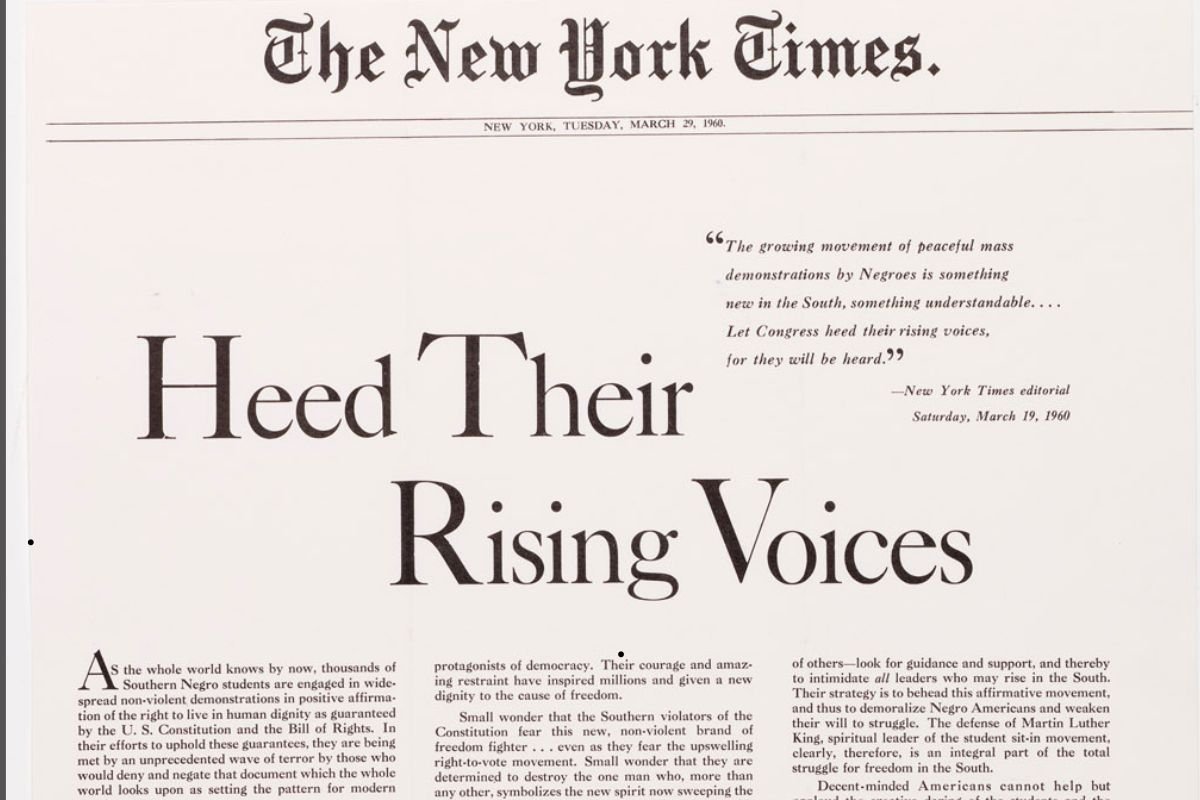
Image courtesy usconstitution.net
The Expansion Free Press Rights in the Civil Rights Era
New York Times v. Sullivan (1964) involves three important areas of constitutional law. It is in one regard a free expression case. It is arguably the most important free press case decided by the U.S. Supreme Court at least as of 1964. The New York Times was sued by an Alabama public official for libel creating a free press issue. The case was originally litigated in an Alabama court based on Alabama libel law and eventually appealed to the U.S. Supreme Court. The Court measured the Alabama libel standards against the First Amendment, meaning that the case also had a federalism dimension to it. The application of the Fourteenth Amendment to civil cases involving private disputes was in question. Finally, the legal dispute involved a political advertisement published in the New York Times that was paid for and authored by a civil rights organization that drew public attention to the treatment of civil rights leaders and student protestors when they were in Montgomery, Alabama. The case’s significance is tied to the civil rights movement and the Supreme Court’s role in expanding civil rights using the Fourteenth Amendment.
The Legal Issues in New York Times v. Sullivan
L. B. Sullivan was a public safety commissioner for the city of Montgomery. He sued four Alabama ministers and the New York Times for libel because he believed that a full-page advertisement in the Times harmed his reputation. The advertisement, “Heed Their Rising Voices,” was written by civil right activist Bayard Rustin and playwright John Murray with help from others including singer, actor, and civil rights activist Harry Belafonte. It was paid for and commissioned by a civil rights organization called the Committee to Defend Martin Luther King and the Struggle for Freedom in the South. The advertisement had a twofold purpose, to draw public attention to the uncivil treatment of black protesters in Montgomery and to raise funds for Martin Luther King Jr’s defense fund.
Several black ministers’ signatures were attached to the advertisement including Ralph Abernathy, Solomon S. Seay, Fred L. Shuttlesworth, and Joseph Lowery, all residents of Alabama who were named in Sullivan’s lawsuit. None of the four Alabama ministers gave their permission for their names to be used in the advertisement. However, they were included in the lawsuit along with the New York Times for strategic reasons. Because the ministers were residents of Alabama, Sullivan could sue in Alabama courts under Alabama libel laws giving him a high probability of winning the case. The New York Times was included in the suit not only because it published the advertisement, but also because it was presumed to have greater financial resources than the ministers. Sullivan sued for $500,000, an amount he was unlikely to get from the ministers alone.
Sullivan won the first Alabama trial in the Circuit Court of Montgomery County, Alabama and the appeal by the New York Times in the Supreme Court of Alabama. He was awarded the full $500,000 he requested. The New York Times appealed the decision to the U.S. Supreme Court.
The Court’s Ruling in New York Times v. Sullivan
The U.S. Supreme Court ruled unanimously for the New York Times. Justice Brennan wrote for the Court. While Sullivan claimed the advertisement was defamatory, he was never mentioned in it specifically by name. There were inaccuracies in the text of the advertisement. Some of them exaggerated the treatment of the civil rights protestors by the Montgomery police. For example, the advertisement claimed that the police created a ring around the Alabama State College campus (they did not); students were expelled for requesting to be served at the lunch counter in the country courthouse, not at the state capitol as the advertisement stated. In the initial trial, the New York Times admitted that it did not scrutinize the copy of the advertisement according to its highest standards. The advertisement was sloppy, factually inaccurate in parts, and the leaders responsible for it never asked some of the ministers for permission to use their names. While these and other factors were sufficient to meet the Alabama libel standards, they were not necessarily consistent with First Amendment standards.
Justice Brennan considered it “uncontroverted that some of the statements…were not accurate descriptions of events which occurred in Montgomery.” Sullivan, however, failed to prove that he “suffered actual pecuniary loss as a result of the alleged libel.” Brennan reversed the Alabama court arguing that it failed to “provide safeguards for freedom of speech and of the press that are required by the First and Fourteenth Amendments in a libel action brought by a public official against critics of his official conduct.” Context mattered. Sullivan was not any citizen but a public official. The proper functioning of American democracy requires that citizens and the press need to have the freedom to criticize public officials for their official actions without concern for overreaching libel and slander laws. Justice Brennan added that the Fourteenth Amendment applies in the case because a state law was the basis for the ruling and award that were initiated by a state official. He also dismissed the contention that the First Amendment was not applicable to the case because it involved a paid advertisement as opposed to reported news.
The Court’s holding created a new libel standard. Untruth does not, by definition, constitute defamation or libel. To meet First and Fourteenth Amendment standards, statements must be made with “actual malice” to be libelous. State officials enjoy a high level of immunity for statements they make in their official capacity. That same privilege, granted by the First Amendment, applies to the press and the people who play an equally important role in the functioning of democracy. Sullivan did not present sufficient evidence to prove actual malice on the part of the New York Times and the four Alabama ministers. Apart from Sullivan’s failure to prove the actual malice standard, he also failed to prove that he was the target of the advertisement. The statements in the advertisement used the pronoun “they”; Justice Brennan concludes, then, that “it is plain that these statements could not reasonably be read as accusing respondent [Sullivan] of personal involvement in the acts in question.”
Justice Black was joined by Justice Douglas in a concurring opinion. He suggested that the Court take a more absolutist, some might say fundamentalist or legalistic, First Amendment position and declare that the “defendants had an absolute, unconditional right to publish in the Times advertisement their criticisms of the Montgomery agencies and officials.” Black and Douglas were convinced that malice was a slippery concept subject to interpretation, “hard to prove and hard to disprove.” They favored something close to the preferred position doctrine which states that laws and government actions limiting First Amendment civil liberties should be presumed to be unconstitutional unless there is an obvious, overwhelming, and compelling reason to suggest otherwise.
New York Times v. Sullivan Legacy
Just as New York Times v. Sullivan encompasses more than one area of constitutional law and politics, its legacy is multi-dimensional. In the immediate aftermath of the Alabama court decisions, the New York Times had to tread lightly when covering civil rights protests and government reaction to them. A certain degree of self-censorship was the outcome of those decisions. When the U.S. Supreme Court reversed the state court decisions, it removed the reticence of the press and civil rights leaders to criticize public officials for their reaction to the civil rights movement. An unintended effect was the increasing incivility that has become all too common in American politics by public officials, the press, and citizens. Whatever the deficiencies of the old libel law regime, it served as a restraint on excessive vituperation and uncivil expression.
New York Times v. Sullivan also continued the depreciation of state sovereignty and power. It created uniform, national standards that made it more difficult to maintain local standards that were more apt to fit local circumstances than were broad, uniform standards created by the Supreme Court. In a way, the loss of local and state autonomy was the price that was paid for slavery, Jim Crow, and the failure to realize Martin Luther King Jr.’s vision of a nation in which individuals are treated according to the content of their character and not the color of their skin. Dr. King understood that racism obscured one of the great injustices of American history. In 1947, Jackie Robinson played his first game for the Brooklyn Dodgers. In the 17 years between then and the Court’s ruling in New York Times v. Sullivan, it was apparent to any Major League Baseball fan that racism is an obstacle to meritocracy.

Professor of Political Science at Middle Tennessee State University
Related Essays